
On this page
Start here
Quick answer
A level washer can still make noise from an unbalanced load, a coin or wire in the drum or drain path, shipping bolts or packing left after installation, a hose or nearby object striking the cabinet, normal pump or motor sounds, a flexible floor, or an internal drive or suspension fault. First classify the sound and whether it occurs during fill, agitation, drain, or spin. With the washer stopped, redistribute the load, check for reachable foreign objects, and inspect the rear for shipping hardware if it was recently installed. An empty spin test can separate load noise from a machine noise, but do not keep running a washer that grinds, scrapes, leaks, smells hot, trips power, or moves excessively. If the unit is level and the noise continues with an empty drum, leave it off and arrange appliance service.
Before you begin
Safety first
- Homeowner-safe checks are classifying the sound, checking stable contact without moving the machine, redistributing laundry after the drum stops, inspecting reachable foreign objects, checking confirmed transit material against the exact manual, and observing one safe test. Panels, pumps, motors, bearings, suspension, wiring, sealed tubs, leaks, and moving the appliance belong to a qualified professional.
Work through in order
Diagnostic checks
Use only checks that match the exact appliance or system and its official guide.
-
Check 1
From a safe position, note whether the noise occurs while filling, agitating, draining, accelerating into spin, at steady spin, or when stopping; also note whether it sounds like clicking, rattling, thumping, humming, squealing, scraping, or grinding.
Expected result: The sound is limited to fill or drain, follows the drum speed, happens only with laundry, or remains a harsh sound even when the drum is empty.
Next step: Record the timing and sound before changing anything. Use the matching checks below, and stop operating the washer for grinding, scraping, burning smell, smoke, or severe movement.
Why this matters
Why: Fill or drain timing makes hoses, valves, pump, or household plumbing more relevant. Speed- or load-dependent pounding suggests imbalance or contact. A persistent harsh empty-drum sound makes an internal drive, bearing, suspension, or foreign-object problem more likely.
-
Check 2
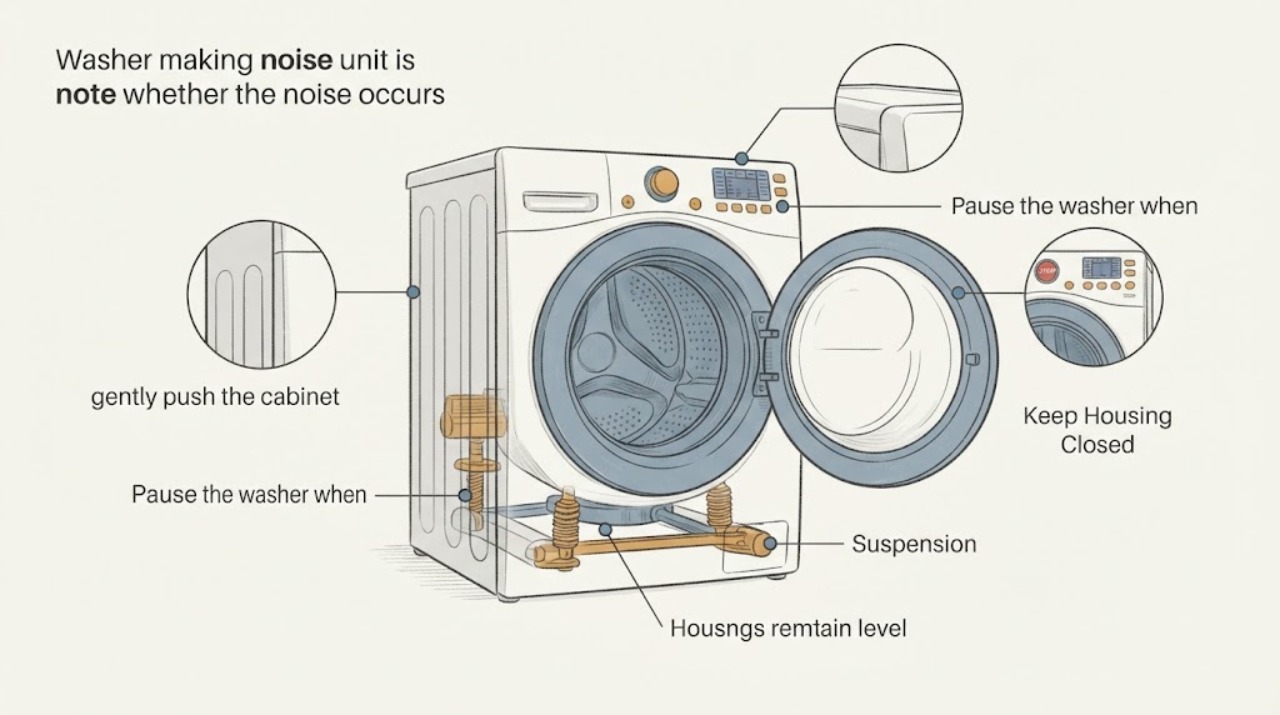
With the washer empty and off, gently push the cabinet at diagonal corners and confirm all four feet remain firmly planted; check the floor around it for flexing, sagging, or a pedestal that rocks even if the top appears level.
Expected result: The cabinet rocks, a foot is not firmly contacting, the pedestal moves, or the cabinet and floor remain rigid and stable.
Next step: If adjustment is allowed by the model manual, correct the feet and lock the nuts while the washer is empty; do not shim with loose objects. If the floor, pedestal, or cabinet is damaged or remains unstable, arrange service or installation help.
Why this matters
Why: A level reading can coexist with a loose foot, unlocked foot nut, unstable pedestal, or flexible floor that transmits noise during spin. A rigid, planted cabinet makes basic leveling less likely but does not rule out load or internal causes.
-
Check 3
Pause the washer when the noise occurs during agitation or spin, wait for the drum to stop, then spread the laundry evenly and remove an obviously overloaded or single bulky item; do not reach into a moving drum.
Expected result: Laundry is gathered on one side, a rug/blanket/waterproof item is lopsided, the load is tightly packed, or the noise remains with a balanced ordinary load.
Next step: Run the recommended cycle with a balanced load only once. If the noise returns with ordinary laundry, continue to the empty-drum and foreign-object checks instead of adding more weight or repeatedly restarting.
Why this matters
Why: A lopsided, bulky, or tightly packed load can make a level washer pound, rattle, or extend the spin. If a balanced ordinary load produces the same noise, a machine, object, or floor issue becomes more likely.
-
Check 4
Remove laundry and inspect the drum, wash plate, door seal, and any accessible drain-filter area for coins, keys, bra wires, buttons, or other foreign objects; use only the model-approved tool and access procedure, with power isolated before reaching into an opening.
Expected result: An object is visible in the drum or filter, the object appears caught between tubs, or no object is found but the noise continues.
Next step: Remove only a loose, reachable object without disassembling the washer. If it is caught, the filter cannot be reseated, or the noise persists after removal, leave the machine off and arrange service.
Why this matters
Why: Loose metal can click or rattle against the basket, and a caught object can interfere with the tub or pump. An object between sealed components or a clear drum with persistent noise needs service-level access.
-
Check 5
If the washer was recently installed or moved, compare the rear and base with the installation instructions for shipping bolts, packing blocks, braces, or transit material; do not remove hardware unless the exact model manual identifies it as shipping material.
Expected result: The washer is newly installed, shipping hardware appears present, all shipping material is confirmed removed, or the model and installation history are unknown.
Next step: Use the exact manual to identify and remove only confirmed shipping material, or call the installer/service technician. Do not operate a newly installed washer with transit hardware still fitted.
Why this matters
Why: Shipping bolts or packing can hold a tub rigid and create excessive noise and vibration. If installation history is unclear, a missing or incorrectly removed part cannot be inferred safely from appearance alone.
-
Check 6
With the washer empty and all panels closed, run one brief model-approved rinse or spin test from a safe distance; listen for the same sound and watch for rocking, leaking, or abnormal drum motion, stopping immediately for a hazard.
Expected result: The empty test is quiet, the noise remains empty, the noise occurs only while draining, or the washer rocks or produces a harsh sound.
Next step: Do not repeat the test to confirm a harsh noise. Leave the washer off for persistent empty noise, poor drainage, severe rocking, or a leak, and arrange model-specific appliance service.
Why this matters
Why: A quiet empty test makes load distribution or clothing hardware more likely. Persistent empty noise points toward a pump, motor, bearing, suspension, foreign object, or other internal issue. Drain-only sound may be normal pump operation or a blockage depending on character and whether water drains.
-
Check 7
Inspect only the external, reachable water and drain hoses and nearby shelves or walls for contact, kinks, loose fittings, or a drain opening that backs up; keep hands away from energized wiring and do not pull the washer out alone.
Expected result: A hose taps the cabinet, a shelf touches the washer, a drain backs up, a fitting leaks, or all external clearances and plumbing look sound.
Next step: Secure or reposition only an obviously loose external hose or object as the manual allows. Stop for leaks, drain backup, inaccessible connections, or any need to move the appliance and arrange qualified help.
Why this matters
Why: A level washer can sound noisy when a loose hose or adjacent object vibrates against it. A backed-up drain or leaking fitting is a plumbing/installation problem. Clear external surroundings shift concern back to the drum, pump, motor, or suspension.
Use your observations
Decision map
Find the observation that best matches what you see, then follow the next safe action.
-
PATH 01Next step
What you see
The washer is level and stable, but the noise appears only with a bulky, single, or one-sided load and disappears with an ordinary balanced load.
Do this next
Use the model’s loading guidance, redistribute or balance suitable items, and avoid repeatedly spinning a visibly lopsided load. Request service if the symptom begins with normal balanced loads.
Why this path and its safety boundary
Why it matters: Load distribution or fabric type is more likely than a failed internal part.
-
PATH 02Next step
What you see
A coin, wire, button, or other object is found in the drum, wash plate, door seal, or filter, or the noise is a sharp metallic rattle.
Do this next
Remove only the loose reachable object with power isolated and the model-approved procedure. Have service remove an object caught between tubs or in the pump, or if noise continues after removal.
Why this path and its safety boundary
Why it matters: Foreign-object contact or a partially blocked drain path is more likely than a leveling fault.
-
PATH 03Next step
What you see
The washer is newly installed or moved and the tub is unusually rigid, with shipping bolts or packing not confirmed removed.
Do this next
Stop the cycle and compare the rear/base with the exact installation manual. Remove only identified shipping material or have the installer correct it; do not guess at fasteners.
Why this path and its safety boundary
Why it matters: Transit hardware or installation error is more likely and can cause excessive noise even when the cabinet appears level.
-
PATH 04Next step
What you see
The drum is empty, the cabinet and floor are stable, and the same grinding, scraping, roaring, or harsh rattling persists.
Do this next
Leave the washer off and arrange appliance service for diagnosis. Do not remove panels or continue empty spin tests to force the fault to reveal itself.
Why this path and its safety boundary
Why it matters: An internal object, pump, motor, bearing, suspension, or drive fault is more likely than a load or basic leveling issue.
-
PATH 05Next step
What you see
Noise is accompanied by a leak, electrical smell, smoke, sparks, unusual heat, repeated breaker trips, severe movement, or a drain that backs up onto the floor.
Do this next
Stop the washer, isolate power and water only if safe, keep clear of the appliance, and arrange qualified appliance or plumbing help. Leave for active smoke, fire, or immediate danger.
Why this path and its safety boundary
Why it matters: The symptom may involve an electrical, water, mechanical, or structural hazard and is outside routine user checks.
Helpful context
Understand the symptom
“Level” rules out only one part of the problem
A bubble centered on the washer does not prove all four feet are firmly contacting the floor, that the floor is rigid, or that the drum and load are balanced. It also does not rule out a coin in the tub, a drain-pump obstruction, a loose hose, shipping hardware, or a worn internal part. Use the timing and character of the sound to choose the next check.
Classify the sound before replacing a part
Clicking or light metallic contact can come from buttons, zippers, or a foreign object. Pounding or rattling during spin often follows a lopsided load. Gurgling or humming while draining can be normal pump operation, while continuous grinding or scraping from the bottom is not a useful DIY diagnosis. The exact model manual takes priority over a generic noise label.
An empty test is informative, not a repair
If the washer is safe to operate, a brief empty rinse or spin can show whether the noise follows the laundry. It should be stopped immediately for severe vibration, a leak, burning odor, smoke, or electrical symptoms. An empty drum that still produces a loud or harsh noise points toward the machine rather than the load and is a service boundary.
Safety boundary
Stop conditions
- Do not keep running a level washer that grinds, scrapes, roars, bangs severely, rocks, leaks, or produces unusual heat, smoke, sparks, or a burning smell. Stop the cycle and arrange service.
- Do not remove panels, suspension parts, the pump, motor, bearings, wiring, or a foreign object trapped between tubs. Do not move the appliance alone or reach into a moving drum.
- If shipping bolts, leveling hardware, a pedestal, or the floor is damaged or cannot be identified from the exact manual, stop installation troubleshooting and use qualified appliance or installation help.
- For a repeated breaker trip, exposed wiring, electrical smell, active leak, drain backup, smoke, fire, or immediate falling/movement hazard, isolate power or water only when safe, leave the area if necessary, and obtain emergency or qualified help.
Only after diagnosis
Potential parts
- washer drain pump or filter component
Only consider this part after a model-approved filter inspection or service diagnosis links the noise or poor draining to a damaged pump or filter rather than a loose object.
Pump assemblies, filters, wiring, and access vary by model; confirm the appliance model and manufacturer fit information before ordering or installing. - washer suspension or drum support component
Only consider a suspension or drum-support part when an empty-drum test and qualified inspection identify persistent banging, excessive movement, or a failed support component.
Suspension rods, dampers, bearings, and support hardware are model-specific and require safe appliance disassembly; do not choose a part from noise alone.
When checks do not resolve it
Need a professional?
Safety scope: Homeowner-safe checks are classifying the sound, checking stable contact without moving the machine, redistributing laundry after the drum stops, inspecting reachable foreign objects, checking confirmed transit material against the exact manual, and observing one safe test. Panels, pumps, motors, bearings, suspension, wiring, sealed tubs, leaks, and moving the appliance belong to a qualified professional.
Common questions
FAQ
Why is my washer noisy even though it is level?
Leveling addresses cabinet position, not every noise source. A lopsided load, foreign object, shipping bolt, flexible floor, loose hose, nearby object, pump, motor, bearing, or suspension fault can still make noise. The timing and whether an empty drum is quiet are useful distinctions.
Can an unbalanced load make a level washer bang?
Yes. Bulky, single, waterproof, or tightly packed items can gather on one side and create pounding or rattling during spin. Pause only after the drum stops, redistribute the load, and stop using the washer if ordinary balanced loads produce the same severe noise.
What should I check if the washer makes a metallic rattling noise?
With power isolated, remove laundry and inspect reachable drum, wash-plate, seal, and model-approved filter areas for coins, keys, wires, buttons, or other objects. Do not disassemble the tub or pump; have service remove anything trapped or diagnose noise that remains after a loose object is removed.
Could shipping bolts cause noise after a washer installation?
Yes. Manufacturer guidance says shipping bolts hold the tub during transport and can cause excessive noise and vibration if left in place. If the washer was recently installed or moved, compare the rear with the exact installation manual and remove only confirmed transit hardware or call the installer.
When should a noisy level washer be serviced?
Arrange service when the noise remains with an empty drum, persists after a balanced load and foreign-object check, or comes with grinding, scraping, severe movement, poor drainage, a leak, heat, burning odor, smoke, sparks, or repeated breaker trips. Stop operation for those hazards.
Read the exact guide
Official sources
- Whirlpool Washer Owner’s Manual W11691191Whirlpool · Official Whirlpool manual for a specified model family; use the exact washer manual for model-specific procedures and normal-sound descriptions.
- LG Washer - Troubleshooting Noises During the CycleLG USA Support · Manufacturer troubleshooting guidance for LG washers; exact access steps and normal sounds vary by model and load type.
- LG Washer - Troubleshooting Clacking Noise When the Washing Machine is FillingLG USA Support · General LG washer fill-noise guidance; hose routing and water pressure limits are model and installation specific.
- LG washer - How to Level an LG Front Load Washing MachineLG USA Support · LG front-load leveling guidance; other models may use different feet, pedestals, or access arrangements.
- LG Washer – Troubleshooting Vibration Issues on an LG Washing MachineLG USA Support · General LG washer guidance; the exact shipping hardware and leveling procedure are model-specific.
Community feedback
Share a repair observation
Share a plain-text repair observation. Accepted observations are published automatically; this page may take a moment to update.