
On this page
Start here
Quick answer
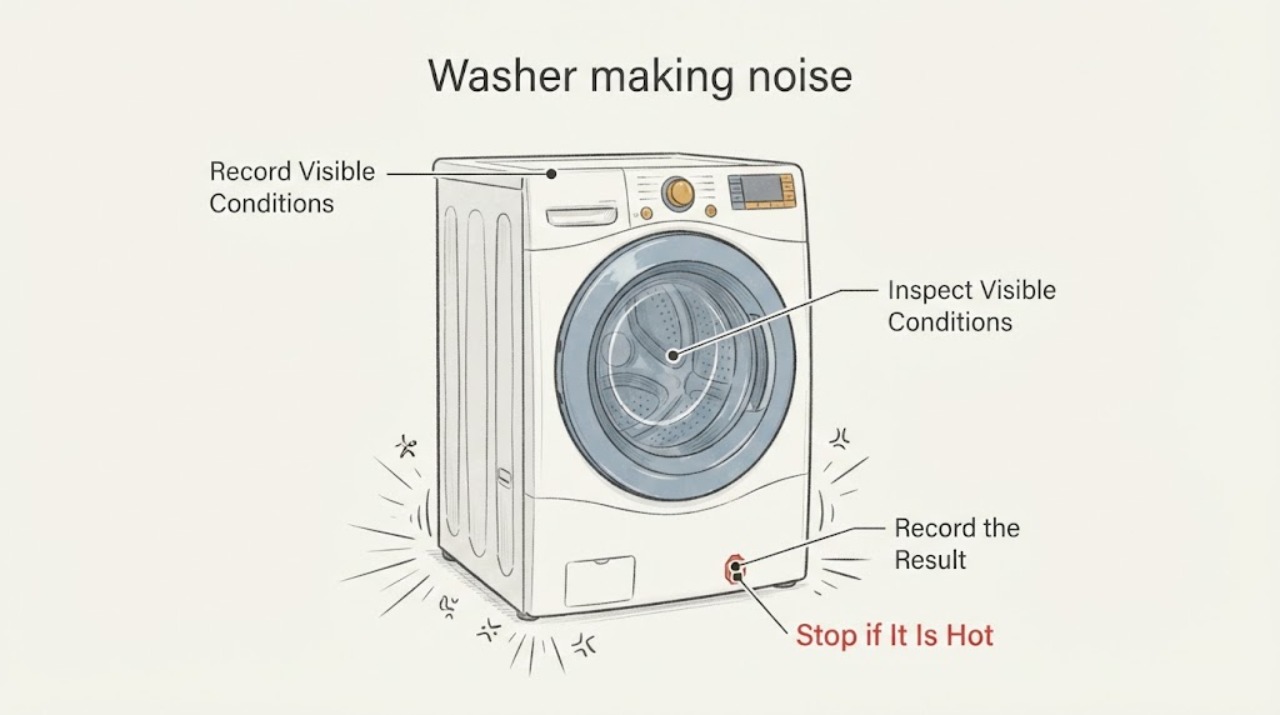
First identify when the noise occurs and whether the washer is moving, leaking, or making metal-on-metal contact. Spraying, splashing, sloshing, and some brief clicks or clunks can be normal; pounding during spin, a washer that walks, grinding or rubbing, a harsh rattling, or a new noise with poor drum movement is not a reason to keep testing. From a safe position, observe the load, floor stability, visible hoses, nearby objects, and cycle phase. Do not reach into a moving tub, open panels, remove a filter, adjust suspension or leveling hardware, or order a bearing, pump, or shock based only on sound. Stop the washer for banging, grinding, metal contact, violent vibration, burning odor, smoke, leaks, or electrical concerns and call an appliance technician.
Work through in order
Diagnostic checks
Use only checks that match the exact appliance or system and its official guide.
-
Check 1
From a clear position, observe and record the noise without repeating a hazardous cycle: note whether it occurs during fill, wash or agitation, drain, the transition to spin, or high-speed spin, and whether the tub or cabinet moves unusually.
Expected result: The sound may be a brief spray, splash, slosh, click, or transition clunk; a rhythmic thump or bang; a rattle; a hum; a grind or rub; or a sharp intermittent contact sound.
Next step: Write down the phase, timing, sound character, and movement, then use the exact model manual or arrange service. Stop immediately if the noise is harsh, metallic, violent, or accompanied by a leak, odor, smoke, or electrical concern.
Stop if: Stop for metal-on-metal contact, violent shaking, walking, smoke, a burning odor, a leak, unusual heat, exposed wiring, or any need to repeat the cycle to make the sound occur.
Why this matters
Why: Phase-specific water and drive sounds can be normal on some models. A repeated bang during spin, grinding or rubbing, a noise that grows louder, or movement of the washer points toward a load, stability, foreign-object, drain, or internal-mechanical path that should not be diagnosed by repeated cycling.
-
Check 2
Only when the washer is fully stopped and the lid or door is already unlocked, observe whether the load is bunched on one side, a single bulky item, unusually small, overloaded, or accompanied by a visible loose object; do not reach into a moving or locked tub.
Expected result: The load may look evenly distributed, be concentrated on one side, contain a heavy blanket or mat, fill the tub unusually little or much, or show a coin or other object that is plainly loose and accessible without tools.
Next step: Record the load and object observations. Follow only the model manual's normal pause and load instructions if the tub is stopped and unlocked; do not force removal, use a tool, or restart the washer just to test the result.
Stop if: Stop for a moving or locked tub, a sharp or lodged object, violent imbalance, water in the tub that makes access unsafe, or any need to reach past the opening or dismantle the washer.
Why this matters
Why: An unbalanced or bulky load can create pounding and vibration during spin. A visible foreign object can create rattling, but an object that is lodged, sharp, or inaccessible may require service. A balanced-looking load does not rule out a mechanical fault.
-
Check 3
With the washer stationary, observe from floor level whether it sits squarely, whether visible gaps around the cabinet change during a safe normal phase, and whether hoses, a drain pan, shelf, wall, dryer, hanger, or loose object is touching or leaning against the washer; do not push, rock, lift, or adjust the appliance.
Expected result: The washer may appear stable with clear surroundings, rock or shift during spin, show uneven cabinet gaps, or have a hose or nearby object that could contact the cabinet.
Next step: Photograph the floor, cabinet, hoses, drain pan, and surrounding clearance from a safe position. Remove only a loose object that can be moved without touching the washer or entering its operating path; otherwise call an appliance technician.
Stop if: Stop for a washer that walks, a damaged floor or drain pan, a crushed hose, unstable stacking, a tight or inaccessible space, or any need to move or level the machine.
Why this matters
Why: An unlevel or unstable washer can amplify thumping and vibration, while an external contact can create a rattle that is not an internal failure. A washer that moves aggressively or has a damaged pan or cabinet needs service rather than a leveling adjustment based on guesswork.
-
Check 4
From outside the appliance, note whether the noise occurs only while water enters or leaves, whether the washer finishes that phase, and whether water remains in the tub; do not open a pump filter, disconnect hoses, or reach behind a running washer.
Expected result: The sound may be a normal fill spray, a hum or grind during drain, repeated pump attempts, a quiet stop with water remaining, or a sound unrelated to water movement.
Next step: Record the phase, water level, and whether the tub empties. Keep the washer out of use for persistent grinding, standing water, or repeated attempts and call service; do not disassemble the drain system.
Stop if: Stop for standing water, a leak, a hot or burning smell, a pump that runs continuously, a hose that must be disconnected, or any need to open a filter, panel, or cabinet.
Why this matters
Why: A phase-specific hum or grind with poor draining keeps a drain-pump, hose, filter, or obstruction path in consideration. A normal drain with noise continuing in wash or spin points elsewhere. Standing water or repeated attempts can worsen damage if the washer is kept running.
-
Check 5
If the noise began after installation or relocation, observe from outside whether the washer is stable on its intended floor and whether any shipping or packing material is visibly documented as still present; do not reach behind the machine, remove rear hardware, or move it to investigate.
Expected result: The washer may be newly installed, recently moved, stable with no visible installation clue, or accompanied by a manual or installation record that identifies an unresolved setup item.
Next step: Provide the installation date, relocation history, manual, and photos to the installer or appliance technician. Keep the washer out of high-speed operation if it vibrates severely or moves.
Stop if: Stop for a machine that is unstable, stacked incorrectly, inaccessible at the rear, connected through damaged hoses or cords, or any need to pull, tip, or dismantle it.
Why this matters
Why: Installation or relocation can leave a washer unstable or with model-specific transport hardware still fitted, producing vibration and noise. A visual clue is not permission to remove rear hardware or make an unverified adjustment.
Use your observations
Decision map
Find the observation that best matches what you see, then follow the next safe action.
-
PATH 01Next step
What you see
The sound is a brief spray, splash, slosh, click, or transition clunk, the washer remains stable, and no leak, odor, metal contact, or unusual vibration is present.
Do this next
Compare the sound with the exact model manual and monitor it without repeated testing. Arrange service if it becomes louder, lasts beyond its normal phase, or is accompanied by movement or a new symptom.
-
PATH 02Next step
What you see
Pounding or thumping occurs during spin and the load is visibly bunched, bulky, very small, overloaded, or associated with repeated redistribution.
Do this next
Do not reach into a moving or locked tub. When it is fully stopped and unlocked, follow only the model manual's normal pause and load guidance; if the symptom repeats or the washer moves, stop using it and call service.
-
PATH 03Next step
What you see
The washer rocks or walks, cabinet gaps change, or an accessible hose, pan, shelf, wall, dryer, or loose object appears to contact it.
Do this next
Stop high-speed operation and call an appliance technician or installer. Remove only a loose external object that can be moved without touching the appliance; do not push, level, lift, or relocate the washer yourself.
-
PATH 04Next step
What you see
A hum, grind, or repeated attempt occurs during drain, especially if water remains in the tub or the machine does not finish draining.
Do this next
Keep the washer out of use and arrange service for the drain path and pump. Do not open the drain filter, disconnect a hose, or reach behind the washer to clear an obstruction.
-
PATH 05Next step
What you see
A rattle changes with the load or a plainly visible loose object is present, but it is not safe or simple to remove without tools or reaching into the tub.
Do this next
Stop cycling and call an appliance technician if the object is lodged, sharp, or inaccessible. Do not use a tool inside the tub or dismantle the cabinet to retrieve it.
-
PATH 06Next step
What you see
Grinding, rubbing, roaring, sharp metal contact, or a new harsh noise persists outside a normal phase or occurs with poor drum movement.
Do this next
Stop using the washer and call an appliance technician. A pump, bearing, suspension component, drive system, or foreign object may be involved, but no internal part should be selected from sound alone.
-
PATH 07Next step
What you see
There is violent movement, a leak, smoke, burning odor, unusual heat, exposed wiring, an electrical warning, or a damaged cord or outlet.
Do this next
Stop controls and keep people away. If it can be done without touching a hazard, shut off water and power at accessible safe controls; do not approach wet electrical areas or open the washer. Obtain qualified appliance service and emergency help appropriate to the danger.
Helpful context
Understand the symptom
Classify the sound before deciding whether to continue
A washer can make different normal sounds during fill, agitation, rinse, and the transition into spin. Water spraying or sloshing, motor direction changes, and a brief drive-system clunk may be expected on some models. The useful warning signs are a sound that is new or getting louder, a noise that coincides with the tub striking the cabinet, a machine that walks or rocks, or grinding that persists outside a normal phase. The exact model manual governs what a particular sound means.
The same noise can have different causes
A bunched or bulky load can make a tub pound during spin, while an unlevel washer can amplify vibration. A loose hose or object leaning against the cabinet can rattle from the outside. A coin or other foreign object can strike the tub, and a drain-related hum or grind can occur during pump-out. These clues narrow the path but do not identify a failed shock absorber, drain pump, bearing, motor, or other internal part.
Keep inspection outside the cabinet and tub
Observe from a stable position with the washer stationary whenever possible. Do not open an appliance panel, reach into a moving or locked tub, remove a drain filter, adjust leveling feet or suspension hardware, or probe wiring. If the machine has already produced metal contact, severe vibration, smoke, a burning smell, a leak, or an electrical warning, leave it out of use and arrange qualified service.
Safety boundary
Stop conditions
- Do not reach into a moving or locked tub, open panels, remove a drain filter, disconnect hoses, adjust suspension or leveling hardware, or move or tip the washer as a sound test.
- Stop immediately for banging with metal contact, grinding or rubbing, violent vibration, walking, a leak, smoke, burning odor, unusual heat, exposed wiring, or a damaged cord or outlet.
- Do not order or install a shock absorber, drain pump, bearing, or other internal part based only on a noise; diagnosis and model fitment require qualified service.
- If external observations do not identify a safe normal sound or simple loose-object clue, leave the washer out of use and call an appliance technician with the phase, sound pattern, movement, load, water, and installation observations.
Only after diagnosis
Potential parts
- washer shock absorber
Consider this category only after a technician confirms a worn or damaged suspension component is causing persistent vibration or banging after load, floor, installation, and other causes are ruled out.
Confirm the exact washer model, suspension layout, part revision, mounting points, and manufacturer fit information before ordering; a similar-looking damper may not fit or control the tub correctly. - washer drain pump
Consider this category only when a technician confirms that a drain-phase hum, grind, or failed drain is caused by the pump rather than the hose, filter, blockage, wiring, or control.
Match the exact washer model, pump configuration, electrical connector, seal arrangement, and manufacturer fit information; do not open the filter or pump area as a homeowner test. - washer drum bearing
Consider this category only after a technician distinguishes bearing noise from load imbalance, external contact, foreign objects, suspension, pump, and drive-system causes.
Confirm the exact washer model, tub and bearing design, repair scope, and manufacturer fit information before ordering; sound alone cannot establish bearing failure.
When checks do not resolve it
Need a professional?
Call an appliance technician when grinding, rubbing, roaring, repeated banging, or harsh rattling persists; when the washer walks or vibrates severely; when noise occurs with standing water, failed drain, poor drum movement, a visible foreign object, or a recent installation; or when the source is not clear. Stop immediately for a leak, smoke, burning odor, unusual heat, exposed wiring, damaged cord or outlet, or metal-on-metal contact. Provide the washer brand and model if visible, sound character and phase, movement, load and foreign-object observations, floor and external-contact clues, water level and drain behavior, and installation or relocation history. Do not open the appliance or select an internal part before diagnosis.
Common questions
FAQ
Are some washer noises normal?
Yes. Spraying, splashing, sloshing, motor direction changes, and a brief transition clunk can be normal on some models. A new, harsh, metallic, persistent, or movement-producing sound should be stopped and assessed against the exact model manual or by a technician.
Why does my washer bang during spin?
A bunched, bulky, very small, or overloaded load can cause pounding, and an unstable or unlevel washer can amplify it. Observe from outside and follow only the model's normal pause and load instructions when the tub is stopped and unlocked. Stop service if the washer walks or the noise repeats.
What does a grinding or rubbing washer sound mean?
It may be a model-specific drive sound, overload, drain-phase trouble, foreign object, or internal mechanical fault. Note the cycle phase and whether water drains, but do not open the cabinet, remove a filter, or order a pump, bearing, or suspension part from sound alone.
Can a loose hose make a washer rattle?
Yes. A supply or drain hose, drain pan, shelf, wall, dryer, or loose object can contact the cabinet and rattle. Observe from outside with the washer stationary; move only a loose external object that is safe to move without touching the appliance, and call service for a crushed hose or unstable machine.
Should I keep using a noisy washer?
Do not keep testing a washer that bangs with metal contact, grinds, walks, vibrates violently, leaks, smells burnt, smokes, becomes unusually hot, or shows an electrical warning. Keep it out of use and call an appliance technician.
When should I replace a washer shock absorber, drain pump, or bearing?
Only after a technician identifies the failed component and confirms the exact model fit. Load balance, level, external contact, a foreign object, drain trouble, and normal cycle sounds can mimic an internal part failure.
Read the exact guide
Official sources
- Sounds: Spraying, Splashing, or Sloshing NoiseWhirlpool Product Help · Whirlpool top-load sound guidance; normal sound patterns differ by model and cycle.
- LG Washer - Troubleshooting Noises During the CycleLG USA Support · LG washer support guidance covering model families; exact controls, load instructions, and access rules vary by model.
- Grinding or Rubbing Noise - WasherWhirlpool Product Help · Whirlpool front-load guidance; exact washer design, normal sounds, and user checks vary by model.
Community feedback
Share a repair observation
Share a plain-text repair observation. Accepted observations are published automatically; this page may take a moment to update.