
On this page
Start here
Quick answer
When a washer stops at the drain portion of a cycle, first keep it off long enough for any hot water to cool, note whether water remains and whether an error code appears, and check the visible drain hose and household drain for a restriction or incorrect routing. If the model provides an accessible pump filter, use the model instructions with the power off, a container ready, and caution for residual water; never open a filter that may contain hot water without allowing it to cool. A single model-documented drain or spin test can distinguish a clear external path from a pump, filter, sensing, or control fault. Stop and arrange appliance service if the washer does not drain after the visible path and permitted filter check are clear, the pump only hums or is silent, the cycle repeatedly stops, water leaks or overflows, or there is smoke, sparking, or exposed wiring.
Before you begin
Safety first
- This article supports power-off observation, safe cooling, visible hose and drain checks, and a model-approved accessible filter procedure only. Internal pump, sensor, interlock, control, cabinet, and live electrical diagnosis belongs to qualified service.
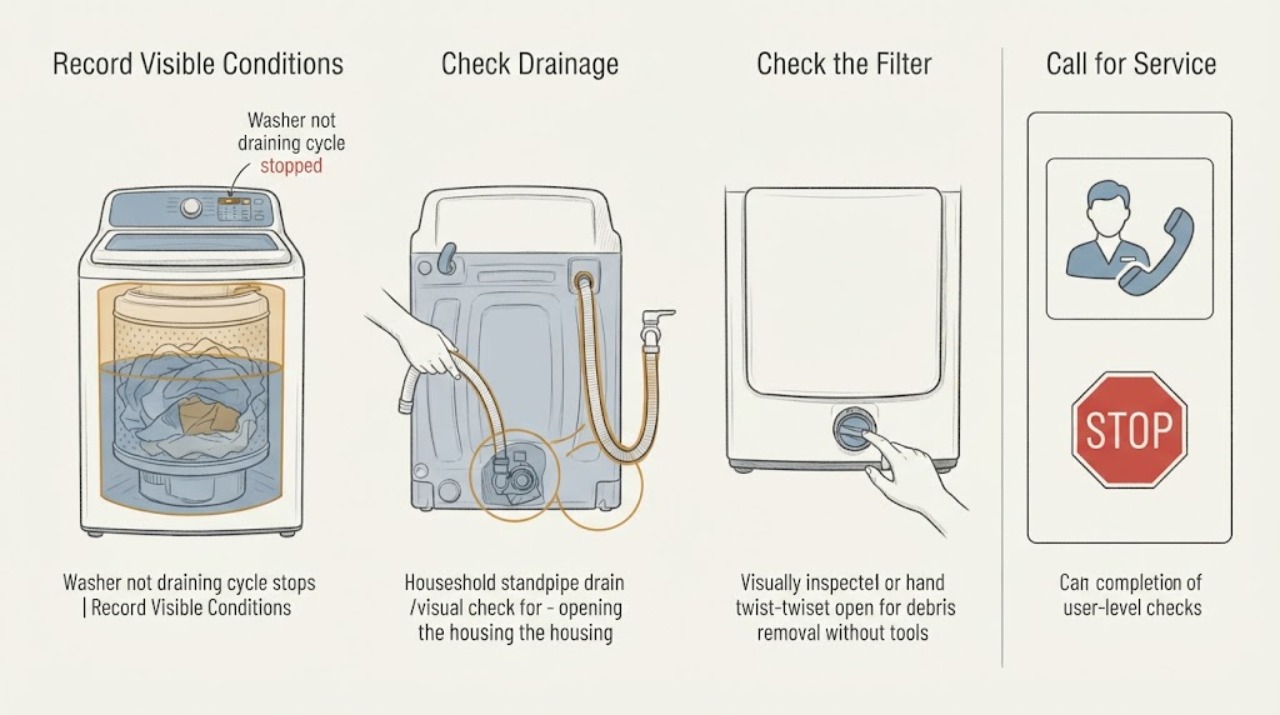
Work through in order
Diagnostic checks
Use only checks that match the exact appliance or system and its official guide.
-
Check 1
Stop the washer using its normal control and record the displayed code, cycle stage, whether the tub is full or only damp, whether the water may be hot, and whether the pump was humming before the stop; wait for complete motion to cease before approaching.
Expected result: Water remains, the washer shows a drain or overflow code, the water is hot, there is no code, the pump hums without visible flow, or the washer is silent.
Next step: Keep the washer off while water is hot or moving. Once safe, continue with a visible hose and household-drain inspection; preserve the code and observations for the model manual or technician.
Stop if: Do not reach into the tub, defeat a lid or door lock, or continue a cycle when water is overflowing, smoke or sparking is present, or an exposed electrical part is wet.
Why this matters
Why: Standing water confirms that the washer has not completed drainage. A drain code supports a restriction or drain-system fault but does not identify a particular part; hot water changes the safe timing, while humming without flow and silence are useful clues for later service diagnosis.
-
Check 2
From a stable, dry position, inspect the visible drain hose and its connection to the standpipe or laundry sink without moving the washer more than is safe; look for kinks, crushing, freezing, submersion, slipping, an airtight connection, excessive height, or a clogged household drain.
Expected result: The hose is bent or pinched, routed under the appliance, submerged, loose, too high, inserted incorrectly, visibly damaged, or the household drain backs up; alternatively, the visible path appears open and correctly supported.
Next step: Correct only a plainly visible routing problem according to the exact installation instructions, or stop using the appliance and arrange plumbing or appliance service for a blocked, damaged, or inaccessible path. Do not force the washer forward or open a cabinet.
Stop if: Stop if the washer is heavy or unstable to move, the hose or standpipe cannot be safely contained, water is leaking onto electrical equipment, or the drain backs up toward the floor.
Why this matters
Why: Incorrect hose routing or a blocked household drain can prevent the washer from emptying even when its pump works. A split or damaged hose is not fixed by straightening. A clear, correctly routed path makes an internal filter, pump, sensor, or control issue more likely if water remains.
-
Check 3
If the exact model manual identifies a user-accessible pump filter or residual-water hose, turn the washer off and isolate power safely, wait for potentially hot water to cool, place a shallow container and towels, and clean or drain only as that manual describes; do not assume every top-load washer has a removable filter.
Expected result: The manual shows no user-accessible filter, the filter contains lint or a foreign object, the filter and opening are clear, the cap or seal is damaged, or water cannot be contained safely.
Next step: Reinstall the filter, cap, and residual-water hose securely only if the manual permits the procedure, then wipe the area dry. If access is not documented, the water is hot, the seal is damaged, or draining cannot be contained, leave the washer off and call service.
Stop if: Do not loosen a filter or hose with hot water, force a stuck cap, remove cabinet panels, or probe the pump or wiring.
Why this matters
Why: Debris in an accessible pump filter can reduce draining effectiveness, while a clear filter does not rule out a pump, hose, sensor, or control fault. A damaged seal or unsafe access can create a leak or injury and needs model-specific service.
-
Check 4
After the water is safe and the visible path or permitted filter check is complete, run one drain, spin-only, or equivalent test exactly as the model manual describes, staying clear of the appliance and watching for a steady discharge without leaks.
Expected result: Water discharges steadily and the washer spins, water discharges but the washer does not spin, the pump hums with little or no flow, the pump is silent, or the test stops again with a code.
Next step: Stop after the single test if flow is absent, abnormal, leaking, or the cycle stops again. Record the sound, flow, code, and remaining water for an appliance technician instead of repeating tests or replacing a pump by guesswork.
Stop if: Do not run repeated tests with a full tub, bypass a lock or lid switch, remove panels, or touch moving parts, wiring, or a leaking pump area.
Why this matters
Why: Steady discharge makes a temporary external restriction more likely. Flow without spin points toward a separate lid, balance, or spin-control condition. Humming without flow suggests a restriction or pump problem; silence or a repeated code needs model-specific electrical, sensing, or control diagnosis.
-
Check 5
If the washer drained during the documented test, check that the filter cap and hose connections are dry and secure, then run one small, supervised cycle using the correct detergent amount for the model; observe whether it completes the drain stage without excess suds or an unbalanced load.
Expected result: The small load completes and drains, the issue returns at the same drain stage, excess suds appear, the load repeatedly becomes unbalanced, or a leak or unusual noise occurs.
Next step: Use the washer only if it completes normally and remains dry. If the drain stop recurs, leave it off and provide the technician the code, cycle, water level, hose and filter findings, pump sound, and test result.
Stop if: Stop immediately for overflow, a leak that reaches electrical components, burning smell, smoke, sparking, severe vibration, or a repeated no-drain code.
Why this matters
Why: One successful retest supports a corrected routing, debris, suds, or load condition but does not prove an internal part is healthy. Recurrence points to a remaining restriction, pump, water-level, or control issue; suds or balance can compound wet-clothes symptoms but do not explain unsafe leaks.
Use your observations
Decision map
Find the observation that best matches what you see, then follow the next safe action.
-
PATH 01Safety boundary
What you see
The tub contains hot water, water is rising or overflowing, the lid or door remains locked, or the area around the washer is wet.
Do this next
Stop the cycle, keep people away, wait for safe cooling, and follow the exact model's emergency draining guidance or arrange service. Address active overflow or electrical hazard promptly under local emergency guidance.
Why this path and its safety boundary
Why it matters: The immediate issue is safe containment and cooling, not a routine pump experiment; hot water and wet electrical areas add injury and shock risk.
Safety stop: Do not open a hot filter, reach into the tub, defeat a lock, or touch wet wiring or controls.
-
PATH 02Safety boundary
What you see
The drain hose is kinked, crushed, submerged, frozen, incorrectly supported, or the standpipe or laundry sink backs up, and the issue improves after a safe visible correction.
Do this next
Keep the hose routed exactly as the model installation instructions require and perform one supervised drain test. Arrange plumbing or appliance service if the path cannot be cleared safely or the restriction returns.
Why this path and its safety boundary
Why it matters: The external discharge path is more likely than a failed washer component; a damaged hose or recurring household backup still needs the appropriate professional assessment.
Safety stop: Do not extend, seal, or force a hose connection, move an unstable washer, or continue if water reaches electrical equipment.
-
PATH 03Safety boundary
What you see
The exact model documents an accessible filter, debris is found, the filter is reinstalled without damage, and a later test drains normally.
Do this next
Keep the area dry and monitor the next small supervised load. If the error or retained water returns, stop testing and report the filter finding and recurrence to service.
Why this path and its safety boundary
Why it matters: A filter restriction likely contributed to the stopped drain stage, but a single successful test does not rule out a recurring obstruction or pump weakness.
Safety stop: Do not operate with a wet or damaged cap seal, an uncertain filter installation, or a filter that cannot be safely accessed.
-
PATH 04Safety boundary
What you see
The external path and permitted filter are clear, but the pump hums with little or no discharge, or the washer drains only intermittently before stopping.
Do this next
Leave the washer off and arrange appliance service for internal drain diagnosis. Provide the model, code, water level, filter result, hose condition, and whether humming changes with the stop.
Why this path and its safety boundary
Why it matters: A remaining internal restriction, failing drain pump, impeller problem, or sensing/control issue is more likely than a simple hose kink; sound alone does not identify the failed part.
Safety stop: Do not keep restarting a stalled pump, insert tools into the pump path, or replace a part based only on humming.
-
PATH 05Safety boundary
What you see
The washer is silent at the drain command, shows a recurring drain or overflow code, or fails the documented test even though the visible path is clear.
Do this next
Stop using the washer and request model-specific appliance service. Do not infer a pump replacement until a qualified diagnosis checks the complete drain and control path.
Why this path and its safety boundary
Why it matters: An internal pump, wiring, water-level sensing, door or lid interlock, or control fault is possible; the public checks cannot safely isolate that cause.
Safety stop: Do not bypass an interlock, open the cabinet, or test live wiring as an ordinary user check.
-
PATH 06Safety boundary
What you see
The washer drains during a test but does not spin or repeatedly stops after draining, especially with a single bulky load, excessive suds, or a washer that rocks.
Do this next
Use the model instructions for load and detergent limits and make only safe visible leveling observations. If the problem repeats with a normal small load, arrange service and report that water did drain.
Why this path and its safety boundary
Why it matters: The initial drain restriction may be resolved, while load balance, detergent or suds, leveling, lid or door sensing, or spin control may be preventing completion; this is not proof of a drain-pump failure.
Safety stop: Stop for severe vibration, a moving appliance, a damaged lock, water leak, burning odor, smoke, or sparking.
Helpful context
Understand the symptom
Why the cycle stops at drain
The washer must remove water before it can finish draining and move safely into spin. A restricted hose, blocked household drain, clogged accessible filter, frozen line, or a pump that cannot move water can leave the tub full. Excessive suds or an unbalanced load can also leave clothing unusually wet, but standing water and a repeated stop at the drain stage make the drain path the first decision point. The exact error code and model manual take priority over a generic procedure.
Separate the external path from the washer
A hose that is kinked, crushed, submerged, inserted incorrectly, or routed too high can restrict flow even when the washer itself is healthy. The standpipe or laundry sink can also be blocked. Inspect only what is visible and safely reachable, and do not pull a heavy washer forward or disconnect a wet hose without a safe way to contain water. If the external path is clear but the washer still retains water, the filter, pump, water-level sensing, or control system needs model-specific diagnosis.
Treat residual water as a safety boundary
Water trapped in the tub or service hose may be hot, especially after a hot or sanitizing cycle. Turn the washer off, isolate power only by the normal safe means, wait for the water to cool, and use a shallow container if the model manual permits an accessible residual-water hose or pump filter. Never reach into moving parts, bypass a lid or door lock, open the cabinet, or handle wiring to prove a pump fault.
Safety boundary
Stop conditions
- Keep the washer off for overflow, a leak reaching electrical equipment, smoke, sparking, burning odor, exposed wiring, or severe vibration.
- Allow potentially hot water to cool before opening a model-approved residual-water hose or pump filter, and use a container only when the manual documents the procedure.
- Do not defeat a lid or door lock, reach into moving parts, remove cabinet panels, probe live wiring, or move a heavy unstable washer as an ordinary drain check.
- Stop after one documented drain or spin test if there is no flow, abnormal noise, a leak, a repeated code, or water remains; arrange appliance service instead of repeatedly restarting.
- Do not order or replace a pump, sensor, control, hose, or filter based only on a code or humming sound; confirm the model-specific diagnosis first.
Only after diagnosis
Potential parts
- washer drain hose
Consider this part class only when the hose is confirmed split, crushed, frozen-damaged, or otherwise unusable after safe routing and the exact model requires replacement.
Confirm the exact washer model, hose connection, length, routing requirements, and manufacturer fit information before ordering. - washer drain pump
Consider this part class only after qualified diagnosis finds a failed or obstructed pump despite a clear hose, household drain, and model-approved filter path.
Confirm the exact model, pump design, electrical connection, seal requirements, and manufacturer fit information; humming alone is not proof of pump failure. - washer pump filter or cap
Consider this part class only when the exact model has an accessible filter and its filter, cap, or seal is confirmed damaged or unable to seal after debris is removed.
Confirm the exact model and the manufacturer service or parts information; top-load and front-load designs are not interchangeable by appearance. - washer water-level sensor or control component
Consider this class only after qualified diagnosis shows that the washer drains or the drain path is clear but sensing or control behavior prevents the cycle from completing.
Confirm the exact model, diagnostic result, wiring, and manufacturer fit information before any component replacement.
When checks do not resolve it
Need a professional?
Arrange appliance service when the washer still stops at drain after a safe visible hose and household-drain check and any model-approved filter cleaning, when the pump is silent or hums without flow, when a drain code returns, or when water drains but the washer repeatedly fails to finish. Seek prompt help for overflow, a leak near electrical parts, hot water that cannot be contained, smoke, sparking, burning odor, exposed wiring, severe vibration, or a lock that cannot be safely released.
Safety scope: This article supports power-off observation, safe cooling, visible hose and drain checks, and a model-approved accessible filter procedure only. Internal pump, sensor, interlock, control, cabinet, and live electrical diagnosis belongs to qualified service.
Common questions
FAQ
Why does my washer stop exactly when it should drain?
The washer may be retaining water because the visible hose or household drain is restricted, a permitted pump filter is blocked, or the pump, sensing, or controls cannot complete drainage. Record the code and water state, check the safe external path, and follow only the exact model's filter and test instructions.
Should I open the washer pump filter when water is still inside?
Only if the exact model documents an accessible filter or residual-water hose, and only after the washer is off, power is safely isolated, potentially hot water has cooled, and a container can catch the water. Do not assume every washer has a removable filter or force a stuck cap.
What does it mean if the drain pump hums but no water comes out?
Humming shows that the pump may be attempting to run, but it does not prove the pump is healthy. A blocked filter, hose, pump inlet or impeller, or another internal fault can still prevent flow. Stop repeated testing and arrange service if the external path and permitted filter are clear.
What if the washer drains but still will not finish the cycle?
A load that drains but does not spin can have a separate balance, suds, leveling, lid or door sensing, or spin-control issue. Try only the model-approved load and detergent guidance once; if a normal small load still stops, report that water did drain and arrange service.
When should I stop troubleshooting a washer that will not drain?
Stop for overflow, water near electrical components, hot water that cannot be contained, smoke, sparking, burning odor, severe vibration, a lock that cannot be safely released, or a repeated no-drain code. Also stop after the safe hose and model-approved filter checks fail; continuing to restart a stalled washer can worsen the fault.
Read the exact guide
Official sources
- [LG Washing Machine] Water Not Draining (OE Error)LG USA Support · Official LG troubleshooting page; the assigned washer brand and model are not specified, so the exact model manual takes precedence for access and test procedures.
- [LG top load washing machine drain] Water is not drained during washing and the washing machine stops.LG USA Support · Official LG top-load guidance; apply only the portions that match the washer design and defer to the exact model instructions.
- Samsung washing machine will not drainSamsung Support · Official Samsung troubleshooting page used for cross-manufacturer drain-system safety and decision points; the assigned washer brand and model are unspecified, so its manual controls.
- LG Washer - Troubleshooting Washer Does Not Drain or Spin (Clothes Too Wet)LG USA Support · Official LG troubleshooting flow; use only the procedures supported by the exact washer model and do not infer an internal part from symptoms alone.
Community feedback
Share a repair observation
Share a plain-text repair observation. Accepted observations are published automatically; this page may take a moment to update.