
On this page
Start here
Quick answer
If a washer will not drain but you hear a hum, the drain-pump motor may be receiving power while water is blocked by the pump filter, pump inlet, drain hose, or household drain. A hum is not proof that water is moving. Stop the washer, note whether the water is hot and whether a leak or electrical warning is present, then inspect only visible hose routing and the model-approved filter access. If the exact model provides safe user access, let residual water drain into a suitable container before cleaning the filter; otherwise request service. Reassemble every cap and cover correctly and perform only the model-approved drain or spin test. Stop for hot water, a leak near electrics, smoke, burning odor, arcing, a damaged cord, or a filter that cannot be safely accessed. If the pump hums but water still does not leave after the documented filter and hose checks, a blocked pump, impeller, internal hose, or household drain needs qualified diagnosis.
Before you begin
Safety first
- Keep the washer off for hot water, leaks near electrical parts, smoke, burning or electrical odor, arcing, a hot plug or outlet, damaged wiring, pooled water, or repeated breaker trips. Do not open the cabinet, bypass a lid or door interlock, force wet access, or repeat drain tests.
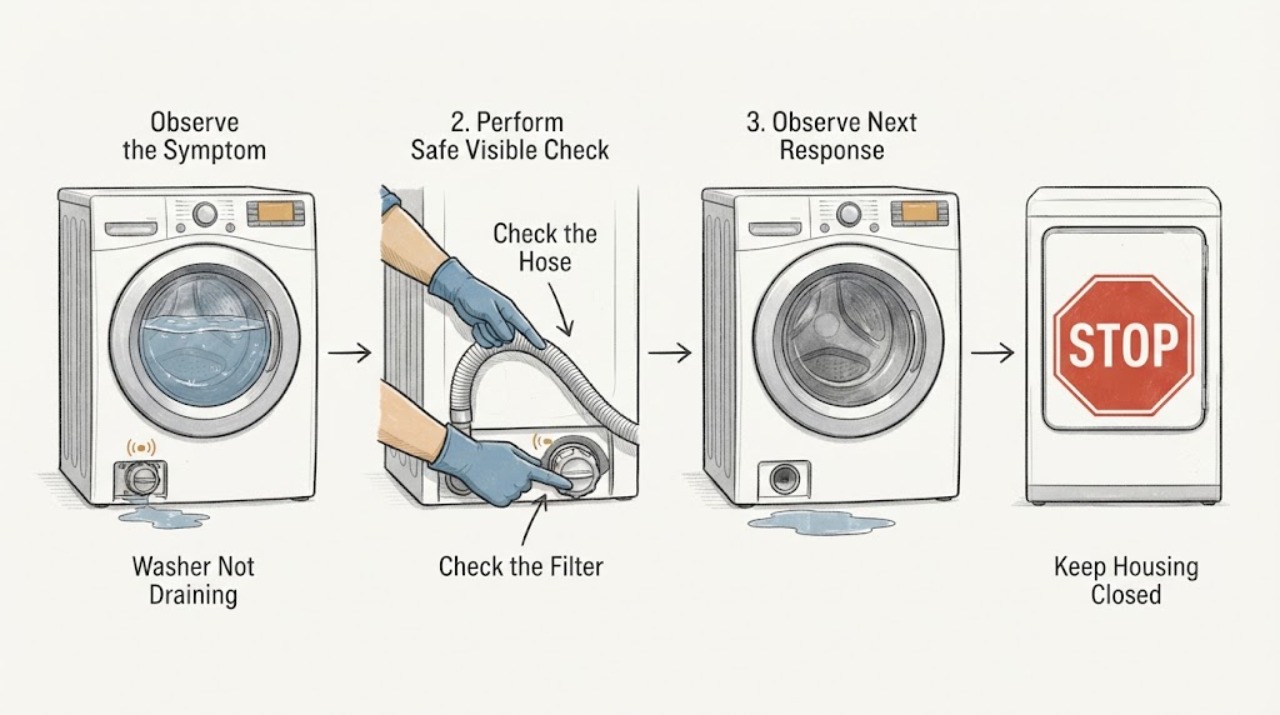
Work through in order
Diagnostic checks
Use only checks that match the exact appliance or system and its official guide.
-
Check 1
Stop the program, wait for the drum to become completely still, and record whether water remains, whether it may be hot, whether the hum occurs during drain or spin, and whether there is a leak, smoke, burning odor, hot plug, or repeated breaker trip.
Expected result: Water remains but the washer is otherwise cool and dry, the water may be hot, the pump hums without visible drainage, or a safety symptom is present.
Next step: For any safety symptom, keep the washer off and arrange qualified or emergency help. Otherwise continue only after the tub is still and the exact model procedure is available; do not reach into moving water or restart repeatedly.
Why this matters
Why: A hum with retained water keeps a restriction in the pump or drain path in focus. Hot water creates a scalding risk. Smoke, electrical odor, arcing, a hot connection, or a breaker trip is a safety event rather than a routine drain check.
-
Check 2
Inspect the visible drain hose behind the washer without pulling the appliance across connected services. Check for a kink, crushing against the wall, a damaged section, a submerged end, or routing that conflicts with the exact installation manual.
Expected result: The hose is kinked, pinched, damaged, submerged, or incorrectly routed; the household drain backs up; or the visible hose and drain appear normal.
Next step: Correct only an obvious routing problem documented for the model, then perform one supervised drain or spin test if the floor is dry and no hot-water hazard exists. Stop for a leak, backup, damaged hose, or a returning no-drain symptom and arrange service.
Why this matters
Why: A restricted hose can prevent water from leaving even when the pump hums. Backup at the household drain points to plumbing. A normal visible route leaves an internal filter, pump, hose, or drain restriction possible.
-
Check 3
Find the exact model's instructions for a pump-filter or residual-water access. If the manual identifies safe user access and the water is cool enough to handle, place a container and towels, drain residual water through the documented route, and open the filter only as instructed; never force the cap.
Expected result: Debris, lint, coins, or threads are present in the documented filter; no debris is present; water cannot be contained; the filter is inaccessible; or the cap or cover is damaged.
Next step: Clean only the model-approved filter and opening, reinstall the filter and residual-water cap securely, and close the cover. Request service if access is not documented or safe, the filter is damaged, or water still does not drain.
Why this matters
Why: Debris can restrict the pump inlet or filter and cause a hum without flow. A clear filter does not rule out an impeller, internal hose, or household drain problem. Unsafe access, trapped water, or damage is a service boundary.
-
Check 4
With all access caps and covers secured, run only the model-approved drain, drain-and-spin, or spin-only test. Listen for the hum and observe whether water exits the washer, whether it backs up at the household drain, and whether the pump sound is unusually loud or changes to clicking or grinding.
Expected result: Water drains normally, the pump hums but no water exits, water exits the hose but backs up in the household drain, the pump is silent, or abnormal noise appears.
Next step: Use the matching branch. Do not repeat the test if water leaks, the pump overheats, a safety symptom appears, or the same no-drain condition returns.
Why this matters
Why: Normal flow after filter or hose correction supports a cleared restriction. A hum with no flow keeps the pump inlet, impeller, internal hose, or discharge route suspect. Flow followed by backup points to plumbing. Silence or mechanical noise needs model-specific diagnosis.
-
Check 5
If the washer shows a no-drain or overflow code, copy the full code and note the stage, water level, hum, hose condition, and filter result. Use only the exact model support page or manual; do not apply another brand's code meaning or repeated reset sequence.
Expected result: The code identifies a drain restriction, returns after the documented check, is not listed for the model, or appears with a leak, overflow, or electrical symptom.
Next step: Perform only the model's matching visible check once. Keep the washer off and arrange qualified service for a returning, unlisted, or safety-related code; provide the exact code and observations.
Why this matters
Why: A drain code supports the blocked-path diagnosis but does not identify which component is blocked. A returning or unlisted code needs service, especially with water damage or safety signs.
-
Check 6
After a successful drain, inspect the floor, filter cover, drain hose, and household drain for leaks and confirm the washer no longer leaves water behind. Do not continue ordinary loads if the hum returns, drainage slows, or water appears under the machine.
Expected result: The washer drains and remains dry, drainage is slow, the hum returns, water leaks from the filter or hose, or water remains after the test.
Next step: Stop using the washer and arrange qualified appliance service for recurrence, slow drainage, leaks, or retained water. Use plumbing service when the washer discharges but the household drain backs up.
Why this matters
Why: A dry, complete drain after one correction supports a resolved visible restriction. Recurring hum, slow flow, a leak, or retained water indicates an unresolved pump, seal, hose, filter, or plumbing issue.
Use your observations
Decision map
Find the observation that best matches what you see, then follow the next safe action.
-
PATH 01Next step
What you see
The pump hums during the drain test, but no water leaves and the filter or hose contains debris or a visible restriction.
Do this next
Use only the exact model's safe filter procedure, clear reachable debris, correct a visible hose kink, secure all caps, and test once. Service the washer if flow does not return or the restriction is internal.
Why this path and its safety boundary
Why it matters: A blocked pump filter, pump inlet, or discharge hose is more likely than a completely inactive motor.
-
PATH 02Next step
What you see
The pump hums but the filter is clear, the external hose is open, and water still does not move.
Do this next
Stop repeated drain tests and arrange qualified appliance diagnosis. Do not open the cabinet, touch the pump wiring, or try to free an internal impeller while energized or water-filled.
Why this path and its safety boundary
Why it matters: An obstructed pump impeller, internal hose, pump fault, or downstream restriction is possible; the hum alone cannot distinguish them.
-
PATH 03Next step
What you see
Water exits the washer's hose during the test but backs up at the standpipe, sink, or laundry tub.
Do this next
Keep the washer off until the household drain is cleared and checked. Arrange plumbing service for the building drain, or appliance service if the restriction remains at the washer connection.
Why this path and its safety boundary
Why it matters: The washer pump and discharge path may be moving water, while the household drain is restricted or unable to accept the flow.
-
PATH 04Next step
What you see
The pump is silent during the model-approved test, the code returns, or the washer stops with no drainage after the hose and filter checks.
Do this next
Leave the washer off and give service the exact model, code, test stage, water level, and observations. Do not bypass the door or lid lock, make live electrical tests, or repeatedly reset the appliance.
Why this path and its safety boundary
Why it matters: A control, interlock, wiring, pump-motor, or model-specific fault is more likely than a simple visible hose restriction.
-
PATH 05Next step
What you see
Hot water, a leak near electrical parts, smoke, burning odor, arcing, a hot plug, damaged wiring, or repeated breaker trips occur.
Do this next
Stop immediately, keep clear, close the water supply only if safe to reach, and isolate power only from a dry safe location. Obtain qualified appliance or emergency help; do not restart to test.
Why this path and its safety boundary
Why it matters: Continued operation could cause scalding, shock, fire, or water damage.
Helpful context
Understand the symptom
What a humming pump does and does not tell you
A hum heard during a model-approved drain or spin test usually means the pump motor has started. It does not prove that water can pass through the filter, pump inlet, internal hose, external drain hose, or household drain. A steady hum with no water movement therefore points first to a restriction or blocked discharge path, while silence points more toward a control, wiring, pump-motor, or interlock issue. Do not diagnose the electrical path by opening the cabinet or making live measurements.
Start with the water and the external hose
Turn the washer off and assess the remaining water from a safe position. Water may be hot after a warm or sanitize program. Look behind the washer for a drain hose that is kinked, crushed against the wall, damaged, submerged, or installed contrary to the model manual. A visible routing problem can be corrected only when the exact installation guidance is clear and the floor and connections are dry. A normal-looking hose does not rule out a clogged household drain or an internal restriction.
Pump-filter access is model dependent
Some front-load washers provide a user-accessible pump filter; many top-load designs do not have a removable filter in the same location. Follow the exact manual before opening an access cover. If it provides a residual-water hose or filter procedure, protect the floor, allow the water to cool, drain it into a container, clean only the described filter area, and secure each cap before testing. If water cannot be contained, the cover is stuck, or the washer has no documented user access, stop and request service.
When the household drain is the problem
If water flows from the washer's discharge hose during a model-approved test but backs up at the standpipe, laundry tub, or sink, the household drain may be restricted. Keep the washer off until the backup is addressed; an appliance technician or plumber can determine whether the restriction is inside the washer or the building drain. Do not pour chemical drain cleaner into the washer or disconnect a water-filled connection just to compare flow.
Safety boundary
Stop conditions
- Stop immediately for smoke, burning or electrical odor, arcing, a hot plug or outlet, damaged wiring, repeated breaker trips, or a washer that becomes abnormally hot. Do not restart it to test.
- Stop for hot water, a leak near electrical parts, pooled water, wastewater backup, a damaged drain hose, or a filter cap or cover that will not safely close. Close the supply faucet only if it is safe to reach and arrange qualified service.
- Do not reach into a moving drum, open the cabinet, touch energized pump wiring, force a filter cap, disconnect a water-filled hose, pour drain cleaner into the washer, or make live electrical measurements.
- Do not apply another model's drain-code meaning, hose dimensions, filter location, or reset sequence. Use one model-approved test after a visible correction, then service a returning no-drain condition.
Only after diagnosis
Potential parts
- drain pump or pump filter
Consider this category only after qualified diagnosis identifies a failed pump, damaged filter, or restricted pump assembly after safe hose and filter checks.
Pump and filter designs vary by washer style, region, and exact model. Do not select a part from humming alone. - drain hose or internal drain hose
Consider this category only when inspection confirms a damaged external hose or qualified diagnosis identifies an internal hose restriction or failure.
Hose routing, length, and fittings are model-specific. Confirm exact model and diagnosis before any replacement decision. - pump motor or control component
Consider this category only when the pump is silent or fails qualified testing after the drain path is clear and the control or motor fault is confirmed.
Electrical and control parts require model-specific diagnosis and safe installation; do not infer fit or failure from a no-drain symptom alone.
When checks do not resolve it
Need a professional?
Arrange qualified appliance service when a washer still will not drain after the exact model's visible hose and filter checks, when the pump hums with no water movement and the accessible path is clear, when the pump is silent or unusually noisy, when a code returns, or when a pump, impeller, internal hose, control, or wiring fault is possible. Arrange plumbing service when the washer discharges but the household drain backs up. Treat hot water, leaks near electrics, smoke, burning odor, arcing, a hot plug, and repeated breaker trips as immediate safety issues.
Safety scope: Keep the washer off for hot water, leaks near electrical parts, smoke, burning or electrical odor, arcing, a hot plug or outlet, damaged wiring, pooled water, or repeated breaker trips. Do not open the cabinet, bypass a lid or door interlock, force wet access, or repeat drain tests.
Common questions
FAQ
What does it mean if my washer hums but will not drain?
The hum can mean the drain-pump motor has started, but it does not prove that water can pass through the filter, pump, internal hose, external hose, or household drain. Check the exact model's safe visible path and arrange service if the path is clear but water still does not move.
Can a clogged pump filter cause a humming washer?
Yes. Manufacturer troubleshooting links a humming drain test with a pump that has started and directs the next check toward a clogged filter or another restriction. Only clean a filter when the exact model provides safe access and you can contain residual water.
Should I open the washer filter when water is still in the drum?
Use the exact model procedure first. Residual water may spill and may be hot, so do not force access or open a cap when the water cannot be safely contained or the filter location is not documented. Request service instead.
How can I tell whether the household drain is clogged?
During a model-approved test, water that exits the washer hose but backs up at the standpipe, sink, or laundry tub points toward the household drain. Stop the washer and arrange plumbing service; do not pour drain cleaner into the appliance.
Is a humming sound from a washer always a failed pump?
No. A hum can be normal pump operation when water is draining, or it can accompany a restriction that leaves water behind. Compare the sound with actual water flow and stop for unusually loud mechanical noise, recurring no-drain, leaks, or safety symptoms.
When should I stop troubleshooting a washer that will not drain?
Stop for hot water, a leak near electrics, smoke, burning odor, arcing, a hot plug, damaged wiring, repeated breaker trips, unsafe filter access, or a no-drain symptom that returns after the model-approved hose and filter checks. Keep the washer off and arrange qualified service.
Read the exact guide
Official sources
- [LG Washing Machine] Water Not Draining (OE Error)LG Electronics · Manufacturer guide for LG washer models; images and access can differ, so use the exact model manual.
- LG Front Load Washer - Error Code List(New)LG Electronics · Manufacturer error-code guidance; codes and controls are model and region dependent.
- Samsung washing machine will not drainSamsung Electronics · Manufacturer support guidance; exact Samsung model controls dimensions, filter location, and test procedure.
- LG Washer - Troubleshooting Washer Does Not Drain or Spin (Clothes Too Wet)LG Electronics · Manufacturer troubleshooting guide; exact model controls cycle names, hose installation, and access procedures.
Community feedback
Share a repair observation
Share a plain-text repair observation. Accepted observations are published automatically; this page may take a moment to update.