
On this page
Start here
Quick answer
If water remains in a washer tub, first decide whether the machine truly failed to drain or whether a low-spin setting, an unbalanced load, or a paused cycle left wet clothes behind. Keep hands out of standing water, stop the appliance, and disconnect power only from a dry, safe point when water is near electrical parts. If the model documents a Drain and Spin cycle, try it once after correcting an obvious load or cycle issue. Then inspect the external drain hose for kinks, incorrect routing, or a household standpipe or utility-sink backup. On models with a user-accessible pump filter, clean it only as the manual directs and only after the water is cool and contained. A pump that hums without flow, a persistent fault, inaccessible residual water, a leak, or water near electrical parts is a service boundary.
Before you begin
Safety first
- This article covers cycle and load observations, visible hose and household-drain checks, and a documented user-accessible filter procedure. It does not authorize opening panels, bypassing interlocks, testing live parts, handling unsafe standing water, moving a stacked unit, or replacing internal components.
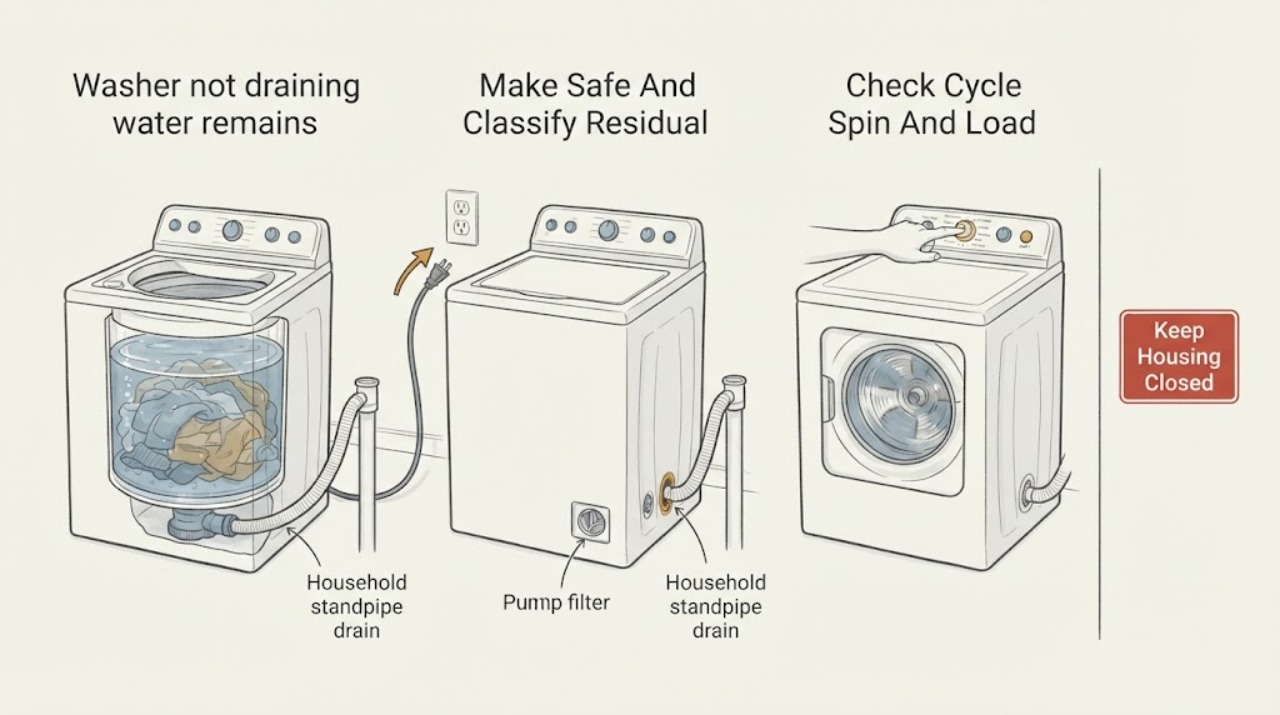
Work through in order
Diagnostic checks
Use only checks that match the exact appliance or system and its official guide.
-
Check 1
Stop the washer and record whether the tub has visible standing water, the clothing is merely wet, the cycle ended or paused, a lid or door indicator is present, and any display code; keep hands out of the water and do not restart repeatedly.
Expected result: The tub is visibly full, only clothing is wet, the cycle stopped before drain, a lid or door code is present, or no code is shown.
Next step: If water is near an outlet, cord, or control, stop and use the safety boundary. Otherwise continue with the cycle and external drain checks; do not open a panel to reach trapped water.
Stop if: Stop immediately for water near electrical parts, a damaged cord, smoke, burning odor, sparks, or uncontrolled leakage.
Why this matters
Why: Visible water or a stopped drain stage makes a drain hose, household drain, filter, pump, or control issue more likely. Wet clothing with little or no visible water can instead reflect low/no spin, an unbalanced load, or an incomplete cycle.
-
Check 2
Check whether Low Spin, No Spin, a delicate cycle, or a pause was selected; if the manual permits it and there is no hazard, redistribute a bulky or uneven load and run the documented Drain and Spin or Rinse and Spin cycle once.
Expected result: The load was unbalanced, the selected cycle used little or no spin, the machine completes the drain-and-spin cycle, or the tub still holds water afterward.
Next step: Use the model-recommended cycle and load size if the tub empties. If water remains, stop repeated cycles and inspect the external drain path next.
Stop if: Do not reach into a moving basket, force a locked lid or door, or continue if the washer shakes violently, leaks, or shows a repeated fault.
Why this matters
Why: A corrected load or cycle that removes water points to spin selection or load balance rather than a blocked pump. Water that remains after a documented drain cycle makes the drain hose, household drain, pump filter, pump, or control path more likely.
-
Check 3
With the washer stopped, inspect the visible drain hose from the cabinet to the standpipe, laundry tub, or utility sink; look for kinks, crushing, a loose end, an airtight seal, excessive insertion, or a blocked household drain, and check for water backing up at the outlet.
Expected result: The hose is kinked or clogged, the end has slipped, the outlet is sealed or inserted contrary to the manual, the standpipe or sink backs up, or the external route is clear.
Next step: Correct only an obvious accessible hose position or kink according to the manual. Clear a household drain only with normal plumbing methods and without chemical drain cleaner in the washer. If the outlet backs up, arrange plumbing help; if it is clear but the tub remains full, continue to the model-specific filter check.
Stop if: Do not detach a hose full of water without a safe containment plan, seal the drain opening with tape, move a stacked unit, or push tools into the hose or pump.
Why this matters
Why: A restricted hose or household drain can prevent the pump from emptying the tub. A hose that is too deep or sealed can create siphoning or backflow. A clear, correctly routed external path makes a filter, pump, or internal control problem more likely.
-
Check 4
If the exact owner manual identifies a user-accessible pump filter or emergency drain hose, turn the washer off, let hot water cool, place towels and a shallow container, and follow that procedure to remove lint or small debris; do not open other panels.
Expected result: The model has no documented user filter, the filter contains lint or an object, the filter is clean, or water cannot be contained safely.
Next step: Refit the filter and cap exactly as documented, then run one model-approved drain test if safe. If the filter will not seat, is damaged, or does not restore flow, arrange appliance service.
Stop if: Do not force the filter, remove a sealed pump cover, use a sharp tool near the impeller, or work while water is hot or near electrical parts.
Why this matters
Why: A blocked accessible filter can restrict pump flow. A clean filter, no documented access, or unsafe residual-water handling shifts the likely cause toward the drain pump, internal hose, control, or a service-only procedure.
-
Check 5
After only the documented external correction, observe one drain or Drain and Spin attempt from a dry, safe position; note whether water flows steadily, flows slowly, the pump hums with no flow, the washer is silent, water returns, or a fault appears.
Expected result: Water flows and the tub empties, flow is weak or intermittent, a hum occurs without movement, the pump is silent, water backs up, or the display shows a drain-related fault.
Next step: Stop testing when the result is unchanged, unsafe, or unclear. Give the technician the exact sound, flow pattern, code, water level, and checks already completed.
Stop if: Do not measure live voltage, bypass a lid or door lock, remove panels, or run repeated drain attempts with abnormal noise, odor, heat, smoke, or a leak.
Why this matters
Why: Steady flow after correction supports a hose, load, or household-drain issue that was resolved. Weak flow or a hum without movement can indicate a restriction or pump problem; silence or a recurring fault can involve a lid or door interlock, wiring, control, or pump. Backflow points back to drain routing or household plumbing.
-
Check 6
Only if the tub emptied and no hazard occurred, compare one correctly sized, balanced load with the original result; record whether the issue returns only with bulky laundry, returns with an empty tub, or is accompanied by backflow or a code.
Expected result: An empty or balanced load drains normally, every load remains full, only the household outlet backs up, or the fault returns regardless of load.
Next step: Keep the washer out of service when the tub remains full or the fault repeats. Arrange appliance service for a washer-side fault and plumbing service for a household drain backup.
Stop if: Do not keep rerunning full cycles, leave standing water in the washer for extended periods, or replace a pump or control without model-specific diagnosis.
Why this matters
Why: Load-dependent recovery supports balance, spin, or cycle selection. Failure with an empty tub makes a restriction, pump, drain hose, control, or household drain problem more likely. Outlet-only backup needs plumbing attention rather than a washer part.
Use your observations
Decision map
Find the observation that best matches what you see, then follow the next safe action.
-
PATH 01Safety boundary
What you see
The tub is empty or nearly empty, but clothes are wet after a low/no-spin, delicate, paused, or unbalanced cycle and a corrected Drain and Spin removes the water.
Do this next
Use the model-recommended spin and load arrangement. Monitor the next normal load; escalate if visible water remains or the issue recurs with a balanced load.
Why this path and its safety boundary
Why it matters: The symptom is more consistent with spin selection, load balance, or an incomplete cycle than with a failed drain pump.
Safety stop: Do not force the lid or door or continue if the washer shakes violently, leaks, or shows a repeated fault.
-
PATH 02Safety boundary
What you see
The drain hose is kinked, displaced, sealed, too deeply inserted, or the standpipe or utility sink backs up when the washer tries to discharge.
Do this next
Restore only the model-documented hose route. If the household outlet backs up after the hose is correctly positioned, stop using the washer and arrange plumbing help.
Why this path and its safety boundary
Why it matters: The outlet path or household plumbing is more likely than an internal washer failure; correct routing can also prevent backflow into the tub.
Safety stop: Do not tape the hose into the drain, use chemical drain cleaner in the appliance, or detach a water-filled hose without safe containment.
-
PATH 03Safety boundary
What you see
The external route is clear, the tub remains full after a drain attempt, the accessible filter is packed with debris, or the pump hums with weak or no water movement.
Do this next
Follow the exact manual for a filter or emergency-drain procedure once, then arrange appliance service if flow does not return or the filter is absent, damaged, or impossible to refit.
Why this path and its safety boundary
Why it matters: A filter, internal hose, drain pump, or impeller restriction is more likely. A user-accessible filter may be cleaned, but pump access and internal obstruction diagnosis are model-specific.
Safety stop: Do not open the pump or cabinet, reach into an impeller, force a cap, or test the pump with live power.
-
PATH 04Safety boundary
What you see
The washer is silent during a documented drain attempt, shows a recurring drain or lid or door fault, fails with an empty tub after external checks, or has an inaccessible residual-water procedure.
Do this next
Leave the washer off and arrange qualified appliance service. Provide the model, code, water level, drain-cycle behavior, hose and filter observations, and any abnormal sound or odor.
Why this path and its safety boundary
Why it matters: A lid or door interlock, wiring, control, drain pump, internal hose, or other service-only fault is more likely than a simple load issue.
Safety stop: Do not bypass safety switches, remove panels, measure live circuits, or repeatedly restart a washer with standing water or a fault.
Helpful context
Understand the symptom
Separate poor spin from a blocked drain
A tub that still holds visible water points to the drain path, but wet clothing alone does not prove that the pump failed. A low or no-spin setting, an unbalanced bulky load, or a cycle that did not complete can leave extra water in the load. If the tub is visibly full, the pump never moves water, or water returns from the standpipe, treat it as a drain-path problem and do not keep restarting cycles.
The outlet path matters as much as the washer
The drain hose must have the routing and air gap specified for the model. A kink, clog, hose pushed too far into a standpipe, or a blocked utility sink can prevent discharge or let water return. Manufacturer installation requirements differ, so use the owner's manual for the exact insertion depth and height rather than applying a universal measurement.
Only some washers have a user-accessible pump filter
Many front-load designs provide a small drain hose and pump-filter access panel, while some top-load models do not provide a user-cleanable filter. Do not remove panels or reach into the pump because another washer has a filter. If the manual does not describe access, record the symptom and arrange service.
Safety boundary
Stop conditions
- Stop and keep the washer off if water reaches the outlet, plug, cord, controls, or other electrical parts; do not touch wet electrical equipment.
- Do not open cabinet, pump, control, or sealed panels, bypass a lid or door interlock, test live circuits, or reach into a moving basket or impeller.
- Stop for smoke, burning odor, sparks, abnormal grinding, hot water that cannot be contained, a damaged cord or hose, uncontrolled leakage, or a recurring fault.
- Do not detach a water-filled hose, force a filter or cap, tip a stacked or built-in washer, or use chemical drain cleaner in the washer.
- Do not order a drain pump, hose, filter, lid or door lock, or control until the exact model and qualified diagnosis identify the failed part and fit.
Only after diagnosis
Potential parts
- drain hose
Consider this category only when the visible hose is cracked, crushed, damaged, or the exact model's installation parts list identifies it as the cause after routing and household-drain checks.
Confirm the exact washer model, hose length, end fittings, routing requirements, and manufacturer fit information before ordering. - drain pump or pump filter
Consider this category only when the external drain path is clear and qualified diagnosis confirms a blocked, damaged, or non-operating pump or a damaged model-specific filter or cap.
Confirm the exact model, pump design, filter access, electrical connector, and manufacturer procedure; do not select a pump by appearance alone. - lid or door interlock or control
Consider this category only when the washer will not authorize draining, a documented lid or door fault repeats, and qualified diagnosis rules out load, hose, household drain, filter, and pump causes.
Confirm the exact model, top-load or front-load design, control revision, wiring, and technician diagnosis before ordering.
When checks do not resolve it
Need a professional?
Arrange appliance service when the tub remains full after model-approved cycle, hose, household-drain, and accessible-filter checks; when the pump is silent or hums without moving water; when a drain, lid, or door fault repeats; or when internal access is required. Arrange plumbing service when the standpipe, laundry tub, or utility sink backs up after the washer hose is correctly routed. Seek prompt help for smoke, burning odor, sparks, uncontrolled water, or water near electrical parts.
Safety scope: This article covers cycle and load observations, visible hose and household-drain checks, and a documented user-accessible filter procedure. It does not authorize opening panels, bypassing interlocks, testing live parts, handling unsafe standing water, moving a stacked unit, or replacing internal components.
Common questions
FAQ
Why is there still water in my washer after the cycle?
A low/no-spin or unbalanced cycle can leave clothes wet without a full tub. Visible standing water is more suggestive of a kinked or blocked drain hose, a backed-up household drain, an accessible pump-filter restriction, a drain pump problem, or a control or interlock issue.
Should I run Drain and Spin when water remains in the tub?
If there is no electrical or other hazard and the owner's manual documents that cycle, correct an obvious load issue and try it once. If the tub stays full, the pump is silent, a fault repeats, or water is near electrical parts, stop and arrange service instead of repeating cycles.
Can a clogged household drain make a washer look like it will not drain?
Yes. A standpipe, laundry tub, or utility sink that backs up can slow discharge or return water to the washer. Check the visible outlet and hose routing; if the household drain backs up with the hose correctly positioned, arrange plumbing help.
Do all washers have a pump filter I can clean?
No. Some front-load models document an accessible pump filter, while many top-load models do not provide a user-cleanable filter. Use the exact manual. Do not remove a cabinet panel or force a filter that is not documented for your model.
When is a washer that will not drain unsafe to keep using?
Stop for water near electrical parts, smoke, burning odor, sparks, abnormal grinding, uncontrolled leakage, hot water that cannot be contained, a damaged cord or hose, or a repeated fault. Keep it off and arrange qualified appliance service; use plumbing help when the household drain is the source of backup.
Read the exact guide
Official sources
- Not Draining - WasherWhirlpool Corporation · Official Whirlpool top-load washer guidance used for generic external drain and load clues; the model installation guide controls exact routing and dimensions.
- Water Remains in Tub or Inside Washer - Front Load WasherWhirlpool Corporation · Official Whirlpool guidance used for the distinction between visible residual water, wet clothing, load balance, and spin selection; exact cycle names and controls vary by model.
- Steps to resolve water drainage issues with your Samsung washerSamsung Electronics · Official Samsung Canada guidance used as a cross-brand safety and diagnostic comparison; it explicitly notes model and regional differences, so the exact owner's manual controls.
- Washer Not Draining or Spinning? Troubleshooting GuideWhirlpool Corporation · Official Whirlpool product-help guide used for the drain-system checklist and accessible pump-filter limitation; exact filter access is model-specific.
Community feedback
Share a repair observation
Share a plain-text repair observation. Accepted observations are published automatically; this page may take a moment to update.