
On this page
Start here
Quick answer
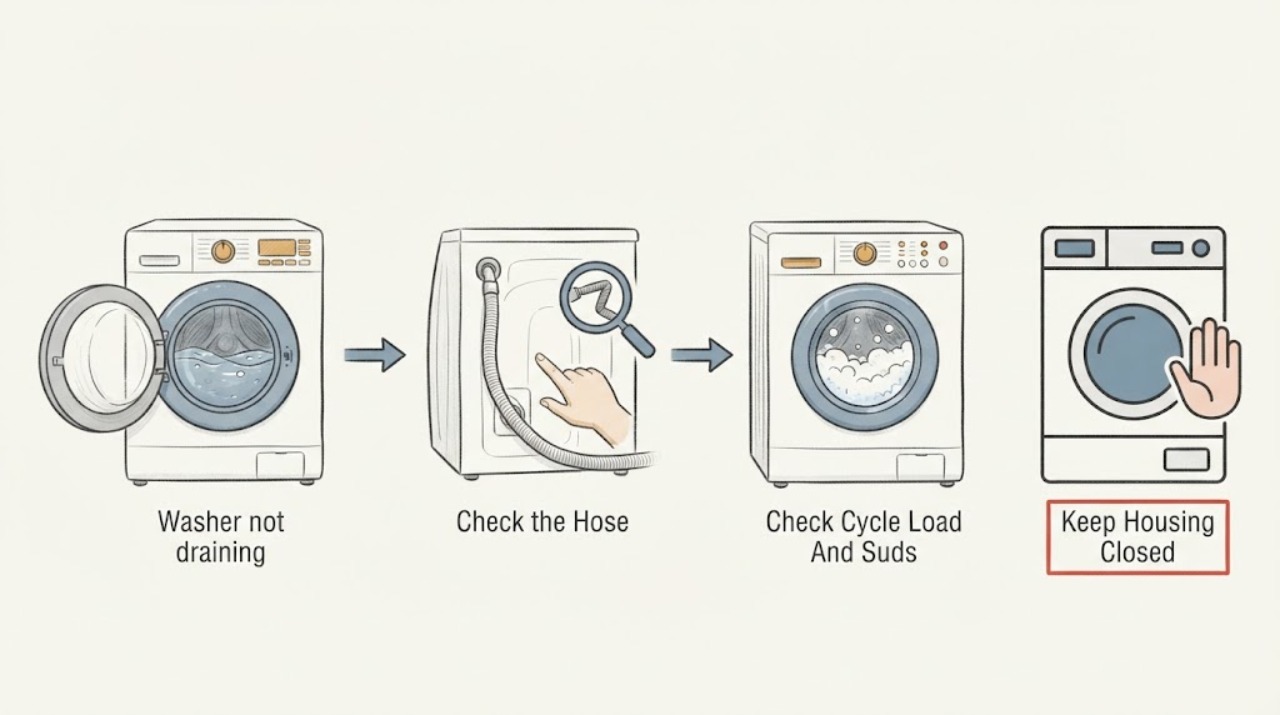
If a washer leaves water in the tub, stop the cycle and unplug it before any access. First record whether the problem is standing water or merely wet clothes, the selected cycle, load balance, any display code, and any leak or unusual sound. From outside the appliance, check that the drain hose is not kinked, crushed, leaking, routed at an unknown height, or inserted too far; consult the exact owner manual because hose limits and filter access vary. Only if the manual identifies a normal user-accessible pump filter, use a shallow pan and towels to drain it while the washer is unplugged and stable. Do not remove panels, reach under a full or unstable washer, bypass a lid or door lock, touch wiring, or run a machine with parts removed. If water remains, the filter is inaccessible or stuck, the pump is silent or grinding, a leak is present, or the cause is not clear, stop and call a professional appliance repair technician.
Work through in order
Diagnostic checks
Use only checks that match the exact appliance or system and its official guide.
-
Check 1
Stop the cycle, keep the washer still, and unplug it from a dry position before opening any cover or reaching toward a hose or filter. Record whether water is visible in the tub, whether clothes are only wet, the selected cycle and spin setting, any display code, and whether there was a leak, hum, grinding, or silence.
Expected result: The tub may be full, partly full, or empty with wet clothes; the control may show a code; the last sound may have been a hum, grinding, repeated clicking, or no pump sound.
Next step: Write down the model and serial from the visible label if safe, preserve the code and sound description, and continue only with external observations and manual-approved user access.
Stop if: Stop and call a professional if water is near an outlet, the floor is flooding, the washer is unstable, a burning odor or sparking is present, or accessing the plug would require standing in water or moving the appliance.
Why this matters
Why: Standing water makes this a drain-path or pump-safety issue, while wet clothes without standing water can result from low spin, suds, or an unbalanced load. A code or unusual sound is model-specific evidence, not permission to open the cabinet.
-
Check 2
Without pulling the washer out or disconnecting the hose, look from the rear or side only as far as normally accessible. Check for a kink, crush point, visible leak, hose end pushed unusually far into the standpipe or tub, and an installation height that is unknown or conflicts with the exact manual.
Expected result: The hose may be open and undamaged, sharply bent or crushed, leaking, inserted too far, or routed in a way that cannot be verified without moving the machine.
Next step: If a loose, reachable kink can be straightened without moving the appliance, correct only that visible kink; otherwise photograph the routing and have a technician or installer verify the hose, standpipe, and pump path against the manual.
Stop if: Stop if the hose must be detached, the washer must be tilted or moved, a connection is leaking, the standpipe is overflowing, or the hose cannot be inspected without reaching behind a heavy or wet machine.
Why this matters
Why: A kink, crush, blockage, leak, or incorrect routing can restrict flow or cause siphoning and can explain a no-drain symptom. Whirlpool's product help specifically limits how far its hose enters a standpipe and says not to tape it to the pipe; exact limits vary by model.
-
Check 3
Review the completed cycle and load without starting another cycle: note whether it was Delicate, Hand Wash, no-spin, or another low-spin selection; whether one bulky item or a tightly packed load was present; and whether there were excessive suds or detergent residue.
Expected result: The washer may have drained but left wet clothes, or it may still contain standing water; the load may be balanced, tightly packed, bulky, or surrounded by excessive suds.
Next step: Record the cycle and load details. Only after the manual and the water condition make it safe should you consider the model's normal drain-and-spin guidance; do not repeatedly restart a leaking or mechanically abnormal washer.
Stop if: Stop if water remains, the washer leaks, the tub or cabinet is damaged, the load cannot be safely removed, or a further cycle would operate with an unresolved electrical, lock, or pump symptom.
Why this matters
Why: Low/no spin, excess suds, and an unbalanced load can leave laundry wet without proving a failed drain pump. Standing water, repeated failure on a normal cycle, or a pump sound problem keeps a physical drain fault in the lead.
-
Check 4
Only when the exact owner manual identifies a normal user-accessible pump filter or drain tube, the washer is unplugged and stable, and a shallow pan and towels fit safely, open that access gently and allow residual water to drain; do not force the cap or reach into hidden pump parts.
Expected result: The manual may show no filter, the filter may be clean, lint or pocket debris may be present, water may drain slowly, or the filter may be stuck or inaccessible.
Next step: Follow only the manual's cleaning and reseating instructions, capture a photo of debris without exposing internal parts, and call service for a stuck cap, no safe drain tube, continued standing water, or an unexplained result.
Stop if: Stop immediately for a filter that will not turn, a pan that may overflow, hot or foul water, a sharp or unreachable obstruction, an inaccessible filter, or any need to remove a panel or use a tool.
Why this matters
Why: Debris at an accessible filter can restrict flow, but a clean filter does not clear the pump, hose, standpipe, lock, control, or wiring. Filter access and draining procedure are model-specific; top-load machines often lack easy user access.
-
Check 5
Do not run the washer with a panel removed or with a leak present. Instead, review the earlier drain attempt and, only if the manual explicitly permits a normal user-level drain test after the hose/filter checks, observe from a dry position whether water exits and whether the pump sounds normal; never reach into the tub, hose, or pump while energized.
Expected result: Water may flow normally, flow weakly or intermittently, fail to move, or be accompanied by a smooth hum, grinding, repeated clicking, or silence.
Next step: Stop testing, restore only manual-approved covers, and give the technician the water level, flow result, sound, cycle, error code, and hose/filter observations. Do not perform continuity tests or bypass a lid/door switch.
Stop if: Stop for any leak, exposed wiring, water near electricity, smoke, burning odor, sparking, grinding that worsens, unexpected movement, or any request to run the appliance with a cover removed.
Why this matters
Why: Weak or absent flow with a grinding or silent pump can indicate a blocked or failed pump, but sound alone cannot distinguish pump, control, lock, hose, or wiring faults. Normal flow after a safe correction points away from a persistent pump blockage but does not prove the repair.
-
Check 6
Compare the symptom with one documented normal cycle only after the machine is dry, intact, safely plugged, and the manual allows the test; otherwise leave it unplugged. Note whether the washer drains fully, stops before drain, repeats the code, or leaves water after the accessible checks.
Expected result: The symptom may clear once, recur on a normal cycle, remain constant, or be accompanied by a leak, lock warning, or unusual noise.
Next step: Arrange appliance repair and provide the model, cycle, load, code, water level, hose route, filter result, flow, sound, and leak observations; preserve any photos and do not disassemble further.
Stop if: Stop using the washer and call a professional for any repeat no-drain condition, remaining water, leak, inaccessible filter, pump noise, control/lock fault, or uncertainty about safe access.
Why this matters
Why: A repeat failure after external hose and manual-approved filter checks makes a pump, control, lock, internal hose, or wiring diagnosis more likely. A one-time clear does not establish that the underlying condition is safe or fixed.
Use your observations
Decision map
Find the observation that best matches what you see, then follow the next safe action.
-
PATH 01Safety boundary
What you see
Water remains in the tub, especially in a top-load washer or one with no clearly accessible drain path.
Do this next
Keep the washer unplugged and call a professional appliance repair technician to drain and diagnose it; provide the water level, model, cycle, code, hose observations, and any leak.
Why this path and its safety boundary
Why it matters: Manual draining and internal pump or hose access may be unsafe or model-specific.
Safety stop: Do not tilt, move, siphon, detach hidden hoses, or remove panels.
-
PATH 02Safety boundary
What you see
The visible drain hose is kinked, crushed, leaking, blocked at the standpipe, inserted too far, or routed at an unverified height.
Do this next
Correct only a loose reachable kink if the washer remains stable and the manual supports it; have a technician or installer verify the complete route and standpipe before further operation.
Why this path and its safety boundary
Why it matters: The external drain route can restrict discharge or cause siphoning, but exact routing is model-specific.
Safety stop: Stop for a leak, overflow, hose disconnection, or any need to move the appliance.
-
PATH 03Safety boundary
What you see
The tub is empty but the load is wet after a low-spin cycle, excessive suds, or an uneven/bulky load.
Do this next
Record the cycle, detergent, and load; follow the exact manual's load and spin guidance on a later safe cycle, and call service if a normal cycle still fails.
Why this path and its safety boundary
Why it matters: The result can be reduced spin rather than a blocked drain.
Safety stop: Stop if water appears, the machine leaks, makes abnormal noise, shows a persistent code, or requires a panel or lock bypass.
-
PATH 04Safety boundary
What you see
The manual identifies a user-accessible filter and debris is found, with safe pan capacity and no leak or electrical hazard.
Do this next
Clean and reseat only as the manual directs, then stop and arrange service if water remains or the fault recurs.
Why this path and its safety boundary
Why it matters: Debris may have restricted the pump inlet, but removal does not prove the pump or hose is healthy.
Safety stop: Do not force the filter, probe the pump, or continue if the cover or drain path is stuck.
-
PATH 05Safety boundary
What you see
The hose route is acceptable and the accessible filter is clear or unavailable, but flow is absent/weak, the pump grinds or stays silent, or the code repeats.
Do this next
Leave the washer out of use and call a professional appliance repair technician for diagnosis and any pump, hose, lock, control, or electrical work.
Why this path and its safety boundary
Why it matters: A pump, internal hose, lid/door lock, control, or wiring fault needs diagnosis; the observation cannot identify a replacement part by itself.
Safety stop: Do not remove panels, test live wiring, bypass a lock, or order a part without exact-model confirmation.
-
PATH 06Safety boundary
What you see
Water is near an outlet, the floor is flooding, the washer is unstable, wiring is exposed, smoke or burning odor is present, or the cabinet is damaged.
Do this next
Keep clear, do not touch wet electrical equipment or move the machine, and seek urgent qualified help appropriate to the hazard before appliance service.
Why this path and its safety boundary
Why it matters: The situation exceeds a safe user observation and may involve shock, fire, flood, or movement hazards.
Safety stop: Stop all operation immediately.
Helpful context
Understand the symptom
What a washer's drain path is telling you
A washer normally moves tub water through a pump and drain hose into a standpipe or laundry tub. A kink, crush, blockage, incorrect hose routing, clogged user-accessible filter, excessive suds, low-spin cycle, or unbalanced load can leave water or make clothes unusually wet. Pump, lid or door-lock, control, and wiring faults can look similar. Filter locations and whether a filter exists vary by model, so the owner manual controls the safe procedure. Whirlpool's manufacturer guidance describes the pump, drain pipe, hose routing, filter variation, cycle, load, and detergent checks; its product-help page also warns against incorrect hose insertion and kinks. Maytag similarly identifies hose, installation, spin setting, load, filter, and pump causes and says to use the manual before draining or repair.
Use the safest accessible checks first
Keep the washer stationary and work from a dry, well-lit position. Unplug before opening any user-accessible filter cover. A shallow pan and towels can contain residual water, but a full top-load tub, inaccessible drain hose, stuck filter, or water near an outlet is a service boundary. Do not tilt or move the appliance alone, remove a cabinet or pump panel, probe a hose with a tool, bypass a lid or door lock, or perform electrical testing. A clear hose and normal-looking cycle do not prove the pump or controls are sound; the observation only narrows the next step.
Separate a spin result from a true drain failure
A low- or no-spin setting, excess detergent, or an uneven bulky load can leave clothes wet even when the tub has drained. If there is visible standing water after the cycle, prioritize the drain hose, accessible filter, and professional pump diagnosis. If there is no standing water but clothes are wet, record the cycle and load condition and follow the model manual's user-level guidance; do not repeatedly run a washer that leaks, makes a grinding sound, or shows an unresolved fault.
Safety boundary
Stop conditions
- Unplug before any user-accessible filter or hose-area access; stop if the plug, outlet, or floor is wet.
- Do not remove panels, reach under or behind a full or unstable washer, detach hidden hoses, probe the pump, test energized wiring, or bypass a lid or door lock.
- Stop for flooding, a leak, smoke, burning odor, sparking, exposed wiring, an unstable cabinet, a stuck filter, or unexpected movement.
- If external and manual-approved checks do not restore safe draining, leave the washer out of use and call a professional appliance repair technician.
Only after diagnosis
Potential parts
- washer drain pump
Consider this category only after a technician confirms the pump is the failed component rather than a hose, filter, standpipe, lock, control, or wiring issue.
Match the exact washer model, pump revision, connector, mounting pattern, and manufacturer procedure; do not replace a pump based on sound alone. - washer drain hose
Consider this category only when the existing hose is confirmed kinked, crushed, leaking, blocked, or incompatible with the documented installation.
Confirm exact model, hose length and fittings, standpipe requirements, clamps, and routing from the installation manual; never extend or tape a hose as an unverified fix. - washer pump filter
Consider this category only if the exact manual confirms a replaceable filter and a technician identifies a damaged or missing filter rather than ordinary debris.
Many washers have no user-accessible filter and filter shapes vary; match the exact model, seal, cap, and service instructions before selection.
When checks do not resolve it
Need a professional?
Call a professional appliance repair technician for standing water, repeat no-drain failure, pump noise, a leak, an inaccessible or stuck filter, a persistent code or lock fault, or any need to remove panels or handle wiring.
Have this ready
- Washer brand, exact model and serial if visible without moving the appliance
- Front-load or top-load type, selected cycle, load description, and whether water remains
- Display code, when the cycle stopped, and prior pump sound such as hum, grinding, clicking, or silence
- Visible drain-hose routing, standpipe overflow or leak, accessible-filter result, and safe photos
- Whether the symptom recurred after any manual-approved external correction
Common questions
FAQ
Why is my washer not draining?
Common possibilities include a kinked, crushed, blocked, leaking, or incorrectly routed drain hose; a clogged accessible filter; an unsuitable cycle or spin setting; excessive suds; an unbalanced load; or a failed pump, lock, control, or internal hose. Start with unplugged, external, manual-approved checks because exact access varies by model.
What should I do if my washer is full of water?
Stop the cycle and unplug from a dry, safe position. Check the exact manual before opening any user-accessible filter, and use a shallow pan and towels only when the washer is stable and the procedure is explicit. A full top-load washer, inaccessible drain path, leak, or water near electricity is a professional service boundary.
Can a cycle or load make clothes wet even when the washer drains?
Yes. Low- or no-spin settings, delicate cycles, excessive suds, and bulky or uneven loads can reduce spin and leave clothes wet. If the tub contains standing water, treat it as an unresolved drain problem rather than assuming the issue is only balance or detergent.
Should I clean the washer pump filter?
Only if the exact owner manual identifies a normal user-accessible filter and gives a safe procedure. Unplug first, use a pan and towels, and do not force a cap or reach into a hidden pump. Some washers have no accessible filter; a stuck or inaccessible filter needs a technician.
When should I call an appliance repair technician for a washer that will not drain?
Call when water remains after manual-approved checks, the hose or filter cannot be safely accessed, the filter is stuck, flow is weak or absent, the pump grinds or stays silent, a leak or persistent code is present, or the problem recurs. Do not remove panels, test energized wiring, or bypass a lid or door lock.
Read the exact guide
Official sources
- Why is My Washing Machine Not Draining?Whirlpool · General Whirlpool guidance; filter access, hose limits, indicators, and procedures vary by exact washer model.
- Not Draining - Washer - Product HelpWhirlpool Product Help · Whirlpool top-load product-help guidance; exact installation requirements must be checked in the washer manual.
- How To Drain a Washing MachineMaytag · General Maytag guidance; use the exact model manual because top-load access and front-load drain/filter arrangements differ.
Community feedback
Share a repair observation
Share a plain-text repair observation. Accepted observations are published automatically; this page may take a moment to update.