
On this page
Start here
Quick answer
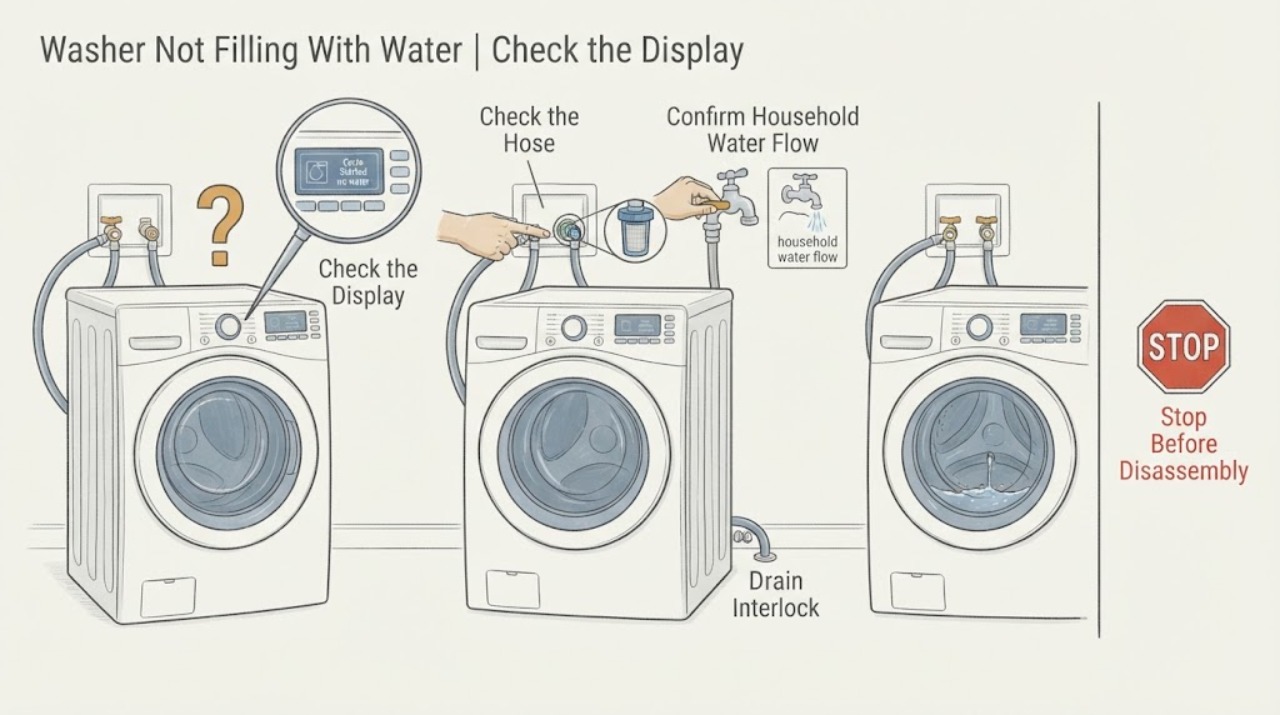
If the washer's supply valves are open but the tub is not filling, check whether the washer is intentionally sensing the load, whether the door or lid is closed, and whether the display shows a water-inlet warning. Then inspect the visible inlet hoses for bends or crushing, confirm that water actually flows from the household faucet, and check the inlet filters only by the exact owner-manual procedure. Cold-weather freezing, low household flow, a blocked filter, a drain hose installed in a way that siphons water out, or a failed inlet valve can all look like an open-valve problem. Do not repeatedly start a dry or faulted machine. If the valves and external hoses are sound but no water enters, the inlet valve, control, interlock, or supply needs qualified diagnosis.
Work through in order
Diagnostic checks
Use only checks that match the exact appliance or system and its official guide.
-
Check 1
Confirm that the washer has power, the selected cycle requires a fill, the door or lid is fully closed, and the display is not waiting for a start confirmation or showing a water-inlet warning. Press Start or Resume once according to the model instructions and observe whether the tub begins a brief sensing or locking sequence before water enters.
Expected result: The washer is sensing or locking normally, the door or lid warning remains, an inlet warning appears, or the washer is completely silent after Start.
Next step: Close the door or lid without forcing it, follow the exact model procedure for the displayed warning, and continue with external supply checks. If the washer remains silent or will not lock after a correct close, arrange appliance service rather than bypassing the interlock.
Stop if: Do not defeat a door or lid lock, repeatedly restart an error, or reach into the tub while the washer is attempting to lock or fill.
Why this matters
Why: A short sensing period can be normal on some models, while an open-door or lid condition prevents normal filling. An inlet warning confirms that the control did not detect enough water in the expected fill period but does not identify whether the cause is supply, hose, filter, valve, or control.
-
Check 2
With the washer stopped, check the household faucet or supply point feeding the washer and compare it with another nearby cold-water outlet. Look for a supply interruption, a faucet that turns but provides little or no flow, or signs of freezing. Do not disconnect a pressurized hose just to perform this check.
Expected result: The household flow is absent or weak, the faucet is frozen, other outlets also have poor flow, or household flow appears normal.
Next step: Resolve a household supply or faucet issue with plumbing help. For suspected freezing, warm the faucet and exposed line only as the manufacturer permits and without open flame. If household flow is normal, continue with the washer's visible inlet path.
Stop if: Do not heat a frozen line with a torch, force a frozen faucet, or open a connection while water pressure is present.
Why this matters
Why: An open washer valve cannot fill the tub if the home supply is interrupted, restricted, or frozen. A wider household flow problem points toward plumbing or building supply; normal flow shifts attention toward the washer hose, filter, inlet valve, or control.
-
Check 3
Inspect the visible hot and cold inlet hoses from the faucet to the washer. Look for a sharp bend, crushing where the washer has shifted toward a wall, a disconnected end, a crack, or a hose routed to the wrong marked inlet. Do not pull the washer forward or loosen the hose at the machine while it is connected to the open supply.
Expected result: A hose is kinked, crushed, damaged, disconnected, visibly leaking, or routed correctly with an unobstructed bend.
Next step: Close the household washer valves before any model-approved hose correction. Replace a visibly damaged hose through qualified service or the exact installation procedure; if the hose is sound and accessible, continue to the filter and drain-installation checks.
Stop if: Do not straighten a pressurized hose by force, use a hose with a bulge or crack, or move the washer against its connected lines.
Why this matters
Why: A restricted or damaged inlet hose can prevent filling even when the valves are open. A disconnected or leaking hose can also make the washer appear not to fill because water is escaping before it reaches the tub. A sound external hose makes a filter or internal inlet fault more plausible.
-
Check 4
If the exact owner manual identifies the inlet screen or filter as user-accessible, close the washer's water faucets and follow that manual's stopped-appliance procedure to inspect it for rust, sand, scale, or other debris. Prepare for residual water and reinstall every screen and connection exactly as shown. If the manual does not authorize this work, inspect only from outside and arrange service.
Expected result: The manual-approved filter is visibly blocked, the filter is clean, a screen or seal is damaged, or the filter cannot be accessed safely.
Next step: Clean and reinstall a user-accessible filter only as the manual directs, then reopen the faucets slowly and check for leaks before a test fill. If the filter is damaged, absent, inaccessible, or the no-fill condition remains, arrange appliance service.
Stop if: Do not remove an inlet screen without the model procedure, run the washer with a filter missing, or continue after a connection leaks.
Why this matters
Why: Sediment or debris can reduce or stop flow through the inlet valve. A clean filter does not prove the valve or control is good, and a damaged or missing screen can create later valve or flooding problems. Inaccessible filter work is a service task.
-
Check 5
Inspect the visible drain hose and standpipe arrangement without moving the washer. Confirm that the hose is secured, not bent or blocked, and installed at the model-specified position rather than pushed unusually deep into the drain. Observe whether any water that enters immediately disappears or whether the drain backs up.
Expected result: The hose is inserted too deeply, is loose, bent, or blocked; water appears to siphon or drain away as filling starts; the standpipe backs up; or the drain arrangement looks correct.
Next step: Correct only an obvious external hose position using the exact installation instructions. Have a plumber address a restricted standpipe; have an appliance technician assess a no-fill condition that remains with a sound drain arrangement.
Stop if: Do not pull the drain hose from a full or running washer, pour water into a questionable standpipe, or continue a cycle that overflows.
Why this matters
Why: An incorrectly installed drain hose can siphon water out while the washer fills, making a supply problem look like no fill. A loose hose or blocked standpipe can cause drainage or overflow problems. A correct visible drain path makes inlet flow and internal control causes more likely.
-
Check 6
If the problem began during freezing weather or after an unheated-space exposure, inspect the faucet and exposed inlet hose for frost or an unusually hard section. Warm only the exposed faucet or hose as the model instructions permit, then allow it to thaw fully before reconnecting or testing. Record whether normal flow returns.
Expected result: A faucet or hose is frozen, thawing restores flow, or the supply is unfrozen but the washer still does not fill.
Next step: Use the washer only after the line is fully thawed and leak-free. If no-fill persists after normal flow, stop repeating cycles and arrange qualified appliance diagnosis.
Stop if: Do not use an open flame, apply intense heat to plastic fittings, or reconnect a line that is cracked or still frozen.
Why this matters
Why: Frozen supply lines can block water even with open valves. If thawing restores flow, the no-fill cause was external and the installation needs protection from recurrence. An unfrozen supply with continued no-fill points toward the hose filter, inlet valve, door or lid interlock, control, or another washer fault.
-
Check 7
Record the washer model, cycle, display message, door or lid behavior, household-flow result, hose condition, filter result, drain-hose arrangement, and whether a faint valve click or hum occurs when filling is requested. Keep the cabinet closed and do not probe the inlet valve or wiring.
Expected result: The valves and household flow are normal, hoses and manual-approved filters are clear, the door or lid closes correctly, but no water enters or the inlet warning returns.
Next step: Arrange qualified appliance repair and provide the recorded pattern. A technician can test the model's inlet and control circuit safely and identify whether a valve or another component is actually at fault.
Stop if: Do not bypass the door or lid interlock, apply power directly to a valve, or open panels to test internal wiring.
Why this matters
Why: The remaining possibilities include an inlet valve, control, interlock, wiring, or another internal fault. A click or hum is not enough to prove that the valve is opening or that water is reaching the tub.
Use your observations
Decision map
Find the observation that best matches what you see, then follow the next safe action.
-
PATH 01Next step
What you see
The washer powers on, locks or senses the load briefly, and then begins filling without an error.
Do this next
Allow the documented sensing sequence to finish. Request service only if filling never begins, the delay is new and persistent, or a water-inlet warning appears.
Why this path and its safety boundary
Why it matters: The delay is likely part of the model's normal load-detection sequence rather than a no-fill failure.
-
PATH 02Next step
What you see
The washer valves are open but the faucet has weak or no flow, other outlets are affected, or the faucet or exposed line is frozen.
Do this next
Use plumbing help for a supply interruption or faucet problem, or safely thaw the exposed line according to the manufacturer. Do not use flame or force frozen fittings.
Why this path and its safety boundary
Why it matters: The washer cannot fill until the household supply or frozen line is restored; an internal washer fault is not yet established.
-
PATH 03Next step
What you see
Household flow is normal, but an inlet hose is kinked, crushed, leaking, or a manual-approved inlet screen is blocked.
Do this next
Close the faucets and correct only the visible hose issue or manual-approved filter procedure. If a hose, screen, or seal is damaged, replace it using exact model guidance or arrange service.
Why this path and its safety boundary
Why it matters: The water path to the washer is restricted or leaking before the tub, even though the supply valves are open.
-
PATH 04Next step
What you see
Water enters briefly but immediately disappears, or the drain hose is unusually deep, loose, bent, or blocked.
Do this next
Correct only the visible drain-hose position using the exact installation instructions; use plumbing help for a restricted standpipe. If the path is correct and water still will not remain, arrange appliance service.
Why this path and its safety boundary
Why it matters: Drain-hose installation or a household drain restriction can prevent the tub from maintaining its fill level and may be mistaken for an inlet failure.
-
PATH 05Next step
What you see
Household flow, valves, hoses, manual-approved filters, drain installation, and door or lid closure are normal, but the washer never fills or repeatedly shows an inlet warning.
Do this next
Stop user troubleshooting and arrange qualified appliance service with the model, display message, and completed external checks. Do not buy or install an inlet valve until the diagnosis confirms it.
Why this path and its safety boundary
Why it matters: An inlet valve, interlock, control, wiring, or another internal fault is more likely; the open valves do not identify the failed component.
-
PATH 06Next step
What you see
Water is leaking at a hose or valve, the washer is near standing water, a control is hot or erratic, or there is smoke, burning odor, or damaged wiring.
Do this next
Keep the washer off and obtain qualified appliance, plumbing, or electrical help as appropriate; use local emergency guidance for smoke, fire, or active electrical danger.
Why this path and its safety boundary
Why it matters: This is a water or electrical safety condition, not a routine fill adjustment.
Helpful context
Understand the symptom
An open valve does not guarantee water can reach the tub
The household valves can be fully open while flow is restricted by a kinked hose, sediment at an inlet filter, a frozen faucet or line, a supply interruption, or an inlet valve that is not opening. Some washers also spend a short period sensing the load before adding water, and a door or lid warning can prevent filling. Start with the display and external supply path rather than replacing a valve from the symptom alone.
Use the exact model manual for any hose or filter work
Washer connections and filter procedures vary between front-load and top-load designs. A user-accessible filter check can be reasonable when the manual specifically permits it, but it involves residual water and hose reconnection. Keep the washer stopped, close the faucet before any manual-approved hose procedure, and stop if a fitting is seized, damaged, leaking, or difficult to access.
Only after diagnosis
Potential parts
- model-specific washer inlet hose or hose seal
Consider this only when a visible hose, fitting, or seal is confirmed as damaged or leaking after the household faucet is shown to be sound.
Hose ends, seals, and routing vary by model. Confirm the exact washer model and installation requirements before selecting a replacement. - model-specific inlet valve or inlet screen assembly
Consider an inlet valve or related assembly only when qualified testing confirms normal household flow and a fault inside the washer's inlet path.
Valve ports, screens, wiring, and control logic are model-specific. Do not select or wire a valve from appearance or a no-fill symptom alone.
When checks do not resolve it
Need a professional?
Arrange qualified appliance service when the washer still will not fill after normal household flow, sound hoses, manual-approved filter checks, correct drain installation, and a properly closed door or lid; when an inlet valve, interlock, control, or wiring diagnosis is needed; or when a connection, filter, or fitting cannot be safely accessed. Use plumbing service for a faulty faucet, building supply, or backing-up standpipe. Keep the washer off for leaks near electrical parts, standing water, smoke, burning odor, damaged wiring, a hot or erratic control, or active flooding; use local emergency guidance for fire or active electrical danger. Do not bypass the interlock, apply power directly to a valve, open panels, or disconnect a pressurized hose.
Common questions
FAQ
Why is my washer not filling even though the supply valves are open?
Open valves are only one part of the water path. A kinked or crushed hose, blocked inlet screen, weak household flow, frozen faucet or hose, door or lid condition, siphoning drain installation, or a failed inlet valve or control can still prevent the tub from filling.
How long should a washer wait before adding water?
Some models briefly sense the load or lock the door before adding water. If the washer then fills normally, that delay may be expected. A new or persistent delay, a silent washer, or a water-inlet warning needs the exact model guidance and possibly service.
Can a kinked inlet hose stop a washer from filling?
Yes. Vibration can press or bend an inlet hose and restrict flow even when the faucet is open. Inspect the visible hose, close the faucet before any manual-approved correction, and arrange replacement or service for a damaged hose.
Can a drain hose cause a washer to appear not to fill?
Yes. If the drain hose is installed in a way that siphons water out as it enters, the tub may not maintain its fill level. A loose or blocked drain can create a separate drainage problem. Follow the exact installation guidance and use plumbing or appliance service when the arrangement is unclear.
When should I call a professional for a washer that will not fill?
Arrange service when household flow, open valves, visible hoses, manual-approved filter checks, drain installation, and door or lid closure are normal but no water enters or the inlet warning returns. Stop for leaks, standing water near electrical parts, smoke, burning odor, damaged wiring, or a hot or erratic control.
Read the exact guide
Official sources
- LG top load washing machine - Why is no water supplied to my washing machine?LG USA Support · LG top-load washer no-water-supply behavior, load sensing, hoses, filters, freezing, and door status
- LG Washer - Troubleshooting Fills Too Slow / Does Not FillLG USA Support · LG washer no-fill and slow-fill causes, inlet hose, supply, inlet filter, freezing, and service guidance
- LG Washer – Troubleshooting An IE Error CodeLG USA Support · LG front-load washer water-inlet error, hose, filter, freezing, drain installation, and inlet-valve service guidance
Community feedback
Share a repair observation
Share a plain-text repair observation. Accepted observations are published automatically; this page may take a moment to update.