
On this page
Start here
Quick answer
If a washer pump filter is not draining, first confirm that the washer actually has an owner-accessible filter; many top-load models do not, and some front-load models require service. Unplug the washer, treat remaining water as potentially hot, and use the model's residual-water procedure with a shallow container and towels before opening an accessible filter. Remove only visible lint or objects, clean and fully reseat the filter and hose cap, then check the drain hose and household standpipe for kinks, siphoning, or blockage. If the filter is clear but the washer still has standing water, only hums, shows a recurring drain error, leaks after reassembly, or has no safe access procedure, stop and arrange qualified appliance service. Never reach into a powered washer, open a pump housing, or run the machine with a panel removed.
Before you begin
Safety first
- Pump, internal hose, motor, wiring, water-level sensor, door-lock, control, cabinet, and inaccessible filter repairs should be performed by a qualified appliance technician following the exact model procedure and electrical safety requirements.
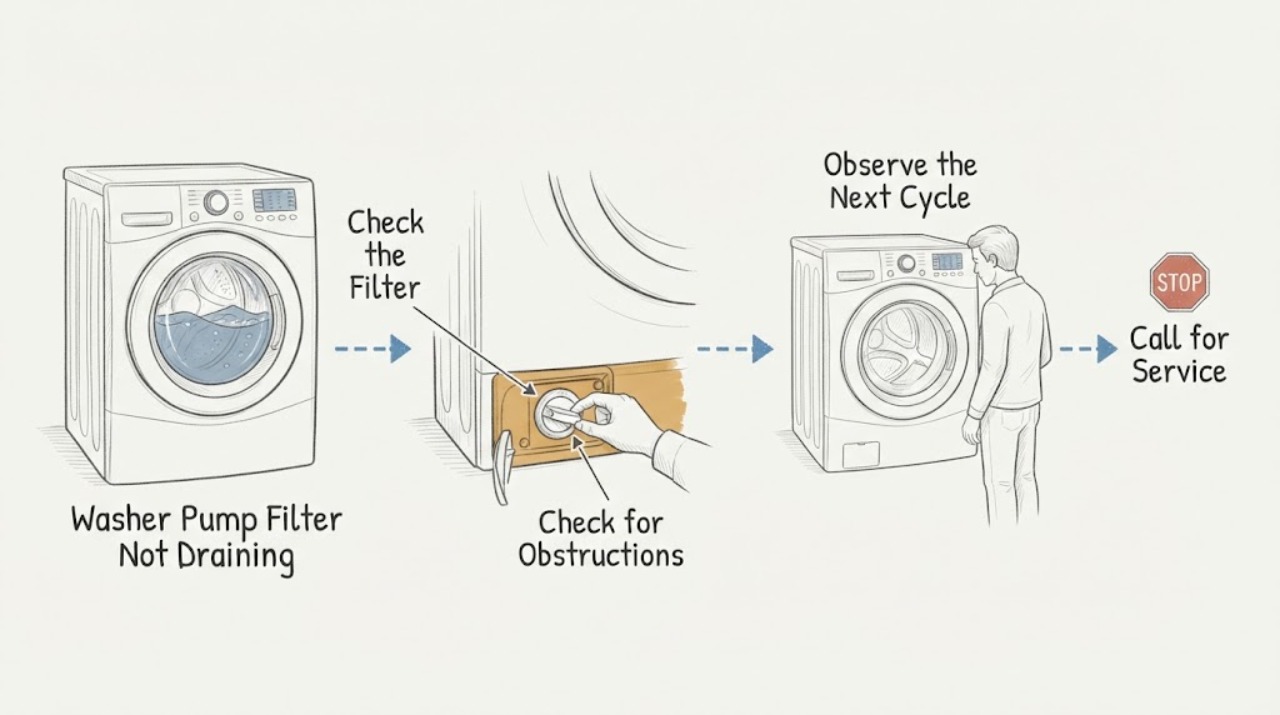
Work through in order
Diagnostic checks
Use only checks that match the exact appliance or system and its official guide.
-
Check 1
Pause the washer and note the remaining water level, any drain error, whether the pump hums, and whether the problem occurs on every cycle or only one. Confirm from the owner's manual or visible model-specific labeling whether this washer has an owner-accessible pump filter; do not remove a panel just to search for one.
Expected result: The washer is a front-load model with a documented filter access, a top-load or other model with no filter access, or the filter location and drain procedure are uncertain.
Next step: Record the model and symptom, then follow only the exact manual procedure for an accessible filter. If there is no owner procedure, arrange service rather than removing the cabinet or tipping the washer.
Stop if: Stop if the door is locked, water is hot, the washer is leaking, wiring is exposed, or the model does not provide a safe filter-access procedure.
Why this matters
Why: A documented filter gives a safe, model-approved first check; no access or uncertain instructions means the pump path may be service-only. A hum, error, or standing water helps separate a drain restriction from a control or pump fault but does not identify a part.
-
Check 2
If the manual confirms an accessible filter, turn the washer off and disconnect power. Place a shallow container and towels at the lower access area, use the residual-water hose if provided, and drain slowly; do not open the filter cap while the tub may contain hot water or while the washer is powered.
Expected result: Residual water drains into the container, drains only slowly, is unusually hot, or does not drain through the documented residual-water path.
Next step: Keep the washer unplugged and control the spill before proceeding. If the water is hot, the hose is blocked, or the path does not work as described, close the access area and arrange service.
Stop if: Stop for hot water, a blocked residual hose, uncontrolled flow, electrical contact, or any need to tip or dismantle the washer.
Why this matters
Why: A large or slow release can indicate a full tub or obstruction and creates a spill or scald risk; failure of the documented drain path means the filter should not be forced open. Water temperature cannot be inferred safely from the cycle setting alone.
-
Check 3
With power disconnected and the residual water controlled, remove the accessible pump filter only as the manual describes. Inspect and clean lint, coins, buttons, or other visible debris; check the seal and threads for damage, then reinstall the filter and hose cap fully and close the access panel.
Expected result: Debris is present and the filter reseats normally, the filter is clear, the seal or threads are damaged, or the filter cannot be removed or fully tightened by the documented method.
Next step: Clean only the removable filter and retest after confirming the cap, seal, hose, and access panel are fully restored. If the filter is damaged, stuck, cross-threaded, or leaks, do not run the washer; arrange service.
Stop if: Do not probe behind the filter, remove the pump housing, force the cap, cut a seal, or operate the washer with the filter or access panel missing.
Why this matters
Why: Debris can restrict the pump and prevent draining; a clear filter shifts attention to the hose, pump, standpipe, or controls. Damaged sealing surfaces or an incomplete seat can cause a leak and require the correct model-specific repair.
-
Check 4
Inspect the visible drain hose and household standpipe or sink connection for a kink, compression, blockage, excessive insertion, sealed tape connection, or water backing up. Do not disconnect the hose from the washer or alter the installation beyond the model's instructions; if the hose is safely accessible, straighten an obvious kink.
Expected result: The hose is kinked or compressed, the standpipe or sink backs up, the hose is sealed or pushed too far down, or the external drain path is clear.
Next step: Correct only a plainly visible, model-approved hose position, and have a plumber address a blocked household drain. If the external path is clear and the washer still retains water, proceed to one controlled test or service rather than opening the pump.
Stop if: Stop if the hose connection leaks, the standpipe overflows, the hose must be removed from the cabinet, or water is near electrical parts.
Why this matters
Why: A restricted or incorrectly installed hose or a blocked household drain can mimic a clogged pump filter and can prevent the washer from completing drain or spin. A clear external path makes a pump, internal hose, sensor, or control issue more likely after the filter is clean.
-
Check 5
After the filter is fully restored and the area is dry, run one model-approved drain or spin test while staying nearby. Observe whether water exits the hose, whether the pump hums or stays silent, whether the water level drops, and whether the washer completes the cycle without a new error or leak.
Expected result: Water exits and the cycle completes, the pump hums but little or no water moves, the pump is silent, a drain error returns, or the filter area leaks.
Next step: Stop testing when drainage is not restored, the pump is silent, an error returns, or water leaks. Arrange qualified appliance service and provide the model, filter contents, hose observations, sound, and test result.
Stop if: Do not repeat cycles with standing water, run the washer with an open panel, reach into the pump path, or bypass a door lock or error.
Why this matters
Why: Successful draining after cleaning supports filter debris or an installation issue. Humming with little flow can indicate a remaining restriction or pump problem; silence, a recurring error, or a new leak requires model-specific diagnosis rather than repeated filter cleaning.
Use your observations
Decision map
Find the observation that best matches what you see, then follow the next safe action.
-
PATH 01Next step
What you see
Do this next
Use the filter-cleaning interval and loading guidance in the owner's manual. If slow or no draining returns with a clean filter, investigate the external drain path or arrange service.
Why this path and its safety boundary
Why it matters: The obstruction was a likely cause of the no-drain symptom, and the repair result is supported by restored water flow rather than by a clean-looking filter alone.
-
PATH 02Next step
What you see
Do this next
Keep the washer unplugged if water remains and arrange qualified appliance service. Do not open the pump housing or order a pump from the filter symptom alone.
Why this path and its safety boundary
Why it matters: A drain pump, internal hose, water-level sensing, door or control sequence, or another internal fault is more likely than the pump filter itself.
-
PATH 03Next step
What you see
Do this next
Stop repeated drain cycles and have a technician diagnose the pump path and electrical/control sequence using the exact model procedure.
Why this path and its safety boundary
Why it matters: A remaining obstruction, damaged pump, restricted internal hose, or pump-control problem is possible; the sound does not establish which component failed.
-
PATH 04Next step
What you see
Do this next
Use the model manual's external drain and hose checks only, then arrange qualified service for the pump path.
Why this path and its safety boundary
Why it matters: The pump filter is not an ordinary owner check for this configuration, and forcing access can cause injury, leaks, or equipment damage.
-
PATH 05Next step
What you see
Do this next
Stop the washer, contain the water, correct only an obvious model-approved hose position, and use qualified plumbing or appliance service for a blocked drain or leaking filter assembly.
Why this path and its safety boundary
Why it matters: A household plumbing or drain-installation issue, or an incorrectly seated filter seal, is more likely than a pump motor failure alone.
Helpful context
Understand the symptom
A pump filter is model-dependent
A front access panel and pump filter are common on many front-load washers, but they are not universal. GE notes that some front-load models without front access require service, and LG says its filter guidance applies to front-load washers and combo units rather than top-load models. Use the exact owner's manual before opening any panel.
Clear the filter without creating a second problem
Standing water can spill suddenly and may still be hot. Power must be disconnected before the filter is opened, and the residual-water hose or filter must be reseated completely to prevent a new leak. A clean filter does not prove that the drain pump, hose, standpipe, or control system is working; the result of a controlled drain test determines the next step.
Safety boundary
Stop conditions
- Stop for hot or uncontrolled residual water, flooding, water near electrical parts, exposed wiring, a locked door that must be forced, or a washer that requires tipping or cabinet removal.
- Disconnect power before opening an owner-accessible filter and never reach into a powered washer, moving drum, pump path, or drain opening.
- Do not force the filter cap, remove the pump housing, cut or reuse a damaged seal, bypass a door lock or error, or operate with the filter or access panel missing.
- Stop repeated tests when the filter is clear but water remains, the pump hums without flow, a drain error returns, the washer is silent during drain, or the filter area leaks.
- Arrange qualified appliance service for models without documented filter access, inaccessible internal filters, pump or control faults, persistent no-drain symptoms, or any uncertainty about the safe procedure.
Only after diagnosis
Potential parts
- washer pump filter and seal
Consider this only when the exact model's filter or sealing surface is damaged, missing, or unable to reseat after the filter has been cleaned.
Filter threads, seals, access design, and fit vary by model; confirm the complete model and service documentation before ordering. - washer drain pump
Consider this only after a qualified technician confirms that the filter and hoses are clear but the pump fails to move water or respond during the model-approved test.
Pump voltage, mounting, impeller, hose connections, and control compatibility are model-specific; a humming or no-drain symptom alone does not establish fit or failure. - washer drain hose
Consider this only when inspection confirms a damaged, collapsed, or model-specific hose restriction that cannot be corrected by safe repositioning.
Length, routing, connections, and anti-siphon requirements depend on the washer model and installation; confirm the manual before ordering.
When checks do not resolve it
Need a professional?
Contact qualified appliance service when the pump filter is inaccessible, cannot be removed or reseated, leaks after cleaning, or does not restore drainage; also call for standing water, a silent or humming pump without flow, recurring drain errors, internal hose restrictions, or a blocked pump path.
Safety scope: Pump, internal hose, motor, wiring, water-level sensor, door-lock, control, cabinet, and inaccessible filter repairs should be performed by a qualified appliance technician following the exact model procedure and electrical safety requirements.
Have this ready
- Provide the washer make and model, front- or top-load configuration, water level and temperature, error code, filter-access and cleaning result, debris found, hose and standpipe observations, pump sound, test-cycle result, and any leak or electrical symptom.
Common questions
FAQ
Does every washer have a pump filter I can clean?
No. Pump-filter access depends on the design. It is common on many front-load washers, while some top-load models or front-load models without an access panel require service. Check the exact owner's manual before opening anything.
Why is no water coming out when I open the washer pump filter?
The residual-water hose or filter path may be blocked, the tub may still contain water, or the model may use a different drain procedure. Keep power disconnected, do not force the cap, and use the model's documented residual-water method or arrange service.
Can a clean pump filter still leave a washer not draining?
Yes. A kinked or incorrectly installed hose, clogged household drain, internal hose restriction, failed pump, water-level or door-control issue, or recurring control fault can produce the same symptom. A controlled test and model-specific diagnosis are needed.
How do I clean a washer pump filter safely?
Only if the model documents owner access: empty and turn off the washer, disconnect power, treat residual water as potentially hot, place a shallow container and towels, drain through the provided hose if present, clean visible debris, and fully reseat the filter, cap, hose, and panel. Do not open the pump housing.
When should I stop cleaning the pump filter and call for service?
Stop for hot or uncontrolled water, a blocked or inaccessible filter, a damaged seal, a leak after reassembly, a silent or humming pump with no flow, a recurring drain error, or any need to remove the cabinet or tip the washer. Arrange qualified appliance service.
Read the exact guide
Official sources
- Cleaning the Pump Filter - Front Load WasherWhirlpool Product Help · Manufacturer product-help procedure for applicable Whirlpool front-load models; the model manual controls panel and filter access.
- [LG Washing Machine] Water Not Draining (OE Error)LG USA Support · Manufacturer troubleshooting guidance for LG washers and combos; images and access can differ by model.
- Not Draining - Front Load WasherWhirlpool Product Help · Manufacturer troubleshooting page for applicable front-load washers; hose dimensions and filter access are model-dependent.
- LG Washer – How to Clean the Drain Pump FilterLG USA Support · Manufacturer guidance for applicable LG front-load washers and combo units; exact model instructions control access and procedure.
- Front Load Washer - TroubleshootingGE Appliances · Manufacturer troubleshooting guidance for GE front-load washers; models without front pump-filter access require service.
Community feedback
Share a repair observation
Share a plain-text repair observation. Accepted observations are published automatically; this page may take a moment to update.