
On this page
Start here
Quick answer
A washer noise that seems to come from a shock absorber is most convincing when it appears during spin with tub bouncing, cabinet impact, or repeated out-of-balance movement. Worn or damaged shock absorbers can let the tub move excessively, but an uneven load, an unlevel floor, leftover shipping bolts, a hose or nearby cabinet striking the washer, a foreign object, or a drum bearing can sound similar. Pause the cycle, disconnect power before any hands-on check, and start with the load, visible surroundings, level, and shipping hardware. Do not remove panels or reach under a moving washer to inspect a shock absorber. If the noise continues with an empty or evenly distributed test, the tub moves abnormally, the washer walks, a shock mount is damaged, or grinding, leaking, electrical, or water hazards appear, stop using it and arrange qualified appliance service.
Before you begin
Safety first
- Accessing or replacing shock absorbers, springs, mounts, drum supports, bearings, motors, wiring, or control components should be performed by a qualified appliance technician following the exact model instructions and electrical safety procedures.
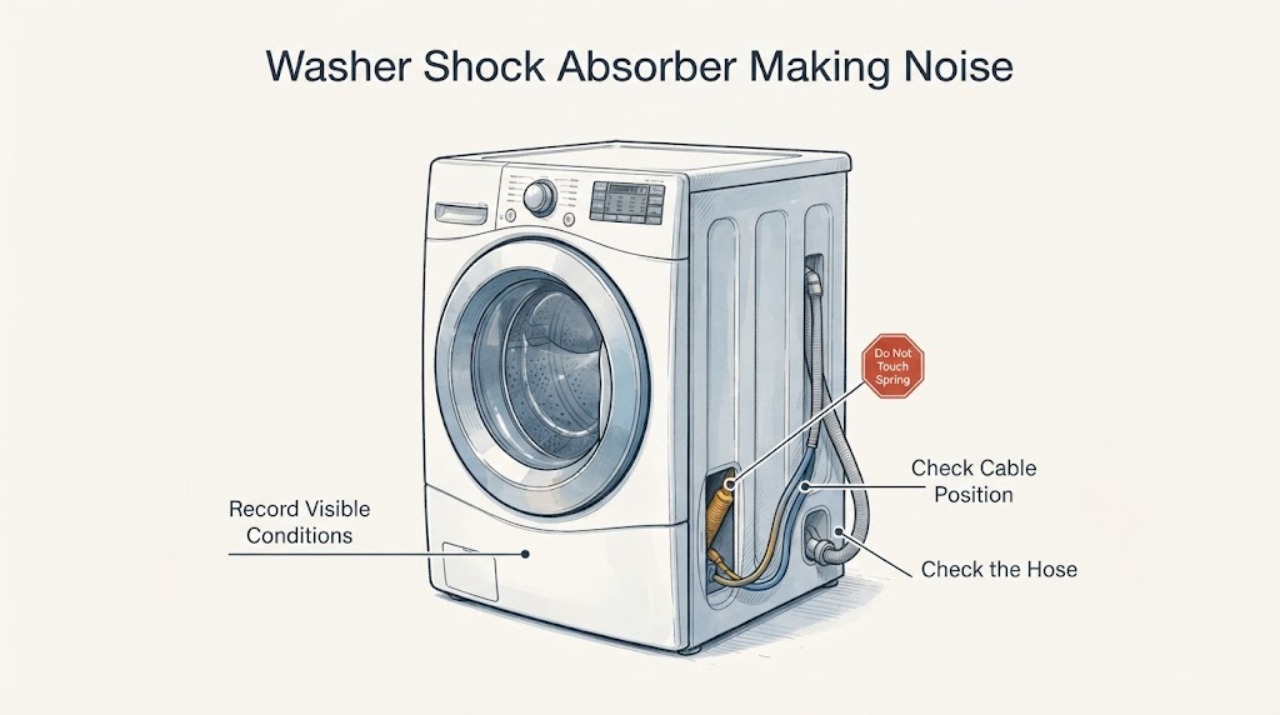
Work through in order
Diagnostic checks
Use only checks that match the exact appliance or system and its official guide.
-
Check 1
Pause the washer and note exactly when the noise occurs: filling, wash or agitation, spin acceleration, steady high spin, or spin-down. From a safe distance, record whether it sounds like a light tap, repetitive thump, scrape, grind, or a heavy cabinet impact, and whether the washer rocks or walks.
Expected result: The noise is limited to spin and accompanies tub movement, occurs while water or a hose moves, occurs with the drive changing direction, or continues while the drum is stationary.
Next step: Record the phase and sound for the remaining checks. Stop using the washer for severe impacts, scraping, smoke, burning odor, or movement toward an edge; do not diagnose a moving part by touch.
Stop if: Disconnect power and stop immediately for violent movement, exposed wiring, a burning smell, smoke, water near electrical parts, or a damaged cabinet or tub.
Why this matters
Why: Spin-only impact with excessive movement makes load balance, level, suspension, or shock absorption more plausible. A fill-related tap can be a hose or cabinet contact; a direction-change knock can be drive behavior; a stationary scrape or grind points away from the shock absorber and toward an object or other mechanical issue.
-
Check 2
With the washer paused, redistribute the clothing evenly and remove a single bulky or waterproof item if the model instructions permit. Check pockets and the visible drum for coins, wires, or other objects; do not reach through a locked door or insert tools into gaps.
Expected result: The noise disappears after the load is balanced, returns only with one bulky item, continues with an empty drum, or a foreign object is visible.
Next step: Run only the model-approved cycle with a balanced load after the washer is stationary. If an object is trapped, the door will not open safely, or the sound persists empty, arrange service rather than forcing the object out.
Stop if: Do not reach into a moving or locked tub, remove a door or panel, or continue a cycle that produces hard impacts or a grinding sound.
Why this matters
Why: A noise that follows a particular load is more consistent with imbalance than a failed shock absorber. Noise with an empty drum, or an object that cannot be safely removed, keeps suspension, drum, bearing, or trapped-object causes in consideration.
-
Check 3
Check the washer's external surroundings and stability while it is off: verify that all feet contact the floor, the cabinet does not rock when gently pushed at diagonal corners, and no shelf, pedestal, storage item, drain hose, or inlet hose can strike the cabinet. If the washer was recently installed, check the installation instructions for shipping-bolt status without removing a bolt unless the exact instructions identify it.
Expected result: The washer rocks, a foot is off the floor, a hose or nearby object contacts the cabinet, or shipping hardware may still be installed; alternatively, the washer is stable and clear externally.
Next step: Correct only a clearly external obstruction or model-approved leveling adjustment with the washer stationary, then retest cautiously. Have service inspect a suspected shipping-bolt or internal suspension problem if the exact instructions are unavailable or the noise persists.
Stop if: Do not crawl under the washer, loosen structural hardware, remove panels, or continue operation if it walks, strikes a wall, or has a damaged pedestal or floor.
Why this matters
Why: An unstable washer, nearby contact, or retained shipping hardware can create severe vibration and noise that resembles a suspension problem. A stable, clear installation makes an internal suspension, drum, or bearing issue more plausible if the sound remains.
-
Check 4
After disconnecting power and only if the door or lid opens normally, inspect the visible basket or drum for obvious off-centering, scraping marks, or damage. Gently move the empty basket only as far as the owner's manual allows; do not remove the cabinet or reach below the tub to view the shock absorber.
Expected result: The basket appears centered and moves normally, it rubs or clanks when stationary, it has unusual looseness, or the washer shows visible damage or residue near the base.
Next step: Leave the washer disconnected and arrange qualified service for abnormal basket movement, rubbing, clanking, damaged mounts, or suspected shock failure. Provide the model, sound phase, load result, and photos from outside the cabinet.
Stop if: Do not force the basket, operate with a panel removed, or continue if the basket is loose, scraping, cracked, or contacting the cabinet.
Why this matters
Why: A centered basket without stationary noise does not prove the shocks are good, but rubbing, clanking, excessive looseness, or visible damage raises concern for the shock mounts, springs, drum support, bearing, or another internal fault. The shock absorber cannot be confirmed from sound alone.
-
Check 5
If the external checks are clear and the washer is stable, run one short, model-approved test with a small balanced load or empty drum only when the owner's manual permits it. Stay nearby and stop at the first hard impact, rapid walking, loud grinding, or abnormal tub movement; do not repeat tests to reproduce damage.
Expected result: The test is quiet, the noise returns only at high spin, the washer bangs and moves despite a balanced load, or the sound is a continuous grind or scrape.
Next step: Stop and arrange appliance service when the noise persists or movement is excessive. Do not order a shock absorber until the technician or model-specific diagnosis identifies the failed component and fit.
Stop if: Stop immediately for severe vibration, walking, hard cabinet impact, smoke, burning odor, leak, electrical hazard, or any sound that worsens during the test.
Why this matters
Why: A quiet balanced test shifts suspicion toward load, leveling, hose, or installation conditions. Repeated high-spin impact with a balanced load makes worn shock absorbers, mounts, springs, drum support, or bearings more likely; continuous grinding points to a broader mechanical diagnosis.
Use your observations
Decision map
Find the observation that best matches what you see, then follow the next safe action.
-
PATH 01Next step
What you see
Do this next
Stop repeated high-spin tests and arrange qualified appliance service for internal inspection. Do not remove the cabinet or replace a shock absorber from the sound alone.
Why this path and its safety boundary
Why it matters: An internal suspension issue, including a worn or damaged shock absorber, mount, spring, drum support, or bearing, is more likely than a hose or simple load problem.
-
PATH 02Next step
What you see
Do this next
Use evenly distributed loads and the model's guidance for bulky or waterproof items. Arrange service if the same noise returns with ordinary balanced loads.
Why this path and its safety boundary
Why it matters: Load imbalance or a cycle/load mismatch is more likely than a failed shock absorber, although repeated imbalance can stress the suspension.
-
PATH 03Next step
What you see
Do this next
Correct only the visible, model-approved external condition with the washer off and stationary. Use the installation manual or qualified service for shipping hardware or structural leveling questions.
Why this path and its safety boundary
Why it matters: Installation or external contact is more likely than an internal shock failure and can create severe spin vibration.
-
PATH 04Next step
What you see
Do this next
Keep the washer disconnected and arrange service. Do not force the drum, reach into hidden gaps, or run additional cycles to locate the sound.
Why this path and its safety boundary
Why it matters: A foreign object, drum support, bearing, basket, or another internal mechanical fault is more likely than normal suspension movement.
-
PATH 05Next step
What you see
Do this next
Stop the cycle, disconnect power only if it is safe to do so without contacting water or damaged wiring, keep clear, and obtain qualified appliance service.
Why this path and its safety boundary
Why it matters: This is an equipment, electrical, water, or injury hazard rather than a routine shock-absorber check.
Helpful context
Understand the symptom
A shock absorber is a diagnosis, not just a sound label
Shock absorbers control tub movement, so a worn or broken one is more likely when the washer bangs or moves excessively during spin, especially after load, level, hose, and shipping checks are ruled out. A washer can make a similar clunk when a bulky load shifts, a hose hits the cabinet, a foreign object is trapped, or the drum bearing is failing. Note when the sound occurs and whether the tub or cabinet moves before assuming a part has failed.
Keep the inspection external and stationary
The safe checks are made with the washer paused and disconnected when a hands-on inspection is needed. Do not run the machine with a panel removed, reach near the tub while it spins, or pull on a suspected shock absorber. Manufacturer guidance sends persistent drum or shock symptoms to service because access and diagnosis vary by model.
Safety boundary
Stop conditions
- Stop immediately for violent vibration, walking, hard cabinet or wall impact, a continuous grinding sound, smoke, burning odor, exposed wiring, a leak, or a damaged tub, cabinet, pedestal, or floor.
- Pause and disconnect power before any hands-on inspection; never reach near the tub, drum, belt, motor, or suspected shock absorber while the washer is running.
- Do not remove the cabinet, pull on a shock absorber, alter springs or mounts, bypass a door lock, or run the washer with a panel removed.
- Do not continue testing when the washer remains noisy with a balanced load and stable installation, or when the basket is loose, scraping, or clanking while empty.
- Arrange qualified appliance service for suspected shock, mount, spring, drum-support, bearing, motor, or control faults and provide the model, sound phase, load result, and external observations.
Only after diagnosis
Potential parts
- washer shock absorber or damper
Consider this only after a technician confirms abnormal tub movement is caused by a worn or damaged damper rather than load balance, leveling, a mount, spring, bearing, or drum fault.
The number, mounting style, resistance, and fit vary by washer model; confirm the exact model and part specification before ordering. - washer suspension spring or shock mount
Consider this only when inspection identifies a broken spring, loose mount, or damaged mounting point that is allowing the tub to move excessively.
Suspension geometry and mounting hardware are model-specific, and replacing a mount may require internal access; use a qualified technician for selection and installation. - washer drum bearing or support component
Consider this only when empty-drum scraping, grinding, or looseness leads a technician to diagnose a bearing, basket support, or related internal mechanical fault.
Compatibility and repair scope depend on the washer design and model; a spin noise alone does not establish a bearing failure.
When checks do not resolve it
Need a professional?
Contact qualified appliance service when a washer continues to bang, thump, scrape, or grind during spin after load and installation checks, when the basket moves abnormally, or when a shock absorber or its mount is suspected. Escalate immediately for violent movement, smoke, burning odor, leaks, electrical hazards, or structural damage.
Safety scope: Accessing or replacing shock absorbers, springs, mounts, drum supports, bearings, motors, wiring, or control components should be performed by a qualified appliance technician following the exact model instructions and electrical safety procedures.
Have this ready
- Provide the washer make and model, top- or front-load configuration, cycle phase and sound description, whether the noise changes with an empty or balanced load, level and shipping-bolt status, visible basket movement, and any impact, leak, odor, or error observations.
Common questions
FAQ
How can I tell if a washer shock absorber is making the noise?
A shock problem is more plausible when the noise occurs during spin with excessive tub bounce or cabinet impact, even after a balanced load, level installation, clear hoses, and removed shipping hardware are confirmed. Sound alone cannot identify the failed part; internal inspection belongs to service.
Can an unbalanced load sound like a bad shock absorber?
Yes. A single bulky, absorbent, or waterproof item can shift weight to one side and create thumping, vibration, or a prolonged spin. Pause, redistribute the load, and use the model's recommended cycle; persistent noise with a balanced load needs diagnosis.
Could an unlevel washer cause shock-absorber noise?
Yes. If the washer rocks or a foot is not firmly on the floor, spin vibration can become severe and resemble suspension trouble. Check stability with the washer off and stationary, then use the model's leveling instructions or arrange service.
Should I run the washer with the panel removed to watch the shock absorbers?
No. Do not operate a washer with panels removed or reach near the tub, belt, motor, or suspension while it is moving. Record the sound and movement from outside and have a qualified technician inspect the internal parts.
When should I stop using a noisy washer?
Stop for violent movement, walking, hard impacts, continuous grinding, smoke, burning odor, a leak, exposed wiring, or a damaged tub or cabinet. Also stop repeated testing when noise persists with a balanced load and stable installation, and arrange qualified appliance service.
Read the exact guide
Official sources
- LG Washer – Troubleshooting Vibration Issues on an LG Washing MachineLG USA Support · Manufacturer guidance for washer vibration used for safe stationary installation checks and the stop point when vibration persists.
- How to Stop a Washer From ShakingWhirlpool · Manufacturer guidance for washer shaking and vibration; used for external checks and the distinction between worn shock absorbers, bearings, and installation causes.
- [LG Front Loader] Noise During Spin DryLG USA Support · Manufacturer support guidance for front-load washer noise during spin; used for load, level, foreign-object, hose, and normal-versus-abnormal noise distinctions.
- Knocking or Thumping - NoiseWhirlpool · Manufacturer product-help page for washer knocking or thumping; used to rule out external hoses, nearby items, load imbalance, and unlevel installation before internal diagnosis.
- LG Washer - Troubleshooting Noises During the CycleLG USA Support · Manufacturer support page used for distinguishing load-related noise from persistent empty-drum noise and for the service boundary.
Community feedback
Share a repair observation
Share a plain-text repair observation. Accepted observations are published automatically; this page may take a moment to update.