
On this page
Start here
Quick answer
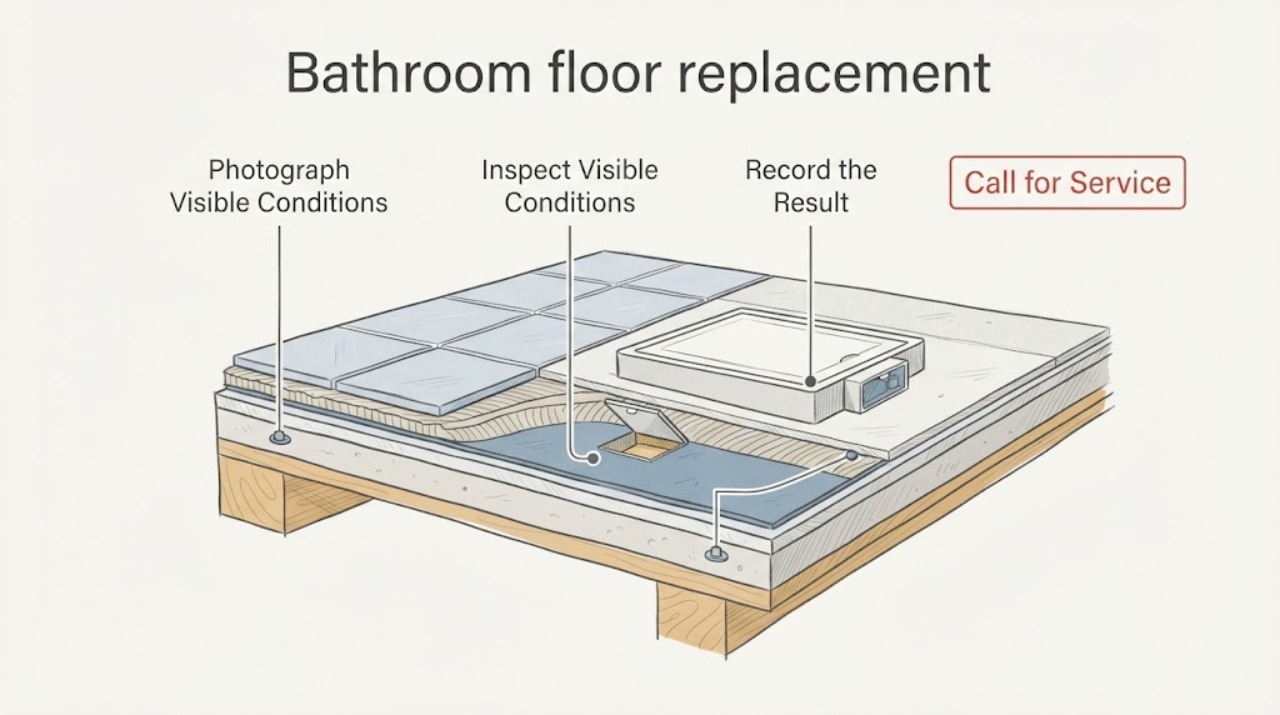
Before arranging a bathroom floor replacement, determine whether you are dealing with surface wear, movement or softness, or an active moisture problem. A few low-risk observations can make the quote more useful: map the visible damage, check whether moisture returns after fixtures are used, confirm that bathroom ventilation is actually moving air, and document the room, fixtures, floor type, and transitions. Do not pry up an old floor or cut into a damp or soft area yourself. If the floor is springy, persistently wet, moldy, or made from an unknown older resilient material, stop and ask a qualified remodeling or remediation professional to assess the substrate and safe work scope.
Work through in order
Diagnostic checks
Use only checks that match the exact appliance or system and its official guide.
-
Check 1
Inspect and photograph the dry floor surface, fixture edges, doorway, and transitions without lifting or cutting the finish.
Expected result: Isolated cosmetic damage differs from repeated cracks, movement, softness, staining, odor, or damage around a fixture.
Next step: Mark each symptom on a room sketch and give the pattern to the remodeling professional.
Stop if: Stop and request professional assessment if the floor is soft, unstable, persistently damp, moldy, or unsafe.
Why this matters
Why: Surface-only signs may support a finish scope; movement, softness, or moisture signs require substrate and moisture investigation.
-
Check 2
Dry the floor and observe removable paper towels at accessible fixture edges after normal bathroom use, without dismantling plumbing.
Expected result: Dampness may follow one fixture, shower use, or return while the room is unused.
Next step: Record timing and location, limit water exposure if practical, and provide it to a qualified professional.
Stop if: Stop using the affected fixture and seek prompt help if water pools, the level below stains, or the floor softens.
Why this matters
Why: The timing distinguishes a possible fixture or enclosure path from an active or concealed moisture source that must be addressed before replacement.
-
Check 3
Run the bathroom exhaust fan and observe its grille airflow using tissue only without touching moving parts or accessing wiring.
Expected result: The fan may run with little pull, show recurring condensation, or appear to exhaust normally while a leak remains possible.
Next step: Add fan and airflow observations to the written remodeling scope and ask what ventilation correction is included.
Stop if: Do not climb, open ductwork, or access electrical or concealed spaces; escalate those checks to a qualified professional.
Why this matters
Why: Ventilation can reduce shower moisture but does not rule out plumbing, enclosure, threshold, or floor water-management failure.
-
Check 4
Measure the room, map fixtures and transitions, photograph the current finish, and request written scope assumptions for removal, substrate, waterproofing, trim, disposal, and permits.
Expected result: Two quotes with the same floor area can differ because they include different concealed-condition and transition assumptions.
Next step: Send one sketch and photo set to qualified remodelers and ask what evidence is needed before final pricing.
Stop if: Pause if a proposal promises to cover a soft or wet floor without inspecting the cause or omits concealed-condition handling.
Why this matters
Why: A comparable quote makes the finish, substrate, moisture work, fixture handling, disposal, and change-order triggers explicit.
Helpful context
Understand the symptom
What a replacement quote needs to distinguish
A quote is not just a surface-area calculation. The scope changes if the existing finish is sound but unattractive, if tiles or grout are moving, or if water has reached the underlayment or subfloor. The replacement material also has to suit a room that regularly receives water. EPA guidance for bathroom remodeling says the floor should resist water and limit water reaching the subfloor, and that leaks and condensation should be addressed before the remodeling work is treated as finished.
Older flooring and suspected contamination
If the existing resilient flooring, backing, adhesive, or other material is old and its composition is unknown, do not sand, scrape, grind, or pull it up just to inspect the layers below. OSHA identifies asbestos as a renovation hazard and provides construction guidance for evaluation, exposure control, and removal. Ask the contractor or an appropriately qualified assessor what survey or testing is required for the property and local rules before any disturbance. Similarly, visible mold, sewage-contaminated water, or hidden damage behind the finish calls for a qualified remediation or building professional rather than a cosmetic replacement.
When to stop and call a professional
Call a bathroom remodeling professional when you are ready to compare written scopes, and call a plumbing or remediation professional first when the moisture source is active, the subfloor may be damaged, mold keeps returning, or the room has contaminated water. Provide the symptom map, fixture-related timing, room measurements, photos, current finish, approximate building or flooring age, and ventilation observations. For an unknown older material, disclose that uncertainty before anyone disturbs it.
Only after diagnosis
Potential parts
- grout-repair
Only if the professional confirms that joints are the isolated surface issue and the substrate and moisture source are sound.
- tile-spacer
A layout accessory for a tile replacement scope, selected by the installer for the confirmed tile format and joint plan.
- flooring-transition
May be needed at the bathroom doorway or a change in floor height; the installer should measure the finished levels first.
When checks do not resolve it
Need a professional?
Request a professional bathroom remodeling assessment when the floor needs replacement or when any symptom suggests movement, moisture, or hidden substrate damage. Use a plumbing or remediation professional first for active leaks, sewage-contaminated water, recurring mold, or damage extending below the finish.
Common questions
FAQ
Can I replace the bathroom floor without fixing a leak first?
No. First identify and correct active leaks, recurring dampness, or condensation problems. A new finish can be damaged again if water is still reaching the floor or the layers below it.
What should be included in a bathroom floor replacement quote?
Ask the written scope to identify the existing finish, removal and disposal assumptions, substrate inspection or repair, moisture or waterproofing work, fixture and trim handling, doorway transitions, ventilation or leak corrections, and any permit or inspection coordination.
Should I pull up old flooring to see whether the subfloor is damaged?
Not when the material, backing, or adhesive is unknown, or when the area is damp or moldy. Have a qualified professional determine how to assess it safely, including whether hazardous-material precautions apply.
Why does the replacement quote change after the floor is opened?
The visible finish may conceal moisture damage, a soft substrate, failed water-management details, unknown old material, or a height difference at the doorway. Ask each contractor what concealed conditions trigger a revised scope before work begins.
Does a working bathroom fan prove the floor has no moisture problem?
No. A fan can reduce shower humidity, but it cannot rule out a plumbing leak, failed enclosure or threshold, or moisture already below the finish. Record fan behavior separately from fixture-related dampness.
Read the exact guide
Official sources
- Remodeling Your Home and Indoor Air QualityU.S. Environmental Protection Agency · General U.S. residential bathroom remodeling guidance; project and local requirements may vary.
- Asbestos - ConstructionOccupational Safety and Health Administration · U.S. construction safety information; material assessment and work requirements depend on the property, employer, and jurisdiction.
- A Brief Guide to Mold, Moisture and Your HomeU.S. Environmental Protection Agency · General homeowner guidance; it does not replace a site assessment or local requirements.
Community feedback
Share a repair observation
Share a plain-text repair observation. Accepted observations are published automatically; this page may take a moment to update.