
On this page
Start here
Quick answer
A bathroom floor underlayment should be evaluated for replacement when the finished floor moves, feels soft, stays damp, or shows damage that may extend below the visible surface. Those signs do not identify the failed layer by themselves. Keep the inspection visual and from a safe standing position, stop using an affected area when it is unsafe, and have a qualified bathroom remodeling professional assess the tile or finish, underlayment, subfloor, moisture path, and nearby fixtures as one assembly. Do not remove flooring, cut or pry the underlayment, disturb suspected mold or older flooring, or disconnect plumbing as a do-it-yourself test.
Work through in order
Diagnostic checks
Use only checks that match the exact appliance or system and its official guide.
-
Check 1
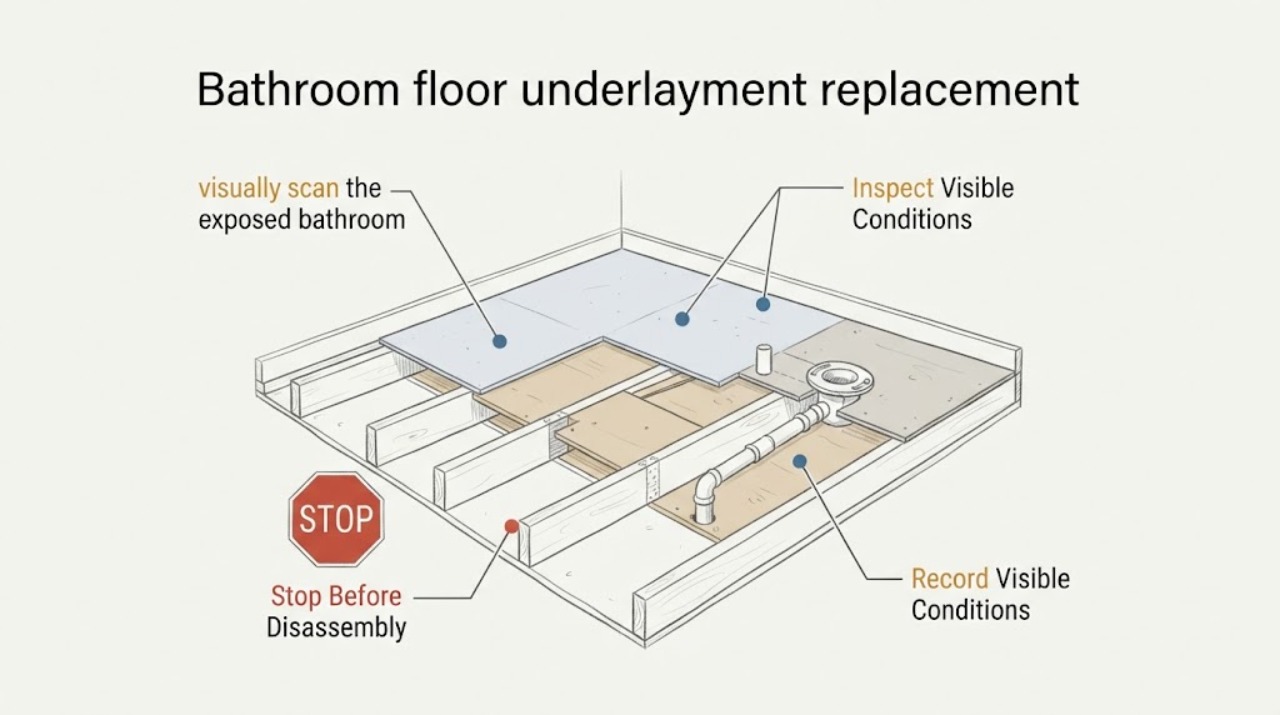
From a stable standing position, visually scan the exposed bathroom floor for a soft-looking area, visible movement, cracked or lifted finish, swelling, unevenness, or a change in the floor plane; do not press hard, probe, lift flooring, or move heavy fixtures.
Expected result: The floor looks stable and the concern is limited to a surface crack or grout change, or the floor visibly moves, sags, swells, or has a soft-looking area.
Next step: Photograph the area and mark its location on a simple room sketch. If movement, sagging, or a fall hazard is present, restrict access and arrange professional service; otherwise continue with the moisture and extent observations.
Stop if: Stop the inspection and keep people out if the floor feels unsafe, drops or shifts, or contents or fixtures appear unstable.
Why this matters
Why: A surface-only appearance does not confirm underlayment failure. Visible movement, sagging, or swelling raises concern for moisture or substrate involvement and needs an in-person assessment rather than a cosmetic patch alone.
-
Check 2
Observe the floor and nearby visible joints, thresholds, and baseboard edges without removing trim, flooring, or fixture parts; compare the concern with the room's normal dry condition.
Expected result: Discoloration, swelling, an open-looking joint, or a height change is isolated near a fixture or doorway, or it spans a wider area.
Next step: Record the boundary and take photographs from the same angles. Ask the professional to inspect the finish-to-underlayment-to-subfloor assembly and the adjacent fixture or transition rather than assuming the visible boundary is the full damage area.
Stop if: Do not pull trim or flooring to find the boundary; stop and escalate if the edge is loose enough to catch a foot or if the surface is wet and slippery.
Why this matters
Why: A localized pattern can point the professional toward a nearby moisture path or transition. A broad or spreading pattern makes concealed moisture or substrate damage more important to rule out before selecting a replacement layer.
-
Check 3
Record when the dampness, odor, stain, or floor change appears in relation to showering, bathing, sink use, toilet use, cleaning, a spill, or a recent plumbing event; make no deliberate water test and do not disconnect a fixture.
Expected result: The condition recurs after one visible fixture or use pattern, follows a spill or cleaning event, or appears without a known water event.
Next step: Keep the affected fixture or area out of service when continued use could spread water, and give the professional the timing, photographs, and any prior leak or repair history.
Stop if: Stop using the nearby fixture and seek prompt professional help for active leakage, spreading dampness, a sewage-like odor, or water near electrical equipment.
Why this matters
Why: A repeatable relationship can help distinguish a fixture or waterproofing investigation from a finish-only repair. A condition with no clear trigger still warrants assessment because moisture can be concealed or intermittent.
-
Check 4
From a safe position, note whether the crack, movement, stain, or odor is isolated or appears at several locations, including around the toilet, tub or shower edge, vanity, doorway, and room perimeter; do not open the floor or disturb the material.
Expected result: Only one visible location is affected, or several locations share a line, boundary, or moisture pattern.
Next step: Share the room sketch and photos with a qualified remodeler and ask for the proposed investigation area, moisture-source plan, and how the replacement will match the existing floor height and waterproofing system.
Stop if: Do not continue if the floor is unstable, visibly collapsing, actively wet, or creating a trip hazard; isolate the area and arrange professional service.
Why this matters
Why: An isolated finish symptom may have a narrower cause, while a repeated pattern can indicate movement, moisture migration, or an assembly condition that requires a broader scope review. The observation cannot identify the failed layer on its own.
-
Check 5
Look only at the visible surface for mold-like growth, crumbling, or an older flooring material that may be disturbed by renovation; do not touch, scrape, sand, sample, sweep, or remove it.
Expected result: There is no unusual material or odor, or there is suspected mold, crumbling material, or an older finish whose composition is unknown.
Next step: Keep the area undisturbed and tell the remodeling professional exactly what was seen. If an older suspect flooring material may be disturbed, ask for an appropriately trained professional to determine the safe renovation path before any removal is planned.
Stop if: Stop all renovation activity and keep occupants away from crumbling, visibly contaminated, or suspect material until qualified professionals assess it.
Why this matters
Why: The appearance alone cannot identify a hazardous material or establish the moisture source. Suspected mold or an older material that could be disturbed changes the job from a routine surface observation to a controlled professional assessment.
Use your observations
Decision map
Find the observation that best matches what you see, then follow the next safe action.
-
PATH 01Next step
What you see
The floor appears stable and the concern is a small surface-only change with no moisture history.
Do this next
Have a flooring or remodeling professional confirm whether a finish repair is suitable and whether the underlayment remains sound; do not assume a patch proves the assembly is dry.
-
PATH 02Next step
What you see
The floor moves, sags, swells, or feels unsafe.
Do this next
Restrict access and arrange a professional bathroom floor assessment. Request evaluation of the visible finish, underlayment, subfloor, waterproofing, and supporting structure as applicable.
-
PATH 03Next step
What you see
The condition follows use of a nearby toilet, tub, shower, sink, or other plumbing fixture.
Do this next
Limit use of the suspected fixture and ask a qualified professional to investigate the moisture source before any underlayment replacement is selected.
-
PATH 04Next step
What you see
The condition is spreading, has a persistent odor, or appears in several floor areas.
Do this next
Treat it as a broader moisture or assembly assessment. Provide the timeline and photos, and do not cover the evidence or remove the floor to chase the boundary.
-
PATH 05Next step
What you see
Suspected mold or an older flooring material could be disturbed by the planned work.
Do this next
Pause renovation and obtain the appropriate qualified environmental or renovation professional assessment before disturbing the material.
Helpful context
Understand the symptom
Why the visible floor is not the whole diagnosis
Tile, resilient flooring, grout, underlayment, subfloor, waterproofing, and plumbing can interact. A cracked finish can be cosmetic, or it can reflect movement or moisture below it; a water-durable backer product also does not prove that the surrounding assembly is dry or structurally sound. The material, thickness, fastening, and waterproofing details must be confirmed against the existing floor and the selected manufacturer's system by the professional doing the work.
What to prepare for the assessment
Photograph the visible condition from the doorway or another stable position, note when the change was first noticed, and record whether it follows bathing, cleaning, a spill, or a fixture event. Keep people and pets away from a slick, sagging, or loose area. These observations help the professional decide whether the next stage is finish repair, moisture-source investigation, or a planned underlayment replacement.
Only after diagnosis
Potential parts
- tile-spacer
Consider only if a professional confirms that the tile layout is being rebuilt and spacers are needed for the selected tile system.
Confirm the tile, joint design, installation system, and professional's specified accessory before ordering; the floor condition alone does not identify a suitable spacer. - grout-repair
Consider only when assessment shows a sound, dry assembly with a localized grout or finish issue rather than underlayment or subfloor movement.
Match the existing grout type, joint condition, tile system, and manufacturer's instructions; a grout product is not a substitute for repairing moisture or substrate damage. - flooring-transition
Consider only when the planned floor assembly changes the visible threshold or height and the professional confirms a transition is needed.
Confirm finished-floor heights, adjacent flooring, moisture details, and the exact transition profile with the installer before ordering.
When checks do not resolve it
Need a professional?
Call a qualified bathroom remodeling or flooring professional when the floor moves, stays damp, shows spreading damage, has a fixture-related leak, or needs underlayment replacement. Prompt service is appropriate for active water, an unsafe floor, suspected mold, or material that may contain asbestos.
Have this ready
- Provide the room location, photos, the first-noticed date or sequence, moisture and fixture timing, affected boundaries, prior repairs, and whether the floor is currently safe to use.
Common questions
FAQ
Does a cracked bathroom tile prove that the underlayment needs replacement?
No. A crack can be limited to the finish, or it can reflect movement or moisture below it. Have the floor assembly and moisture history assessed before choosing between a finish repair and underlayment work.
Can I lift one tile to check the underlayment?
Do not use removal as a homeowner diagnostic step. It can spread damage, disturb suspect material, and expose waterproofing or plumbing. Use visual observations and have a qualified professional plan any opening.
What should I do if the bathroom floor feels soft?
Restrict access, avoid repeated walking or fixture use that could add water, photograph the area, and arrange a professional assessment. Softness can involve the finish, underlayment, subfloor, or moisture source, so a surface patch may not address it.
Is a water-resistant underlayment automatically waterproof?
No. Underlayment properties and the waterproofing of the complete floor assembly are different questions. The installer should match the replacement materials, barriers, seams, transitions, and finish to the specific bathroom design and manufacturer instructions.
Read the exact guide
Official sources
- What is an Operations and Maintenance Program?U.S. Environmental Protection Agency · Supports the stop-and-escalate boundary for suspected material; it is not a bathroom floor installation specification.
- Durock Brand Cement Board with EdgeGuardUSG · Provides manufacturer context for a cement-board underlayment product; product selection and assembly design remain project-specific.
- I'm remodeling my home. Do I need to be concerned about asbestos in the building materials?U.S. Environmental Protection Agency · General residential remodeling guidance for suspect materials; it does not identify the material in a particular bathroom.
Community feedback
Share a repair observation
Share a plain-text repair observation. Accepted observations are published automatically; this page may take a moment to update.