
On this page
Start here
Quick answer
A breaker that keeps tripping is a warning, not a nuisance to work around. Do not repeatedly reset it, open the panel cover, replace the breaker, install a larger breaker, or bypass it. From a safe position, note which circuit is affected, what was already running, and whether there is smoke, a burning smell, buzzing, sparking, heat, or discoloration. If any warning sign is present, leave the area and get urgent professional or emergency help; otherwise arrange a qualified electrician and provide the observed trip pattern.
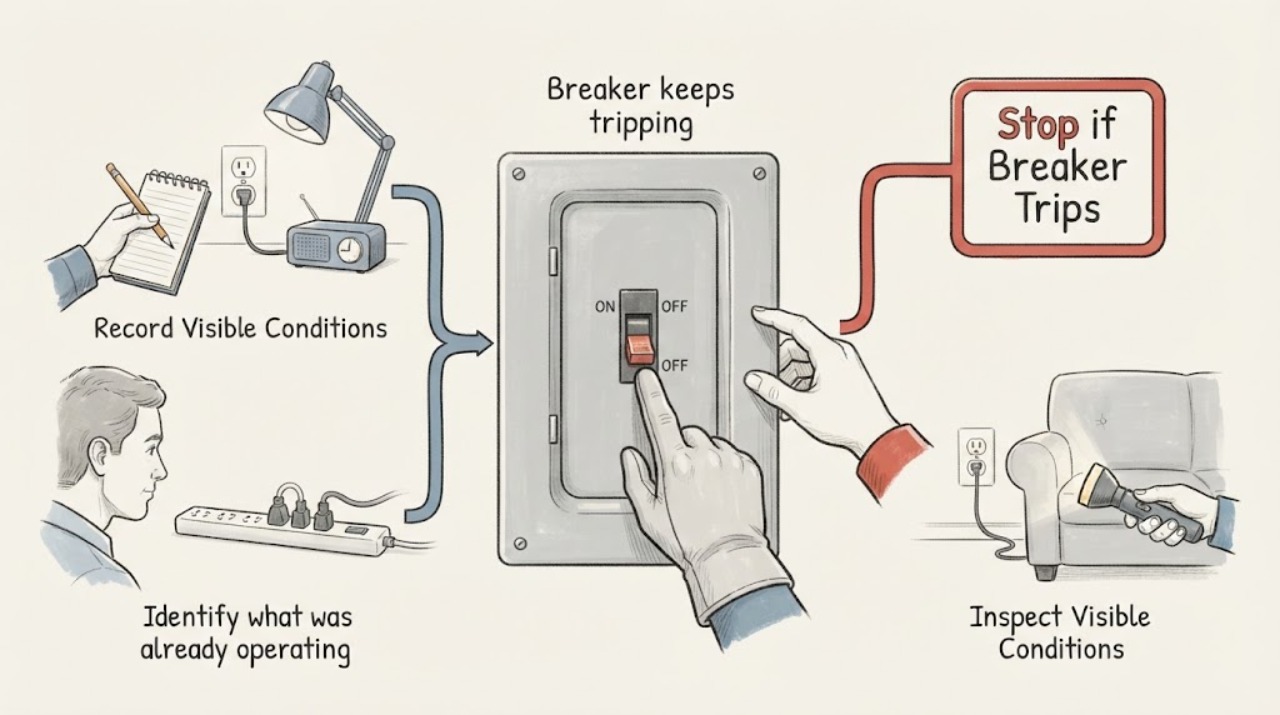
Work through in order
Diagnostic checks
Use only checks that match the exact appliance or system and its official guide.
-
Record the existing trip pattern
Without opening the panel or deliberately resetting the breaker again, use your memory and any existing notes to record which breaker or already-visible circuit label was involved, when it tripped, and whether it has happened more than once.
Expected result: The pattern may be tied to one recognizable event, may recur with no clear event, or may be unknown.
Next step: Keep the record and give it to a qualified electrician. Do not create another test event to make the pattern clearer.
Stop if: Stop if finding the label would require opening a cover, touching wiring, or resetting the breaker; call a qualified electrician instead.
Why this matters
Why: A repeat tied to one event gives the electrician a useful lead about a load or appliance; a random or immediate repeat can point to a circuit, wiring, or breaker fault. The observation does not identify the failed component by itself.
-
Identify what was already operating
From normal use and memory, list the appliances, heaters, tools, or other loads that were already operating when the trip occurred; do not add loads, move plugs around, or operate a suspect appliance to reproduce the trip.
Expected result: One appliance may stand out, several high-demand loads may have been running, or no particular load may be identifiable.
Next step: If one appliance is clearly associated, leave it unused through its normal controls when safe and tell the electrician; otherwise keep the affected area undisturbed and arrange professional assessment.
Stop if: Stop if the appliance is hot, wet, damaged, smoking, sparking, or difficult to disconnect safely; leave it alone and seek urgent professional or emergency help as appropriate.
Why this matters
Why: The context helps the electrician separate a possible appliance-related event from a broader circuit or wiring concern, but it is not proof that any one appliance is safe or faulty.
-
Look for warning signs without touching electrical parts
From a safe position, visually inspect accessible outlets, switches, appliance cords, and the outside of the closed panel for smoke, flame, arcing, a burning odor, sizzling or buzzing, discoloration, or unusual warmth; do not touch or open anything to check it.
Expected result: There may be no visible warning sign, or there may be one or more signs of overheating, arcing, or fire.
Next step: For smoke, flame, active arcing, or a strong burning odor, leave the area and contact emergency services when safe. With no emergency sign, arrange a qualified electrician and report exactly what was observed.
Stop if: Stop immediately and leave the area if smoke, flame, active arcing, or a strong burning odor appears; do not investigate further.
Why this matters
Why: Smoke, flame, arcing, a strong burning odor, or rapidly worsening heat raises the urgency beyond routine troubleshooting and may indicate fire or shock danger.
-
Read only an already-visible circuit label
If the closed panel door or an existing directory already shows a circuit label, read or photograph that label from outside; do not remove the panel cover, expose wiring, or assume an old label is correct.
Expected result: The label may identify a room or load, may be partial, or may be absent or inconsistent with what lost power.
Next step: Give the label and the actual affected area to the electrician, noting any mismatch rather than trying to correct the directory yourself.
Stop if: Stop if the only way to read more would be opening the panel, removing a cover, or testing a live circuit.
Why this matters
Why: A visible label can help the electrician start the inspection, while a missing or questionable label is itself a reason to let the professional identify the circuit.
Use your observations
Decision map
Find the observation that best matches what you see, then follow the next safe action.
-
PATH 01Next step
What you see
Smoke, flame, active arcing, or a strong burning odor is present.
Do this next
Leave the area, keep others away, and contact emergency services when safe; do not touch the panel or continue troubleshooting.
-
PATH 02Next step
What you see
There is unusual heat, buzzing, discoloration, or a burning smell without visible flame.
Do this next
Do not touch or repeatedly reset anything; keep clear and request urgent assessment by a qualified electrician.
-
PATH 03Next step
What you see
The trip was clearly associated with one appliance or one known event, and no emergency warning sign is present.
Do this next
Leave the suspected appliance unused through normal controls when safe, do not deliberately retest it, and give the timing and load details to the electrician.
-
PATH 04Next step
What you see
The trip is unexplained, repeats with no clear load, or the breaker will not stay on.
Do this next
Do not keep resetting or attempt a panel repair; keep the affected circuit undisturbed and arrange a qualified electrician.
Helpful context
Understand the symptom
Why repeated trips matter
A circuit breaker is intended to interrupt a circuit when current exceeds a safe level. Repeated trips can reflect an overloaded circuit, a faulty appliance, a wiring problem, or a breaker problem, and the distinction cannot be made safely by forcing the circuit to run. The CPSC advises treating frequent trips and related heat, odor, buzzing, or arcing as warning signs and using qualified help for panel work.
Safe information to collect
Collect observations from outside the closed panel and from normal room controls only. Write down the time, the circuit label if it is already visible, what was operating, and any unusual sound, smell, heat, or discoloration. Do not remove a cover, probe an outlet, deliberately add load, or keep testing a breaker that trips.
What to tell the electrician
Tell the electrician whether the trip followed one appliance, several simultaneous loads, wet conditions, or no obvious event; whether the handle will not stay on; and whether you saw or smelled anything abnormal. This narrows the initial inspection without asking you to perform energized electrical work.
Only after diagnosis
Potential parts
- circuit breaker replacement
Consider this only if a qualified electrician diagnoses the breaker itself and confirms replacement is appropriate; repeated trips alone do not identify the breaker as the cause.
The electrician must match the panel system, breaker family, rating, and installation requirements; do not substitute a larger or unverified breaker. - breaker panel directory
A directory may be useful after the circuit has been professionally identified or repaired, but it does not correct an overload, wiring fault, or breaker fault.
Use the electrician's verified circuit mapping rather than assuming an existing label is accurate. - surge protector
Consider surge protection only if an electrician recommends it for the home's system after the repeated-trip cause is addressed; it is not a substitute for diagnosis.
System type, installation method, and local requirements determine suitability; a qualified professional should select and install any panel-connected device.
When checks do not resolve it
Need a professional?
Call promptly for repeated or immediate trips. Treat smoke, flame, active arcing, or a strong burning odor as an emergency; leave the area and contact emergency services when safe.
Common questions
FAQ
Why does a breaker keep tripping?
An overload, a faulty appliance, a wiring problem, or a breaker problem can all be possibilities. The trip pattern and safe observations help a qualified electrician decide what to inspect; repeated trips alone do not identify the cause.
Can I keep resetting a breaker that trips?
No. Do not repeatedly reset it or create deliberate test conditions. Record what was already happening and arrange qualified electrical assessment.
Should I install a larger breaker so it stops tripping?
No. A larger or bypassed breaker can remove intended protection and create a fire or shock hazard. Breaker selection and replacement belong to a qualified electrician after diagnosis.
What should I tell the electrician?
Share which breaker or visible label was involved, when and how often it tripped, what was operating, whether one appliance was associated, and any observed smoke, odor, buzzing, arcing, heat, or discoloration.
Read the exact guide
Official sources
- CPSC Guide to Home Wiring HazardsU.S. Consumer Product Safety Commission · Repeated breaker trips and observation-only homeowner triage
- Commission Closes Investigation Of FPE Circuit Breakers And Provides Safety Information For ConsumersU.S. Consumer Product Safety Commission · Repeated trips associated with a load or branch circuit
Community feedback
Share a repair observation
Share a plain-text repair observation. Accepted observations are published automatically; this page may take a moment to update.