
On this page
Start here
Quick answer
A GE-labeled breaker that keeps tripping is opening the circuit because it detects an overload, fault, ground leakage, arc signature, or a problem in the breaker or wiring; the trip itself is not a diagnosis. Stop repeatedly resetting it. From a safe, dry position, note whether it trips immediately, only when one GE appliance or load starts, or when several loads run together. Turn off or unplug ordinary plug-in loads only if their plugs and outlets are dry and undamaged, then make at most one reset using the panel handle's full Off-then-On motion. Never install a larger breaker, bypass the breaker, open the panel, or touch wiring. If it trips again, if it trips with no load, if an AFCI/GFCI test or reset does not hold, or if there is heat, odor, buzzing, arcing, smoke, or a damaged outlet, leave the circuit off and call a qualified electrician; a repeatedly tripping GE appliance should remain unplugged and be serviced.
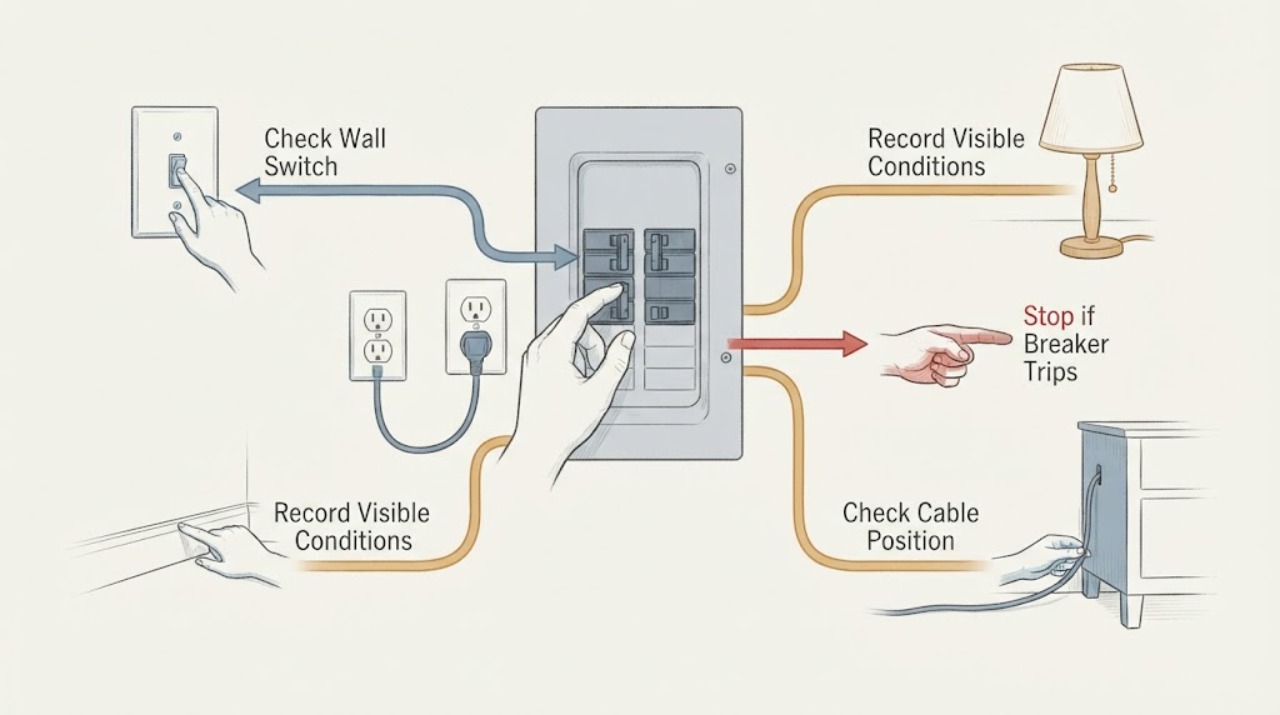
Work through in order
Diagnostic checks
Use only checks that match the exact appliance or system and its official guide.
-
Check 1
Stop using the affected circuit and look from a safe position for smoke, sparks, buzzing or sizzling, a hot or discolored breaker/panel, a warm outlet or switch, a melted plug, water near electricity, or a burning odor. Do not touch the panel interior or any damaged electrical equipment.
Expected result: There is smoke, arcing, a hot or discolored component, a burning odor, water near the circuit, exposed conductor, or another immediate electrical hazard.
Next step: Keep people away, leave the circuit off if it can be left off without approaching the hazard, and use local emergency guidance for smoke, fire, or active arcing. Arrange a qualified electrician; do not investigate inside the panel.
Stop if: Stop immediately for smoke, active arcing, fire, a hot/discolored panel or outlet, water entering electrical equipment, or a shock.
Why this matters
Why: This is a potential shock or fire event, not a routine reset. A breaker opening may be the only visible warning of a more serious fault.
-
Check 2
Identify which GE-labeled breaker opened and what loses power. Record whether it is a single-pole or double-pole handle, whether it has AFCI/GFCI Test or Reset markings, and which GE appliance, receptacles, lights, or other loads are on that branch; do not rely on the handle's apparent position alone.
Expected result: A single appliance or receptacle is associated with the trip, several loads share the branch, a double-pole breaker appears partly tripped, or the circuit and load map are unknown.
Next step: Use the GE installation instructions or panel labeling to confirm the correctly sized circuit without changing it. If the mapping or breaker type is uncertain, leave the circuit off and ask an electrician to identify it.
Stop if: Stop if the panel label is missing, the breaker is damaged or hot, the circuit is shared in an unknown way, or identification would require removing the panel cover.
Why this matters
Why: GE notes that a double breaker can partially trip while appearing On. A single known appliance points toward appliance service; several loads or an unknown circuit map keeps overload, wiring, panel, or protective-device causes in focus.
-
Check 3
If there is no hazard and the affected loads are ordinary plug-in devices, turn them off and unplug only dry, accessible plugs without moving a damaged appliance. Do not unplug hard-wired equipment, pull a refrigerator/range/dryer, use extension cords to bypass the branch, or disconnect anything in the panel.
Expected result: The breaker supplies one GE appliance, multiple portable loads, a receptacle or lighting branch, or a hard-wired load that cannot be safely disconnected.
Next step: Keep a suspect GE appliance unplugged and request appliance service. For a receptacle, lighting circuit, hard-wired load, or unknown circuit, leave the breaker off and arrange qualified electrical service rather than testing by reconnecting loads.
Stop if: Stop for a warm, loose, wet, damaged, hard-wired, or inaccessible connection, or if unplugging would require moving a heavy appliance or touching bare metal near water.
Why this matters
Why: Removing ordinary plug-in loads can separate an overload or appliance-side fault from a circuit-side fault, but it cannot prove a circuit is safe and does not apply to hard-wired equipment.
-
Check 4
Only if the panel and all accessible plugs are dry and show no hazard, make one reset by moving the GE breaker handle fully to Off and then to On. For a GE appliance's 220/240-volt double breaker, use the same full Off-then-On motion; do not hold the handle On or reset it repeatedly.
Expected result: The breaker holds with the loads disconnected, trips immediately, trips as soon as one load starts, or a GFCI/AFCI Test/Reset device will not hold.
Next step: If it trips again, leave it Off. Keep a suspect GE appliance disconnected and call an appliance technician; call an electrician for an immediate no-load trip, receptacle/lighting trip, AFCI/GFCI recurrence, or any panel/circuit concern. Do not increase the breaker rating.
Stop if: Stop after the first renewed trip, any crackling or heat, an immediate no-load trip, or a breaker that will not latch normally.
Why this matters
Why: Holding with loads disconnected shifts concern toward a connected appliance or branch load, though it does not prove the circuit safe. An immediate trip with loads removed or a continuing AFCI/GFCI trip points toward wiring, the protective device, or a fault requiring qualified diagnosis.
-
Check 5
If the breaker holds once, restore no more than one previously disconnected load at a time while watching and listening from a safe position. Record whether the GE appliance trips the circuit at startup, during heating, when a motor or compressor starts, or only when other loads are added; do not repeat a trip test.
Expected result: The GE appliance alone causes a trip, the circuit trips only with multiple loads, the trip occurs at a particular operating stage, or the breaker holds with all loads.
Next step: Turn the suspect GE appliance Off and unplug it if safe, or leave a hard-wired appliance unused, and arrange service. For multiple-load or circuit-specific trips, reduce use without using extension cords and have an electrician evaluate the branch; do not keep resetting to find a pattern.
Stop if: Stop immediately on any renewed trip, odor, heat, buzz, spark, damaged cord, or abnormal appliance behavior.
Why this matters
Why: A repeatable appliance-specific trip makes an appliance fault more likely; a combined-load trip makes overload more likely; a stage-specific trip can involve a component that starts then. A single successful run does not certify the breaker or appliance.
Use your observations
Decision map
Find the observation that best matches what you see, then follow the next safe action.
-
PATH 01Safety boundary
What you see
Is there smoke, arcing, heat, burning odor, water near electricity, visible damage, or a shock?
Do this next
Keep clear, leave the circuit off if safe, and use local emergency guidance for an active fire or electrical event. Arrange qualified electrical help.
Why this path and its safety boundary
Why it matters: A visible electrical hazard overrides all reset and load-separation checks.
Safety stop: Keep the breaker off while identifying the circuit and the timing of the trip.
-
PATH 02Next step
What you see
The GE breaker trips immediately after a full Off-then-On reset with loads disconnected, or will not latch.
Do this next
Leave it Off and call a qualified electrician. Do not open the panel, substitute a breaker, or attempt another reset.
Why this path and its safety boundary
Why it matters: The pattern makes a circuit, breaker, panel, or wiring fault more likely than a simple overload from the disconnected loads.
-
PATH 03Next step
What you see
The breaker holds with other loads disconnected but trips when one GE appliance is turned on or reaches a repeatable operating stage.
Do this next
Keep that GE appliance unplugged or unused and arrange appliance service. Do not bypass the breaker or move the appliance to another circuit as a workaround.
Why this path and its safety boundary
Why it matters: An appliance cord, heater, motor, compressor, electronic control, or internal component may be faulty; the breaker is responding to the connected load rather than proving itself defective.
-
PATH 04Next step
What you see
The breaker trips only when several loads run together, or an AFCI/GFCI trips again after its reset.
Do this next
Stop adding loads and leave the affected circuit off if the protective device will not hold. Have an electrician identify the circuit capacity and fault; do not install a higher-rated breaker or defeat AFCI/GFCI protection.
Why this path and its safety boundary
Why it matters: Several simultaneous loads make branch overload more likely; a recurring AFCI/GFCI trip may indicate ground leakage, arcing, wiring, device, or appliance trouble. The exact cause still needs evaluation.
Helpful context
Understand the symptom
The breaker is a protective symptom, not proof that the GE breaker itself failed
A breaker can open because the connected load is too large, an appliance or cord has a fault, a circuit has a short or ground-leakage condition, an AFCI detects an arc signature, or the breaker, panel, or wiring needs evaluation. GE's appliance guidance starts with the correct breaker or fuse specified for the appliance and sends persistent trips to service. Do not infer the cause from the label, appearance, or the fact that the handle still looks On.
Classify when it trips before trying a reset
Record whether the breaker trips as soon as it is reset, when a specific GE appliance starts a heating, motor, or compressor load, when several devices run at once, or when a particular receptacle, light, or switch is used. That timing changes the next safe owner: an appliance technician may evaluate a single GE appliance, while an electrician must evaluate a breaker, circuit, panel, or wiring issue. Timing does not justify opening the panel or changing the breaker rating.
AFCI and GFCI labels change what the trip may be sensing
GE explains that GFCI protection reacts to current leaking to ground, while AFCI protection reacts to an electrical signature associated with arcing. A reset that holds once is different from a device that continues to trip. Do not defeat or replace either protection device merely to keep an appliance running; recurring trips need the appliance, receptacle, circuit, and protective device assessed by qualified help.
Safety boundary
Stop conditions
- Stop and keep clear for smoke, active arcing, fire, shock, a hot or discolored panel/outlet, water near electricity, a damaged cord, or a burning odor; use local emergency guidance as appropriate.
- Do not repeatedly reset a GE breaker, hold it On, bypass it, tape the handle, replace it with a higher-amperage device, or install a fuse/breaker of an unverified rating.
- Do not open the electrical panel, remove a breaker or cover, probe wiring, or troubleshoot a hard-wired appliance as a homeowner check.
- After the first renewed trip, leave the breaker off and stop the test; keep the suspect GE appliance unplugged or unused until qualified appliance or electrical service evaluates it.
Common questions
FAQ
Why does my GE breaker keep tripping?
The trip may reflect an overload, a GE appliance or cord fault, a short or ground-leakage condition, an AFCI arc signature, or a breaker/panel/wiring issue. Note whether it trips immediately, with one appliance, or only when several loads run. Do not infer the cause from the GE label or keep resetting it.
How do I reset a GE breaker safely?
Only if there is no heat, odor, water, damage, or other electrical hazard: turn the handle fully Off and then On once. GE notes that a 220/240-volt double breaker can partially trip while appearing On and needs the same full motion. If it trips again, leave it Off and arrange qualified service.
What if the GE breaker trips as soon as I turn it back on?
Leave it Off. An immediate trip with loads disconnected makes a circuit, breaker, panel, or wiring problem more likely and requires a qualified electrician. Do not open the panel, hold the breaker On, or replace it with a higher-rated device.
What does it mean if a GE appliance trips the breaker only when it starts?
A repeatable appliance-specific trip makes a fault in the appliance, cord, or a component that starts at that stage more likely, but it does not prove which part failed. Keep the appliance unplugged or unused and arrange appliance service; do not move it to another circuit as a workaround.
What if the GE breaker is AFCI or GFCI and keeps tripping?
GE explains that GFCI responds to current leakage to ground and AFCI responds to a signature associated with arcing. Reset it only once if safe; if it trips again, leave the circuit off and arrange qualified electrical or appliance service. Never defeat the protection device to keep the load running.
Read the exact guide
Official sources
- CPSC Guide to Home Wiring HazardsU.S. Consumer Product Safety Commission · U.S. consumer electrical-safety guidance on overloads, recurring trips, appliance defects, qualified electricians, and not installing higher-rated protective devices
- GE Appliance - Circuit Breaker TripsGE Appliances · GE appliance guidance on properly sized breakers, appliance-versus-house-wiring trip patterns, and electrician/service boundaries
- GE Appliance - Resetting Your Circuit BreakerGE Appliances · GE appliance guidance for identifying and resetting a tripped household breaker, including partial trips on 220/240V double breakers and recurring-trip service limits
- Appliance - AFCI, GFCI and GFI UseGE Appliances · GE explanation of AFCI arc detection, GFCI ground-leakage detection, reset behavior, and recurring-trip service guidance
Community feedback
Share a repair observation
Share a plain-text repair observation. Accepted observations are published automatically; this page may take a moment to update.