
On this page
Start here
Quick answer
A GE branch-circuit breaker that keeps tripping is interrupting power because of an overload, a fault in one connected appliance, a ground-fault or arc-fault protective trip, or a wiring or breaker problem. First note whether it trips immediately with loads disconnected or only when one GE appliance starts or when several loads run together. From a dry, safe position, inspect only accessible plugs, cords, outlets, and the equipment exterior for heat, scorching, water, damage, or a burning smell. If there is any hazard, if the breaker trips again after one safe reset attempt, or if the trip returns with a particular appliance, leave the circuit or appliance off and arrange qualified electrical or appliance service. Do not remove the panel cover, replace the breaker with a different rating, bypass AFCI/GFCI protection, or keep resetting the breaker.
Before you begin
Safety first
- This article supports recording the trip pattern, controlling accessible appliance loads, checking external plugs, cords, and receptacles for visible hazards, identifying visible GFCI/AFCI markings, and making at most one safe external-handle reset attempt when there is no hazard. A qualified professional must handle panel covers, breaker replacement, branch wiring, receptacles, live testing, protective-device diagnosis, appliance disassembly, and internal component repair.
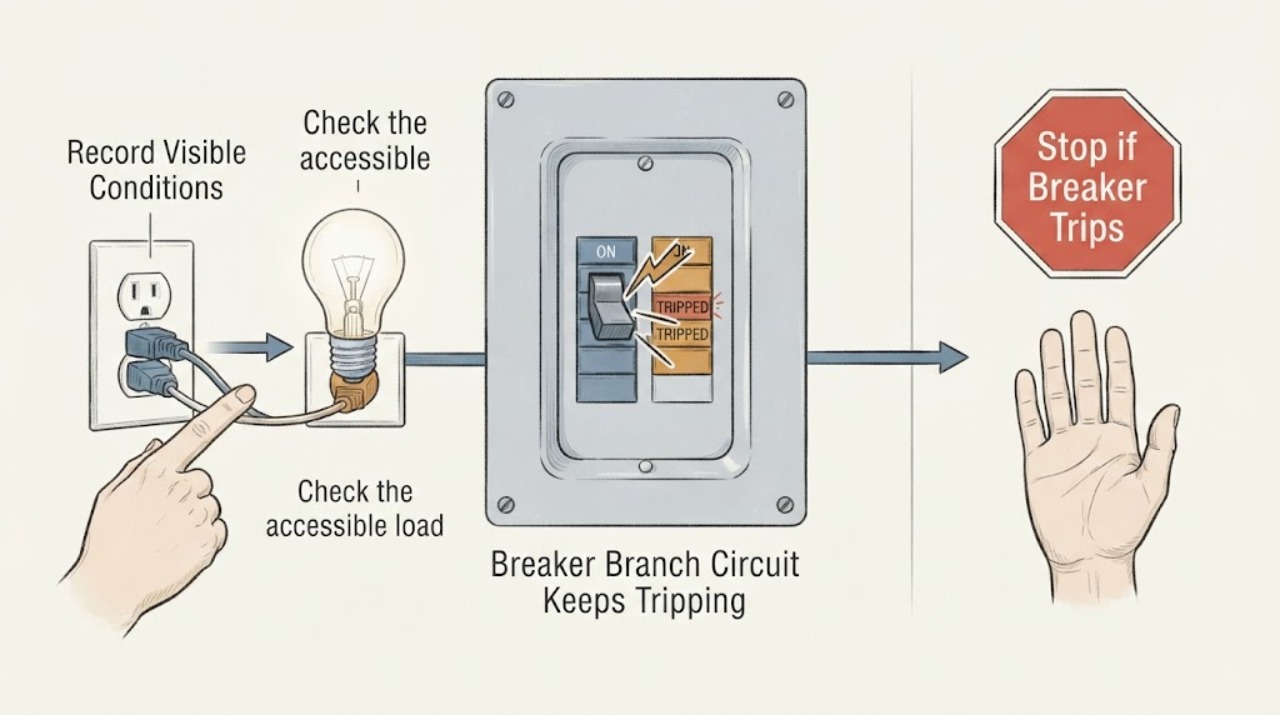
Work through in order
Diagnostic checks
Use only checks that match the exact appliance or system and its official guide.
-
Record when and where the breaker trips
Write down the breaker label, the room or outlets that lose power, what GE appliance or other load was running, and whether the trip happened immediately at startup, after the appliance warmed up, after another load was added, or during wet weather. Do not remove the panel cover to trace the circuit.
Expected result: The trip follows one GE appliance, follows several loads running together, happens with no load apparent, or coincides with rain, a leak, a hot outlet, smoke, a burning smell, buzzing, or visible damage.
Next step: Use the matching diagnostic path below. If any smoke, arcing, water, heat, odor, or exposed damage is present, leave the affected circuit off and arrange qualified electrical service immediately.
Stop if: Do not keep operating the appliance to reproduce the trip, and do not remove the service-panel cover or touch exposed electrical parts.
Why this matters
Why: A repeatable appliance pattern makes an appliance or cord fault more likely; a multiple-load pattern makes an overload more likely; an immediate no-load trip or a hazard sign makes a branch, protective-device, or wiring fault more likely.
-
Check the accessible load and connection condition
With the circuit off and the area dry, leave the suspected GE appliance disconnected. Look only at the appliance plug, cord jacket, accessible receptacle face, and nearby connection for scorch marks, melted plastic, looseness, moisture, corrosion, or a cord that has been pinched. Do not pull out a hard-wired appliance or open a junction box.
Expected result: The appliance or receptacle has heat discoloration, damage, moisture, looseness, or an odor; the connection looks normal; or the suspected appliance cannot be safely disconnected.
Next step: Leave damaged or wet equipment unused and call qualified electrical or appliance service. If the connection looks normal, continue with one controlled isolation check rather than repeatedly powering the circuit.
Stop if: Do not touch wet parts, repair a cord, tighten terminals, open the appliance, or use a damaged outlet or plug.
Why this matters
Why: Visible damage or moisture can explain a protective trip and raises shock or fire risk. A clean exterior does not prove the appliance or branch is safe; an internal short or loose connection can remain hidden.
-
Separate a multi-load overload from a single-device fault
If there is no visible hazard, turn off or unplug the other accessible loads on the affected branch and keep the suspected GE appliance disconnected. Identify only the loads you can reach without moving wiring or opening equipment, then make at most one reset attempt using the breaker handle as labeled: move it fully off and back on only if it is safe to do so.
Expected result: The breaker remains on with the suspected GE appliance disconnected; it trips immediately despite the loads being off; or it stays on only when several loads are not running together.
Next step: Do not reconnect a device that was associated with the trip. Reduce simultaneous high-demand use only as a temporary observation, and arrange electrical evaluation if the circuit cannot support normal intended use or trips again.
Stop if: Do not reset repeatedly, hold the breaker on, change its rating, use a fuse substitute, or open the panel to investigate.
Why this matters
Why: Staying on after the appliance is disconnected makes that appliance or its cord more likely; an immediate trip with loads off points toward wiring, the breaker, or a protective device; stability only with fewer simultaneous loads is consistent with branch overload.
-
Identify whether a GFCI or AFCI device is reporting the trip
From a dry, safe position, look for a visible Test or Reset button on the affected receptacle and read the breaker or outlet label for GFCI, AFCI, or dual protection. Do not remove the receptacle or breaker. If the device has no visible damage and its instructions permit a reset, perform one reset attempt and note whether it trips again without reconnecting the suspected appliance.
Expected result: A GFCI or AFCI indicator trips again; the device will not reset; no protective-device indicator is visible; or the device stays on until the GE appliance is connected.
Next step: Leave the appliance disconnected and arrange qualified electrical or GE appliance service. Never bypass the protective device or replace it with a different type as a trial.
Stop if: Do not test live conductors, remove an outlet or breaker, defeat Test/Reset protection, or keep resetting a device that trips again.
Why this matters
Why: A GFCI recurrence keeps ground leakage or a connected-device fault in consideration; an AFCI recurrence keeps arcing or a wiring/device fault in consideration. A trip only when the appliance is connected makes the appliance or its cord more suspicious. A device that will not reset needs professional diagnosis.
-
Check whether the appliance-specific fault returns
Keep any GE appliance that coincided with the trip unplugged or switched off. If a qualified person has confirmed that the receptacle and branch are safe, use the appliance only according to its installation instructions and observe whether the breaker trips when that appliance starts or enters a heating, cooling, pumping, or motor cycle. Do not repeat this test if the first reconnection trips, sparks, heats, or smells.
Expected result: The breaker trips as soon as the appliance is connected or starts; the appliance runs while other loads are off; or the breaker trips even with that appliance disconnected.
Next step: Leave the appliance out of use and provide the model number, trip timing, and any visible symptom to qualified appliance service. Use a qualified electrician when the trip persists without the appliance connected.
Stop if: Do not open the GE appliance, defeat a door or safety switch, bypass a ground, or continue a test after a trip or hazard sign.
Why this matters
Why: A trip that follows the appliance points toward an appliance component, cord, plug, or appliance-side leakage; GE lists shorted heaters, loose wires, failed components, and similar faults among possible appliance causes. A trip with the appliance disconnected points more toward the house wiring or breaker box.
-
Confirm the professional handoff includes the useful evidence
Before calling, record the breaker label, the affected rooms or outlets, GE model and serial information if available, the connected loads, whether the breaker trips immediately or after operation, the result with the GE appliance disconnected, and any GFCI/AFCI indication or visible damage. Keep the circuit and suspected appliance off while waiting if the symptom recurs.
Expected result: The technician has a repeatable appliance pattern, a no-load trip, a protective-device trip, an overload pattern, or a hazard observation to investigate.
Next step: Use qualified electrical service for branch, breaker, receptacle, GFCI/AFCI, wiring, heat, arcing, or no-load trips; use qualified GE appliance service for a trip that follows one appliance after the branch is verified safe.
Stop if: Do not restore normal use merely because the breaker stays on briefly, and do not replace a breaker or appliance part before the fault is diagnosed.
Why this matters
Why: This separates appliance service from electrical service and helps the professional inspect the correct branch, breaker or protective device, receptacle, cord, and GE component without repeated homeowner tests.
Use your observations
Decision map
Find the observation that best matches what you see, then follow the next safe action.
-
PATH 01Next step
What you see
The breaker trips immediately after the accessible loads are off and the suspected GE appliance is disconnected.
Do this next
Leave the breaker off and arrange qualified electrical service. Do not keep resetting it or open the panel.
Why this path and its safety boundary
Why it matters: The GE appliance is less likely to be the only cause; the branch wiring, receptacle, protective device, or breaker remains suspect.
-
PATH 02Next step
What you see
The branch stays on with other loads controlled, but trips when one GE appliance is connected or starts.
Do this next
Leave that appliance disconnected and request qualified GE appliance diagnosis. Use electrical service too if the outlet, cord, or branch shows heat, damage, or instability.
Why this path and its safety boundary
Why it matters: An appliance-side component, cord, plug, or leakage fault is more likely than a general overload; GE notes shorted heaters, loose wires, and failed components as possible appliance causes.
-
PATH 03Next step
What you see
The breaker stays on with fewer loads but trips when several appliances or heating loads operate together.
Do this next
Do not run the combination together while waiting. Have a qualified electrician verify the branch capacity, circuit assignment, connections, and protective device; do not change the breaker rating yourself.
Why this path and its safety boundary
Why it matters: An overloaded branch or an installation that does not match the GE appliance instructions is more likely than a single failed appliance.
-
PATH 04Next step
What you see
A GFCI or AFCI outlet or breaker trips again, will not reset, or trips with no obvious load.
Do this next
Leave the affected circuit or appliance off and use qualified electrical service. Tell the technician which indicator or button operated and whether the GE appliance was connected.
Why this path and its safety boundary
Why it matters: Ground leakage, arcing, a damaged device, wiring trouble, or a connected appliance fault remains possible; repeated protection trips are not a condition to bypass.
-
PATH 05Safety boundary
What you see
There is smoke, active arcing, a burning smell, a hot or discolored outlet or plug, water, exposed conductor, sizzling, or unusual buzzing.
Do this next
Move away from the hazard, leave the affected circuit off if it can be done without contact with the hazard, and contact qualified electrical or emergency help as appropriate. Do not touch or investigate the damaged part.
Why this path and its safety boundary
Why it matters: The situation is an electrical safety hazard, not a routine reset problem.
Safety stop: Do not operate the appliance, spray or dry the connection, touch the panel or damaged wiring, or attempt a repair.
Helpful context
Understand the symptom
The timing of the trip is the useful clue
A breaker that trips only after several appliances are running is consistent with the branch carrying more load than it can safely deliver. A breaker that trips as soon as one GE appliance starts makes that appliance, its cord, or its connection more suspicious. A trip that occurs immediately with the appliance disconnected points away from the appliance and toward the branch wiring, breaker, or protective device. These are decision points, not permission to open the panel or change wiring.
AFCI and GFCI trips should not be bypassed
Some GE appliance circuits are protected by a GFCI outlet or breaker, while an AFCI is normally incorporated into a breaker. GE describes a GFCI trip as protection against current leaking toward ground and an AFCI trip as response to an arc-like current signature. Identify the device by its visible Test or Reset controls or its panel label, but do not substitute an ordinary breaker or defeat the protection to keep the appliance running.
Visible damage changes the safe next step
A warm or discolored receptacle, a loose or damaged plug, damaged cord insulation, water near the connection, sizzling, buzzing, smoke, or a burning odor is not a normal nuisance trip. CPSC lists these observations as warning signs of home electrical hazards and advises qualified inspection or prompt correction. Stop using the affected circuit and get qualified help rather than testing it with another appliance.
Safety boundary
Stop conditions
- Stop immediately for smoke, active arcing, a burning odor, a hot or discolored outlet, water near electrical parts, exposed conductors, sizzling, unusual buzzing, or damaged insulation; leave the affected circuit off and seek qualified help.
- Do not repeatedly reset a breaker or GFCI/AFCI, hold a breaker on, replace it with a higher-rated device, substitute a fuse, or bypass protective protection.
- Do not remove a service-panel cover, open a junction box, remove a receptacle, test live voltage, move branch-circuit conductors, or open the GE appliance as a homeowner diagnostic.
- Keep a GE appliance disconnected when the trip follows that appliance, and keep the branch off when it trips with loads disconnected or immediately after a safe reset attempt.
- Arrange qualified electrical service for a no-load trip, repeated protective-device trip, suspected overload, hot or damaged connection, wiring concern, or breaker concern; arrange qualified appliance service when a verified-safe branch trips only with one GE appliance.
Only after diagnosis
Potential parts
- GE circuit breaker or protective device
Consider this category only after a qualified electrician diagnoses a failed or incompatible breaker or protective device; repeated tripping alone does not prove the breaker is defective.
Confirm the panel, breaker type, circuit function, and local requirements with the electrician and the applicable GE or panel documentation before ordering. - receptacle or GFCI receptacle
Consider this category only when qualified inspection finds a damaged, worn, moisture-affected, or failed receptacle or GFCI device on the affected branch.
Confirm the existing wiring, protection type, location, and approved device specification; do not replace a receptacle as a trial. - GE appliance power cord or internal electrical component
Consider this category only when qualified appliance diagnosis ties the trip to the GE appliance, cord, plug, heater, motor, or another internal component.
Confirm the complete GE model and the service technician's diagnosis; a generic cord or component may be unsafe or incompatible.
When checks do not resolve it
Need a professional?
Call qualified electrical service when the breaker trips with the GE appliance disconnected, trips again after one safe reset attempt, a GFCI/AFCI will not reset or trips repeatedly, several loads together cause the problem, or any outlet, plug, cord, wiring, breaker, or panel shows heat, scorching, water, smoke, buzzing, arcing, or a burning odor. Call qualified GE appliance service when the branch remains stable without one GE appliance but trips when that appliance starts or operates. For active smoke or fire, leave the area and contact emergency services from a safe location.
Safety scope: This article supports recording the trip pattern, controlling accessible appliance loads, checking external plugs, cords, and receptacles for visible hazards, identifying visible GFCI/AFCI markings, and making at most one safe external-handle reset attempt when there is no hazard. A qualified professional must handle panel covers, breaker replacement, branch wiring, receptacles, live testing, protective-device diagnosis, appliance disassembly, and internal component repair.
Common questions
FAQ
Why does my GE breaker keep tripping?
The usual decision points are an overloaded branch, a fault in one GE appliance or its cord, GFCI ground leakage, AFCI arc-fault protection, or a branch, receptacle, or breaker problem. Note whether the trip follows one appliance, several loads, or occurs immediately with loads disconnected; that pattern determines whether appliance or electrical service is the safer next step.
What does it mean if the GE breaker trips immediately with the appliance unplugged?
GE says an immediate trip after the appliance is unplugged typically points toward house wiring or the fuse or breaker box. Leave the circuit off and arrange qualified electrical service instead of repeatedly resetting it.
Can several appliances make a GE branch breaker trip?
Yes. If the breaker stays on with fewer loads but trips when several loads run together, an overload or circuit-assignment problem is more likely. Do not change the breaker rating; have a qualified electrician verify the branch and intended load.
What if the GE breaker is an AFCI or GFCI?
GE describes GFCI devices as responding to current leakage toward ground and AFCI devices as responding to an arc-fault current signature. Identify the visible Test or Reset device, make no more than one safe reset attempt when its instructions permit, and arrange service if it trips again. Never bypass the protection.
Should I replace the GE breaker with a higher-rated breaker?
No. A different-rated breaker can remove the intended protection from the branch. CPSC says a particular outlet or switch that trips a breaker needs qualified electrician help, and GE says an incorrectly sized breaker should be addressed by the installer or an electrician.
When should I call an electrician for a GE breaker that keeps tripping?
Call when the breaker trips with the GE appliance disconnected, trips again after one safe reset attempt, a GFCI or AFCI will not reset, several loads cause the trip, or there is heat, scorching, water, smoke, arcing, buzzing, a burning odor, or damaged insulation. Use qualified GE appliance service when a verified-safe branch trips only with one GE appliance.
Read the exact guide
Official sources
- Home Electrical Safety ChecklistU.S. Consumer Product Safety Commission · Official CPSC household electrical safety page linking the agency's consumer checklist; used as supporting safety context for stopping at visible hazards and professional correction.
- GE Appliance - Resetting Your Circuit BreakerGE Appliances · Official GE Appliances support guidance for recognizing and resetting a tripped appliance breaker from its external handle; it recommends service when the breaker keeps tripping with the appliance on.
- CPSC Guide to Home Wiring HazardsU.S. Consumer Product Safety Commission · Official CPSC home-wiring safety guide for consumers; used for hazard recognition and the boundary against removing a service-panel cover or attempting electrical repairs.
- GE Appliance - Circuit Breaker TripsGE Appliances · Official GE Appliances support guidance for breaker trips associated with GE ranges, cooktops, wall ovens, refrigerators, dishwashers, washers, and dryers; exact product installation instructions control circuit requirements.
- Appliance - AFCI, GFCI and GFI UseGE Appliances · Official GE Appliances support guidance for appliance circuits protected by GFCI/GFI outlets or breakers and AFCI breakers; installation must remain compliant with applicable requirements.
Community feedback
Share a repair observation
Share a plain-text repair observation. Accepted observations are published automatically; this page may take a moment to update.