
On this page
Start here
Quick answer
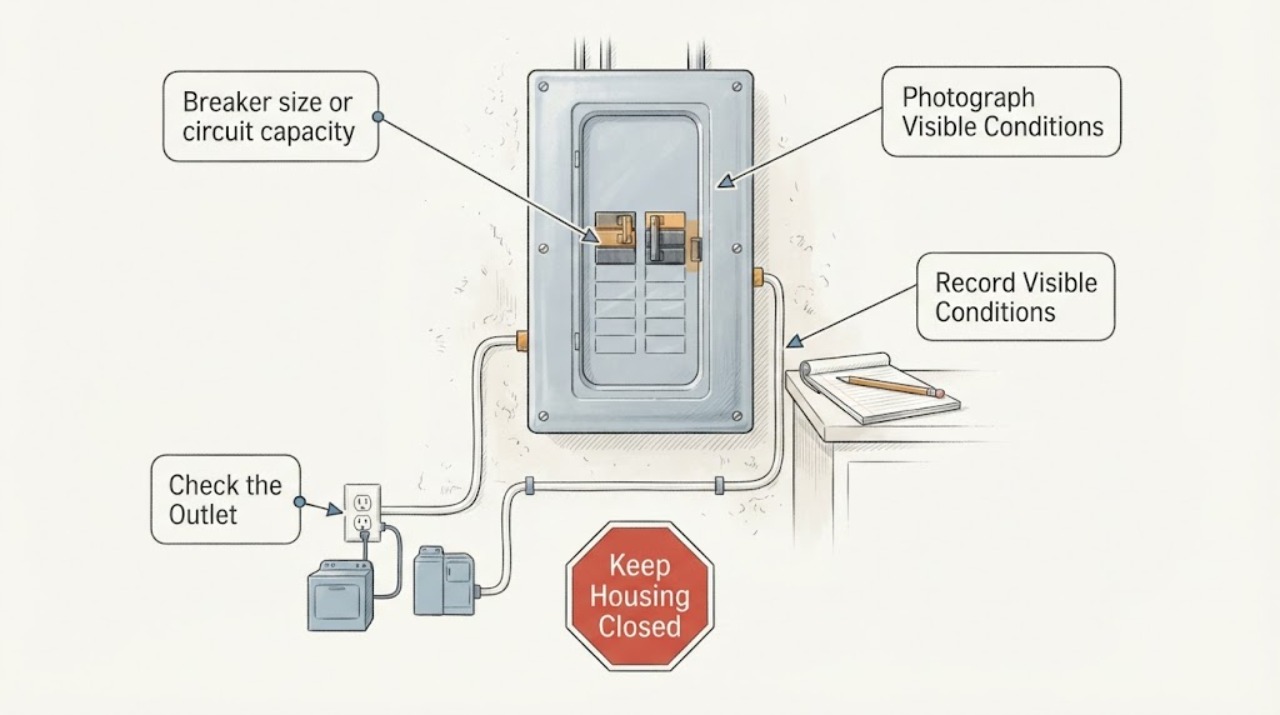
Do not replace a breaker with a larger one or open the panel to test capacity. From outside the panel, photograph the breaker handle and panel directory, read the appliance nameplates without moving wiring, and record which loads were running when the breaker tripped. Frequent trips, warm or discolored outlets, buzzing, a burning smell, flickering, or a breaker rating that does not match the documented circuit are reasons to stop using the affected load and call a licensed electrician. Nameplate observations help identify the question; they do not authorize a homeowner load calculation or breaker change.
Work through in order
Diagnostic checks
Use only checks that match the exact appliance or system and its official guide.
-
Check 1
From outside the closed electrical panel, photograph the affected breaker handle, the panel directory, and any visible rating text without removing the cover or touching the breaker internals. Note whether the handle is fully on, fully off, or sitting in a tripped-looking middle position.
Expected result: A repeatedly tripped handle, an unlabeled circuit, a directory mismatch, or a rating that cannot be confidently read is a documentation lead, not proof that the breaker is the wrong size. A normal-looking handle does not prove the circuit is safe.
Next step: Record what lost power and which appliances or outlets were affected, then inspect the connected loads and their nameplates.
Stop if: Stop for a missing panel cover, exposed conductors, arcing, buzzing, a hot or discolored panel, or any need to open the enclosure.
Why this matters
Why: The electrician needs the panel brand, circuit label, breaker position, and trip history to verify the protective device against the wiring and loads. Do not infer a safe replacement rating from the handle marking.
-
Check 2
Read the accessible nameplate or manual for each appliance that was operating when the trip occurred, recording the stated voltage, wattage, amperage, or circuit requirement exactly as printed. Do not add loads together as a homeowner sizing decision and do not move plugs to reproduce the trip.
Expected result: A high-demand appliance, a stated dedicated-circuit requirement, or two heat-producing loads sharing one outlet area is useful context. Missing or unreadable nameplate information means the load cannot be safely characterized from appearance.
Next step: Photograph the nameplates and note the outlet or room location, then record the trip timing and whether one appliance always triggers it.
Stop if: Stop if reading the label would require opening an appliance, moving a heavy load, handling a damaged cord, or reaching near water or exposed wiring.
Why this matters
Why: Nameplate data helps the electrician compare the appliance requirement with the existing circuit design, but it does not account for conductor length, continuous load, shared circuits, starting current, or local requirements.
-
Check 3
Create a simple trip log without deliberately overloading anything: note the date, time, appliances already running, whether the trip happened at startup or during operation, and whether the same appliance or outlet is involved each time.
Expected result: A trip that follows one appliance or one receptacle can indicate an appliance, cord, receptacle, or branch-circuit fault. A trip that follows several simultaneous loads can indicate an overloaded circuit, but only an electrician can verify capacity and protection.
Next step: Stop using the suspect load if it repeatedly trips, and provide the log with the panel and nameplate photos to a licensed electrician.
Stop if: Stop immediately for smoke, sparks, a burning odor, heat, shock or tingling, melted insulation, or a breaker that will not remain in its normal position.
Why this matters
Why: The pattern changes the service path while preserving the safety boundary: do not keep resetting a breaker or repeatedly recreate the event.
-
Check 4
Inspect accessible plug, cord, receptacle faceplate, power strip, and extension-cord condition without touching damaged areas. Look for looseness, scorch marks, cracking, warmth, discoloration, or an extension cord being used as permanent wiring.
Expected result: A warm, discolored, loose, cracked, or damaged connection is a hazard independent of the printed breaker size. A cool, intact outlet does not clear a circuit that trips or has an unknown directory.
Next step: Keep the affected device disconnected if safe to do so and call an electrician for inspection; keep water and combustible materials away from the area.
Stop if: Stop for any hot, melted, smoking, sparking, wet, or shock-producing component and use the appropriate emergency electrical response.
Why this matters
Why: Visible connection damage raises urgency and may involve the receptacle, cord, appliance, or fixed wiring. Do not cover it, tape it, replace it, or continue using it to test the circuit.
Use your observations
Decision map
Find the observation that best matches what you see, then follow the next safe action.
-
PATH 01Next step
What you see
The breaker trips repeatedly, one appliance consistently triggers the trip, or an appliance nameplate calls for a circuit that is not clearly documented.
Do this next
Stop using the suspect load and call a licensed electrician or qualified appliance professional as appropriate. Do not reset repeatedly, change the breaker, or perform a live-load test.
-
PATH 02Next step
What you see
The panel directory is missing or inconsistent, the breaker rating is unclear, or the panel shows heat, arcing, buzzing, odor, or discoloration.
Do this next
Do not open the panel. Keep clear of the equipment and arrange prompt electrician inspection; escalate immediately for smoke, active arcing, or fire risk.
-
PATH 03Next step
What you see
A plug, cord, receptacle, or power strip is warm, damaged, wet, loose, or discolored.
Do this next
Stop using that connection and do not replace or bypass it as a test. Have a qualified electrician or appliance professional determine whether the device, receptacle, or fixed wiring is involved.
Helpful context
Understand the symptom
Capacity concern is not a breaker-upgrade instruction
A breaker is a protective device for a branch circuit, and a trip can result from an overload, a fault, damaged wiring, a defective appliance, or a protection device problem. The number printed on the handle does not by itself reveal wire size, circuit design, code requirements, or the actual load. A qualified electrician must determine whether the circuit is correctly protected and whether a new appliance needs a dedicated or altered circuit.
Observe from outside the equipment
Use a phone camera and the appliance manuals from a dry standing position. Do not remove the service-panel cover, touch exposed electrical parts, test live current, move conductors, change a breaker, or intentionally run extra appliances to reproduce a trip. A clear record of the load, timing, and visible warning signs is safer and more useful than an improvised capacity test.
Only after diagnosis
Potential parts
- breaker panel directory
Consider this category only after an electrician has verified the circuit identity and is documenting the panel; a new label cannot correct a capacity or protection problem.
Match the panel's labeling format and preserve the electrician's verified circuit mapping. Do not infer circuit capacity from a directory alone. - circuit tracer
Consider this category only as a professional-selected aid for identifying which outlets or loads are on a circuit; it does not measure safe capacity or authorize panel work.
Use only according to the instrument and electrical safety instructions, without opening the panel or treating a trace as a load calculation. - surge protector
Consider this category only for a qualified recommendation after the circuit and connected equipment are safe; a surge protector does not increase branch-circuit capacity or fix repeated trips.
Confirm the device listing, intended location, grounding requirements, and appliance instructions. Never use it to combine loads or bypass a tripping breaker.
When checks do not resolve it
Need a professional?
Call a licensed electrician for a suspected wrong breaker size, repeated trips, a new high-demand appliance, an unlabeled or inconsistent panel, unknown circuit capacity, or any warm, buzzing, scorched, loose, wet, or damaged electrical connection. Call an appliance professional when one appliance alone repeatedly trips a known-safe circuit.
Have this ready
- Provide the panel and directory photos taken from outside, breaker position and visible rating, appliance nameplate photos, outlet or room locations, the trip log, and any signs of heat, odor, sparks, or damage. State that the panel was not opened, no breaker was replaced, and no deliberate overload or live measurement was attempted.
Common questions
FAQ
Can I install a larger breaker to stop nuisance trips?
No. A larger breaker may leave the wiring unprotected and create a fire hazard. Repeated trips need a qualified electrician to identify whether the cause is an overload, appliance fault, wiring problem, or protection-device issue.
Can appliance nameplate watts tell me the correct breaker size?
Nameplate information is useful evidence, but it is not a complete circuit-capacity calculation. Wiring, shared loads, circuit design, starting current, continuous operation, and local requirements also matter; provide the labels to an electrician.
What visible signs mean I should stop using the circuit?
Stop for warmth, discoloration, burning odor, buzzing, sparks, damaged insulation, a loose or wet receptacle, shock or tingling, smoke, or repeated trips. Keep clear and arrange qualified electrical service; do not open the panel or keep resetting the breaker.
Read the exact guide
Official sources
- Electrical SafetyU.S. Consumer Product Safety Commission · The CPSC safety poster warns against overloading outlets and power strips and recommends hiring a licensed electrician for home electrical work.
- Fuse and Breaker BreakdownElectrical Safety Foundation International · ESFI describes oversized protection as a fire hazard, says frequent breaker trips need qualified-electrician inspection, and recommends inspection after major additions or large-appliance changes.
- Guide to Home Wiring HazardsU.S. Consumer Product Safety Commission · The CPSC guide explains that breakers protect branch circuits from overload, lists repeated trips, heat, odors, and arcing as warning signs, and says not to remove a service-panel cover; it supports observation and professional escalation, not DIY sizing.
Community feedback
Share a repair observation
Share a plain-text repair observation. Accepted observations are published automatically; this page may take a moment to update.