
On this page
Start here
Quick answer
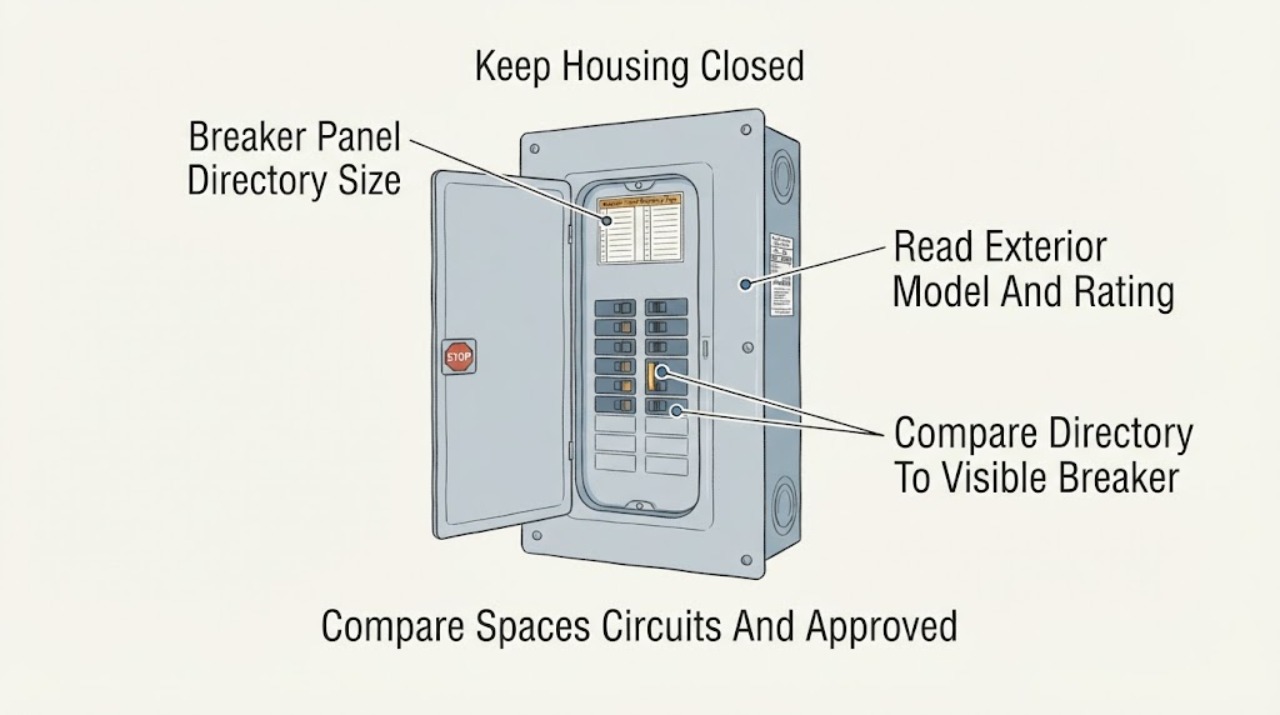
An Eaton panel directory is a circuit-identification aid; its physical label size or the number of lines on it does not determine how much electrical load the panel can carry. To separate the two concerns, read the panel's exterior label or catalog number, record the main ampere rating and listed spaces or maximum circuits, and compare the directory with the breaker positions without removing the cover. A panel can have empty spaces but no safe capacity for a new load, or have a full directory while the actual calculated load remains within its rating. Do not add up breaker-handle numbers, install a larger breaker, move a breaker, double-tap a terminal, or add a circuit based only on the directory. Eaton's loadcenter data shows that spaces, maximum circuits, breaker type, bus or main rating, and wire range are model-specific, while Eaton also says a load calculation is needed to determine adequate system capacity. Have a licensed electrician identify the exact Eaton model, verify permitted breaker combinations and wiring, perform the applicable load calculation, and decide whether a correctly listed circuit, load management, subpanel, or service upgrade is appropriate.
Work through in order
Diagnostic checks
Use only checks that match the exact appliance or system and its official guide.
-
Check 1
With the panel closed and your hands away from openings, photograph the exterior label, door directory, and any visible Eaton catalog or model number. Record the main rating, voltage, panel or loadcenter family, and whether the equipment is identified as a main-breaker panel or a downstream subpanel. Do not remove the deadfront or touch breakers, bus parts, or wiring.
Expected result: The catalog number and main rating are legible; only an Eaton family name is visible; the directory is missing or unreadable; or the panel appears to be a subpanel rather than the service entrance panel.
Next step: Give the photographs and all visible markings to a licensed electrician. If the model cannot be identified without opening the panel, stop at the exterior inspection and have the electrician identify it safely.
Stop if: Do not open the panel, remove the cover, probe for voltage, or rely on an online photo match to select breakers or calculate capacity.
Why this matters
Why: The exact catalog number is needed to determine the listed spaces, maximum circuits, approved breaker types, and wiring limits. A family name alone is not enough because Eaton offers multiple configurations within BR, CH, and other families. A subpanel's capacity and feeder depend on the upstream equipment as well as the subpanel label.
-
Check 2
Using only the closed-door directory and the breaker-handle positions that are visible without opening the enclosure, make a plain-language inventory: room or equipment served, single- or two-pole indication if marked, and any blank position. Mark labels that are missing, duplicated, handwritten without verification, or inconsistent with what turns off a known load; do not turn breakers on or off to test the map.
Expected result: The directory maps each position clearly; one or more positions are blank; labels conflict or are duplicated; or the directory does not match the visible layout.
Next step: Keep the inventory as documentation for the electrician. Ask the electrician to trace and label circuits, confirm the exact breaker positions and permitted combinations, and update the directory with a durable label once the mapping is verified.
Stop if: Do not guess what a circuit supplies, remove a directory, relocate a breaker, install a tandem or double-pole breaker, or energize an unknown circuit to test the label.
Why this matters
Why: An incomplete directory creates a circuit-identification and service-safety problem but does not by itself prove that the panel is electrically overloaded. A blank position may be an available space, a restricted position, or part of a configuration with a different maximum-circuit listing. A mismatched directory means the circuit identity should be verified by an electrician before work.
-
Check 3
After the exact model is identified, compare its manufacturer listing with the number of physical spaces, the stated maximum number of circuits, the main ampere rating, and the permitted breaker family. Use the Eaton catalog or model documentation only for that comparison; do not infer a limit from the door label, panel width, or a visually similar loadcenter.
Expected result: The catalog lists fewer circuits than the directory suggests; the panel has blank spaces; the model permits a different number of circuits than spaces; the breaker family is uncertain; or the panel data is unavailable.
Next step: Have an electrician verify the model label, breaker listing, bus and main rating, and whether any space is actually usable under the manufacturer's instructions and local code. If documentation conflicts, treat the position as unavailable until verified.
Stop if: Do not install a breaker solely because it fits a space, use an unlisted breaker family, remove a filler, or assume that tandem breakers or a subpanel are allowed.
Why this matters
Why: Spaces and circuits are related but not interchangeable. Eaton catalog tables show configurations where the maximum circuit count differs from the number of 1-inch spaces, and listings are tied to a specific loadcenter and breaker combination. Empty space is only a physical-layout clue, not proof of spare ampacity or permission to add a device.
-
Check 4
List the proposed or existing loads that drive the concern, such as heating, cooling, cooking, water heating, EV charging, motors, or other large equipment, using their nameplate information and whether each is continuous or demand-based. Do not add breaker ratings as a substitute for a load calculation and do not assume every breaker runs at full rating at the same time.
Expected result: The proposed load is large or continuous; several large loads overlap; the main breaker has tripped; lights dim or breakers run warm; or the concern is only that the directory looks full.
Next step: Give the load list and any nameplate photos to a licensed electrician for a code-appropriate load calculation and inspection of the service, feeder, bus, terminations, and equipment ratings. The electrician can then evaluate a listed circuit, load management, a subpanel, or a service upgrade.
Stop if: Do not upsize the main or branch breaker, change a fuse or breaker rating, add an EV charger or other large load, or bypass repeated trips to make the calculated load appear acceptable.
Why this matters
Why: A panel can have many breaker handles and still have calculated capacity, or have open spaces while the service, feeder, or calculated demand cannot accept another load. Tripping, heat, dimming, or odor can indicate an active fault or overload rather than a documentation issue. Eaton states that a load calculation is needed to determine adequate system capacity for an added load.
-
Check 5
From outside the closed panel, look and listen for a hot or discolored cover, buzzing, crackling, burning odor, smoke, melted plastic, water intrusion, or a breaker that repeatedly trips. Do not remove the cover to inspect the bus, and do not touch a hot enclosure or exposed wiring.
Expected result: There is smoke, a burning odor, crackling, visible melting or arcing, water intrusion, a hot or damaged enclosure, a shock, or none of these signs.
Next step: For smoke, active arcing, strong burning odor, shock, or water contacting electrical equipment, keep clear and use local emergency or utility guidance as appropriate. Otherwise arrange prompt electrician service to verify the panel and load before any new circuit or equipment is connected.
Stop if: Do not open a damaged panel, spray or dry it, reset a repeatedly tripping breaker, remove a hot cover, or continue operating equipment that produces smoke, odor, crackling, or visible arcing.
Why this matters
Why: These signs indicate an active electrical or environmental hazard that is more urgent than a directory-size question. A quiet, cool, intact exterior does not establish spare capacity; it only means no obvious external emergency was observed.
Use your observations
Decision map
Find the observation that best matches what you see, then follow the next safe action.
-
PATH 01Next step
What you see
The panel is cool and intact, the directory is incomplete or too small, and no new high-demand load or electrical symptom is involved.
Do this next
Have an electrician trace the circuits and install a label that matches the exact Eaton loadcenter family. Do not treat a larger sticker or extra directory lines as added electrical capacity.
Why this path and its safety boundary
Why it matters: The immediate issue is circuit identification or label fit, not proven panel capacity. The missing information still matters for safe servicing.
-
PATH 02Next step
What you see
One or more breaker spaces look empty, but the model, approved breaker configuration, upstream feeder, or calculated demand is not confirmed.
Do this next
Have a licensed electrician identify the model and perform the required configuration and load checks before adding a breaker or circuit. Keep the position unused until that review.
Why this path and its safety boundary
Why it matters: An empty space shows room in the enclosure, not guaranteed bus, feeder, service, or demand capacity. Eaton listings make spaces and maximum circuits model-specific.
-
PATH 03Next step
What you see
The directory is full, or many breaker handles are present, but there are no trips, heat, odor, or proposed large loads.
Do this next
Document the panel model and loads, then ask an electrician to verify the directory and perform a load review if future equipment is planned. Do not remove breakers or change ratings to create apparent space.
Why this path and its safety boundary
Why it matters: A full directory does not by itself prove an overload. Capacity depends on the listed panel configuration and calculated demand, and breaker-handle ratings should not simply be summed.
-
PATH 04Next step
What you see
A new EV charger, heat pump, electric range, water heater, HVAC unit, motor, or other substantial load is planned, or the main rating and feeder capacity are uncertain.
Do this next
Before installation, have a licensed electrician perform the appropriate load calculation and verify the Eaton listing, breaker, conductors, service, and any load-management or upgrade option. Do not connect the equipment as a trial.
Why this path and its safety boundary
Why it matters: This is a system-capacity and load-calculation decision, even if a blank directory position exists. The panel, service, feeder, conductors, and demand must be evaluated together.
-
PATH 05Next step
What you see
The panel is hot, buzzing, crackling, smoking, discolored, wet, damaged, repeatedly tripping, or associated with a burning odor or shock.
Do this next
Keep people clear and obtain emergency or qualified electrician help as appropriate. Do not open, reset repeatedly, or modify the panel until it has been inspected.
Why this path and its safety boundary
Why it matters: The concern has crossed from directory or capacity planning into a possible active electrical hazard.
Helpful context
Understand the symptom
Directory size is not electrical capacity
The directory on a breaker-panel door helps identify which circuit each breaker serves. Eaton sells circuit-identification labels in different formats for different loadcenter families; for example, its CH label kit is specified for CH 3/4-inch loadcenters. That label fit is a documentation and layout question, not a statement about the service amperage or the safe load. Use the exact label, door, and loadcenter documentation for the model rather than using the number of lines or the width of a sticker as a capacity test.
Capacity has more than one limit
An Eaton loadcenter's main rating, bus and enclosure listing, number of spaces, maximum circuits, approved breaker family, conductor sizes, and the building's calculated demand all matter. Eaton's catalog can show different circuit counts for the same number of spaces, and a listed main rating is not the same thing as the sum of every branch-breaker handle. A new large load can require a load calculation even when the directory has an unused position, while a neat directory does not prove that the service or feeder can accept more demand.
Only after diagnosis
Potential parts
- Eaton circuit-identification label or directory kit
Consider this only when the panel is electrically sound and the problem is a missing, worn, or incorrectly sized directory label after the exact loadcenter family is identified.
Label dimensions, spacing, and family fit vary by Eaton loadcenter. Confirm the catalog number and use a label that documents verified circuits; a label does not increase circuit or ampere capacity. - Eaton listed branch circuit breaker
Consider this only after an electrician confirms that the identified position is listed for the breaker family and the load calculation, conductor size, and circuit protection require that breaker.
Breaker type, pole arrangement, interrupt rating, terminal range, and loadcenter listing are model-specific. Do not select a breaker by physical fit, label size, or a higher ampere number. - listed loadcenter or subpanel assembly
Consider this only when a load calculation and inspection show that additional listed spaces or a downstream panel is appropriate and the feeder and service can support it.
The assembly, feeder conductors, overcurrent protection, grounding and bonding, enclosure, and local requirements must be designed and installed by a qualified electrician; a larger box alone does not add service capacity.
When checks do not resolve it
Need a professional?
Call a licensed electrician before adding, moving, or upsizing any breaker; before connecting an EV charger, heat pump, electric range, water heater, HVAC unit, motor, or other substantial load; when the Eaton catalog number or directory cannot be verified; or when a subpanel, service, feeder, bus, or breaker listing is involved. Request circuit tracing, directory correction, model-specific space and breaker verification, inspection of the main and feeder ratings, and an appropriate load calculation. Treat smoke, crackling, burning odor, arcing, a hot or discolored panel, water intrusion, shock, or repeated tripping as an urgent electrical condition. Do not open the enclosure, sum breaker handles as capacity, install a larger breaker, use a breaker solely because it fits, or bypass a trip.
Common questions
FAQ
Does a larger Eaton panel directory mean the panel has more capacity?
No. A directory is for identifying circuits, and its size or number of lines does not set the panel's ampere rating. Confirm the exact Eaton model, listed spaces and circuits, main rating, breaker family, feeder, and calculated demand before judging capacity.
Do empty Eaton breaker spaces mean I can add a circuit?
Not necessarily. An empty position is only physical space. The position must be permitted by the exact Eaton listing and breaker configuration, and the service, feeder, conductors, bus, and calculated load must support the new circuit. Have an electrician verify it before installation.
Can I add up the breaker amp ratings to find Eaton panel capacity?
No. Breaker-handle ratings are not a substitute for a system load calculation, and they do not automatically represent simultaneous demand. Eaton says a load calculation is needed to determine adequate capacity for an added load. Do not change breaker ratings to make the arithmetic work.
Why does my Eaton directory not match the breaker positions?
The directory may be missing, outdated, or incorrectly labeled after wiring or equipment changes. Treat the circuit identity as unverified, do not turn breakers on and off to test it, and have an electrician trace the circuits and install a verified directory that matches the exact loadcenter.
When should I stop using an Eaton breaker panel?
Get urgent qualified help for smoke, crackling, arcing, a burning odor, a hot or discolored enclosure, water intrusion, shock, or repeated tripping. Keep clear and do not open or modify the panel. A panel with no visible warning still needs an electrician before a new large load is connected if capacity is uncertain.
Read the exact guide
Official sources
- 3BR4242BC200R | Eaton BR main breaker loadcenterEaton · Eaton example BR loadcenter catalog number, main ampere rating, spaces, circuits, breaker family, and listing information
- CHBLEaton · Eaton CH circuit-identification label specifications and intended loadcenter family
- Loadcenters and circuit breakers catalogEaton · Eaton BR loadcenter model listings, main ampere ratings, spaces, maximum circuits, approved configurations, and wire ranges
- NEC | Residential Load ManagementEaton · Eaton discussion of residential panel capacity constraints and load-management considerations
- NEC 2023 | Home Electrical SafetyEaton · Eaton guidance on electrical-system capacity, load calculations, and evaluating existing panels before adding substantial loads
- Load center fundamentalsEaton · Eaton explanation of load centers, branch-circuit protection, service panels, subpanels, spaces, and circuit distribution
Community feedback
Share a repair observation
Share a plain-text repair observation. Accepted observations are published automatically; this page may take a moment to update.