
On this page
Start here
Quick answer
A Square D breaker size cannot be chosen from the handle label alone or by adding the numbers printed on neighboring breakers. The correct protective device depends on the actual load, circuit conductors, equipment installation instructions, panel/load-center listing, voltage and pole arrangement, and applicable electrical rules. First keep the panel closed and look for heat, buzzing, odor, arcing, water, or a breaker that trips; leave the circuit off for any hazard. From the outside of the panel, record the Square D QO, Homeline, or other family, breaker rating and poles, panel model, and any label information, then inventory which appliances and receptacles are on the circuit and their nameplate requirements. Do not install a larger breaker to stop nuisance trips, replace a breaker with an unverified type, add a circuit, move wires, or open the panel. Have a qualified electrician verify conductor ampacity, load calculation, breaker compatibility, panel bus/main limits, interrupting rating, and local-code requirements before changing capacity.
Work through in order
Diagnostic checks
Use only checks that match the exact appliance or system and its official guide.
-
Check 1
Keep the panel door closed and inspect only from a safe position for a hot or discolored cover, buzzing or sizzling, burning odor, smoke, arcing, water, exposed metal, or a breaker that will not latch. Do not touch the panel, remove its dead front, or reset a breaker through a hazardous condition.
Expected result: Heat, odor, smoke, arcing, water, a shock, visible damage, or repeated immediate trips are present, or the panel appears cool and intact.
Next step: For smoke, fire, arcing, water near electrical parts, or a shock, keep clear and use local emergency guidance; arrange qualified electrical service. Otherwise leave a repeatedly tripping or suspect circuit off until its ratings and loads are verified.
Stop if: Stop immediately for smoke, active arcing, a hot/discolored panel or outlet, burning odor, water entering the panel, or exposed conductors.
Why this matters
Why: Those signs may indicate an energized fire or shock hazard and override any breaker-size question. A cool exterior does not prove the circuit is correctly sized.
-
Check 2
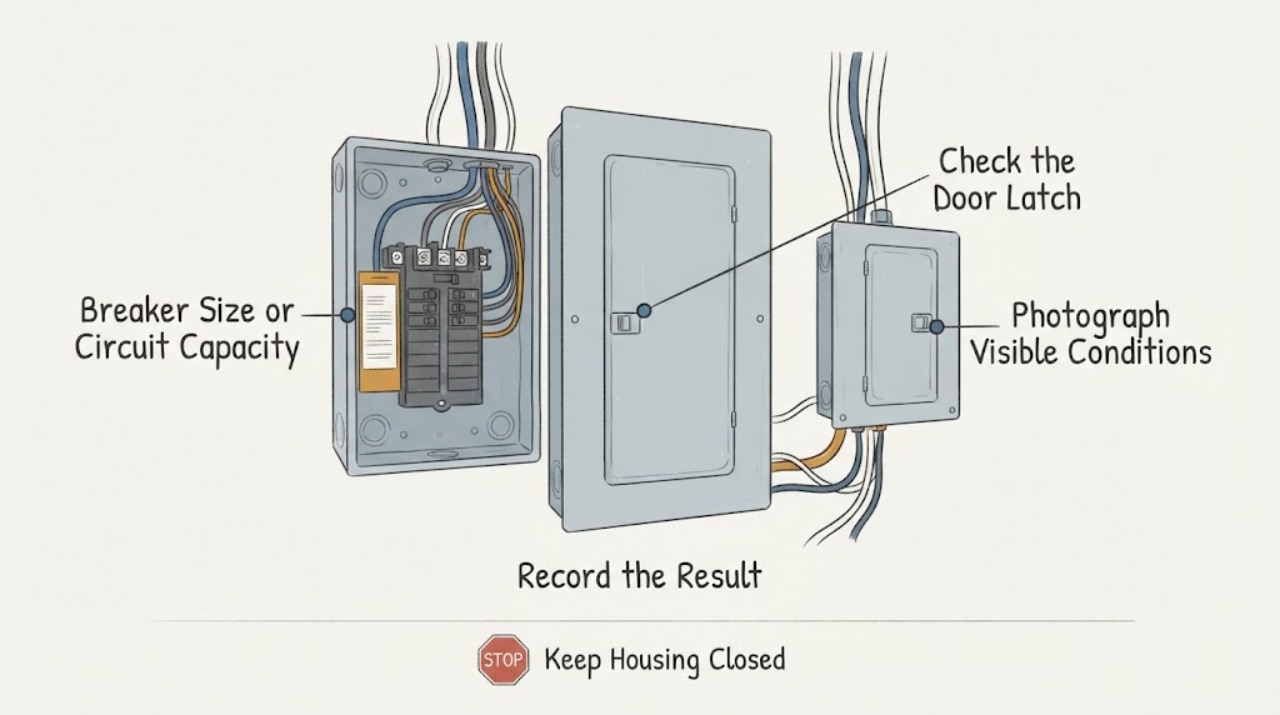
From the closed panel door and any accessible exterior label, record the Square D family and panel model, main rating, bus rating, breaker marking, amperage, poles, and AFCI/GFCI or other protection markings. Photograph the label without opening the enclosure; do not rely on a seller listing or a visually similar breaker.
Expected result: The label identifies a QO, Homeline, NQ, or another Square D family, provides main/bus/short-circuit information, or the panel and breaker identity cannot be confirmed.
Next step: Give the exact label and breaker markings to a qualified electrician and use the matching information manual. If identity is uncertain or the information is inside the panel, stop at the closed-door inspection.
Stop if: Stop if reading the label would require removing the panel cover, exposing buswork, disturbing a breaker, or touching a conductor.
Why this matters
Why: Schneider states that QO and Homeline load-center labels carry key mains, bus, short-circuit, wiring, and cover data. Breaker appearance alone does not establish compatibility or allowable capacity.
-
Check 3
Make a load inventory without opening the panel: list every appliance, receptacle, lighting circuit, and fixed load that loses power with the suspect Square D breaker, and photograph each accessible nameplate or installation label. Note startup motors, heating loads, simultaneous use, extension cords, and whether the breaker trips only when one load operates.
Expected result: Several high-demand loads share the circuit, one appliance trips it, a new load was added, a hard-wired load is involved, or the connected load cannot be identified.
Next step: Stop adding loads and keep a suspect appliance off. Do not move a heavy or hard-wired appliance, use an extension cord as a workaround, or reconnect loads to test the breaker repeatedly. Provide the inventory to an electrician.
Stop if: Stop for a damaged cord, warm plug/outlet, wet connection, hard-wired equipment, overloaded extension cord, or any need to access wiring.
Why this matters
Why: Several simultaneous loads make an overload possible; one repeatable appliance makes an appliance or branch fault possible; a new installation raises circuit-sizing and installation questions. An inventory cannot replace a code-compliant load calculation.
-
Check 4
Compare the installed breaker marking and panel label with the appliance installation instructions and circuit documentation, without removing the breaker or examining live conductors. Check whether the concern is a breaker that trips, a proposed higher rating, a panel with limited bus/main rating, a replacement type mismatch, or an added circuit request.
Expected result: The breaker rating conflicts with the appliance instructions or known conductor documentation, a replacement breaker is a different family, the panel label limits the choice, or the documentation is missing.
Next step: Leave the installation unchanged and arrange an electrician to verify conductors, load, breaker compatibility, interrupting rating, bus/main limits, and local requirements. Do not select a higher breaker from the appliance nameplate alone.
Stop if: Stop if verification would require removing a breaker, opening the panel, tightening lugs, moving wires, or using a replacement whose listing is uncertain.
Why this matters
Why: A mismatch or missing documentation means capacity and compatibility are unverified. Square D panel documentation requires listed breaker families and applicable interrupting/series ratings; wire and load requirements still control the safe selection.
-
Check 5
If the circuit is currently stable and there are no hazard signs, note whether the Square D breaker holds with normal loads or trips at startup, under simultaneous use, at a particular receptacle/light, or with no load. Do not increase the rating or repeat a trip test; leave any circuit that trips again Off.
Expected result: The breaker trips immediately with no load, only with one appliance, only with several loads, at a particular outlet or light, or remains stable after the load inventory.
Next step: Call an electrician for no-load, receptacle, lighting, panel, breaker, or uncertain-capacity symptoms. Keep an appliance-specific suspect disconnected and arrange appliance service; have an electrician perform any load calculation or capacity change.
Stop if: Stop after the first renewed trip or for heat, odor, buzzing, arcing, flickering, a damaged outlet, or abnormal appliance behavior.
Why this matters
Why: Immediate no-load or receptacle/light trips make a wiring, breaker, panel, or protective-device fault more likely; appliance-specific trips point toward the appliance or branch; simultaneous-load trips may indicate overload. A stable observation does not prove capacity.
Use your observations
Decision map
Find the observation that best matches what you see, then follow the next safe action.
-
PATH 01Safety boundary
What you see
Is there heat, odor, buzzing/sizzling, smoke, arcing, water, a shock, or visible panel/wiring damage?
Do this next
Keep clear, leave the circuit off if safe, and use local emergency guidance for fire or active electrical events. Arrange qualified electrical service.
Why this path and its safety boundary
Why it matters: Hazard signs override all size or capacity checks and require immediate protection of people and property.
Safety stop: Keep the panel closed and classify the breaker, panel, loads, and timing of any trip before discussing capacity.
-
PATH 02Next step
What you see
The Square D breaker trips immediately with loads disconnected, will not latch, or trips when one receptacle or light is used.
Do this next
Leave the circuit Off and call a qualified electrician. Do not replace the breaker, open the panel, or increase its rating.
Why this path and its safety boundary
Why it matters: The pattern makes a branch wiring, breaker, panel, receptacle, lighting, or protective-device fault more likely than a simple total-load question.
-
PATH 03Next step
What you see
The breaker trips only when several known loads run together, or the concern began after adding a high-demand appliance.
Do this next
Stop combining the loads and do not use an extension cord as a permanent workaround. Have an electrician inventory and calculate the circuit before adding a circuit or changing protection.
Why this path and its safety boundary
Why it matters: The pattern makes an overload or inadequate circuit capacity more likely, but conductor size, continuous-load rules, panel limits, and equipment instructions still must be verified.
-
PATH 04Next step
What you see
One appliance causes a repeatable trip, or the installed/replacement Square D breaker type or rating does not match the panel and installation documentation.
Do this next
Keep the suspect appliance off and use appliance service when appropriate. For breaker, panel, wire, rating, or compatibility concerns, have a qualified electrician verify the installation against the Square D documentation and local requirements.
Why this path and its safety boundary
Why it matters: An appliance or branch fault is more likely in the first pattern; a listing, compatibility, conductor, or installation problem is more likely in the second. Neither pattern is safely solved by a larger handle.
Helpful context
Understand the symptom
Breaker amperage is not the same as available circuit capacity
A breaker protects a particular circuit and its conductors; it is not a request for the panel to supply any load that fits on the handle. The panel's bus, main rating, breaker family, conductor size, equipment instructions, circuit arrangement, and local requirements all matter. Schneider's Square D documentation points users to the panel label and information manual for these ratings, while its wire-sizing guidance ties breaker selection to wire gauge and code. A larger handle does not make smaller conductors or an overloaded circuit safe.
Identify the exact Square D load center before discussing a replacement
QO and Homeline are not a universal interchangeability rule. Schneider says the load-center box label carries the main rating, bus-bar rating, short-circuit rating, wiring diagram, cover number, and related data. The Square D panel label also limits replacement units to listed breaker families and requires the applicable interrupting rating or series combination. Photograph the closed-door label and breaker markings; do not remove the cover to read an inside label unless a qualified electrician is doing the work.
Treat repeated trips as evidence to investigate, not a sizing suggestion
A trip when several loads run together can be an overload, while a trip with one appliance, receptacle, or lighting load can indicate an appliance, branch-circuit, ground, arc, or wiring fault. CPSC advises identifying the affected branch and loads and obtaining qualified help for recurrent trips. Do not defeat the protection by installing a higher-rated breaker or fuse, and do not assume a breaker is undersized merely because it opens during a high-load event.
Safety boundary
Stop conditions
- Stop and keep clear for smoke, arcing, fire, shock, water near electricity, a hot/discolored panel or outlet, burning odor, or exposed conductors; use local emergency guidance as appropriate.
- Do not replace a Square D breaker with a larger rating, bypass it, tape it On, use an unlisted type, or substitute a fuse/breaker whose rating is unverified.
- Do not open the panel, remove a dead front or breaker, move wires, tighten lugs, calculate capacity from handle numbers alone, or use an extension cord as a permanent capacity workaround.
- After the first renewed trip, leave the circuit Off and stop testing; keep a suspect appliance disconnected until qualified appliance or electrical service evaluates the cause.
Common questions
FAQ
Can I install a larger Square D breaker if the current one trips?
No. A larger breaker can allow more current through conductors that were not designed for it. Breaker selection depends on the actual load, conductors, panel/load-center listing, equipment instructions, and local requirements. CPSC specifically warns against installing a higher-rated protective device; have an electrician evaluate the cause and capacity.
How do I find the correct Square D breaker size for my circuit?
Do not choose it from neighboring handle numbers. Identify the exact panel and breaker family, read the closed-door label and manual, inventory the loads, and have a qualified electrician verify conductor ampacity, load calculation, panel bus/main limits, interrupting rating, compatibility, and local requirements.
Does adding up all the breaker handle numbers tell me my panel's capacity?
No. The printed branch ratings are not a substitute for a load calculation or the panel's main and bus ratings. Schneider identifies those ratings on Square D load-center labels, and the conductors, equipment, panel listing, and applicable rules also matter. Have an electrician evaluate an added load or capacity concern.
What does it mean if the Square D breaker trips immediately with nothing running?
An immediate trip with loads disconnected makes a branch wiring, breaker, panel, or protective-device fault more likely than a simple simultaneous-load overload. Leave it Off and call a qualified electrician. Do not open the panel or try a higher-rated breaker.
How do I know whether a replacement Square D breaker is compatible with my panel?
Confirm the exact load-center model, breaker family, listing, pole arrangement, interrupting/series rating, conductor requirements, and installation manual. Schneider's Square D panel documentation identifies compatible breaker families and rating information; a similar-looking breaker is not enough. Have a qualified electrician make the replacement.
Read the exact guide
Official sources
- SPD Circuit Breaker and Wire SizesSchneider Electric USA · Schneider Electric Square D guidance tying breaker selection for surge-protection equipment to wire gauge and local electrical codes
- GE Appliance - Circuit Breaker TripsGE Appliances · GE appliance guidance distinguishing appliance-specific trips from immediate house-wiring or breaker-box trips
- 80041-647-06Schneider Electric / Square D · Square D NQ panelboard wiring-label requirements for short-circuit rating, continuous-load marking, compatible breaker families, and conductor information
- CPSC Guide to Home Wiring HazardsU.S. Consumer Product Safety Commission · U.S. consumer electrical-safety guidance on overloads, recurring trips, proper protective-device ratings, appliance faults, and qualified electrical help
- Video: Where are the Mains Rating, Bus bar rating, cover number, lug torque data and the short circuit current rating located on the QO and Homeline Load Centers?Schneider Electric USA · Square D QO and Homeline load-center label locations and the mains, bus, short-circuit, wiring, and cover information shown on those labels
Community feedback
Share a repair observation
Share a plain-text repair observation. Accepted observations are published automatically; this page may take a moment to update.