
On this page
Start here
Quick answer
A Siemens breaker that seems too small, trips under load, or is being considered for a larger appliance should not be upsized by reading the handle rating alone. The breaker, branch conductors, panel, equipment connection, and total load must work together. Read the panel and breaker markings from the outside, record what loads are running when the trip occurs, and check for heat, odor, buzzing, discoloration, sparks, water, or damaged insulation without removing the panel cover. Never install a higher-rated breaker to stop nuisance trips. A licensed electrician should verify Siemens breaker-to-panel compatibility and calculate branch, feeder, and service capacity before replacing a breaker, adding a circuit, or connecting new high-load equipment.
Before you begin
Safety first
- Breaker replacement, panel work, conductor inspection, load calculation, new-circuit installation, service changes, and any diagnosis behind the panel cover belong to a qualified electrical professional. The user can provide observations and documentation but should not expose live parts or alter protection.
Work through in order
Diagnostic checks
Use only checks that match the exact appliance or system and its official guide.
-
Check 1
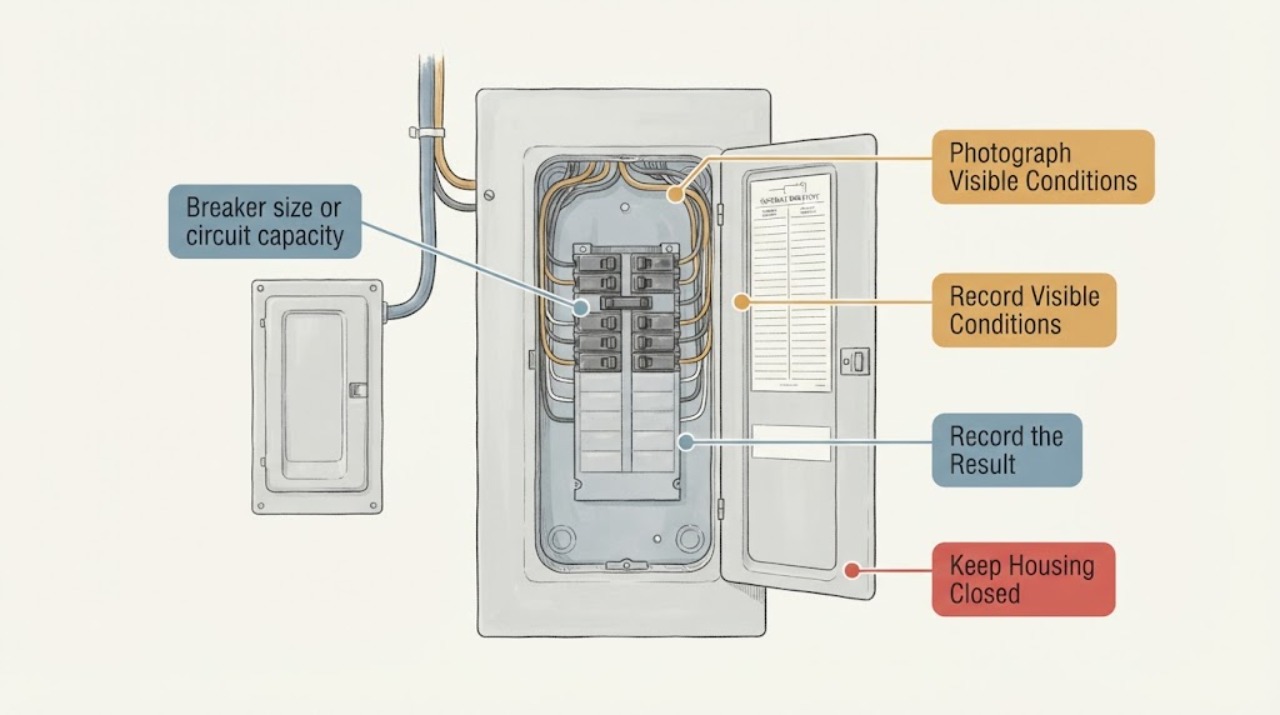
With the panel closed, photograph or write down the panelboard label, the Siemens breaker face markings, the circuit directory entry, and the number of poles; do not remove the cover or touch anything inside.
Expected result: The panel model and breaker type are legible and the directory identifies the affected circuit, or the label is missing, contradictory, or unreadable.
Next step: Keep the breaker and panel untouched and arrange qualified electrical service if the identity is unclear, a replacement is being considered, or the panel directory does not match the physical circuit.
Why this matters
Why: The markings give an electrician the starting point for checking listed breaker-to-panel compatibility. An unreadable or contradictory label leaves compatibility and circuit identity unverified; the Siemens name alone is not enough.
-
Check 2
Record what happens when ordinary plug-in loads on the affected circuit are used one at a time, and note whether the breaker trips immediately, only after several loads run, or only when one particular appliance starts; do not repeatedly reset a tripping breaker.
Expected result: The trip is immediate, follows one appliance, follows a combination of loads, or does not recur after the other ordinary loads are off.
Next step: Leave the affected circuit off when the trip is immediate or repeatable and call an electrician or appropriate appliance professional. If the pattern follows combined loads, keep high-load devices from sharing that circuit and have an electrician assess the circuit and capacity instead of upsizing the breaker.
Why this matters
Why: An immediate or single-appliance trip keeps a short, ground fault, appliance fault, or wiring problem in consideration. A pattern only under combined load makes an overload or capacity issue more likely, but neither pattern proves that a larger breaker is safe.
-
Check 3
Make a load list from appliance nameplates or manuals for the devices that may operate together, including any new or planned equipment; record the stated electrical requirements without adding breaker-handle ratings together.
Expected result: A new high-load appliance is planned, multiple substantial loads share the circuit, or the equipment requirement is absent or conflicts with the circuit label.
Next step: Give the load list, equipment manuals, panel model, and breaker markings to a licensed electrician before connecting the equipment or changing any breaker. Keep a planned installation disconnected when its required circuit is unknown.
Why this matters
Why: The concern needs a branch-circuit and possibly feeder or service-capacity assessment. Breaker handle totals are not a substitute for the load calculation, and missing equipment requirements prevent a reliable sizing decision.
-
Check 4
From a safe distance, look and listen for a hot or discolored breaker or panel area, a burning or unusual odor, buzzing or sizzling, sparks, smoke, water, flickering, or damaged insulation; do not touch the panel to test temperature.
Expected result: Any heat, discoloration, odor, buzzing, sparking, smoke, water intrusion, flickering, or visible damage is present.
Next step: Stop using the affected circuit and keep clear. If safe, switch off the affected circuit without opening the panel; for smoke, active sparking, fire, or an immediate hazard, leave the area and use emergency assistance. Arrange qualified electrical service.
Why this matters
Why: These are warning signs of an unsafe electrical condition, loose or damaged connection, arcing, overheating, or moisture exposure; the cause cannot be safely diagnosed from the outside.
-
Check 5
Compare the proposed change with the exact panel and equipment instructions only at the document and label level: check whether the panel documentation identifies an allowed breaker family and whether the equipment specifies a circuit requirement; do not install or test the replacement yourself.
Expected result: The documentation identifies a listed breaker family and the equipment requirement is clear, or the proposed breaker, panel, and equipment information do not line up.
Next step: Have a qualified electrician verify the breaker, conductor, panel, and load calculation before any breaker replacement, new circuit, service change, or equipment connection. Do not substitute a visually similar Siemens or other breaker.
Why this matters
Why: A listed family and clear equipment requirement give the electrician information to verify, but they do not establish conductor condition or whole-service capacity. A mismatch or missing listing means fit, protection, and capacity are unresolved.
Use your observations
Decision map
Find the observation that best matches what you see, then follow the next safe action.
-
PATH 01Next step
What you see
The breaker trips immediately, trips again with one appliance, or will not stay reset even after ordinary loads are disconnected.
Do this next
Leave the circuit off, do not keep resetting it, and arrange qualified electrical diagnosis. If the pattern follows one removable appliance, leave that appliance disconnected until it is assessed. Do not open the panel.
Why this path and its safety boundary
Why it matters: A short, ground fault, defective appliance, or wiring/connection problem is more likely than a simple capacity calculation; a larger breaker could remove protection from the existing circuit.
-
PATH 02Next step
What you see
The breaker trips only when several loads operate together, or a new high-load appliance causes the concern, while no immediate heat, odor, sparks, or damage is visible.
Do this next
Keep high-load equipment off that circuit and have an electrician perform the required load and conductor assessment before using the equipment or changing protection.
Why this path and its safety boundary
Why it matters: An overload or inadequate branch, feeder, or service capacity is more likely, but the safe remedy may be load management, a new circuit, equipment changes, or a service upgrade—not automatically a larger breaker.
-
PATH 03Next step
What you see
The panel or breaker is hot or discolored, there is buzzing, sizzling, a burning odor, smoke, sparking, water, flickering, or damaged insulation.
Do this next
Stop using the circuit and keep clear. Isolate power only if it can be done without approaching an immediate hazard; leave and use emergency assistance for smoke, fire, or active sparking, then arrange qualified electrical service.
Why this path and its safety boundary
Why it matters: An active electrical hazard or damaged connection is possible and is more urgent than deciding whether the breaker is too small.
-
PATH 04Next step
What you see
The proposed breaker is not identified in the panel documentation, the panel and breaker markings conflict, or a new circuit or service change is planned without a verified load calculation.
Do this next
Do not install the proposed breaker or connect the new equipment. Give the exact markings and equipment requirements to a licensed electrician for compatibility, code, and capacity verification.
Why this path and its safety boundary
Why it matters: Breaker compatibility, interrupting protection, conductor suitability, and available capacity are unresolved; appearance or shared branding cannot establish a safe fit.
Helpful context
Understand the symptom
Why breaker size is not a standalone number
A breaker is part of a protective system: its rating must suit the conductors and equipment it protects, while the panel and service must be able to accept the circuit and the connected load. A Siemens label does not by itself prove that every Siemens breaker fits every Siemens load center, or that a breaker with a larger handle rating is safe for the existing wiring. The visible markings can identify what needs to be checked; they cannot replace the electrician's compatibility and load calculation.
Start with observations that do not expose live parts
Use the panel directory, breaker face, equipment nameplates, and the owner's or installation manual. Record the exact panel and breaker markings, pole arrangement, circuit label, and the loads that are operating when the concern appears. Do not remove the service-panel cover, loosen a terminal, probe a breaker, or handle conductors to obtain a rating.
Treat a trip as information, not an invitation to upsize
A trip that follows several loads or a newly added appliance can indicate an overloaded circuit or an inadequate planned capacity. A trip that happens immediately, repeats with one appliance, or occurs with a hot or noisy panel can indicate a fault or dangerous connection. Turning off ordinary plug-in loads may help isolate a pattern, but it does not authorize changing the breaker or opening the panel.
When the question is an upgrade, get the whole path checked
Adding an electric range, heat pump, EV supply equipment, workshop tool, or other substantial load can affect the branch circuit, feeder, panel, and service. An electrician needs the equipment nameplate or installation instructions and the existing panel information to determine a compliant path. Keep the equipment disconnected if its required circuit or capacity is uncertain, and do not use a higher-rated breaker as a workaround.
Safety boundary
Stop conditions
- Never install a higher-rated breaker to stop trips, substitute a visually similar breaker, bridge or bypass protection, or remove the panel cover as a homeowner troubleshooting step.
- Keep the circuit off and arrange qualified electrical service for repeated or immediate trips, a breaker that will not reset, a proposed breaker replacement, a new high-load circuit, or a service-capacity question.
- If there is smoke, fire, active sparking, a burning odor, severe heat, water entering electrical equipment, or exposed/damaged wiring, leave the area and use emergency assistance when appropriate; do not touch the equipment.
When checks do not resolve it
Need a professional?
Safety scope: Breaker replacement, panel work, conductor inspection, load calculation, new-circuit installation, service changes, and any diagnosis behind the panel cover belong to a qualified electrical professional. The user can provide observations and documentation but should not expose live parts or alter protection.
Common questions
FAQ
Can I install a larger Siemens breaker to stop repeated trips?
No. A larger breaker can allow more current than the existing conductors or equipment are designed to handle. First identify whether the trip is caused by one appliance, a fault, combined loads, or a capacity problem, then have a qualified electrician verify the circuit before any change.
Does a Siemens breaker fit any Siemens panel?
Not necessarily. Siemens documentation identifies panel-specific listed breaker types and warns against using other types. Read the exact panel and breaker markings without opening the panel and have an electrician confirm the listed fit and protection.
How can I tell whether the problem is overload or a short?
A trip only when several loads run can make overload or capacity more likely, while an immediate or repeatable trip with one appliance can indicate a fault in the appliance, wiring, or circuit. These patterns are clues, not a safe diagnosis. Leave a repeat-tripping circuit off and arrange qualified service.
What information should I collect before calling an electrician?
Collect clear photos or notes of the panel and breaker markings visible with the cover closed, the circuit directory entry, the loads operating when the trip occurs, the timing and reset behavior, and the nameplate requirements for any new equipment. Do not remove the panel cover or alter the breaker.
Does adding a high-load appliance require a larger breaker?
It may require a different compliant circuit or other electrical work, but a larger breaker is not an automatic remedy. The equipment requirement, existing conductors, panel, feeder, and service capacity need to be assessed together by a qualified electrician before connection.
Read the exact guide
Official sources
- Electrical SafetyU.S. Consumer Product Safety Commission · General consumer electrical-safety flyer for household warning and professional-help boundaries
- CPSC Guide to Home Wiring HazardsU.S. Consumer Product Safety Commission · Residential electrical safety guidance for identifying hazards without treating it as a substitute for qualified electrical work
- 4099827.cdrSiemens Energy & Automation, Inc. · Siemens panelboard instruction sheet; exact breaker acceptance depends on the specific panelboard documentation
- National Electrical CodeU.S. Consumer Product Safety Commission · General U.S. code-scope information; the locally adopted code and a qualified professional determine the applicable installation requirements
Community feedback
Share a repair observation
Share a plain-text repair observation. Accepted observations are published automatically; this page may take a moment to update.