
On this page
Start here
Quick answer
Do not install a larger breaker to stop trips or make a GE circuit appear to have more capacity. The breaker rating, conductor size, load-center listing, connected load, and protection function have to work together, and those details cannot be confirmed by looking at the ampere number alone. From outside the closed panel, record the GE panel and breaker markings, circuit label, appliances on the circuit, what happens when the circuit trips, and any heat, discoloration, buzzing, odor, flicker, or damaged equipment. If the concern is only that the breaker number seems too small, have an electrician verify the design. If the breaker trips again, trips with little load, or shows overheating or damage, leave it off and call a qualified electrician. Do not open the panel or measure current on live wiring.
Before you begin
Safety first
- The homeowner should not open the panel, measure live current, alter wiring, change breaker ratings, bridge protection, repeatedly reset the breaker, or install a replacement. Capacity verification, fault testing, and replacement belong to qualified electrical personnel.
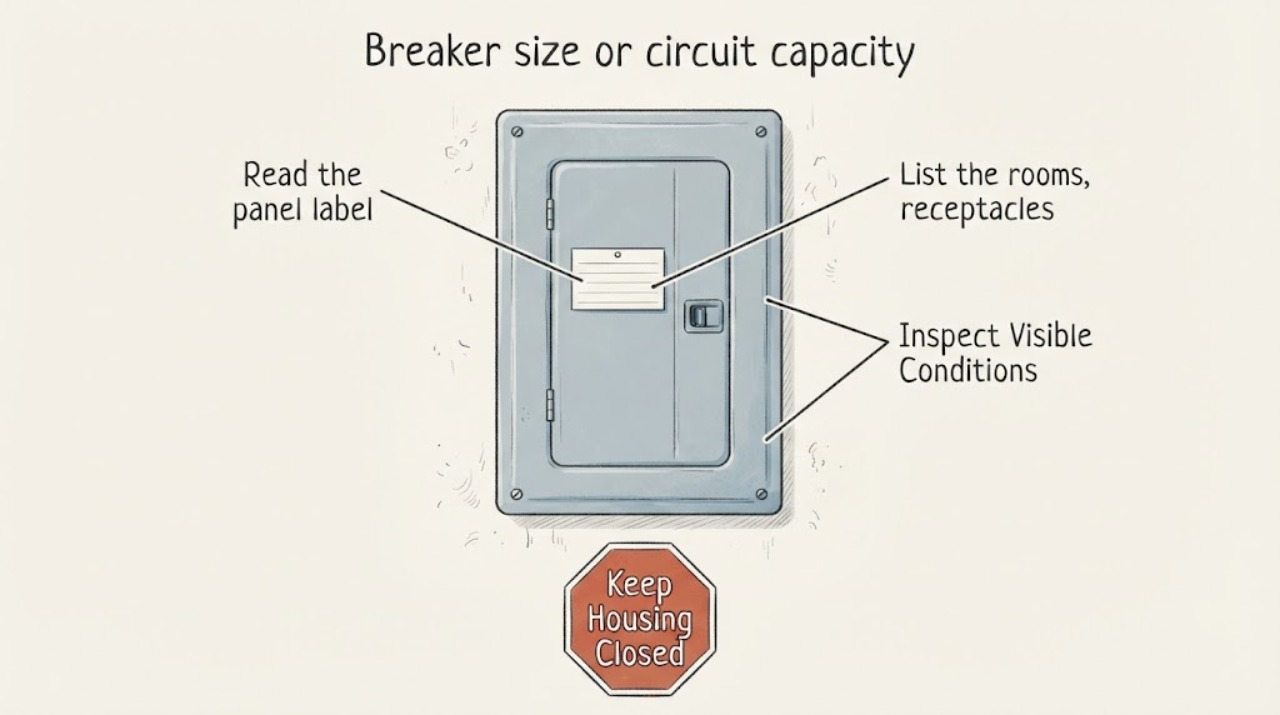
Work through in order
Diagnostic checks
Use only checks that match the exact appliance or system and its official guide.
-
Check 1
Read the GE panel label, breaker face marking, circuit directory, pole count, and ampere marking from outside the closed panel; do not remove the cover, breaker, or dead front to find additional information.
Expected result: The panel and breaker markings are legible, the directory disagrees with the installed marking, or the family and rating are unclear.
Next step: Photograph the exterior label and provide it to a qualified electrician. Do not buy a replacement or change the rating while identification is uncertain.
Why this matters
Why: Legible markings give an electrician the starting identity for capacity and compatibility review. A disagreement or missing marking means the installation cannot be judged safely by appearance or by the ampere number alone.
-
Check 2
List the rooms, receptacles, and permanently connected appliances that lose power when this breaker is off, and note any recent appliance or circuit additions without opening boxes or panel wiring.
Expected result: The circuit serves several high-demand appliances, one recently added appliance, or an unclear and possibly shared group of loads.
Next step: Keep high-demand or suspect appliances off until the capacity is reviewed. Give the load list to an electrician; do not move wiring or add a larger breaker.
Why this matters
Why: Several high-demand loads can exceed the circuit's intended use, while a recent appliance or wiring change may have altered the design. An unclear list means the directory or circuit assignment needs professional verification.
-
Check 3
Observe when the breaker trips during normal use—immediately when a device starts, after it has run for a while, or with no clear load—and do not deliberately add loads or use a meter on live wiring to reproduce it.
Expected result: The trip is immediate at startup, delayed during operation, or unrelated to a known appliance.
Next step: Record the timing and stop using any appliance that consistently triggers the trip. Have an electrician diagnose the circuit and load rather than changing the breaker size.
Why this matters
Why: Schneider describes immediate trips as more consistent with inrush or a short-circuit path and delayed trips as more consistent with thermal overcurrent. A trip with no clear load keeps wiring, equipment, connection, and breaker faults in consideration.
-
Check 4
If there are no visible warning signs and the breaker is in a normal user-accessible reset state, turn off or unplug the known loads on that circuit and reset the breaker once according to the panel's normal handle operation; do not force it or reset an unfamiliar main disconnect.
Expected result: The breaker holds with known loads off, trips immediately again, or will not reset normally.
Next step: If it trips again or will not reset, leave it off and call an electrician. If it holds, keep the suspect load off and do not repeat reset cycles or add appliances.
Why this matters
Why: Holding after loads are removed makes a load or appliance problem more likely, but does not prove the circuit has spare capacity. A repeat trip or failed reset points toward a fault or breaker problem.
-
Check 5
From outside the closed panel and at the connected appliance side, look for discoloration, melted plastic, a burning odor, buzzing, crackling, flicker, hot receptacle covers, damaged cords, or water; do not touch hot equipment or inspect panel connections.
Expected result: No warning signs are visible, or there is heat, odor, noise, discoloration, melting, flicker, damaged equipment, smoke, arcing, or water.
Next step: Stop using the affected circuit or appliance and call an electrician. Leave and call emergency services for smoke, arcing, or fire; keep away from water near electrical equipment.
Why this matters
Why: These signs indicate a possible overheating, connection, equipment, fire, or shock hazard and override any attempt to calculate capacity from labels. A clean exterior does not prove the internal wiring is sound.
-
Check 6
Write down the exact concern—frequent trips, a breaker rating that seems too low, a planned appliance addition, or a suspected mismatch—and provide the electrician the GE panel label, breaker marking, load list, trip timing, and warning signs.
Expected result: The concern is about a proposed new load, a current circuit that trips, or a breaker that appears inconsistent with the panel or directory.
Next step: Schedule an electrician inspection. Keep the affected circuit unchanged and do not perform live-load measurements, panel-cover work, or breaker upsizing while waiting.
Why this matters
Why: A proposed load requires a design and capacity review; current trips require fault diagnosis; and an apparent mismatch requires verification of the listed load center and breaker rather than a visual substitution.
Use your observations
Decision map
Find the observation that best matches what you see, then follow the next safe action.
-
PATH 01Next step
What you see
The breaker rating only seems small on the label, but it is not tripping and there are no heat, odor, noise, flicker, or damage signs.
Do this next
Do not change the breaker. Have an electrician verify the GE load center, wiring, existing load, and intended use before adding equipment or selecting a different rating.
Why this path and its safety boundary
Why it matters: A label-only concern does not establish that the circuit lacks capacity or that the breaker is wrong; conductor, load, panel, and code details are still unknown.
-
PATH 02Next step
What you see
The breaker trips after several appliances run together, or the trip occurs after a period of operation and stops when known loads are removed.
Do this next
Keep the suspect load off and have an electrician assess circuit capacity and the appliances. Never install a larger breaker to keep the circuit energized.
Why this path and its safety boundary
Why it matters: Sustained overcurrent or an appliance problem is more likely than a purely cosmetic rating concern.
-
PATH 03Next step
What you see
The breaker trips immediately at startup, trips with known loads disconnected, or will not reset normally.
Do this next
Leave the breaker off and call a qualified electrician. Do not test live wiring, open the panel, or substitute a breaker.
Why this path and its safety boundary
Why it matters: A short-circuit or ground-fault path, connected equipment fault, wiring issue, or breaker fault is more likely than simple circuit capacity.
-
PATH 04Next step
What you see
Heat, discoloration, melting, buzzing, crackling, burning odor, flicker, smoke, arcing, damaged cords, or water is present near the circuit.
Do this next
Stop using the circuit or appliance, keep clear, and call an electrician. Leave and call emergency services for smoke, arcing, or fire.
Why this path and its safety boundary
Why it matters: The immediate issue may be overheating, fire, or shock risk; calculating load capacity is no longer the priority.
-
PATH 05Next step
What you see
A GE breaker replacement is proposed, but the load-center family, breaker catalog marking, pole configuration, rating, or protection feature is unclear.
Do this next
Have a qualified electrician identify the panel and approved breaker and diagnose the capacity concern before selecting any replacement.
Why this path and its safety boundary
Why it matters: Compatibility and the reason for the original rating are unverified. GE-labeled residential products may now be supported under ABB ReliaHome, but that does not make every breaker interchangeable.
Helpful context
Understand the symptom
A breaker number is not the circuit's complete capacity
The ampere marking describes the protective device, not a permission to add unlimited load. The circuit's wiring, panel, equipment, connection condition, and local requirements all matter. A breaker that trips may be correctly protecting an overloaded or faulty circuit, or it may be part of a wiring or device problem. Do not infer that the circuit is undersized—or solve a trip—by changing the breaker yourself.
Use behavior and exterior information, not live measurements
You can safely gather useful information without removing the panel cover: which appliances lose power, whether the trip occurs at startup or after a period of use, whether one appliance consistently precedes it, and whether there are heat, odor, buzzing, flicker, or discoloration signs. Current measurements, terminal inspection, conductor sizing, and breaker replacement require qualified electrical work.
GE labels and replacement compatibility must be verified
GE residential electrical products moved under ABB's ReliaHome portfolio after ABB acquired GE's Industrial Solutions business. ABB says its breakers are compatible with GE load centers, but that statement does not identify the correct rating, pole configuration, protection feature, or condition of a particular installation. Give the electrician the exact panel and breaker markings; do not substitute a device because it fits physically or carries a similar ampere label.
Safety boundary
Stop conditions
- Do not install a larger breaker, bridge or defeat the breaker, or change the circuit rating to stop trips or add capacity.
- Do not remove the panel cover, touch terminals, inspect live connections, or measure current on energized wiring as a homeowner.
- Do not repeatedly reset a breaker, force a handle, or keep using a circuit that trips again or shows heat, odor, noise, discoloration, or damage.
- Stop and leave for smoke, arcing, fire, severe burning odor, or water near electrical equipment; call emergency services from a safe location.
When checks do not resolve it
Need a professional?
Request electrical inspection for circuit-capacity planning, recurrent trips, a suspected oversized or mismatched breaker, unclear GE load-center compatibility, or any sign of overheating or wiring damage.
Safety scope: The homeowner should not open the panel, measure live current, alter wiring, change breaker ratings, bridge protection, repeatedly reset the breaker, or install a replacement. Capacity verification, fault testing, and replacement belong to qualified electrical personnel.
Have this ready
- Provide the GE panel and breaker markings visible from outside, circuit directory label, pole count and ampere marking if legible, appliances and recent additions on the circuit, trip timing, result of the single conditional reset if used, and photos of exterior warning signs without opening the panel.
Common questions
FAQ
Does a higher-amp breaker give my GE circuit more capacity?
No. A breaker must protect the circuit wiring and match the panel and load. Installing a higher rating can leave the wiring under-protected; have an electrician review the complete installation.
How can I tell whether my GE breaker is the right size?
You cannot confirm it from the ampere number alone. An electrician must compare the GE load-center listing, breaker type, wiring, connected load, protection function, and local requirements.
What does it mean if the breaker trips only when several appliances run?
Sustained overcurrent or an appliance problem becomes more likely. Keep the known suspect load off and have an electrician assess the circuit and appliances rather than upsizing the breaker.
Can I use an ABB breaker in an older GE load center?
ABB says its ReliaHome residential products include GE-compatible load centers and breakers, but exact compatibility, rating, protection type, and installation still require the panel label and a qualified electrician's verification.
Should I measure the circuit amperage to check its capacity?
Do not measure live current or open the panel as a homeowner. Record the appliances, trip behavior, and exterior labels and have a qualified electrician perform any electrical testing.
Read the exact guide
Official sources
- How do you determine why a thermal-magnetic breaker nuisance trips?Schneider Electric USA · Cross-manufacturer technical guidance used for distinguishing startup from delayed trips and for overload, equipment, connection, and breaker-fault possibilities; it does not establish GE-specific fitment.
- UL-listed residential productsABB · Brand-specific manufacturer guidance used only for the compatibility boundary; it does not select a breaker rating for an individual circuit or authorize homeowner installation.
- GE Residential products are now ABB ReliaHome™ABB Electrification U.S. · Brand-specific manufacturer guidance used to explain why a GE-labeled residential load center may be supported through ABB ReliaHome documentation and why exact identification is needed.
- CPSC Guide to Home Wiring HazardsU.S. Consumer Product Safety Commission · Government guidance used for the protective role of breakers, identifying overload and repeated trips, warning against higher-rated protection, and keeping panel-cover work with qualified electricians.
Community feedback
Share a repair observation
Share a plain-text repair observation. Accepted observations are published automatically; this page may take a moment to update.