
On this page
Start here
Quick answer
Do not choose an Eaton breaker by handle size, by matching a larger amp number, or by what physically fits the panel. Breaker selection depends on the exact Eaton loadcenter and listed breaker family, the branch-circuit conductors, the calculated load, the equipment instructions, and applicable code. Read the panel label and breaker markings from the outside, record which loads share the circuit, and note any trip, heat, buzzing, scorch mark, or burning smell without removing the cover. Never install a larger breaker to stop trips, add loads to a circuit that is already overloaded, or work inside an energized panel. Have a qualified electrician verify conductor ampacity, breaker compatibility, panel and service capacity, and any required AFCI, GFCI, two-pole, or other protection before changing a breaker or circuit.
Before you begin
Safety first
- User checks are limited to external labels, a load inventory, and safe observation. A qualified electrician must open the panel, verify conductors and terminations, calculate load, select listed Eaton devices, alter circuits, test protective functions, and handle service equipment.
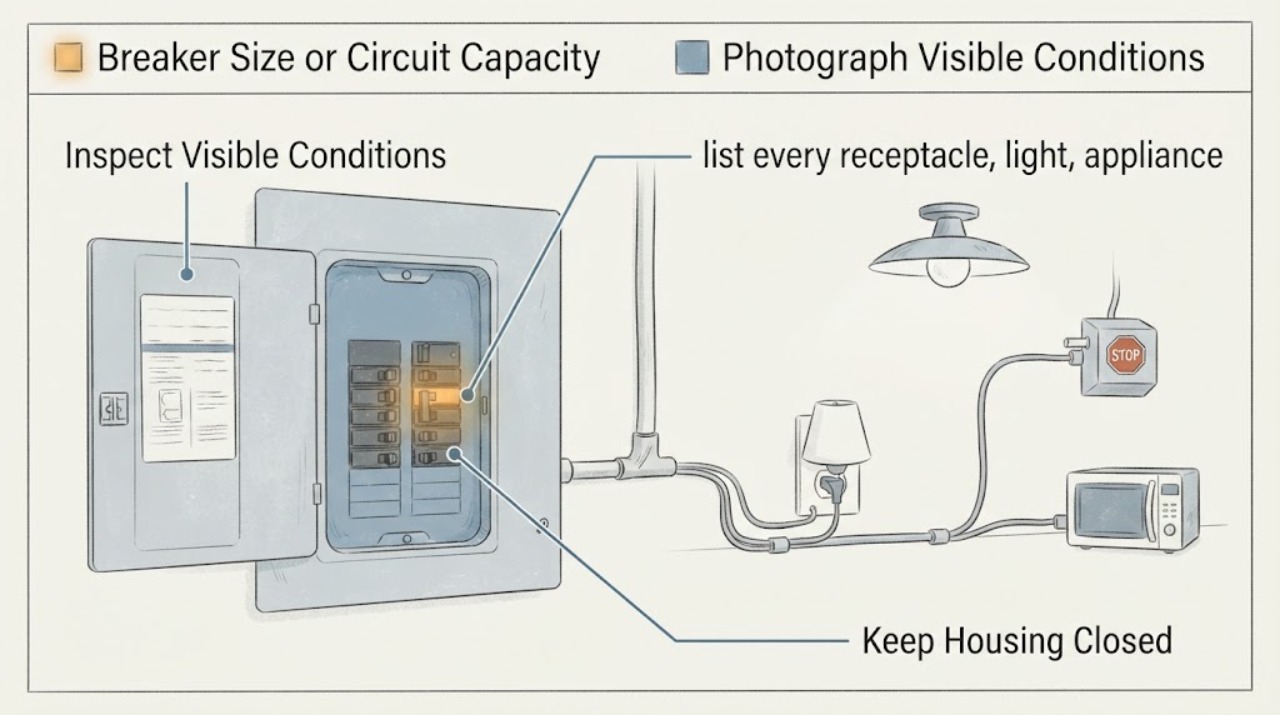
Work through in order
Diagnostic checks
Use only checks that match the exact appliance or system and its official guide.
-
Check 1
From outside the closed panel, photograph or transcribe the Eaton panel label, loadcenter type, breaker label, pole count, amp marking, circuit directory, and any compatibility or warning text; do not remove the deadfront or touch a conductor.
Expected result: The panel type and breaker marking are clear, the directory is missing or inconsistent, the breaker does not appear to match the panel family, or the markings cannot be read safely.
Next step: Give the photographs and markings to a qualified electrician to verify the exact panel, breaker family, pole arrangement, interrupting rating, and required protection. Do not shop for a replacement from the handle marking alone.
Stop if: Stop for a missing cover, exposed metal or wiring, heat, smoke, arcing, water intrusion, or any need to open the panel.
Why this matters
Why: Eaton uses distinct loadcenter and breaker families, and a visible amp number does not establish listing or compatibility. An unclear or inconsistent directory increases the chance of misidentifying the circuit.
-
Check 2
With the circuit left intact, list every receptacle, light, appliance, motor, heater, or fixed load that loses power when the identified breaker is off; use appliance nameplates and manuals from outside the panel and do not add a load for testing.
Expected result: One known load is affected, several rooms or appliances share the circuit, a high-demand appliance shares it with general outlets, or the circuit boundary is uncertain.
Next step: Record the loads, nameplate information, simultaneous-use pattern, and any extension-cord or power-strip use. Ask an electrician to calculate the branch load before adding equipment or changing protection.
Stop if: Stop if identifying the circuit would require probing outlets, removing covers, opening junction boxes, or repeatedly cycling a tripping breaker.
Why this matters
Why: The connected-load pattern helps an electrician identify possible overload and whether the breaker serves a dedicated or multi-outlet circuit. A room label or assumed circuit map is not a substitute for tracing and load calculation.
-
Check 3
Note whether the Eaton breaker trips immediately, only after a load runs, during simultaneous use, or without an obvious load; from a safe distance look for a warm or discolored face, buzzing, burning odor, smoke, arcing, damaged insulation, or a hot receptacle.
Expected result: The trip repeats under load, occurs immediately, occurs randomly, or any heat, odor, smoke, buzzing, arcing, or visible damage is present.
Next step: Stop using the affected circuit or equipment when safe, keep clear of the panel and receptacle, and obtain urgent qualified electrical inspection. Do not reset repeatedly or substitute a higher-rated breaker.
Stop if: Stop immediately for smoke, fire, arcing, burning odor, a hot or melted device, exposed conductors, or a breaker that will not remain safely off.
Why this matters
Why: A repeat under load may reflect overload or equipment demand; an immediate or random trip can involve a fault, ground-fault or arc-fault protection, wiring, or breaker issue. Heat, odor, smoke, and arcing indicate a hazard, not a sizing experiment.
-
Check 4
Record the connected equipment voltage, phase or pole requirement, continuous-use or motor characteristics if stated on the nameplate, and any AFCI or GFCI indication; do not infer conductor size or protection from the equipment plug, receptacle face, or breaker handle.
Expected result: The equipment calls for a dedicated or multi-pole supply, the plug or receptacle does not match the breaker information, protective-device indication is present, or the equipment details are unknown.
Next step: Give the nameplate and panel information to an electrician for a design and compatibility check. Do not install an adapter, replace a receptacle, change poles, or bypass AFCI or GFCI protection to make equipment operate.
Stop if: Stop for a hot plug or receptacle, damaged cord, water exposure, missing ground, repeated protective trips, or any need to access wiring.
Why this matters
Why: Equipment requirements can change the circuit arrangement and protection needed. A matching plug or a breaker that fits the panel does not establish conductor ampacity, load capacity, or code compliance.
-
Check 5
For a proposed new load or remodel, write down the equipment rating, intended simultaneous loads, panel main rating, available breaker spaces, and Eaton loadcenter family from the labels only; do not assume spare spaces or a larger main rating prove capacity.
Expected result: The proposed load is new or high demand, the panel has spare spaces but an unknown bus or service rating, the main or directory is unclear, or existing loads already trip.
Next step: Have a qualified electrician perform the required load calculation, verify the Eaton panel's listed devices and bus limits, assess conductor ampacity and routing, and identify permits or protective requirements before any installation.
Stop if: Stop if the planned work would require opening the panel, moving a service conductor, changing the main, adding a tandem or multi-pole device, or modifying wiring.
Why this matters
Why: Branch conductors, the breaker, the loadcenter bus, and the home's service demand are separate constraints. Existing trips or unknown ratings make a capacity decision unsafe without a calculated assessment.
-
Check 6
Arrange qualified electrical service for any breaker-size or capacity decision, repeated trip, panel compatibility question, new load, or uncertain circuit identity; provide the panel and breaker markings, load map, appliance nameplates, trip timing, and photos taken without opening the enclosure.
Expected result: The electrician can verify the existing installation and calculated load, or critical information remains unknown because the panel or conductors are unsafe to access.
Next step: Keep the circuit in its last safe state and follow the electrician's isolation instructions. Do not install a larger breaker, double-tap a terminal, add a load, or repeatedly reset the existing device while waiting.
Stop if: Stop all user electrical work for exposed energized parts, burning, smoke, arcing, melted insulation, water intrusion, or any service-equipment concern.
Why this matters
Why: Breaker size is not a stand-alone repair choice. Safe resolution may require conductor inspection, load measurement or calculation, listed Eaton compatibility, fault diagnosis, and service or branch-circuit work.
Use your observations
Decision map
Find the observation that best matches what you see, then follow the next safe action.
-
PATH 01Next step
What you see
An existing Eaton breaker trips repeatedly when several known loads operate, with no heat, odor, smoke, or exposed wiring.
Do this next
Reduce use of the affected circuit only by unplugging or turning off accessible loads safely, do not reset repeatedly, and have an electrician verify the load and conductor protection. Never install a larger breaker as the remedy.
Why this path and its safety boundary
Why it matters: An overload or excessive simultaneous demand is possible, but a fault or device problem cannot be ruled out from timing alone.
-
PATH 02Next step
What you see
The breaker trips immediately, will not reset, or trips when one particular appliance or tool starts.
Do this next
Leave the circuit or suspect equipment out of use and arrange prompt electrical diagnosis. Do not substitute a higher rating or bypass protective functions.
Why this path and its safety boundary
Why it matters: A short, ground fault, arc-fault event, equipment fault, starting-current issue, or breaker problem may be involved; this is not enough evidence to resize the breaker.
-
PATH 03Next step
What you see
A proposed load would use a spare Eaton panel position, but the panel family, bus rating, conductor size, or service capacity is unknown.
Do this next
Have an electrician identify the loadcenter and approved breaker family, calculate demand, verify conductors and service, and handle any required installation or permit work.
Why this path and its safety boundary
Why it matters: A spare position is only physical space; it does not establish listed breaker compatibility or capacity for the new circuit.
-
PATH 04Next step
What you see
The breaker amp marking appears larger than the receptacle, equipment, or known circuit wiring, or the breaker does not match the Eaton panel labeling.
Do this next
Do not operate the affected circuit under added load or change the breaker yourself. Arrange an electrician to verify the panel, device listing, conductors, terminations, and required protection.
Why this path and its safety boundary
Why it matters: The overcurrent protection may be incorrectly selected or the installation may have compatibility or conductor concerns. A physical fit is not proof of a safe listing.
-
PATH 05Next step
What you see
The panel or breaker is warm, discolored, buzzing, sparking, wet, smoky, or has a burning odor.
Do this next
Keep clear, stop using the affected equipment if safe, and obtain urgent qualified electrical or emergency help. Do not touch the panel, reset the breaker, or remove its cover.
Why this path and its safety boundary
Why it matters: This is an electrical fire, shock, arc, or equipment hazard, not a routine circuit-capacity question.
Helpful context
Understand the symptom
A breaker size is part of a protection system
The breaker, conductors, load, panel, and required protective functions must work together. A breaker with a larger marking can allow more current before opening, but that does not make the existing wiring or panel suitable for the load. A breaker that trips is giving information about an overload, fault, compatibility issue, or equipment problem; defeating that behavior can leave conductors unprotected.
Separate three different capacity questions
An electrician should distinguish the branch-circuit question—whether the conductors and breaker serve the connected load—from the loadcenter question—whether the Eaton panel and bus accept the proposed device—and the service question—whether the home's calculated demand can support an added load. A vacant breaker position answers none of these by itself.
Treat trips and heat as safety signals
Repeated trips, a warm or discolored breaker, buzzing, a burning odor, smoke, arcing, or damaged insulation are not invitations to try a different breaker. Turn off or unplug the affected load only when that can be done safely without approaching exposed electrical parts, keep people away, and arrange qualified electrical inspection. OSHA notes that improper breaker ratings can remove overcurrent protection.
Safety boundary
Stop conditions
- Do not install a larger breaker, replace a fuse with a larger rating, add a tandem or multi-pole device, or change a breaker type to stop trips.
- Do not remove the panel cover, touch conductors, probe a receptacle, tighten terminals, double-tap a breaker, or infer conductor size from a visible cable or device.
- Stop for heat, discoloration, buzzing, smoke, burning odor, arcing, exposed wiring, water intrusion, melted insulation, or a breaker that will not remain safely off.
- Do not add equipment to a circuit with unknown load or capacity, use adapters to bypass a required circuit, or defeat AFCI, GFCI, grounding, or other protective functions.
- Keep the circuit in a safe state and arrange qualified electrical assessment for all sizing, listing, conductor, loadcenter, and service-capacity decisions.
Only after diagnosis
Potential parts
- Eaton listed replacement breaker
Consider only after an electrician confirms the existing breaker is defective or the exact circuit design requires a listed replacement with the required amp, pole, interrupting, AFCI, GFCI, or dual-function characteristics.
Confirm the exact Eaton loadcenter, breaker family, listing, pole arrangement, and local requirements; a breaker that fits or has the same amp marking may still be unsuitable. - branch-circuit conductors or cable
Consider only when a calculated load requires a new or upgraded branch circuit and a qualified electrician designs the route, conductor, breaker, and protection together.
Conductor ampacity depends on insulation, installation, temperature, number of current-carrying conductors, length, terminals, and local code; do not select by breaker size alone. - Eaton loadcenter or panel component
Consider only if an electrician finds that the existing loadcenter, bus, spaces, or service arrangement cannot support the calculated load or required protection.
Panel and service work can involve service conductors, utility coordination, permits, and listed combinations; exact model and site assessment are required.
When checks do not resolve it
Need a professional?
Arrange qualified electrical service before changing an Eaton breaker, adding a load, or deciding that a circuit has enough capacity. Request prompt diagnosis for repeated trips, an unknown or mismatched breaker, a proposed high-demand appliance, or an inconsistent circuit directory. Seek urgent help for heat, discoloration, buzzing, smoke, arcing, burning odor, exposed wiring, water intrusion, a melted device, or fire.
Safety scope: User checks are limited to external labels, a load inventory, and safe observation. A qualified electrician must open the panel, verify conductors and terminations, calculate load, select listed Eaton devices, alter circuits, test protective functions, and handle service equipment.
Common questions
FAQ
Can I install a larger Eaton breaker if the current one keeps tripping?
No. A larger rating can remove the protection intended for the existing conductors and equipment. Repeated trips need load, fault, equipment, and breaker diagnosis by a qualified electrician.
Does a breaker that fits an Eaton panel mean it is compatible?
No. Eaton has distinct loadcenter and breaker families and listed replacement combinations. The exact panel label, breaker family, pole arrangement, protection type, and local requirements must be verified.
Does an empty space in the Eaton panel prove there is capacity?
No. Spare space is physical room, not proof of bus, breaker, conductor, or whole-service capacity. A proposed load needs a calculated assessment and model-specific compatibility check.
What should I check when only one appliance trips the breaker?
Note whether the trip is immediate or occurs when the appliance starts, leave the equipment out of use if the trip repeats, and have an electrician diagnose the appliance, circuit, and protective device. Do not resize the breaker to accommodate it.
Can I determine circuit capacity from the breaker handle marking?
No. The marking identifies one device characteristic, not conductor ampacity, connected load, panel bus, required protection, or service capacity. Record the marking for an electrician instead.
When is an Eaton breaker concern an emergency?
Get urgent help for smoke, fire, arcing, burning odor, a hot or melted breaker or receptacle, exposed wiring, water in the panel, or a breaker that will not safely remain off. Do not touch or open the panel.
Read the exact guide
Official sources
- eTool: Construction - Electrical IncidentsOccupational Safety and Health Administration · OSHA workplace safety guidance used for the no-larger-breaker and no-exposed-panel boundary; it does not calculate a residential circuit or approve an Eaton installation.
- Loadcenters and Circuit BreakersEaton · Eaton product-family information used to establish that panel and breaker compatibility is model- and listing-dependent; it is not a site-specific load calculation or installation instruction.
- Residential Circuit Breakers | CH Circuit Breakers | EatonEaton · Eaton CH product guidance; the exact panel, breaker listing, conductor, load, protection requirement, and local code control a particular installation.
Community feedback
Share a repair observation
Share a plain-text repair observation. Accepted observations are published automatically; this page may take a moment to update.