
On this page
Start here
Quick answer
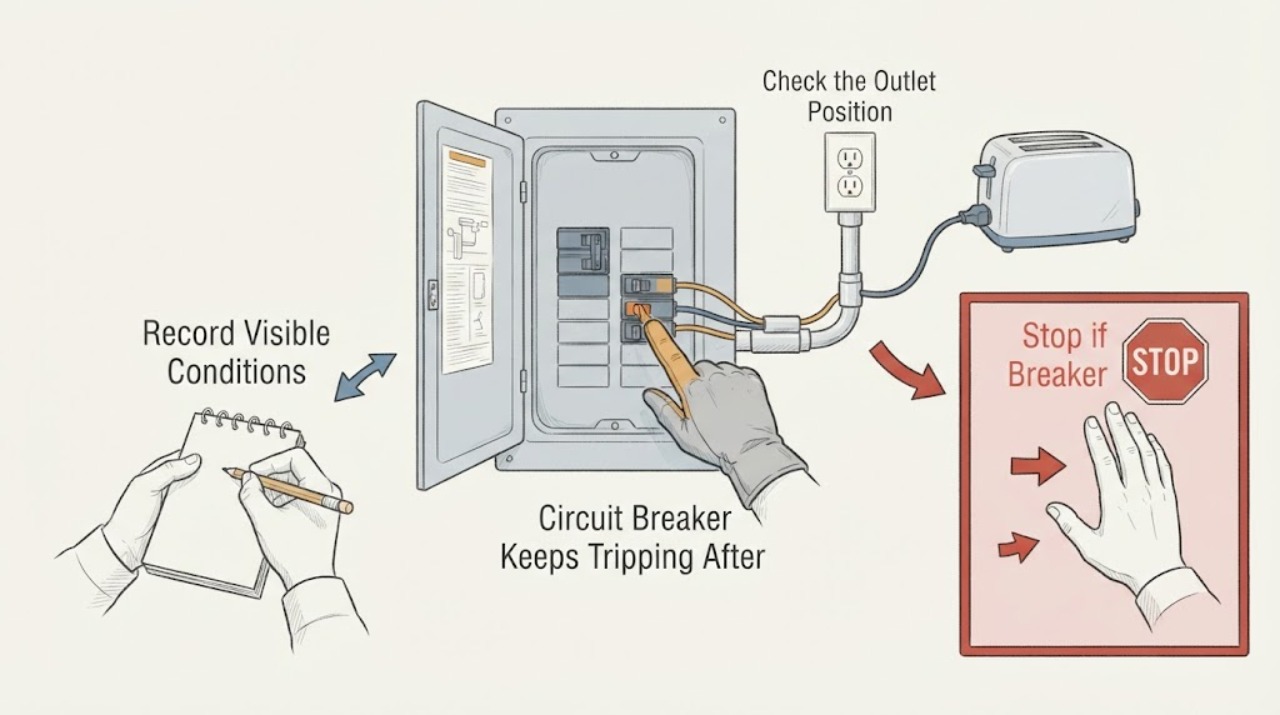
If a circuit breaker trips again after it has been reset, stop resetting it. A breaker may be responding to an overload, short, ground fault, arc fault, failing appliance, or wiring problem; a second trip is not a safe invitation to keep trying. If there is no smoke, flame, burning odor, heat, buzzing, water, shock, visible damage, or active arcing, turn off or unplug accessible portable loads only when it is safe, and make at most one normal reset as directed by the panel or appliance instructions. If it trips again, will not hold, or any warning sign is present, leave the circuit off and call a qualified electrician. Use emergency help for smoke, fire, or active arcing, and do not open the panel or perform a live electrical check.
Work through in order
Diagnostic checks
Use only checks that match the exact appliance or system and its official guide.
-
Check 1
Treat the already repeated trip as the stopping point and record whether it occurred immediately after the reset, when a particular appliance started, after several loads were running, or with no known load; do not reset again to confirm the pattern.
Expected result: The breaker trips immediately, follows one appliance, follows a group of loads, or trips with no known load operating.
Next step: Leave the breaker off and provide the timing and load history to a qualified electrician. Do not recreate the trip or move the suspect appliance to another outlet.
Why this matters
Why: Immediate or no-load tripping keeps a short, ground fault, arc fault, connection, or protection issue in focus; an appliance or group-of-load pattern suggests a load-related branch but does not clear the circuit.
-
Check 2
From a safe, dry position, look and listen without touching the panel, outlet, cord, or equipment for smoke, flame, burning odor, crackling, buzzing, heat, discoloration, soot, melted plastic, water, shock, or active arcing.
Expected result: One or more warning signs are present, or the circuit appears normal from the outside.
Next step: For smoke, flame, strong odor, or active arcing, leave and obtain emergency help. Otherwise keep the circuit off and call a qualified electrician; do not approach or re-energize a hazardous area.
Why this matters
Why: A warning sign can indicate an active fire or shock hazard. A normal exterior view cannot rule out an internal or concealed fault after a repeat trip.
-
Check 3
If and only if there are no warning signs and all accessible equipment is cool and dry, turn off or unplug portable loads that were operating on the branch without reaching behind equipment or touching damaged cords; do not disconnect hard-wired equipment or use an extension for comparison.
Expected result: One appliance, several portable loads, or no obvious load was operating when the breaker tripped.
Next step: Do not reconnect a suspect appliance. If the prior reset has already been followed by another trip, leave the breaker off and request electrical service instead of making another reset.
Why this matters
Why: A single appliance may have a fault, several loads may overload the branch, and no obvious load leaves the receptacle, wiring, breaker, or concealed load unresolved.
-
Check 4
Only when the area is dry and free of heat, odor, damage, water, shock, smoke, or arc, and only if no reset has yet been attempted after the loads were safely turned off, follow the panel's normal single-reset procedure; do not open the panel or use a tool.
Expected result: The breaker holds, trips immediately again, or holds briefly and then trips later.
Next step: If it trips at any point after this one safe reset, stop and leave it off. Do not reset again, restore loads one by one, or perform electrical measurements; call a qualified electrician.
Why this matters
Why: A held breaker does not prove the cause is fixed; an immediate or later second trip confirms that the circuit or a connected load remains unresolved.
-
Check 5
Identify the affected circuit from the existing label and note whether one outlet, room, appliance, light, or several circuits are without power; do not remove the panel cover or operate neighboring breakers to map the circuit.
Expected result: Only one branch is affected, the appliance area and lights are affected together, or multiple circuits show symptoms.
Next step: Keep the affected circuit off and provide the label and scope to the electrician. If several circuits, flickering, or service-level symptoms are present, request urgent electrical assessment.
Why this matters
Why: The scope helps the electrician separate a branch or appliance problem from a broader wiring or supply issue, while neighboring breaker changes can create additional hazards.
-
Check 6
Prepare a service handoff with the number of reset attempts, exact trip timing, breaker label or protection type if readable, connected loads, appliance model information, recent changes, and every odor, sound, heat, moisture, flicker, shock, smoke, or arc observed.
Expected result: The record points to a repeatable appliance, a group of loads, the receptacle or cord, the branch wiring or protection, or an unresolved combination.
Next step: Call a qualified electrician for the circuit and protection. Call appliance service when one appliance is the repeatable trigger, but keep it disconnected and do not authorize a restart merely to reproduce the trip.
Why this matters
Why: A precise history lets a professional choose a safe de-energized diagnostic path without repeatedly energizing a potentially faulty circuit.
Use your observations
Decision map
Find the observation that best matches what you see, then follow the next safe action.
-
PATH 01Next step
What you see
Power was restored once and the breaker has now tripped again, whether immediately or later.
Do this next
Leave the breaker off and call a qualified electrician. Do not reset again, change the breaker rating, or move loads to another outlet.
Why this path and its safety boundary
Why it matters: The underlying overload or fault remains unresolved and further resets can increase heating or arc risk.
-
PATH 02Next step
What you see
Smoke, flame, strong burning odor, buzzing, hot or discolored parts, water, shock, or visible arcing is present.
Do this next
Leave the area and obtain emergency help for smoke, flame, or active arcing. Otherwise keep clear and call a qualified electrician without touching or re-energizing the circuit.
Why this path and its safety boundary
Why it matters: The event may be an active fire or shock hazard, not a nuisance trip.
-
PATH 03Next step
What you see
The same appliance is connected or running whenever the breaker trips, while no warning sign is visible.
Do this next
Keep the appliance out of service and do not try it at another outlet. Arrange appliance service and have the electrician assess the branch if the protective device operated.
Why this path and its safety boundary
Why it matters: The appliance may have a short, ground fault, arc, or overload, but the circuit and protection still need professional clearance.
-
PATH 04Next step
What you see
The trip follows several appliances, the branch supplies multiple outlets or lights, or the circuit scope is unclear.
Do this next
Leave the affected circuit off and request qualified electrical service. Do not use an extension, multi-outlet adapter, or neighboring breaker as a workaround.
Why this path and its safety boundary
Why it matters: A sustained overload, shared connection, or branch fault is possible; the breaker rating must not be changed to carry more load.
-
PATH 05Next step
What you see
No hazard sign was present, accessible portable loads were safely turned off or unplugged, and one normal reset holds.
Do this next
Do not immediately restore all loads or continue using a suspect appliance. Monitor without deliberate reproduction, and call an electrician if the breaker trips again or any warning sign appears.
Why this path and its safety boundary
Why it matters: The immediate condition may have cleared, but the event is not proven repaired and the original load or circuit history still matters.
Helpful context
Understand the symptom
A second trip changes the decision
The first reset may restore power after a temporary overload, but a breaker that trips again has not demonstrated that the circuit is safe. It may be protecting against a continuing load, a short or ground fault, an arc fault, an appliance that fails when energized, or wiring that heats or shifts under load. The correct response is to stop cycling the protection and preserve the event history for a professional.
When one reset is reasonable—and when it is not
Only when the area is dry, cool, and free of smoke, odor, damage, water, shock, or active arcing can a resident turn off or unplug accessible portable loads and make one ordinary reset in accordance with the equipment instructions. Never reach into a panel, remove covers, touch wiring, or reset from a hazardous area. If the breaker has already been reset and has tripped again, the one-reset limit has been reached.
Do not confuse restored power with a repair
If power returns but the same appliance, outlet, or circuit later trips again, keep that load out of service. A breaker may be protecting the appliance, the receptacle, the branch wiring, or the home supply. A qualified electrician can determine the cause safely; an appliance technician may be needed when one appliance is the repeatable trigger.
Safety boundary
Stop conditions
- After the breaker trips again following a reset, stop restoring power and leave the circuit off; do not make another reset to confirm the problem.
- Stop immediately for smoke, flame, active arcing, strong burning odor, buzzing, heat, discoloration, shock, water, damaged insulation, or a breaker or outlet that will not hold.
- Do not open the service panel or outlet, touch conductors, probe wiring, make a live electrical measurement, replace the breaker, install a higher rating, bypass arc-fault or ground-fault protection, or use an extension or multi-outlet adapter as a workaround.
- If smoke, flame, or active arcing is present, leave the area and use emergency help from a safe location; never use water on an energized electrical fire.
When checks do not resolve it
Need a professional?
Call a qualified electrician after any second trip, for a breaker that will not hold, an unknown or branch-wide symptom, flickering, heat, odor, buzzing, shock, water, or visible damage. Call appliance service when one appliance is the repeatable trigger, but keep it disconnected and do not use another outlet to compare. Use emergency help for smoke, flame, or active arcing.
Common questions
FAQ
What should I do if the breaker trips again after I reset it?
Stop restoring power and leave the circuit off. A repeat trip means the overload or fault has not been resolved; call a qualified electrician instead of resetting it again.
Can I reset the breaker one more time if nothing looks wrong?
Only one ordinary reset is reasonable after accessible portable loads are safely turned off and no hazard sign is present, and only when the panel instructions permit it. If it has already tripped again, do not reset it again; arrange qualified service.
What if one appliance causes the breaker to trip?
Keep the appliance out of service and do not move it to another outlet as a comparison. Arrange appliance service and have the electrician assess the circuit, because either the appliance or the branch may be at fault.
When is a repeated trip an emergency?
Smoke, flame, active arcing, a strong burning odor, buzzing, hot or discolored electrical parts, shock, water, or damaged insulation requires leaving the area and obtaining emergency or qualified electrical help from a safe location.
Read the exact guide
Official sources
- Don’t Overload Your HomeElectrical Safety Foundation International · General residential safety guidance used for load and warning-sign branches; it does not diagnose a particular circuit or authorize user electrical work.
- Understanding Your Home Electrical SystemElectrical Safety Foundation International · General residential electrical-safety education used for hazard recognition; local code and a qualified electrician determine actual installation and repair requirements.
- Guide to Home Wiring HazardsU.S. Consumer Product Safety Commission · General U.S. electrical-safety guidance used for stop conditions and service escalation; it is not an instruction manual for homeowner electrical repairs.
- Fuse and Breaker BreakdownElectrical Safety Foundation International · General electrical-safety education used for protective-device context; it does not authorize a resident to replace or alter a breaker.
- CPSC Staff Suggests That Homeowners Check Electrical Wiring For Potential Fire HazardsU.S. Consumer Product Safety Commission · CPSC consumer-safety warning used for recognition of wiring hazards; it is historical general guidance and not a substitute for current local code or professional diagnosis.
Community feedback
Share a repair observation
Share a plain-text repair observation. Accepted observations are published automatically; this page may take a moment to update.