
On this page
Start here
Quick answer
A breaker that trips only after equipment has run for several hours often reflects heat building from a sustained or near-capacity load, but a worn appliance, loose or overheated connection, damaged wiring, or a faulty breaker can look the same. Treat the delayed timing as a thermal warning, not as permission to keep resetting the breaker. From a dry, safe position, record the exact breaker, loads and elapsed time, stop using the affected circuit, and have a qualified electrician identify whether the cause is overload, equipment, connection, or protection-device failure.
Before you begin
Safety first
- The homeowner scope ends at dry external observation, ordinary appliance controls, and recording the event. Panel work, load measurement, terminal inspection, breaker replacement, wiring repair, and re-energization require qualified service.
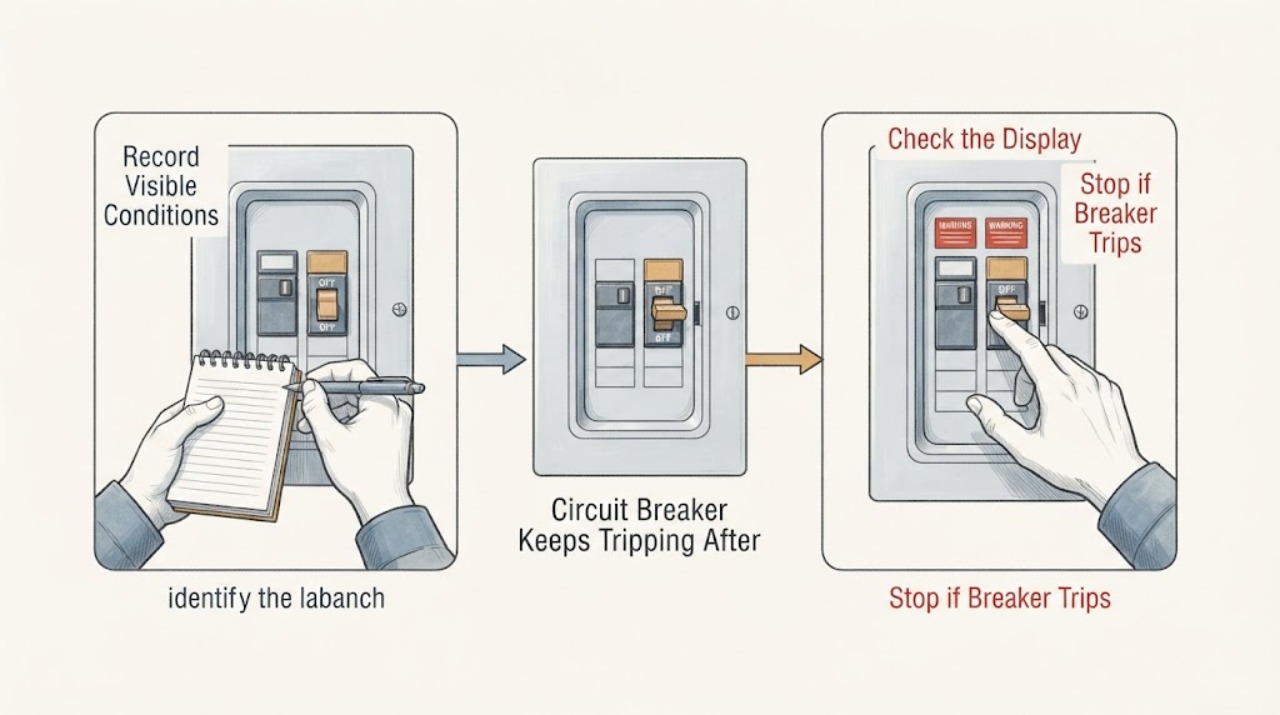
Work through in order
Diagnostic checks
Use only checks that match the exact appliance or system and its official guide.
-
Check 1
Record the exact elapsed time from the first substantial load or appliance start until the trip, along with whether the circuit had been stable before that event; do not reset the breaker to reproduce the delay.
Expected result: The breaker trips after a repeatable long run, after different run lengths, or at an unpredictable time.
Next step: Leave the breaker off and give the timing record to the electrician. Do not keep testing a suspected thermal fault.
Why this matters
Why: A repeatable delayed trip supports heat or sustained-load investigation, while an unpredictable trip keeps intermittent equipment, connection, moisture, and breaker faults in scope.
-
Check 2
From a dry location, identify the labeled branch and list every room, receptacle, light, permanently connected device, and high-demand appliance that lost power when it tripped; do not open the panel or touch the breaker if wet.
Expected result: One appliance or motor is the only common load, several loads run together, or no obvious load explains the circuit.
Next step: Keep the affected circuit off and provide the load list to a qualified electrician rather than moving loads around and trying again.
Why this matters
Why: A single load points toward equipment-side service, combined loads point toward a sustained overload, and no obvious load keeps hidden wiring or a protection-device fault possible.
-
Check 3
Review what changed before the problem began, such as a new heater, pump, compressor, motor, seasonal equipment, extension lead, or appliance used for longer periods; use labels and normal controls only.
Expected result: A new or recently stressed load coincides with the delayed trips, or no usage change is known.
Next step: Stop using the suspect load and tell the electrician when it was added or when its run time changed. Do not substitute a higher-rated breaker.
Why this matters
Why: A new or aging load can increase sustained current or heat, but a stable usage pattern does not rule out a degraded connection, wiring fault, or breaker.
-
Check 4
From a safe distance, look for visible warning signs around dry user-accessible outlets, plugs, cords, appliances, and the panel door: discoloration, melted material, smoke residue, a hot surface, burning odor, buzzing, or flickering.
Expected result: A warning sign is present, or all visible surfaces appear normal.
Next step: For any warning sign, stop using the circuit and arrange urgent electrical service. Do not touch, unplug, or open the suspect item if it is hot, wet, damaged, or energized.
Why this matters
Why: Heat, odor, buzzing, flicker, or discoloration can indicate an overheated connection or equipment fault; a normal exterior cannot clear concealed wiring or internal breaker damage.
-
Check 5
If the circuit supplies a motor or compressor, note whether the trip follows a long continuous run, repeated cycling, an unusual hum, a stalled start, or a change in the equipment's normal sound without opening its enclosure.
Expected result: The trip follows continuous operation, repeated starts, an abnormal motor symptom, or no identifiable equipment change.
Next step: Leave the equipment and circuit off and ask the electrician or qualified appliance technician to evaluate the load and branch together.
Why this matters
Why: Motor loads can draw abnormal current when worn, restricted, or starting poorly; this requires equipment and circuit diagnosis rather than a breaker-size change.
-
Check 6
Check whether the same event affects only this breaker, several breakers in the home, or neighboring properties, using safe observation or conversation without approaching service equipment or downed lines.
Expected result: Only one branch is affected, several home circuits are affected, or a wider outage is occurring.
Next step: Keep the affected branch off, avoid utility equipment, and report a wider outage through the utility or building manager's safe channel while arranging electrical service for the home.
Why this matters
Why: A single branch favors a local load, wiring, or breaker investigation; a wider event can involve building or utility supply conditions outside a homeowner repair.
-
Check 7
Prepare a service handoff with the breaker label, load list, approximate run time, weather or temperature context, trip history, visible warning signs, and any recent electrical work; do not provide a guessed cause as a diagnosis.
Expected result: The record shows a steady delayed pattern tied to one load, several simultaneous loads, or no repeatable load.
Next step: Leave the circuit off until the professional identifies and corrects the cause and confirms that re-energization is safe.
Why this matters
Why: This evidence helps the professional separate thermal overload, worn equipment, high-resistance connection, wiring fault, and suspect breaker without unsafe homeowner testing.
Use your observations
Decision map
Find the observation that best matches what you see, then follow the next safe action.
-
PATH 01Next step
What you see
The same breaker trips only after a long, repeatable run with multiple loads operating.
Do this next
Stop using the affected circuit, do not add or substitute a larger protective device, and have a qualified electrician review the load and branch.
Why this path and its safety boundary
Why it matters: A sustained or near-capacity load with heat accumulation is plausible, but the actual demand and circuit protection must be assessed professionally.
-
PATH 02Next step
What you see
The trip follows one appliance or motor even when other user loads are off.
Do this next
Leave that appliance and the circuit off and arrange qualified appliance or electrical diagnosis. Do not keep reconnecting it to test the pattern.
Why this path and its safety boundary
Why it matters: The appliance may be worn, restricted, or drawing abnormal current as it warms; the breaker may still be responding correctly.
-
PATH 03Next step
What you see
The breaker trips with little or no load, or it trips at increasingly shorter intervals after previous trips.
Do this next
Leave it off and call a qualified electrician. Do not open the panel, touch terminals, or replace the breaker yourself.
Why this path and its safety boundary
Why it matters: A hidden wiring or equipment fault, overheated connection, or suspect breaker is possible; repeated reclosing can add heat and risk.
-
PATH 04Next step
What you see
A receptacle, plug, cord, switch, or panel door is hot, discolored, melted, smoky, buzzing, or giving off a burning odor.
Do this next
Stop using the area and keep clear. Arrange urgent electrical service; use local emergency guidance for active smoke or fire.
Why this path and its safety boundary
Why it matters: The circuit may have an overheated or high-resistance connection and presents a possible fire or shock hazard.
-
PATH 05Next step
What you see
Water, wet equipment, standing water, or a recent leak is present near the circuit.
Do this next
Do not touch wet electrical equipment or operate the breaker from a wet position. Keep clear and obtain qualified electrical inspection.
Why this path and its safety boundary
Why it matters: Moisture can create a shock or ground-fault hazard that cannot be cleared by waiting for the surface to dry.
-
PATH 06Next step
What you see
Several circuits or neighboring properties lose power together.
Do this next
Avoid service equipment and downed lines, keep people away from unsafe areas, and contact the utility or building manager through a safe channel; use an electrician for the home's system.
Why this path and its safety boundary
Why it matters: A building or utility supply event may be involved rather than only the labeled branch.
Helpful context
Understand the symptom
Why several hours changes the diagnosis
The elapsed time is a useful clue. Schneider Electric says a trip after running for a while is consistent with thermal operation, while an immediate startup trip follows a different path. A sustained load near the circuit's capacity can accumulate heat; a motor or appliance can also become abnormal as it warms. The timing does not identify the failed part, and it does not make a breaker safe to repeatedly reclose.
Safe homeowner scope
Limit the investigation to dry, external observation and ordinary appliance controls. Do not remove the panel cover, tighten terminals, touch a hot or discolored device, replace the breaker, install a larger protective device, bypass protection, or perform live electrical measurements. If water, smoke, arcing, burning odor, or painful heat is present, keep clear and obtain urgent professional help.
Safety boundary
Stop conditions
- Stop immediately for smoke, sparks, arcing, burning odor, hot or discolored electrical parts, melted insulation, painful heat, or repeated increasingly rapid trips.
- Stop and keep clear for water near electrical equipment, standing water, a wet panel or floor, a downed line, or a damaged service connection.
- Do not remove a panel or outlet cover, tighten terminals, touch energized parts, perform live measurements, bypass protection, or install a larger breaker.
- Do not keep resetting the breaker or reconnecting a suspect appliance to prove that the delayed trip has returned.
- Leave panel, wiring, breaker replacement, load measurement, and professional isolation or re-energization to a qualified electrician.
When checks do not resolve it
Need a professional?
Call a qualified electrician for any breaker that trips after running several hours, especially when the pattern repeats, the load is unclear, an appliance is implicated, or any heat, odor, water, buzzing, flicker, or damage is present.
Safety scope: The homeowner scope ends at dry external observation, ordinary appliance controls, and recording the event. Panel work, load measurement, terminal inspection, breaker replacement, wiring repair, and re-energization require qualified service.
Common questions
FAQ
Why does the breaker trip only after several hours?
Delayed tripping can occur when a sustained or near-capacity load builds heat, but worn equipment, an overheated connection, wiring fault, or suspect breaker can produce the same timing. Leave the circuit off and have it diagnosed.
Should I replace the breaker with a larger one?
No. A larger protective device can leave the branch wiring inadequately protected. A qualified electrician must determine the circuit rating and correct cause.
Can I keep using the circuit if everything looks normal after it cools?
No. A normal-looking exterior does not rule out an overloaded load, high-resistance connection, damaged wiring, or a faulty breaker. Repeated trips warrant professional inspection before normal use resumes.
Read the exact guide
Official sources
- CPSC Guide to Home Wiring HazardsU.S. Consumer Product Safety Commission · Home wiring warnings, branch circuits, circuit breakers, thermal protection and qualified electrical boundaries
- What could be the impact of running close to MCB capacitySchneider Electric UK · Prolonged high-load operation, heat generation, thermal overload trips, voltage drop and protection margins
- How do you determine why a thermal-magnetic breaker nuisance trips?Schneider Electric USA · Thermal-magnetic circuit breaker timing, startup versus delayed trips, overcurrent, equipment and connection diagnostic paths
- Electrical Safety: ChecklistNational Fire Protection Association · Frequent breaker trips, warm or discolored outlets, burning odors, flickering and sparks requiring qualified help
Community feedback
Share a repair observation
Share a plain-text repair observation. Accepted observations are published automatically; this page may take a moment to update.