
On this page
Start here
Quick answer
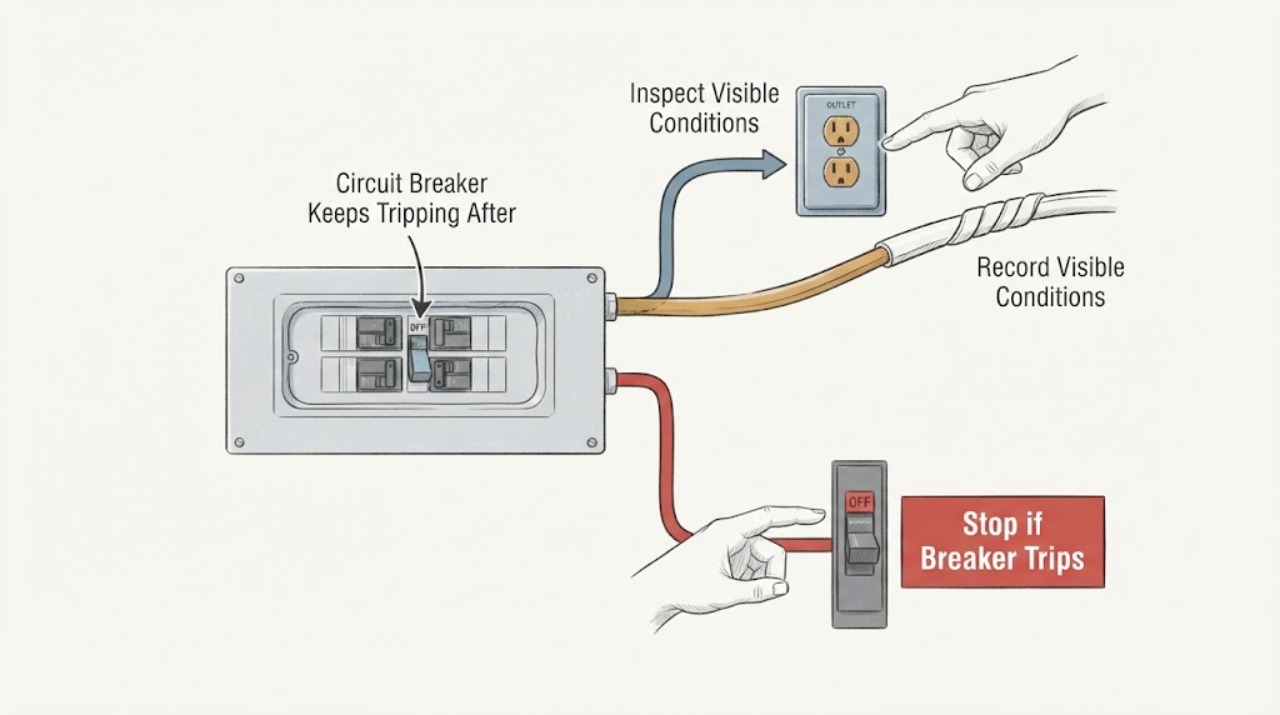
A breaker that trips only after a circuit has been on for several hours should be treated as a possible sustained overload, heat-related connection problem, or equipment fault—not as a nuisance to reset. Stop adding load and do not repeatedly restore the breaker. From a safe position, record which breaker moved, what was operating on that circuit, what changed just before the trip, and whether there was a hot faceplate, burning smell, buzzing, smoke, arcing, water, or visible damage. A qualified electrician should inspect a recurring delayed trip, especially when the circuit serves a high-load appliance or the affected equipment cannot be isolated safely. Leave the circuit off for heat, odor, smoke, arcing, moisture near electrical parts, or another trip.
Before you begin
Safety first
- An electrician can assess circuit loading, wiring, connections, protective-device suitability, and installation; an appliance technician can assess a device linked to the trip without repeated energizing or user access to live parts.
Work through in order
Diagnostic checks
Use only checks that match the exact appliance or system and its official guide.
-
Check 1
Stop using the affected circuit and observe the breaker area, accessible outlets, switches, plugs, cords, and nearby surfaces from a dry, safe position. Do not touch a warm or wet electrical part, open the panel, or move a heavy appliance.
Expected result: There may be no visible sign, or there may be a hot faceplate, burning odor, buzzing, smoke, arcing, melted material, water, or visible damage.
Next step: If any hazard is present, keep the circuit off and use urgent electrical or fire support as appropriate. If no hazard is visible, continue only with a written record of the circuit and timing.
Why this matters
Why: Heat, odor, sound, smoke, arc, or moisture changes the situation to an electrical or fire hazard. A lack of visible damage does not make another energizing cycle safe.
-
Check 2
From outside the panel, note the breaker label or position and list the rooms, outlets, lights, and equipment that lost power. Record whether one branch is affected or several unrelated circuits changed state; do not open the panel or move other breakers.
Expected result: Only one branch may be off, the label may be unclear, or more than one circuit may be affected.
Next step: Leave the breaker off after the trip and provide the scope to a qualified electrician. Do not restore power merely to discover which circuit is involved.
Why this matters
Why: One branch points toward a load, branch wiring, or appliance relationship. Several circuits or an unclear panel points toward a broader supply or panel assessment.
-
Check 3
Write down when the circuit had been energized, what was running, and what changed before the trip: a heater or motor started, another appliance was added, a light or switch was used, weather or moisture appeared, or nothing obvious changed. Do not recreate the event.
Expected result: The trip may follow a predictable high-load event, occur after a fixed period, follow a particular switch or appliance, or remain unexplained.
Next step: Keep the circuit and any implicated equipment out of service and give the timeline to the electrician. If the event involved an appliance, arrange appliance evaluation as well.
Why this matters
Why: The event pattern helps separate a load-related clue from an appliance, connection, or protective-device issue, but timing alone cannot identify a failed component.
-
Check 4
Only when there is no heat, odor, moisture, damage, or active hazard, and only from a cool, accessible location, note whether a portable appliance can be switched off normally without touching a damaged plug or cord. Do not unplug hot equipment, use an extension cord, or handle a built-in appliance.
Expected result: The delayed trip may have involved one portable high-load appliance, several simultaneous loads, or no safely identifiable load.
Next step: Leave the implicated load disconnected only if it was safely switched off, and do not reconnect it to another circuit. Arrange qualified electrical or appliance service.
Why this matters
Why: A portable load association is a clue for a qualified check; it does not prove the appliance or outlet is safe. No identifiable load keeps the branch or supply under suspicion.
-
Check 5
From a safe distance, inspect only the visible faceplate, outlet, switch, and cord entry for discoloration, looseness, cracking, soot, or moisture. Do not remove a cover, tighten a terminal, bend plug blades, make electrical measurements, or touch a hot faceplate.
Expected result: The outlet or switch may look normal, feel hot, show discoloration, fit a plug loosely, or be wet or damaged.
Next step: Stop using an abnormal outlet or switch and arrange qualified electrical service. Keep the circuit off if there is any heat, odor, damage, or water.
Why this matters
Why: Heat, discoloration, looseness, or moisture can indicate a connection, overload, or wiring hazard. A normal appearance cannot clear concealed wiring or a connected appliance.
-
Check 6
If the first trip already occurred while one appliance was operating, record its nameplate identity, operating mode, and whether the trip followed startup, heating, a motor cycle, or several hours of use. Do not plug it into another circuit or run it again as a comparison.
Expected result: The appliance may be the only known load, one of several loads, or unrelated to the trip based on the available timeline.
Next step: Keep the appliance disconnected or switched off only when that was done safely, label it as implicated, and arrange appliance and electrical evaluation.
Why this matters
Why: A repeat association would be important to a technician, but a single association does not prove an internal appliance fault. Moving the appliance to another circuit can create another hazard.
-
Check 7
Prepare the breaker label, circuit scope, elapsed time before the trip, equipment and loads in use, exact switch or appliance event, visible symptoms, recent installation or moisture, and whether the trip has recurred. Do not reset the breaker to fill in missing details.
Expected result: The record may show a delayed load pattern, an appliance-specific pattern, a wiring or outlet warning, or a whole-circuit problem with no visible clue.
Next step: Keep the affected circuit off until it is assessed, especially when the trip has repeated or any heat, odor, smoke, arcing, water, or damage was observed.
Why this matters
Why: A complete record lets a professional select safe tests without repeated energizing and helps separate circuit, protective-device, and appliance paths.
Use your observations
Decision map
Find the observation that best matches what you see, then follow the next safe action.
-
PATH 01Next step
What you see
There is smoke, burning odor, buzzing, arcing, a hot or damaged outlet, melted material, water near electrical parts, or another trip.
Do this next
Stop using the circuit, keep people away, and isolate power only from a dry, safe location without touching damaged equipment.
-
PATH 02Next step
What you see
The trip followed several hours of operation and a heater, motor, or second high-load appliance was running.
Do this next
Leave the circuit off and record the loads and event timing without trying to reproduce the trip.
-
PATH 03Next step
What you see
The trip was associated with one appliance, its switch, or its operating mode, even though the event was delayed.
Do this next
Stop using the implicated appliance and do not move it to another circuit or run it again.
-
PATH 04Next step
What you see
An outlet, switch, plug, faceplate, or cord is hot, discolored, loose, wet, buzzing, or damaged.
Do this next
Discontinue use and keep clear. Do not touch, tighten, remove, or test the part.
-
PATH 05Next step
What you see
The panel is unclear, several circuits are affected, or no safe load association can be identified.
Do this next
Leave the affected breaker or supply off and do not move breakers or open the panel to investigate.
-
PATH 06Next step
What you see
There is no visible hazard, but the breaker has tripped after several hours and the cause remains uncertain.
Do this next
Do not re-energize for a trial. Preserve the timing and load record.
Helpful context
Understand the symptom
Why several hours matters
The delay is useful evidence, not a diagnosis. A circuit can remain below its limit until another load starts, while a loose or damaged connection can heat during use. An appliance can also develop a fault after it warms up. Do not keep turning the breaker back on to reproduce the timing; record the first safe observation and leave the cause for a professional assessment.
Start with the affected circuit
Identify the breaker only from the panel label and its visible handle position. Note which rooms, outlets, lights, or appliances lost power, and which high-load equipment was running. If the panel is unlabeled or several circuits are affected, do not guess by moving breakers or opening the panel cover; an electrician should map and assess it.
Do not confuse a load problem with a safe test
Turning off or unplugging a cool, portable appliance may be reasonable only when it can be done without touching hot, wet, damaged, or arcing equipment. Do not unplug a hot plug, handle a damaged cord, remove a faceplate, open a junction box, or use a larger breaker. These are signs for qualified electrical service.
What the observation can prove
If the circuit stays on after a known portable load is removed, that is a clue for the electrician, not proof that the load or circuit is safe. If it trips again with the same equipment or after warming, keep the equipment and circuit out of service. A delayed trip is never a reason to defeat the protective device.
Safety boundary
Stop conditions
- Stop immediately for smoke, flame, burning or melting odor, buzzing, visible arcing, a hot or damaged outlet or switch, exposed wiring, water near electrical parts, or another breaker trip. Keep clear and use urgent electrical or fire support as appropriate.
- Do not repeatedly reset the breaker, install a larger fuse or breaker, bypass GFCI or AFCI protection, open the panel, remove a faceplate, loosen terminals, or test live wiring.
- Do not unplug a hot, wet, damaged, built-in, or arcing appliance. Do not move an implicated appliance to another circuit to see whether the symptom follows it.
- Stop if the panel is unlabeled, multiple circuits are affected, the source is inaccessible, or the circuit has moisture or structural damage. Leave the affected supply off for qualified assessment.
- A delayed trip after several hours is not a harmless nuisance. Keep the circuit out of service until the load, wiring, protective device, or appliance cause is evaluated.
Only after diagnosis
Potential parts
- circuit breaker or protective device
Consider only when an electrician confirms a defective, damaged, or unsuitable protective device; a trip alone does not prove the breaker is the failed part.
The replacement must match the panel, circuit, local requirements, and installation design; this is qualified electrical work. - receptacle or switch
Consider only when an electrician confirms heat, looseness, damage, or a connection fault at the specific outlet or switch.
Do not remove the faceplate or replace the device yourself when there has been heat, odor, arcing, moisture, or a breaker trip. - appliance cord or internal load component
Consider only when an appliance technician links the delayed trip to a confirmed appliance fault after the circuit is assessed.
Component selection is appliance-specific and requires qualified diagnosis; do not substitute a generic part or bypass protection.
When checks do not resolve it
Need a professional?
Request qualified electrical inspection after a delayed recurring trip, immediately for heat, odor, smoke, arcing, moisture, or visible damage, and also request appliance evaluation when one device or function is implicated.
Safety scope: An electrician can assess circuit loading, wiring, connections, protective-device suitability, and installation; an appliance technician can assess a device linked to the trip without repeated energizing or user access to live parts.
Have this ready
- Provide the breaker label, circuit scope, time energized, loads in use, exact event before the trip, implicated appliance and mode, outlet or cord observations, recent installation or moisture, and any display or fault information.
Common questions
FAQ
Why does a breaker trip only after several hours?
A delayed trip can be related to sustained load, a second load starting, heat at a connection, an appliance fault, or a protective-device issue. The timing is evidence for a qualified inspection, not a reason to keep resetting the breaker.
Should I reset a breaker that keeps tripping later in the day?
Do not repeatedly reset it. Record the affected circuit and what was operating, then leave it off for qualified electrical assessment, with urgent help for smoke, heat, odor, arcing, water, or visible damage.
How can I tell whether one appliance is causing the trip?
Use only the event that already occurred: note which appliance, mode, and operating stage preceded the trip. Do not move the appliance to another circuit or run it again as a test; arrange electrical and appliance evaluation.
What does a hot outlet or faceplate mean?
Heat, discoloration, looseness, buzzing, or odor can indicate an electrical hazard. Discontinue use, do not touch or open the device, and arrange qualified electrician service; use urgent fire support for smoke or arcing.
Can I install a larger breaker to stop the trips?
No. A larger protective device can leave the wiring exposed to unsafe current. The cause must be identified and corrected by a qualified electrician using the circuit and installation requirements.
Read the exact guide
Official sources
- Circuit Breaker Tripping or No PowerSub-Zero, Wolf, and Cove · Wolf and Sub-Zero breaker trips, dedicated supply, installation, GFCI or AFCI, electrician, and service guidance
- Fuse and Breaker BreakdownElectrical Safety Foundation International · Electrical safety education on frequent breaker trips, overload, AFCI and GFCI indications, and qualified electrician inspection
- CPSC Guide to Home Wiring HazardsU.S. Consumer Product Safety Commission · Residential circuit breakers, overloads, appliance and outlet hazards, tracking affected circuits, and qualified electrical help
Community feedback
Share a repair observation
Share a plain-text repair observation. Accepted observations are published automatically; this page may take a moment to update.