
On this page
Start here
Quick answer
If a breaker trips when a particular switch is turned on, leave it off and do not keep resetting the breaker. The switch may control a light, fan, appliance, motor, or fixed wiring fault; the breaker may also be responding to overload, short circuit, ground fault, or damaged connections. From a safe, dry position, record the exact switch, what it controls, whether the trip is immediate, and any hot plate, buzzing, burning smell, smoke, arcing, water, or visible damage. Do not remove the switch cover, touch wiring, or move the breaker repeatedly. A qualified electrician should inspect a switch-triggered trip, with urgent electrical or fire support for heat, odor, smoke, arcing, or moisture.
Before you begin
Safety first
- An electrician can distinguish a switched load, switch or connection, branch wiring, protective-device, and household supply issue without the user opening a panel or re-energizing a suspected fault.
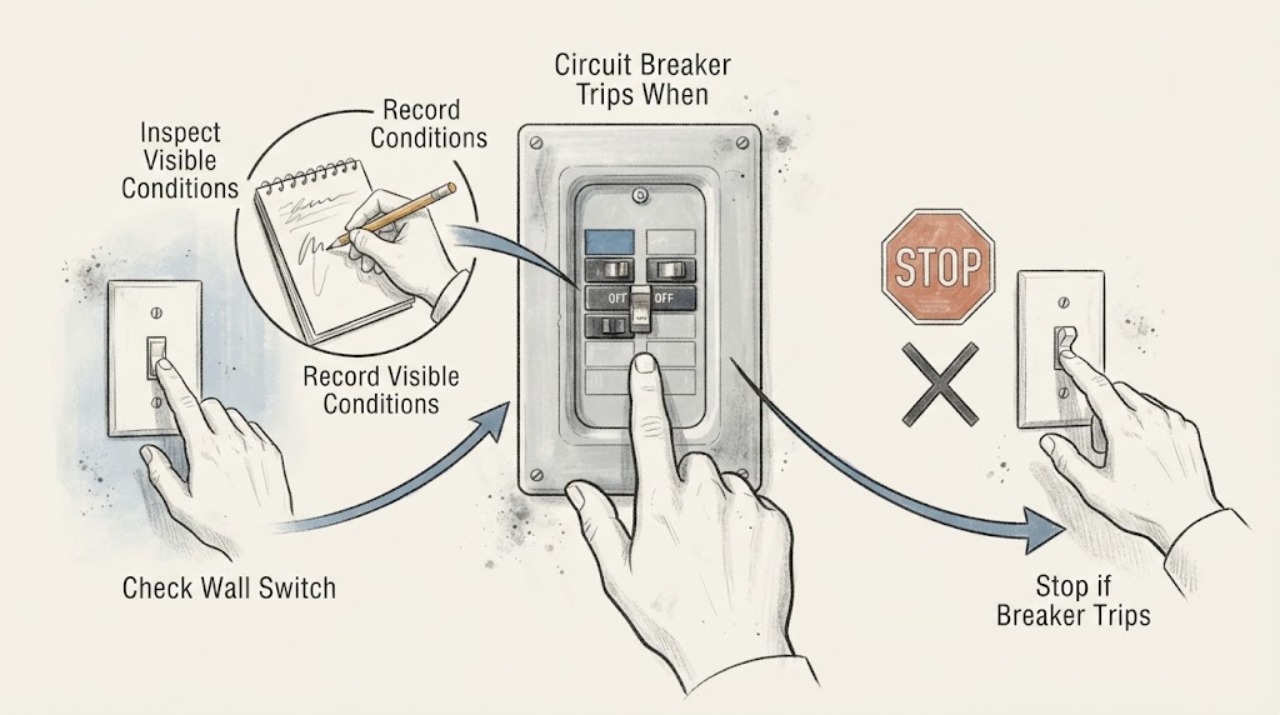
Work through in order
Diagnostic checks
Use only checks that match the exact appliance or system and its official guide.
-
Check 1
Leave the switch off and observe the faceplate, visible fixture, accessible cord, nearby wall, and breaker area from a dry, safe position. Do not touch a warm, wet, damaged, buzzing, or arcing part, and do not remove a cover.
Expected result: There may be no visible sign, or there may be heat, discoloration, burning odor, buzzing, smoke, arcing, water, or melted material.
Next step: If a hazard is present, keep the circuit off, keep people away, and use urgent electrical or fire support as appropriate. If no hazard is visible, record the switch and controlled load without operating it again.
Why this matters
Why: Any heat, odor, smoke, arc, or moisture makes this an electrical or fire hazard rather than a normal switch problem. No visible sign does not make another operation safe.
-
Check 2
From outside electrical equipment, identify which switch was used and what it controls: a light, fan, appliance, motor, exterior fixture, or another outlet. Note whether one fixture or several loads changed state; do not remove the switch plate or follow wiring into a wall.
Expected result: The switch may control one simple fixture, a motor or fan, a high-load device, multiple lights, or an unknown load.
Next step: Keep the switch and implicated load off and provide the identity to the electrician. Do not plug the load into another circuit as a comparison.
Why this matters
Why: The controlled load changes the electrician's diagnostic path. An unknown or multi-load switch needs mapping by a professional rather than trial operation.
-
Check 3
Write down when the breaker moved relative to the switch: immediately on the switch movement, when a light or motor started, after a fixture warmed, or after another device was already operating. Record the circuit label and other outlets or rooms that lost power; do not recreate the event.
Expected result: The trip may be immediate, tied to a starting load, delayed during operation, or accompanied by loss of power beyond the switched fixture.
Next step: Leave the circuit off and give the complete timeline to a qualified electrician. Do not move the breaker to see whether the timing repeats.
Why this matters
Why: Timing and circuit scope distinguish a switched-load clue from a branch or supply concern for a qualified inspection, but they do not prove a short, overload, or breaker defect.
-
Check 4
If the controlled device can be viewed without touching it, note visible cracks, damaged insulation, water, soot, a fallen fixture, a jammed fan, or an abnormal odor. Do not remove a lamp, open an appliance, pull a fixture, or handle a damaged cord after the trip.
Expected result: The load may look normal, show physical or water damage, or have a symptom that began before the breaker opened.
Next step: Keep a damaged or wet load out of service and arrange qualified electrical or appliance service. Do not relocate it to another circuit.
Why this matters
Why: Visible damage or moisture makes the load unsafe to use and can explain a protective trip. A normal appearance does not clear concealed wiring or internal equipment.
-
Check 5
From the panel exterior, note whether the affected breaker supplies only the switch or also nearby outlets, rooms, lights, or equipment. Do not open the panel, change breaker positions, alter labels, or inspect terminals.
Expected result: Only the switched fixture may be off, or a wider branch may have lost power; the panel label may also be unclear.
Next step: Keep the affected branch off and arrange electrical inspection, especially when the circuit scope is unclear or several branches are affected.
Why this matters
Why: A wider loss suggests a branch or supply issue, while a single switched load narrows the clue without proving that the switch itself failed.
-
Check 6
Do not restore the breaker to compare the switch in another position. If the breaker is already off, leave it off; if a qualified person has isolated the circuit, preserve that isolation until the cause is assessed.
Expected result: The switch and circuit remain de-energized, or someone may be urging another reset to see whether the trip was temporary.
Next step: Decline further user testing and arrange qualified electrician service with the original timing and load record.
Why this matters
Why: Repeated energizing can reintroduce an overload, short, ground fault, or heating connection. A temporary successful reset does not establish safety.
-
Check 7
Prepare the switch location, controlled load, circuit label, trip timing, affected rooms, recent installation or moisture, and all visible signs for the service request. Do not remove hardware to find more information.
Expected result: The record may show a fixture-specific event, a motor or appliance event, a wider branch issue, or an unresolved switch-triggered trip.
Next step: Keep the circuit out of use until it is inspected, with urgent escalation for heat, odor, smoke, arcing, water, shock, or another trip.
Why this matters
Why: A complete record allows a professional to separate the switch, load, branch wiring, and protective-device paths without repeated energizing.
Use your observations
Decision map
Find the observation that best matches what you see, then follow the next safe action.
-
PATH 01Next step
What you see
The switch, fixture, outlet, cord, wall, or breaker area is hot, discolored, wet, buzzing, smoking, arcing, or giving off a burning odor.
Do this next
Stop using the circuit, keep clear, and isolate power only from a dry, safe location without touching damaged equipment.
-
PATH 02Next step
What you see
The trip occurred with one light, fan, motor, appliance, or other identifiable switched load.
Do this next
Leave the switch and load off and record the device, operating mode, and first visible symptom.
-
PATH 03Next step
What you see
The breaker tripped at the instant the switch was turned on or as the controlled device received power.
Do this next
Do not operate the switch again. Leave the branch off and record the exact switch and load.
-
PATH 04Next step
What you see
The breaker held briefly after the switch was turned on and tripped only after a light, fan, motor, or other load ran.
Do this next
Leave the circuit off and record the elapsed operation and any change in heat, sound, odor, or load behavior already observed.
-
PATH 05Next step
What you see
Other outlets, lights, rooms, or circuits are also without power, or the circuit label is unclear.
Do this next
Leave the affected supply off and do not open or rearrange the panel.
-
PATH 06Next step
What you see
No visible hazard is present, but a breaker has already tripped when the switch was used.
Do this next
Do not reset for a comparison. Preserve the switch, load, circuit, and timing record.
Helpful context
Understand the symptom
A switch is the trigger, not necessarily the failed part
When a breaker trips as a switch turns on, the switch may be supplying a light, fan, appliance, motor, or another fixed load. The defect can be in the load, the switch box, a connection, or wiring elsewhere on that branch. The useful evidence is the exact switch, controlled equipment, and trip timing—not a guess at which part to replace.
Do not use the breaker as a normal switch
A breaker is a protective device, not a troubleshooting button. Repeatedly restoring it can re-energize a fault and increase heat or fire risk. Do not fit a larger breaker, bypass protection, or open a wall switch or panel. Keep the circuit off and arrange qualified electrical inspection.
Separate safe observation from electrical work
From a dry position, it is useful to note a switch label, the visible fixture, a tripped handle, and signs such as heat, discoloration, buzzing, odor, smoke, water, or arcing. Do not remove a cover, touch a faceplate that is hot or wet, pull a fixture, or make electrical readings. Only qualified persons should work on energized parts.
The first event is enough evidence
Record whether the trip happened as the switch was moved, as a lamp or motor started, after a light warmed up, or only when another load was already running. Do not operate the switch again to compare outcomes. A delayed or immediate pattern helps an electrician choose a safe inspection path but does not identify a specific component.
Safety boundary
Stop conditions
- Stop immediately for smoke, flame, burning or melting odor, visible arcing, buzzing, a hot or damaged faceplate, exposed wiring, water near electrical parts, a shock, or another trip. Keep clear and use urgent electrical or fire support as appropriate.
- Do not repeatedly reset the breaker, install a larger fuse or breaker, bypass protection, or use the breaker as a normal switch.
- Do not remove a switch plate, open a junction box or panel, loosen terminals, pull a fixture, make electrical readings, or work on energized wiring.
- Do not unplug a hot, wet, damaged, built-in, or arcing appliance, and do not move an implicated load to another circuit as a comparison.
- Stop if the panel is unlabeled, multiple circuits are affected, the source is inaccessible, or the switched load cannot be identified safely. Leave the circuit off for qualified assessment.
Only after diagnosis
Potential parts
- switch or dimmer device
Consider only when an electrician confirms the particular switch or dimmer is faulty after the controlled load and wiring are assessed.
The replacement must match the load, wiring, box, and local requirements; do not replace it after a trip without qualified diagnosis. - fixture, fan, or appliance cord
Consider only when the specific switched load has visible or confirmed damage and a qualified professional identifies the replacement path.
Do not move a suspected load to another circuit or use a replacement without confirming its approved electrical fit. - circuit breaker or protective device
Consider only when an electrician confirms a defective or unsuitable protective device; a switch-triggered trip alone does not prove the breaker failed.
The device must match the panel, conductors, circuit design, and local requirements; replacement is qualified electrical work.
When checks do not resolve it
Need a professional?
Request qualified electrical inspection after any switch-triggered breaker trip, immediately for heat, odor, smoke, arcing, shock, moisture, visible damage, or a repeat trip.
Safety scope: An electrician can distinguish a switched load, switch or connection, branch wiring, protective-device, and household supply issue without the user opening a panel or re-energizing a suspected fault.
Have this ready
- Provide the switch location, controlled load, circuit label, trip timing, whether the event was immediate or delayed, affected rooms or outlets, recent installation or moisture, and all visible symptoms.
Common questions
FAQ
Why does the breaker trip when I turn on a switch?
The switch may energize a faulty light, fan, appliance, motor, connection, or branch circuit. Leave it off and arrange qualified electrical inspection rather than assuming the switch or breaker alone is defective.
Should I reset the breaker to see if the switch works now?
No. Repeated resets can re-energize an overload, short, ground fault, or heating connection. Record the first event and keep the circuit off until it is assessed.
What should I record about the switch-triggered trip?
Record the switch location, what it controls, the circuit label, whether the trip was immediate or delayed, which rooms or outlets lost power, and any heat, odor, buzzing, smoke, arcing, water, or visible damage.
Can I remove the switch plate to inspect the wires?
Do not remove the plate or touch wiring after a breaker trip. Electrical work and any energized inspection belong to a qualified person with proper isolation and procedures.
When is a switch-triggered trip an emergency?
Treat smoke, flame, burning smell, arcing, a hot or damaged faceplate, a shock, water near electrical parts, or another trip as an urgent hazard. Keep clear, leave the circuit off when safe, and use electrical or fire support.
Read the exact guide
Official sources
- CPSC Guide to Home Wiring HazardsU.S. Consumer Product Safety Commission · Residential circuit breaker trips at switches, appliance and outlet hazards, overloads, arcing, and qualified electrical help
- Electrical Safety in the WorkplaceNational Institute for Occupational Safety and Health · Electrical shock, burns, arcing, fire, de-energization, and qualified-person boundaries
- Electrical - GlossaryOccupational Safety and Health Administration · Definitions of circuit breaker, overcurrent, fault, arc, energized, de-energized, and qualified person
Community feedback
Share a repair observation
Share a plain-text repair observation. Accepted observations are published automatically; this page may take a moment to update.