
On this page
Start here
Quick answer
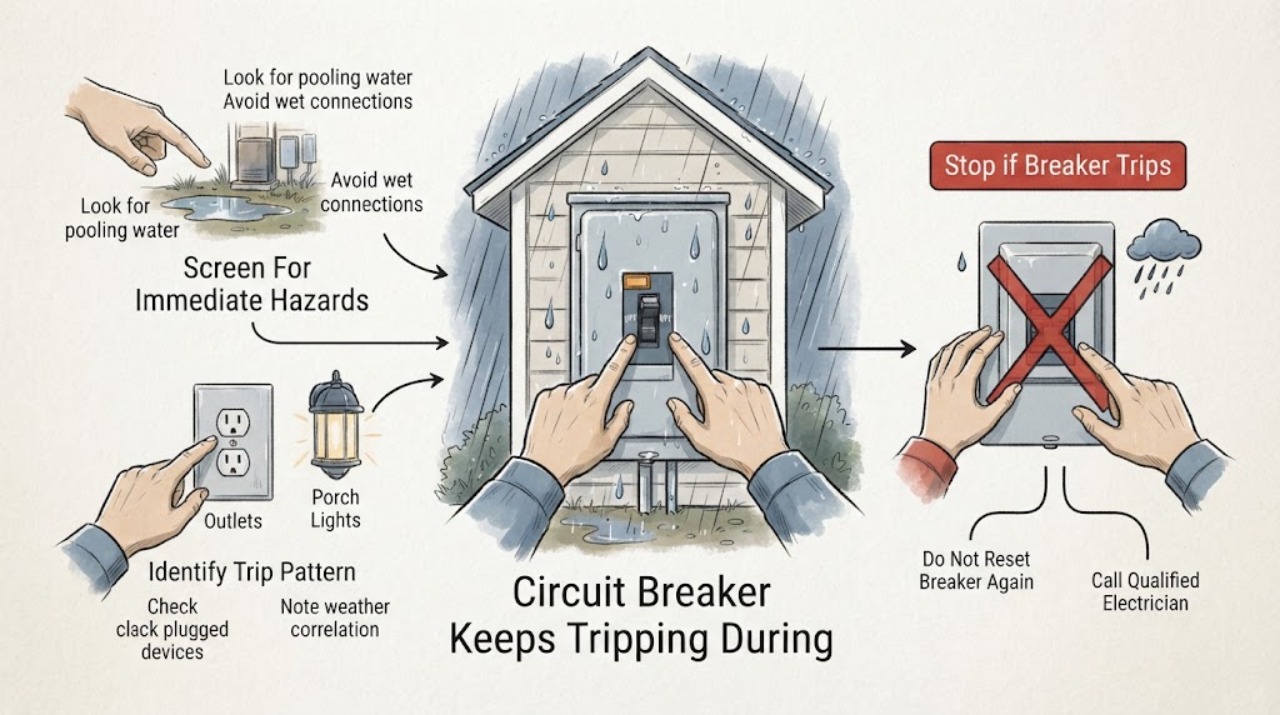
A breaker that trips during heavy rain may be responding to water entering an outdoor device, a damp receptacle or cable, a ground fault, a surge, or a separate circuit overload that happens at the same time. Treat the rain pattern as a safety clue, not proof of one cause. Do not keep resetting the breaker, open the panel, remove covers, test energized wiring, or handle equipment from a wet position. From a dry location, note which breaker trips, whether it is a standard, GFCI, AFCI, or dual-function device, what outdoor or wet-area loads are connected, and whether the trip returns only after a particular load runs. If there is standing water, water inside the panel, a burning odor, buzzing or crackling, heat, smoke, visible arcing, a downed line, or a damaged outdoor cable, keep clear and use emergency help or a qualified electrician. A qualified electrician should inspect any water-affected breaker, receptacle, GFCI, wiring, or appliance before it is returned to service; submerged protective devices may require replacement rather than drying or resetting.
Before you begin
Safety first
- The homeowner should limit the work to dry-distance observation and recordkeeping. A qualified electrician determines isolation, testing, replacement, and re-energization. Do not open panels, expose wiring, defeat protective devices, or make energized checks.
Work through in order
Diagnostic checks
Use only checks that match the exact appliance or system and its official guide.
-
Check 1
From a dry, stable location, write down the breaker label, its handle position, the time of each trip, whether rain was falling or wind was strong, and whether the device has a TEST or RESET marking or an AFCI indicator. Do not open the panel or touch a wet device.
Expected result: One branch trips while the rest of the home remains powered; several circuits trip together; or the main device trips. The trip may occur immediately, only when a load starts, or after the rain has continued.
Next step: Keep a written log and continue only with dry, non-invasive observations. If the main device or multiple circuits trip, or the pattern is not clear, leave the affected supply off when safe and arrange qualified electrical inspection rather than repeated resets.
Why this matters
Why: A single branch points toward that circuit or one of its loads, while several circuits or a main trip raises a service, surge, or widespread water-ingress concern. A TEST or RESET marking suggests ground-fault protection, but the label alone does not identify the fault.
-
Check 2
Look from a safe distance for standing water, a wet or flooded panel area, water entering a receptacle or outdoor box, a damaged cord, a downed line, smoke, a burning odor, buzzing or crackling, scorch marks, or a hot cover. Do not touch, move, unplug, or wipe electrical equipment in the affected area.
Expected result: Any water is near electrical equipment, the panel or device was submerged, wiring is exposed, a line is down, or there is heat, odor, smoke, arcing, or an unusual sound.
Next step: Keep people and pets away. Leave the area if smoke, fire, arcing, or a downed line is present and use emergency services from a safe location. If there is no immediate emergency, have a qualified electrician or utility assess the installation. Do not enter standing water to reach a panel or attempt a repair.
Why this matters
Why: This is no longer a routine breaker-reset question. Water can create a shock path, and heat, odor, sound, smoke, or arcing can indicate an active fire or wiring hazard.
-
Check 3
Using only dry, safe access, list the loads served by the affected circuit: outdoor receptacles, lights, pumps, irrigation controls, air-conditioning equipment, garage equipment, kitchen or bathroom outlets, temporary cords, and any device that was operating when the trip occurred. Do not handle plugs or cords that are wet or damaged.
Expected result: The trip correlates with one outdoor or wet-area load, a temporary cord, or a pump or motor starting; or no particular load is identifiable.
Next step: Leave the suspect load out of service and identify it for the electrician. Do not move it to another receptacle, use an indoor extension lead, or keep trying to start it during the storm. If the circuit powers essential equipment, ask the electrician or utility for a safe temporary plan.
Why this matters
Why: A single weather-exposed load is a strong service lead but not proof that the load alone is defective. A circuit with many simultaneous loads may also be overloaded, while an unknown pattern may involve fixed wiring, a protective device, or water entering a concealed box.
-
Check 4
Read only the visible markings and any normal indicator on the breaker or a nearby GFCI receptacle from a dry position. Do not press TEST or RESET while water is present, while standing on a wet surface, or when the device, cover, or wiring is damaged.
Expected result: The device is identified as GFCI, AFCI, or dual-function; a GFCI receptacle upstream has released; or there is no reliable identification.
Next step: Record the marking and indicator state and give it to the electrician. Do not bypass, replace, or repeatedly reset the protective device. If an unmarked or damaged device cannot be identified safely, treat the circuit as potentially faulted and keep it out of use until inspected.
Why this matters
Why: GFCI behavior is consistent with leakage to ground, which can be caused by moisture or a faulty load. AFCI behavior can indicate an arc-fault pattern in wiring or equipment. A standard breaker still needs overload, short-circuit, and moisture causes considered. A released upstream GFCI can remove power from downstream outlets without the branch breaker being the only visible clue.
-
Check 5
Only if a qualified person has confirmed that the area, panel, and equipment are dry and safe, disconnect or switch off accessible loads using their normal controls, then observe whether the breaker remains stable during ordinary dry operation. Do not perform energized measurements, remove covers, or use a breaker reset as a repeated experiment.
Expected result: The breaker holds with one identifiable load disconnected; it trips with that load restored; or it trips even when ordinary accessible loads are off.
Next step: Keep the associated load isolated and arrange an electrician to inspect the equipment and circuit. Do not transfer the load to another circuit or raise the breaker rating. If rain is ongoing, wait for professional direction rather than testing during wet conditions.
Why this matters
Why: A repeatable association with one load makes that appliance, cord, outdoor connection, or its supply a service suspect. A trip with loads off points more toward fixed wiring, a wet enclosure, the protective device, or an unrecognized downstream load, and cannot be cleared by consumer troubleshooting.
-
Check 6
Compare the event with the whole property: note whether lights flicker, several circuits drop, a utility interruption occurred, exterior service equipment was struck or damaged, or the trip began immediately after a lightning or wind event. Observe from indoors or another safe location only.
Expected result: Several circuits are affected, power is unstable, exterior service equipment or an overhead line appears damaged, or only one interior branch trips.
Next step: Stay clear of utility equipment and downed lines and notify the utility or emergency responders when appropriate. For a single branch, keep it isolated and use a qualified electrician. Never touch a line, meter, service entrance, or wet panel to restore power.
Why this matters
Why: A broad storm pattern may involve utility or service equipment and should not be diagnosed by opening the panel. A single interior branch remains more consistent with a downstream load, receptacle, cable, or branch protection issue, although water can still be hidden.
-
Check 7
If rainwater, floodwater, or runoff reached a breaker, GFCI, receptacle, switch, appliance, cable, or enclosure, record what was wet and how high the water reached without disturbing it. Keep power isolated as directed by a qualified professional.
Expected result: The protective device or electrical equipment was submerged, silted, visibly corroded, or exposed to contaminated water; or only surface moisture is suspected with no evidence of entry.
Next step: Do not dry, spray, open, or reuse the affected device yourself. Arrange qualified inspection and replacement of submerged protective devices as required. Do not restore normal operation until the electrician confirms the circuit and equipment are safe.
Why this matters
Why: A device that was submerged can fail internally even if it appears dry or resets. Contaminated water adds a cleaning and shock hazard. Surface moisture still requires the electrician to determine whether water entered an enclosure or termination.
-
Check 8
Before service, collect the breaker label, device type, trip log, weather timing, affected rooms or outdoor areas, loads that were operating, any safe photographs taken from a dry distance, prior electrical work, and evidence of water entry. Do not include live testing or open-panel photographs that require unsafe access.
Expected result: The event is repeatable only during rain, only after a particular load starts, after water entered an area, or without an observable trigger.
Next step: Give the record to a qualified electrician and keep the suspected circuit or load isolated. If the electrician finds water-damaged equipment, follow the required replacement and re-energization plan rather than relying on a temporary dry-out.
Why this matters
Why: The timing and affected boundary help the electrician separate a moisture-related ground fault from overload, arc-fault, equipment failure, or service-side damage without asking the homeowner to reproduce a dangerous event.
Use your observations
Decision map
Find the observation that best matches what you see, then follow the next safe action.
-
PATH 01Next step
What you see
Water is standing near electrical equipment, the panel or device was submerged, or there is smoke, burning odor, heat, buzzing, crackling, arcing, exposed wiring, or a downed line.
Do this next
Stop all consumer checks, keep clear, and use emergency or utility assistance when indicated. Otherwise arrange qualified electrical inspection; do not reset or touch the affected equipment.
-
PATH 02Next step
What you see
One outdoor, wet-area, pump, motor, cord, or appliance is the only load associated with the trip after rain.
Do this next
Keep that load isolated and have the load, its connection, and the branch circuit inspected. Do not move it to another circuit or run it again in the rain.
-
PATH 03Next step
What you see
The device is a GFCI, AFCI, or dual-function protector, or an upstream GFCI has released.
Do this next
Record the marking and indicator without unsafe testing. Treat a rain-correlated release as a possible leakage or arc-fault condition and arrange qualified diagnosis; never bypass the protection.
-
PATH 04Next step
What you see
Several circuits trip, power flickers broadly, or utility/service equipment appears damaged after wind or lightning.
Do this next
Stay away from service equipment and downed lines and contact the utility or emergency responders as appropriate. Do not open the panel or attempt restoration.
-
PATH 05Next step
What you see
The affected breaker trips even after ordinary accessible loads are safely switched off or disconnected by an appropriate professional.
Do this next
Suspect fixed wiring, a wet enclosure, an unrecognized downstream load, or the protective device itself and leave the circuit for electrician diagnosis.
-
PATH 06Next step
What you see
A breaker, GFCI, fuse, receptacle, or switch was submerged or exposed to silt or contaminated floodwater.
Do this next
Do not dry and reuse it. Arrange professional assessment and replacement of submerged protective devices before re-energization.
Helpful context
Understand the symptom
Why heavy rain changes the diagnosis
The timing can point to a weather-related fault, but it does not identify the failed item. Rain can wet an outdoor receptacle, lighting fixture, extension lead, pump, condenser, or buried cable; wind can move a branch against service equipment; and a storm can make several loads run together. A GFCI trips when it detects leakage to ground, while an AFCI can respond to an arc-fault pattern. A standard breaker can trip from overload or a short. Record the circuit and timing without trying to reproduce the trip in the rain.
Use only a dry, safe observation point
A service panel, receptacle, outdoor disconnect, extension lead, or appliance may remain energized even when one breaker is off. Do not stand in water, touch a wet panel, lift a cover, remove a receptacle, or reach behind outdoor equipment. If the panel, wiring, or a protective device has been wet or submerged, leave it isolated and arrange an electrician's assessment. CPSC says a submerged breaker or GFCI is not made safe by an apparent reset; replacement is the safe resolution for that device.
Do not defeat the protective device
Never install a higher-rated breaker, wedge a handle on, bypass a GFCI or AFCI, or repeatedly reset a trip to keep equipment operating. Those actions can remove protection while the weather-related fault remains. The correct next step depends on whether the same circuit trips with loads disconnected, whether only one outdoor load is associated with the event, and whether any water, heat, odor, sound, or visible damage is present.
Safety boundary
Stop conditions
- Do not reset a breaker repeatedly or hold it in the ON position.
- Stop and keep clear if there is standing water, a wet panel, exposed wiring, a downed line, smoke, fire, arcing, buzzing, crackling, burning odor, heat, or scorch marks.
- Do not open an electrical panel, remove a receptacle or cover, touch a wet device, or perform energized meter checks.
- Do not bypass GFCI or AFCI protection, install a higher-rated breaker, use a damaged cord, or move a suspect load to another circuit.
- Do not restore a submerged breaker, GFCI, receptacle, switch, cable, or appliance based only on drying or an apparent reset.
Only after diagnosis
Potential parts
- GFCI or AFCI protective device
Only consider replacement after an electrician identifies the protective-device type, confirms water or fault damage, and verifies the circuit requirements. A recurring trip is not proof that the device alone is bad.
The electrician must match the panel, circuit, wiring, local requirements, and manufacturer-listed device; never substitute a higher rating or bypass protection. - Outdoor receptacle, enclosure, or weather-resistant cover
This is relevant only if professional inspection finds water entry, corrosion, damaged sealing, or a failed outdoor connection associated with the rain-only trip.
Confirm the installation location, protection method, enclosure rating, wiring condition, and local electrical requirements with the electrician. - Damaged cable, cord, or appliance connection
Consider this only when the trip follows one identified load or when inspection finds weather damage, insulation damage, moisture entry, or a defective appliance connection.
The replacement must be rated for the equipment and environment and installed or approved by a qualified professional; do not repair a damaged cord with tape or an improvised splice.
When checks do not resolve it
Need a professional?
Arrange qualified electrical service for any repeated trip, any circuit that trips with no obvious load, any rain-correlated trip involving outdoor or wet-area equipment, a GFCI or AFCI event that returns, unstable power, or any suspected wiring or service-equipment issue. Use emergency assistance for smoke, fire, active arcing, a downed line, or immediate shock danger. Keep people away from standing or potentially energized water.
Safety scope: The homeowner should limit the work to dry-distance observation and recordkeeping. A qualified electrician determines isolation, testing, replacement, and re-energization. Do not open panels, expose wiring, defeat protective devices, or make energized checks.
Common questions
FAQ
Why does my circuit breaker trip only when it rains hard?
Rain timing makes moisture in an outdoor load, receptacle, enclosure, cable, or appliance a possibility, but a storm can also coincide with an overload, surge, arc fault, or service problem. Record the circuit and keep the suspect load out of service; do not recreate the trip in wet weather.
Should I keep resetting the breaker during the storm?
No. A breaker is a protective device. Repeated resets can leave a moisture or wiring fault energized. Stop if the trip returns, and get qualified electrical help, especially if water, heat, odor, sound, smoke, or arcing is present.
What if the breaker or GFCI got wet?
Do not touch or reset a wet device. If it was submerged or exposed to silt, CPSC says it must be replaced rather than relied on after drying. An electrician should inspect the panel and affected circuit before power is restored.
Is a GFCI trip during rain proof that the GFCI is faulty?
No. A GFCI can be responding to leakage from a wet or defective downstream load, cord, receptacle, or cable. Record the device marking and associated loads, do not bypass the protection, and have the circuit diagnosed.
Can I move the outdoor appliance to another outlet?
Do not move a suspect appliance or damaged cord to another circuit to keep using it. That can transfer the hazard and may defeat the diagnostic clue. Keep it isolated until a qualified person checks the equipment and its connection.
Read the exact guide
Official sources
- CPSC Warns Flood Victims: Replace All Gas Control Valves, Electric Circuit Breakers, GFCIs, and Fuses That Have Been Under WaterU.S. Consumer Product Safety Commission · Submerged circuit breakers, GFCIs, fuses, and water-damaged electrical safety devices
- Electrical safety after a floodElectrical Safety First · Electrical safety after water or flood exposure, wet consumer units, arcing, overheating, and professional inspection
- Understanding Your Home Electrical SystemElectrical Safety Foundation International · Home electrical panels, breaker resetting, overloads, AFCI, GFCI, and electrical safety
- Fuse and Breaker BreakdownElectrical Safety Foundation International · Circuit-breaker, GFCI, AFCI, frequent-trip, and water-related electrical protection guidance
- CPSC Guide to Home Wiring HazardsU.S. Consumer Product Safety Commission · Home wiring warning signs, breaker trips, arcing, overheating, odors, and qualified electrical repair
Community feedback
Share a repair observation
Share a plain-text repair observation. Accepted observations are published automatically; this page may take a moment to update.