
On this page
Start here
Quick answer
A circuit breaker that trips while a device is operating is interrupting current because of an overload, short circuit, ground fault, arc-fault condition, wiring problem, or a failing appliance. Do not keep resetting it or raise its rating. Leave the circuit and the appliance out of service while you identify only safe, external facts: which breaker moved, what was running, whether one appliance always triggers it, whether lights dim, and whether there is buzzing, a hot or discolored outlet, burning odor, smoke, water, sparks, or a damaged cord. A repeat trip from one appliance points to the appliance or its circuit; a trip with several loads points to circuit capacity or wiring. A trip with moisture needs electrical isolation by a qualified person. Stop immediately for smoke, arcing, heat, burning odor, shock, water near electrical equipment, or a breaker that trips again, and arrange a licensed electrician or qualified appliance service.
Before you begin
Safety first
- Do not reset repeatedly, up-rate protection, bypass a safety device, open the panel or appliance, make live measurements, use an extension cord, or touch wet, hot, damaged, buzzing, smoking, or arcing equipment.
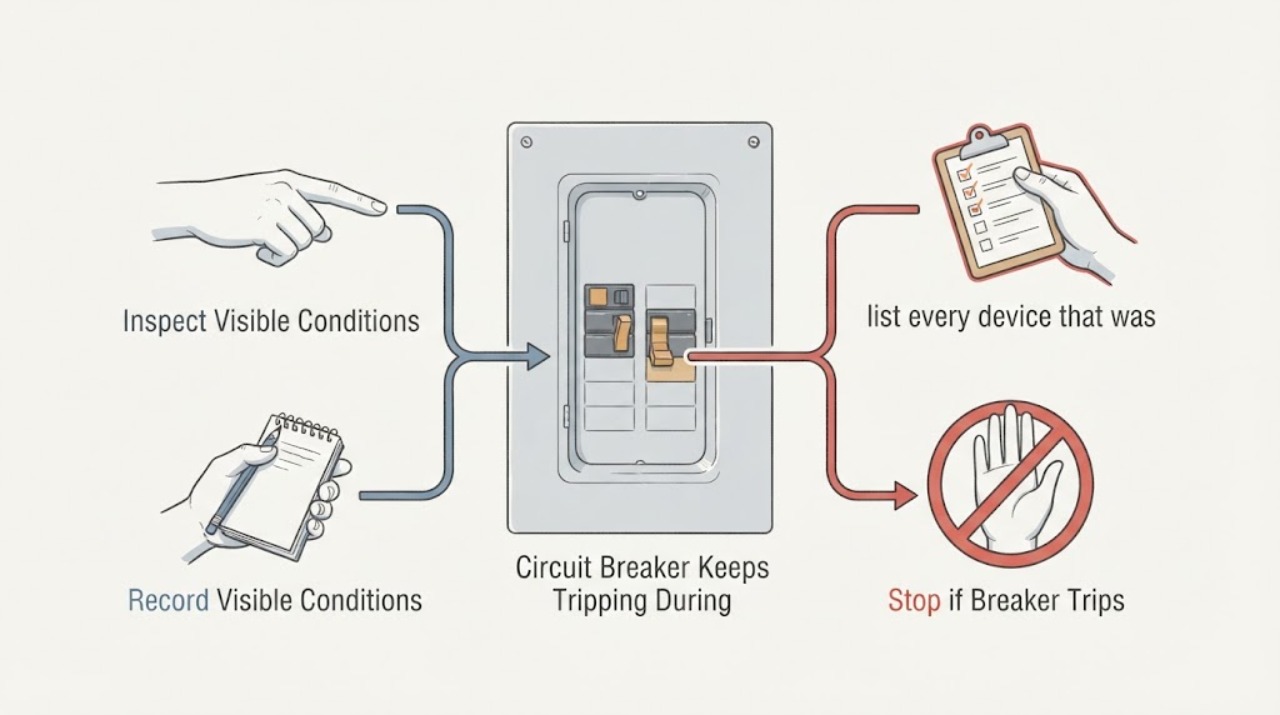
Work through in order
Diagnostic checks
Use only checks that match the exact appliance or system and its official guide.
-
Check 1
Stop the affected appliance or load and observe from a safe, dry position for smoke, sparks, arcing, a burning odor, a hot or discolored outlet or plug, a damaged cord, water, a shock or tingle, or a breaker that has tripped again. Do not reset it to reproduce the event.
Expected result: No warning sign is visible, or smoke, arcing, heat, burning odor, water, shock, or another trip is present.
Next step: For any warning sign, leave the equipment off, keep clear, and contact emergency help for fire or smoke and a licensed electrician for the electrical hazard. If no warning sign is present, continue only with external observations and keep the suspect load off.
Stop if: Stop immediately for smoke, sparks, visible arcing, burning odor, a hot or discolored connection, shock, water near electrical parts, or a repeated trip; do not restore power to reproduce it.
Why this matters
Why: The second result is a fire, shock, ground-fault, arc-fault, or overheating warning, not a routine load-balancing question.
-
Check 2
Record the breaker label or circuit name, whether its handle is fully off or in a middle position, the room or equipment without power, and the exact moment of the trip: startup, heating, motor acceleration, after running for a while, or when another load was switched on. Do not open the panel beyond the normal external access needed to read a label.
Expected result: The trip occurs at the same stage of one appliance, only after several loads run together, immediately on energizing a load, or at an inconsistent time.
Next step: Keep the involved load off and give the timing record to an electrician or qualified appliance technician. Do not swap circuits, use an extension cord, or continue operating to collect more examples.
Stop if: Stop for any panel heat, buzzing, smoke, odor, visible damage, wetness, or a trip that occurs again after the load is stopped.
Why this matters
Why: A repeatable single-load pattern points toward the appliance or its branch; a combined-load pattern points toward demand or circuit capacity; an immediate or inconsistent trip may involve a short, ground fault, wiring, or protective-device problem.
-
Check 3
From a safe position, list every device that was operating on the affected circuit when the trip occurred, including heating appliances, motors, chargers, lights, and recently connected equipment. Do not add another load or move a high-power appliance to another circuit as an experiment.
Expected result: One device was operating alone, several high-demand devices were operating together, or the active devices are unknown.
Next step: Leave the suspect device off and arrange electrical inspection; request appliance service if the same device is the only trigger. Have the electrician map and label the circuit and determine whether the installation supports the connected loads.
Stop if: Stop for a device that trips protection repeatedly, a hot cord or receptacle, an extension-cord setup, smoke, odor, arcing, or any need to connect more equipment for comparison.
Why this matters
Why: A single-device trip can indicate an appliance or branch fault. Several simultaneous loads can exceed the safe capacity of the circuit, and an unknown circuit map prevents a safe conclusion.
-
Check 4
Inspect only the outside of the appliance cord, plug, and receptacle from a dry position for fraying, looseness, discoloration, melting, a plug that feels hot, a cord pinched by furniture, or a receptacle that buzzes. Do not unplug a hot or damaged connection and do not touch anything wet or arcing.
Expected result: The cord and receptacle look cool and intact, or there is looseness, damage, discoloration, heat, buzzing, moisture, smoke, or arcing.
Next step: Keep the appliance off. Arrange a licensed electrician for the receptacle, circuit, or wiring and qualified appliance service for the device; use neither the damaged outlet nor the appliance until cleared.
Stop if: Stop for any hot, loose, damaged, wet, discolored, smoking, buzzing, or arcing cord, plug, or receptacle. Do not touch, unplug, or inspect behind the receptacle.
Why this matters
Why: A sound exterior does not clear the circuit, but damage, heat, buzzing, wetness, or arcing indicates a connection or wiring hazard that requires service.
-
Check 5
Determine from the breaker or receptacle labeling whether the protection is a standard breaker, an arc-fault device, a ground-fault device, or a combination device, without removing the cover or touching wiring. Note whether the event occurred in a damp area or after water reached the equipment.
Expected result: The device is a ground-fault or arc-fault protective device, water or dampness is involved, or the device type cannot be identified safely.
Next step: Keep the circuit and equipment off and arrange a licensed electrician to identify the protective device and find the fault. Do not repeatedly reset it, defeat it, or substitute a different device.
Stop if: Stop for wet equipment, standing water, a damp panel, a shock or tingle, smoke, heat, arcing, or an unidentified device that would require opening the panel.
Why this matters
Why: Ground-fault protection can respond to leakage current when equipment gets wet, while arc-fault protection responds to a fire hazard associated with damaged or overheated wiring or devices. A type that cannot be identified is not a reason to guess.
-
Check 6
Observe whether lights dim, another device loses power, a switch or outlet buzzes, or an appliance seems underpowered when the suspect load runs. Use only the information already visible; do not operate a switch repeatedly or make electrical measurements.
Expected result: Lights dim or flicker, another load loses power, buzzing is heard, an outlet is discolored, or no other symptom is visible.
Next step: Stop using the suspect circuit and arrange a licensed electrician to inspect the load, connections, protection, and wiring. Do not install a higher-rated breaker or continue the load while waiting.
Stop if: Stop for buzzing, visible flicker with heat, a hot or discolored outlet, burning odor, smoke, arcing, or repeated trips.
Why this matters
Why: Dimming, buzzing, discoloration, and underpowered equipment are warning signs of overload, a poor connection, or another electrical-system problem rather than evidence that a larger breaker is needed.
-
Check 7
Prepare a service record without restoring the circuit: breaker label and device type, appliance or load, operating stage, other loads, room conditions, visible cord or outlet condition, water exposure, previous work, and whether the trip stopped when the load was removed. Keep the suspect load out of service.
Expected result: The same appliance is the only trigger, the circuit trips with multiple loads, the event follows moisture or a damaged connection, or the cause remains uncertain.
Next step: Contact a licensed electrician for the circuit, breaker, receptacle, grounding, and wiring. Contact qualified appliance service for a single appliance that repeatedly causes the trip after the circuit is cleared by the electrician. Restore use only after the fault is repaired and the professional says it is safe.
Stop if: Stop for another trip, smoke, fire, odor, heat, arcing, shock, water, or any request to test the circuit by reconnecting the suspect load.
Why this matters
Why: This record gives the electrician a decision-changing pattern without exposing anyone to another trip. A recurring appliance-only pattern may need both appliance and circuit assessment; a multi-load or moisture pattern needs electrical assessment first.
Use your observations
Decision map
Find the observation that best matches what you see, then follow the next safe action.
-
PATH 01Next step
What you see
Smoke, fire, visible arcing, burning odor, a hot panel or connection, shock, or water near electrical equipment is present.
Do this next
Leave the area if needed, keep others away, and contact emergency help for fire or smoke. Have a licensed electrician isolate and assess the circuit; do not touch, unplug, or restore wet or arcing equipment.
Why this path and its safety boundary
Why it matters: Treat this as an immediate fire or shock hazard, not as an overload that can be solved with another reset.
-
PATH 02Next step
What you see
The breaker trips only when several devices, especially high-demand devices, operate together.
Do this next
Keep the combination off and have a licensed electrician map the circuit, review the connected loads, and determine whether a correctly designed circuit is needed. Do not add a larger breaker or use an extension cord.
Why this path and its safety boundary
Why it matters: The combined load may exceed the circuit's safe capacity, or the circuit may have an installation or wiring defect.
-
PATH 03Next step
What you see
The breaker trips whenever one appliance starts or reaches the same operating stage, even when other loads are off.
Do this next
Leave the appliance disconnected or switched off only if it can be made safe without touching heat, water, damage, or arcing. Request qualified appliance service and a licensed electrician as appropriate.
Why this path and its safety boundary
Why it matters: The appliance, its cord or plug, its receptacle, or the branch circuit may have a fault; the repeated appliance-only pattern is not a reason to keep trying.
-
PATH 04Next step
What you see
The trip occurs immediately when a load is energized, or the breaker will not remain set after the load is stopped.
Do this next
Keep the circuit and load off and arrange a licensed electrician. Do not repeatedly reset, bypass, replace with a higher rating, or open the panel.
Why this path and its safety boundary
Why it matters: A short circuit, ground fault, arc-fault condition, damaged device, or protection-device problem is possible.
-
PATH 05Next step
What you see
The event follows moisture, water contact, a damp location, or a ground-fault device indication.
Do this next
Keep people away, do not reach into water or touch wet equipment, and arrange qualified electrical service to isolate and assess the circuit. Do not reconnect it to see whether it has dried.
Why this path and its safety boundary
Why it matters: Leakage current can trip ground-fault protection and can create a shock hazard; drying the visible surface does not clear internal equipment.
-
PATH 06Next step
What you see
Lights dim, outlets buzz or discolor, appliances seem underpowered, or the circuit has frequent trips even without a clear single trigger.
Do this next
Stop using the affected circuit for high-demand loads and arrange a licensed electrical inspection. Do not increase breaker size or keep operating until the cause is identified.
Why this path and its safety boundary
Why it matters: These are warning signs of overload, a poor connection, aged wiring, or another electrical-system fault.
-
PATH 07Next step
What you see
A single trip occurred with no warning signs, and no load is currently connected or operating.
Do this next
Record what was operating and arrange advice if the event repeats, the cause is unknown, or the circuit serves a high-demand appliance. Do not reconnect the suspect load simply to confirm the pattern.
Why this path and its safety boundary
Why it matters: A transient overload or an unresolved fault is possible, but one quiet observation does not prove the circuit is safe for the same load.
Helpful context
Understand the symptom
What “during use” changes
The timing is evidence. A trip exactly when one heater, motor, tool, or appliance starts or reaches a high-load part of its cycle can point to that load or to the circuit serving it. A trip only when several devices run can indicate an overloaded branch. A trip with dampness, an outlet or cord problem, buzzing, dimming, heat, or a burning smell raises a wiring, ground-fault, or arc-fault concern. The breaker is doing its protective job; the cause must be found before power is restored repeatedly.
Keep the diagnosis outside the panel
The safe user role is to observe labels, appliance identity, timing, and visible external conditions from a dry position. Do not remove the panel cover, touch conductors, measure live voltage, substitute a larger breaker, bypass a protective device, or use an extension cord to make a test. A licensed electrician should diagnose the circuit, breaker, receptacle, grounding, wiring, and protection device; qualified appliance service should diagnose a repeatable appliance fault.
Safety boundary
Stop conditions
- Stop immediately for smoke, fire, visible arcing, burning odor, a hot or discolored panel, outlet or plug, shock or tingling, water near electrical equipment, or a breaker that trips again. Leave the area if needed and contact emergency or licensed electrical help.
- Do not repeatedly reset the breaker, install a larger-rated breaker or fuse, bypass AFCI or GFCI protection, use an extension cord to change the result, or reconnect the suspect appliance to reproduce the trip.
- Do not remove the panel cover, touch conductors, measure live voltage, inspect inside an outlet, open an appliance, or work on wiring. A licensed electrician must diagnose the circuit and protection device.
- Stop for a wet appliance or receptacle, standing water, an unstable floor, a damaged cord, a hot or loose connection, or any need to unplug or isolate equipment by entering the hazard. Keep clear and have a qualified person make the area safe.
- Stop using a high-demand load when lights dim, outlets buzz or discolor, appliances seem underpowered, or the breaker trips during use. Keep the circuit out of service until the cause is assessed.
When checks do not resolve it
Need a professional?
Keep the affected circuit and suspect load out of service and request electrical help when the breaker trips during use more than once, the operating pattern is unclear, warning signs are present, or the circuit serves a high-demand appliance. Request appliance service when one device consistently triggers a safe circuit assessment.
Safety scope: Do not reset repeatedly, up-rate protection, bypass a safety device, open the panel or appliance, make live measurements, use an extension cord, or touch wet, hot, damaged, buzzing, smoking, or arcing equipment.
Common questions
FAQ
Why does the breaker trip only when the appliance is running?
The load may draw enough current to expose an overloaded circuit, or the appliance may have a short, ground fault, damaged cord, motor, heater, or other fault. The operating stage is useful evidence, but do not keep running the appliance to prove the pattern.
Should I keep resetting the breaker if it trips during use?
No. A repeat trip is a warning that needs diagnosis. Keep the load off, do not increase the breaker rating or bypass protection, and arrange a licensed electrician or qualified appliance service according to the pattern.
Does a tripping GFCI always mean the GFCI itself is bad?
No. GFCI protection can respond to leakage current, including when equipment gets wet. Keep the wet or suspect equipment out of service and have a qualified electrician identify the source before replacing or resetting anything repeatedly.
Can I install a higher-rated breaker to stop the trips?
No. The breaker protects the wiring. Increasing its rating can allow unsafe current and create a fire hazard; circuit capacity and protection must be assessed by a licensed electrician.
Read the exact guide
Official sources
- Understanding Your Home Electrical SystemElectrical Safety Foundation International · General residential electrical-safety education; the home's wiring and local requirements vary.
- How to Use GFCIsElectrical Safety Foundation International · General GFCI safety guidance; actual device type and local electrical requirements vary.
- Home Electrical SafetyElectrical Safety Foundation International · General home electrical safety; inspection and code requirements depend on the installation and jurisdiction.
- CPSC Guide to Home Wiring HazardsU.S. Consumer Product Safety Commission · General residential wiring safety; local electrical code and the actual installation control.
Community feedback
Share a repair observation
Share a plain-text repair observation. Accepted observations are published automatically; this page may take a moment to update.