
On this page
Start here
Quick answer
A circuit breaker that keeps tripping is a protective warning, not a reason to fit a larger fuse or keep resetting it. From a dry, safe position, identify whether the panel uses a breaker, a fuse, or a fused disconnect; note which circuit is affected, what load was running, and whether the trip is immediate or follows one appliance. Disconnect or switch off the suspected portable load only when the area is dry and safe, and use at most one normal breaker reset only when there is no smoke, burning smell, buzzing, heat, visible arcing, water, or other hazard. Do not open the panel, replace a fuse as a guess, bypass protection, or test live wiring. A repeat trip, a fuse that opens, multiple circuits affected, or any warning sign needs a qualified electrician.
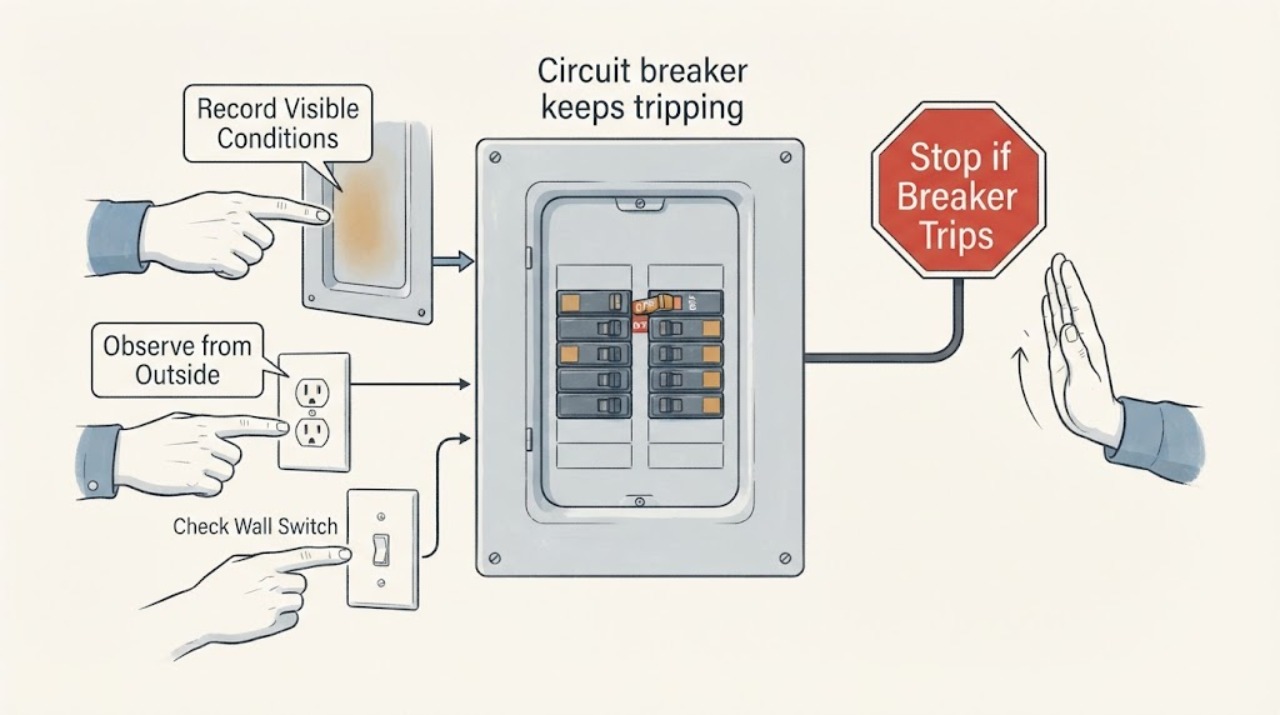
Work through in order
Diagnostic checks
Use only checks that match the exact appliance or system and its official guide.
-
Check 1
From outside the panel and without removing its cover, identify the affected protective device by its label and position: a breaker handle, a visible open fuse, or a fused disconnect. Record whether one branch, several branches, or the whole home is affected, and note the time and stage of the trip.
Expected result: A breaker handle may sit fully OFF or in an intermediate position. An opened fuse will not be restored by moving a handle. One branch points to a local load or circuit; several branches or the main device point to a broader electrical problem.
Next step: Leave a fuse or fused disconnect alone and arrange an electrician. If multiple circuits or the main supply are affected, stop using major loads and request urgent electrical assessment rather than attempting resets.
Why this matters
Why: The device type changes the safe next step, and the number of affected circuits separates a local branch event from a panel or supply concern.
-
Check 2
From a dry, safe position, write down what was operating when the protection opened: one appliance, several high-demand loads, a light or switch, or nothing identifiable. Note whether it happened at startup, during heating or motor operation, after a switch was used, or immediately after a reset.
Expected result: A trip that follows one appliance or one switch is a different branch from a trip that occurs with no identifiable load. A trip at startup may follow inrush or an appliance fault; a trip after a switch, light, or outlet is used raises concern about that fixed circuit.
Next step: Keep the suspected appliance, switch, light, or outlet out of use and label it for the electrician. Do not repeatedly operate it to reproduce the trip.
Why this matters
Why: Timing and load history give the electrician a reproducible symptom without requiring live measurements or panel access.
-
Check 3
When the area is dry and there are no warning signs, switch off or unplug accessible portable loads on the affected branch; pull a plug by its plug body, not its cord. Do not reach behind wet equipment or handle a damaged cord.
Expected result: If removing one portable load stops the symptom, that load or the combined demand is a useful suspect. If the protective device opens with loads disconnected, the fault may be in fixed wiring, an outlet, the device itself, or the protective equipment.
Next step: Keep the suspect load disconnected and arrange the appropriate electrician or appliance technician. Do not substitute a higher-rated protective device or use an extension cord to move the problem.
Why this matters
Why: Load isolation can distinguish a demand-related event from a fault that remains on the branch, but it cannot prove that an appliance or circuit is safe.
-
Check 4
Only if the panel, floor, and surrounding equipment are dry and cool, and there is no smoke, odor, buzzing, visible arc, moisture, or damage, perform no more than one normal reset of the labeled breaker: move an intermediate handle fully OFF, then ON, following the panel label. Do not touch a fuse or open the panel.
Expected result: A breaker that holds with the suspect load isolated may have responded to an overload or appliance event. A breaker that trips immediately, will not latch, or trips again when the same load is used has not been cleared.
Next step: If it trips again or will not hold, leave it off and call a qualified electrician. Do not continue resetting it, replace a fuse by trial and error, or bypass the protective device.
Why this matters
Why: A reset restores power; it does not repair an overload, short, ground fault, arc fault, damaged device, or weak connection. A fuse remains open until correctly serviced.
-
Check 5
From a safe distance, inspect only visible surfaces for a hot or discolored panel or outlet, melted plastic, a damaged cord, buzzing or sizzling, a burning smell, smoke, a flash, or water or dampness near electrical equipment. Do not remove covers or touch the suspected surface.
Expected result: Heat, discoloration, odor, noise, smoke, arcing, or moisture is an immediate hazard indicator rather than a troubleshooting branch. A damaged cord or outlet can make a particular load appear to be the cause while the connection is the hazard.
Next step: Stop using the area and keep people away. If there is smoke, flame, active arcing, or immediate danger, leave and contact emergency services from a safe location; otherwise isolate power only if a safe, clearly accessible control can be reached and request an electrician.
Why this matters
Why: These signs can accompany overheating, arcing, shock risk, or fire risk and cannot be safely resolved by changing a fuse or resetting a breaker.
-
Check 6
Prepare the electrician handoff with the device type, panel label, affected circuit count, load and trip stage, reset result, appliance or outlet involved, recent changes or moisture, visible warning signs, and photos taken from a safe distance. Leave the suspect circuit or device out of service until assessed.
Expected result: A repeat event tied to one appliance may need appliance and circuit evaluation. A trip with no load, an opened fuse, a hot connection, or several affected circuits needs fixed-wiring, panel, or service evaluation.
Next step: Call a qualified electrician for any repeat trip, opened fuse, immediate trip, damaged outlet or cord, unknown panel condition, recent electrical work, or multiple affected circuits. Keep the affected equipment unused until cleared.
Why this matters
Why: A precise symptom history helps the professional choose between appliance fault, overload, ground or arc fault, wiring damage, protective-device issue, and a wider supply problem.
Use your observations
Decision map
Find the observation that best matches what you see, then follow the next safe action.
-
PATH 01Next step
What you see
One breaker opens or one fuse opens when a particular appliance, outlet, switch, or light is used.
Do this next
Arrange qualified service and follow the exact model guidance.
Why this path and its safety boundary
Why it matters: Stop using that load or fixed point and arrange an electrician; an appliance technician may also be needed if the circuit is safe and the appliance is the confirmed suspect. Do not fit a larger fuse or breaker.
-
PATH 02Next step
What you see
The breaker opens immediately with portable loads disconnected, or will not latch after one safe reset.
Do this next
Arrange qualified service and follow the exact model guidance.
Why this path and its safety boundary
Why it matters: Leave it off and request a qualified electrician for a possible fixed-circuit, ground, arc, panel, or protective-device fault. Do not keep attempting resets.
-
PATH 03Next step
What you see
Several branch devices or the main device open, or the whole home loses power together.
Do this next
Arrange qualified service and follow the exact model guidance.
Why this path and its safety boundary
Why it matters: Stop using major loads and seek urgent electrical assessment of the panel or supply. Do not operate unfamiliar main equipment or repeatedly restore power.
-
PATH 04Next step
What you see
An older panel uses a fuse or fused disconnect rather than a resettable breaker.
Do this next
Arrange qualified service and follow the exact model guidance.
Why this path and its safety boundary
Why it matters: Do not substitute a higher-rated fuse, defeat the fuse holder, or treat the fuse as a breaker. Leave the circuit out of service and have an electrician identify the correct protective arrangement.
-
PATH 05Next step
What you see
Smoke, flame, active arcing, burning odor, a hot or damaged panel, water near electrical equipment, or shock is present.
Do this next
Arrange qualified service and follow the exact model guidance.
Why this path and its safety boundary
Why it matters: Stop immediately, keep people away, leave if necessary, and contact emergency services from a safe location. Request an electrician only after the immediate hazard is controlled.
Helpful context
Understand the symptom
The assigned component is fuse, while the user wording says circuit breaker. Those are related protective devices but not interchangeable: a breaker opens and can be reset by its handle, while a fuse opens once and requires the correct replacement by an appropriate person. Some panels contain breakers, fuses, or both. The safe diagnosis is therefore to identify the device and record the circuit behavior, not to assume a fuse is a breaker or alter its rating.
A single appliance can overload a branch circuit or have an internal fault. A breaker that trips with no load, a fuse that repeatedly opens, or several circuits that act together can point to fixed wiring, a ground fault, an arc fault, a panel problem, or a service issue. The observations below are for a safe handoff; they are not permission to work inside the panel.
Safety boundary
Stop conditions
- Stop immediately for smoke, flame, active arcing, a burning or melting smell, sizzling or buzzing with heat, a hot or discolored panel or outlet, damaged insulation, water or dampness near electrical equipment, shock, or a breaker or fuse that opens again.
- Do not open the panel, remove a cover, touch wiring, measure live voltage, replace a fuse with a different rating, bypass a protective device, use a damaged cord, or repeatedly reset the breaker.
- Leave a circuit out of service when the device type or cause is uncertain, the breaker trips with no load, multiple circuits are affected, or the area cannot be kept dry and accessible.
Common questions
FAQ
Why does a circuit breaker keep tripping?
It may be responding to excess demand, a faulty appliance, a ground or arc fault, damaged wiring, or a protective-device or panel problem. Record what was running and when it trips, then stop using the suspect circuit if the event repeats.
Is a fuse the same as a circuit breaker?
No. Both interrupt unsafe current, but a breaker opens a switch and may be reset after the cause is resolved, while a fuse opens once and needs the correct service replacement. Never use a higher-rated fuse or breaker to stop the symptom.
Can I reset the breaker again if it trips?
Do not repeatedly reset it. If the area is dry and free of smoke, heat, odor, buzzing, arcing, moisture, or damage, one normal reset may document the symptom; a second trip or a breaker that will not hold means leave it off and call an electrician.
Read the exact guide
Official sources
- Fuse and Breaker BreakdownElectrical Safety Foundation International · Fuse and breaker operation, oversized fuse hazards, and repeated-trip escalation
- CPSC Guide to Home Wiring HazardsU.S. Consumer Product Safety Commission · Residential fuses, circuit breakers, overloads, and home wiring hazards
- Limit Extension Cords To Reduce Risk Of FireU.S. Consumer Product Safety Commission · Safe appliance cord handling, damaged cords, overload, grounding, and GFCI protection
Community feedback
Share a repair observation
Share a plain-text repair observation. Accepted observations are published automatically; this page may take a moment to update.