
On this page
Start here
Quick answer
Moving outlets to a different breaker can reduce an overload only after a qualified electrician confirms the circuit design, wire size, breaker type, box capacity, grounding, and local code. A tripping breaker is a protective response to overload or a fault, not permission to install a larger breaker or move conductors yourself. From outside the closed panel, record which breaker trips, which outlets and loads lose power, and whether the trip is immediate or load-dependent. Unplug or switch off suspect loads only when the area is dry and safe. Do not open the breaker box, move outlets, add a breaker, change wiring, test live voltage, or repeatedly reset the breaker. Hot or discolored outlets, buzzing, burning odor, sparks, shocks, moisture, smoke, or a breaker that trips again require immediate stop and licensed electrician service.
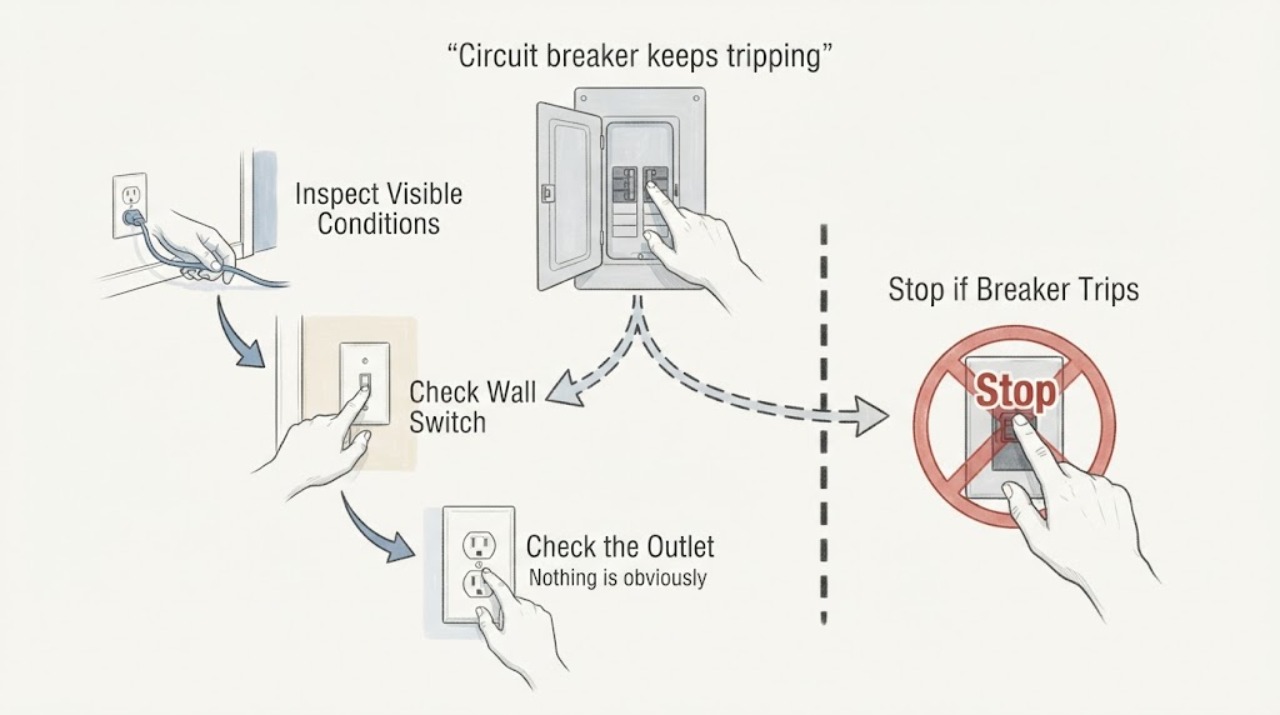
Work through in order
Diagnostic checks
Use only checks that match the exact appliance or system and its official guide.
-
Check 1
From a dry, safe position, look at the closed breaker-box exterior and nearby outlets for smoke, sparks, buzzing, a burning smell, heat, scorch marks, water, exposed wiring, or a shock or tingling sensation. If any is present, stop and keep people away.
Expected result: A hot or discolored outlet, arcing, odor, water, exposed wiring, shock, or smoke is a hazard sign rather than a simple overload.
Next step: Do not touch the panel, outlet, or switch and do not operate the affected circuit if doing so would enter the hazard area. Leave if there is smoke or fire and contact emergency help; otherwise arrange licensed electrician service.
Why this matters
Why: These signs can indicate overheating, a fault, or live parts and make resetting or opening the box unsafe.
-
Check 2
Without opening the panel, identify the exact breaker or safety switch that opens, the rooms and outlets that lose power, and whether one circuit or several are affected. Note the breaker label and whether the lever is fully OFF, intermediate, or apparently ON.
Expected result: One labeled branch affecting a repeatable group of outlets suggests a branch-circuit issue; several breakers or the main device changing state suggests a wider installation or supply concern. An unlabeled or inaccurate panel is important service information.
Next step: Write down the outlet locations and affected appliances. Do not remove the panel cover or identify conductors by touch.
Why this matters
Why: A circuit map helps an electrician trace the protected wiring without the homeowner moving conductors or assuming outlet location equals circuit ownership.
-
Check 3
With no warning sign and no standing water, list every appliance, power strip, light, charger, and fixed load that was operating when the trip happened. Unplug portable loads from the affected outlets only if the plugs, hands, and floor are dry and the equipment is not hot or damaged.
Expected result: A trip that follows one portable appliance points toward that load or its cord; a trip that occurs when several high-demand loads run together points toward demand or circuit capacity. A trip with everything disconnected still needs professional diagnosis.
Next step: Leave a suspected appliance disconnected and do not substitute a larger fuse or breaker. Give the load list and timing to the electrician.
Why this matters
Why: The timing and load pattern distinguish a possible use-related overload from an installation or equipment fault without live testing.
-
Check 4
If local instructions permit one normal reset, first switch off or unplug the known loads from the affected branch, then reset the breaker from its external handle without opening the box. If it trips again, stop; do not keep cycling it.
Expected result: A breaker that stays on only with loads removed may reflect overload or a faulty appliance. A breaker that trips immediately, trips with no portable loads, or will not reset indicates a fault or installation issue.
Next step: Leave the circuit off and arrange licensed electrician service. Never replace a breaker or fuse with a higher rating to keep the circuit energized.
Why this matters
Why: A reset is an observation, not a repair. Repeated tripping can defeat the protective response and increase fire or shock risk.
-
Check 5
Record whether the trip happens when a particular outlet is used, at startup of a motor or heater, during wet conditions, or without an obvious load. Do not test by repeatedly plugging devices in, using an extension arrangement, or operating equipment with a damaged cord.
Expected result: A repeatable outlet, appliance, moisture, or startup pattern narrows the handoff; an unexplained or intermittent trip keeps wiring, connection, protective device, and equipment faults in scope.
Next step: Keep the affected outlet or appliance out of use when the pattern repeats, and supply the electrician with the time, load, weather or moisture context, and breaker label.
Why this matters
Why: The trigger pattern is useful to a professional, but it cannot prove that moving outlets will solve the underlying fault.
-
Check 6
Ask a licensed electrician to evaluate the proposed outlet move at the panel and at each affected outlet, including conductor size, breaker compatibility, neutral and grounding paths, box space, shared circuits, GFCI or AFCI protection, and local code. Do not remove a cover, pull an outlet, move a conductor, or install a breaker yourself.
Expected result: The electrician may find that a dedicated branch circuit is appropriate, that a load needs repair or relocation, or that a short, loose connection, incorrect protection, or damaged wiring must be corrected first.
Next step: Provide the circuit map, breaker behavior, load list, photos taken from a safe distance, and any history of remodeling or previous electrical work. Keep the affected branch de-energized when directed.
Why this matters
Why: Only an on-site electrical assessment can establish whether an outlet can be moved safely and whether the repeated trip has a different cause.
Use your observations
Decision map
Find the observation that best matches what you see, then follow the next safe action.
-
PATH 01Next step
What you see
There is smoke, fire, buzzing, arcing, burning odor, heat, scorch marks, exposed wiring, water, or a shock or tingle.
Do this next
Arrange qualified service and follow the exact model guidance.
Why this path and its safety boundary
Why it matters: Stop using the affected area and do not touch or open the panel. Leave for smoke or fire and contact emergency help; otherwise arrange licensed electrician service before any reset or outlet move.
-
PATH 02Next step
What you see
The breaker trips only when several known loads operate together and no damage or moisture is present.
Do this next
Arrange qualified service and follow the exact model guidance.
Why this path and its safety boundary
Why it matters: Keep high-demand loads separated or off as a temporary precaution, record the circuit and load pattern, and have an electrician assess capacity and whether a dedicated branch circuit is permitted. Do not install a larger breaker.
-
PATH 03Next step
What you see
The breaker trips when one appliance, cord, or outlet is used.
Do this next
Arrange qualified service and follow the exact model guidance.
Why this path and its safety boundary
Why it matters: Leave that appliance or outlet out of use and arrange electrical or appliance diagnosis. Moving outlets will not make a damaged load safe.
-
PATH 04Next step
What you see
The breaker trips immediately, trips with portable loads removed, will not reset, or several breakers are involved.
Do this next
Arrange qualified service and follow the exact model guidance.
Why this path and its safety boundary
Why it matters: Treat it as a possible wiring, protective-device, or supply fault. Leave the affected circuit off and call a licensed electrician; do not repeatedly reset or open the breaker box.
-
PATH 05Next step
What you see
The panel is unlabeled, the home was recently remodeled, or the proposed move would change fixed wiring.
Do this next
Arrange qualified service and follow the exact model guidance.
Why this path and its safety boundary
Why it matters: Have a licensed electrician map and evaluate the installation, circuit protection, grounding, and code requirements. The homeowner should supply observations only, not move conductors or outlets.
Helpful context
Understand the symptom
The phrase “move some outlets to their own breaker” describes a wiring alteration, not a homeowner reset. Outlets that appear close together may be on different branches, and a new breaker is not safe unless the conductor, overcurrent protection, panel space, neutral and grounding arrangement, and local requirements all match. A breaker that keeps tripping may also be protecting against a short, ground fault, damaged appliance, loose connection, or failing breaker.
The useful homeowner contribution is a safe symptom map. Keep the panel cover closed, stay away from exposed wiring, and record what was operating when the trip occurred. A licensed electrician can then decide whether the remedy is load management, a dedicated branch circuit, equipment repair, or a fault in the existing installation.
Safety boundary
Stop conditions
- Stop immediately for smoke, fire, arcing, buzzing, burning odor, hot or discolored outlets, exposed wiring, water or dampness, electric shock or tingling, repeated trips, or a breaker that trips with no clear portable load.
- Do not open the breaker box, remove its cover, move outlets or conductors, add or replace a breaker, change a fuse rating, test live voltage, bypass protective devices, use damaged cords, or repeatedly reset the circuit.
- Keep the affected branch out of service until a licensed electrician has assessed the fault and confirmed that any dedicated circuit or outlet relocation is correctly designed and installed.
Common questions
FAQ
Will moving outlets to their own breaker stop the breaker from tripping?
It may address a verified overload, but it will not fix a damaged appliance, short, ground fault, loose connection, incorrect protection, or failing breaker. A licensed electrician must assess the wiring and design before any outlet or breaker is moved.
Can I install a larger breaker so the outlets stop losing power?
No. Breaker rating must match the circuit design and conductors. A larger protective device can allow unsafe current and overheating. Keep the circuit off when trips continue and arrange electrician service.
What should I record before calling an electrician?
Record the breaker position, rooms and outlets affected, appliances and loads in use, whether the trip is immediate or load-dependent, any moisture or remodeling history, and any odor, heat, buzzing, or visible damage. Do not open the panel or move wiring to collect these details.
Read the exact guide
Official sources
- Electrical equipment safety at homeElectrical Safety Office Queensland · Household electrical equipment, repeated trips, moisture, shocks, and electrician escalation
- Introduction to electrical safetyHealth and Safety Executive · Electrical shock, arcing, fire, wet-area, and competent-person boundaries
- Electrical wiring in your homeWorkSafe New Zealand · Household wiring, circuit-breaker trips, warning signs, and licensed electrical work
- Indoor Electrical Safety CheckElectrical Safety Foundation International · Circuit-breaker overload, safe reset context, and hot outlet warning signs
Community feedback
Share a repair observation
Share a plain-text repair observation. Accepted observations are published automatically; this page may take a moment to update.