
On this page
Start here
Quick answer
If the breaker trips even though this is the only outlet on the circuit, do not assume the breaker itself is bad or keep resetting it. A single outlet can still have an overloaded or failing appliance, damaged plug or cord, a ground fault, a worn receptacle, a loose connection, or a branch-wiring problem. Turn the connected equipment off and disconnect it only if there is no heat, smoke, water, sparking, or other immediate hazard. Note whether the breaker trips with the equipment disconnected, inspect the outlet and plug from a safe position, and leave the circuit unused if the trip returns. A qualified electrician should diagnose the receptacle, branch wiring, and protective device; a qualified appliance technician should evaluate equipment that causes the trip when connected.
Before you begin
Safety first
- This article covers stopping use, safe disconnection only when no immediate hazard is present, external observation, and documenting timing. Receptacle, breaker, GFCI, AFCI, panel, wiring, grounding, and electrical measurement work require a qualified electrician.
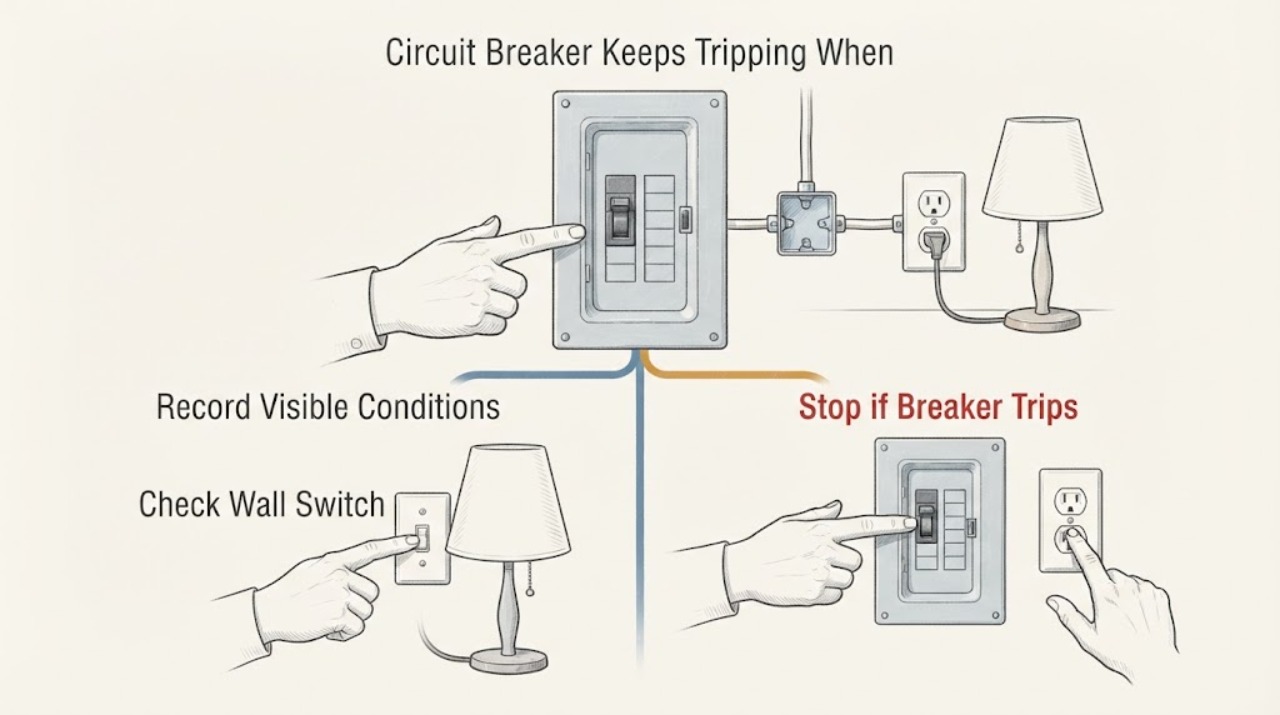
Work through in order
Diagnostic checks
Use only checks that match the exact appliance or system and its official guide.
-
Check 1
From a dry, safe position, record which breaker or protective device operates, what equipment was connected to the one outlet, and whether the trip happened at plug-in, switch-on, motor start, heating, or after several minutes. Do not deliberately recreate the trip.
Expected result: The trip is immediate on connection, occurs only when the equipment starts or heats, happens after running for a while, or occurs with no equipment connected.
Next step: Keep the timing record and follow the matching branch. Leave the circuit off when the cause is not obvious rather than repeating the event to get a clearer pattern.
Stop if: Stop immediately for smoke, active sparking, burning odor, shock, severe heat, wet equipment, or a breaker or panel that appears damaged.
Why this matters
Why: Immediate operation keeps a short, ground fault, damaged cord, receptacle, or equipment fault in focus; a delayed trip can reflect sustained load or heat; operation with no load shifts concern toward the receptacle, protective device, or fixed wiring.
-
Check 2
If there is no smoke, sparking, water, severe heat, or visible damage, switch the connected equipment off normally and disconnect it by holding the plug body; do not pull the cord or handle a damaged connection.
Expected result: The equipment, plug, or cord is hot, cracked, melted, discolored, loose, wet, or odor-producing, or all three appear cool and intact after disconnection.
Next step: Keep suspect equipment disconnected and label the symptom for the appliance technician or electrician. Do not connect it to another outlet as a comparison.
Stop if: Do not handle a plug or cord that is smoking, actively arcing, wet, melted, or severely hot; keep clear and obtain qualified or emergency help.
Why this matters
Why: A damaged or hot appliance connection can be the source of the trip and must not be reused. A cool exterior does not prove the appliance or outlet is safe, but it permits the electrician to examine the disconnected equipment without another live trial.
-
Check 3
With the equipment disconnected and the circuit left alone, inspect the outlet face, wallplate, plug, and nearby wall from a safe position without touching the outlet or removing its cover.
Expected result: There is discoloration, melting, cracking, a loose-looking receptacle, a loose plug fit, moisture, soot, a burning smell, or no visible abnormality.
Next step: Leave the outlet and circuit unused and arrange qualified electrical service for any abnormal sign. Provide photos taken from a safe position and do not touch the outlet to check its temperature.
Stop if: Stop for heat, smoke, odor, wetness, crackling, sparks, shock, or any need to remove a wallplate or reach into the receptacle.
Why this matters
Why: Visible or odor evidence supports a receptacle, plug, cord, moisture, or wiring hazard even if the breaker is currently on. No visible damage cannot rule out a loose connection or fault inside the box.
-
Check 4
From outside the electrical panel and without handling a damaged area, note whether the outlet or nearby bathroom, kitchen, garage, or outdoor receptacle has TEST/RESET buttons and whether an indicator shows an interruption. Record the breaker handle position without opening the panel.
Expected result: A nearby GFCI or AFCI indicator is tripped, the protective device will not stay set, the branch breaker is visibly open, or no protection indicator is found.
Next step: Leave the affected circuit unused and report the indicator, handle position, and timing to a qualified electrician. Do not keep operating a device merely because a button or handle changes position.
Stop if: Do not open the panel, remove a cover, alter wiring, bypass protection, or operate a reset in a wet, hot, sparking, or visibly damaged area.
Why this matters
Why: GFCI protection can interrupt power when it detects leakage, while a breaker can open for overload, short, ground fault, equipment, or wiring trouble. An indicator or handle position does not identify the failed component and does not clear heat or water damage.
-
Check 5
Using the equipment nameplate and the trip record, write down the equipment type, rated input, whether it has a motor, heater, compressor, or charger, and whether any power strip, adapter, or extension cord was involved. Do not add another load or move the suspect equipment for a comparison.
Expected result: The connected item is a high-demand or motor-driven load, a heat-producing item, a charger or adapter, a damaged cord or power strip, or a small load that still causes an immediate trip.
Next step: Give the load details to the electrician and, where appropriate, the appliance technician. Keep the suspect item disconnected and leave the circuit unused until the cause is cleared.
Stop if: Do not use an extension cord or power strip as a test, change the breaker rating, bypass a protective device, or continue a load that has caused a trip.
Why this matters
Why: Load and startup characteristics help separate sustained demand from a device or connection fault, but the rating label alone cannot establish allowable circuit capacity or locate a wiring problem. A small load that trips immediately is not made safe by the fact that it uses little power.
-
Check 6
Prepare a service report with the outlet location, whether it is the only visible outlet on the branch, breaker or GFCI behavior, connected equipment, trip timing, photos from a safe distance, moisture history, and any recent electrical or appliance work.
Expected result: The evidence points to the connected equipment, the receptacle or protection, or remains ambiguous because the breaker trips with the outlet unloaded.
Next step: Call a qualified electrician for a circuit, receptacle, and protective-device assessment; call an appliance technician as well when the equipment is the repeat trigger. Keep the circuit unused until cleared.
Stop if: Do not remove covers, touch conductors, perform electrical measurements, reset repeatedly, or reconnect the equipment to obtain more evidence.
Why this matters
Why: A clear timeline lets a professional isolate the appliance from the branch circuit without asking the homeowner to energize a questionable connection. A trip with no load is a fixed-circuit or protective-device warning until diagnosed.
Use your observations
Decision map
Find the observation that best matches what you see, then follow the next safe action.
-
PATH 01Safety boundary
What you see
The breaker trips when the same equipment is connected or switched on, while no immediate heat, smoke, water, or visible damage is present.
Do this next
Keep the equipment disconnected and request qualified electrical and appliance diagnosis. Provide the nameplate and exact trip timing.
Why this path and its safety boundary
Why it matters: The equipment, plug, cord, receptacle, or a load-related fault is implicated, but the outlet may still be damaged.
Safety stop: Do not connect the equipment to another outlet or keep resetting the breaker to see whether it will run.
-
PATH 02Safety boundary
What you see
The breaker trips or will not remain set when the only outlet has no equipment connected.
Do this next
Leave the circuit off and arrange prompt qualified electrical diagnosis. Tell the electrician that the trip occurs with the outlet unloaded.
Why this path and its safety boundary
Why it matters: The receptacle, protective device, upstream connection, or fixed branch wiring may have a fault; the single-outlet description does not make it safe to access.
Safety stop: Do not open the panel or receptacle, probe the outlet, or install a different protective device.
-
PATH 03Safety boundary
What you see
The outlet, wallplate, plug, or cord is hot, discolored, melted, cracked, loose, wet, smoking, sparking, or smells burnt.
Do this next
Keep clear, leave the equipment and outlet unused, and obtain qualified electrical service; use local emergency guidance for smoke, fire, or active arcing.
Why this path and its safety boundary
Why it matters: This is a shock or fire hazard, regardless of whether the breaker currently holds.
Safety stop: Do not touch the damaged area, unplug an actively arcing connection, apply water, or return power to reproduce the symptom.
-
PATH 04Safety boundary
What you see
A GFCI or AFCI indicator shows an interruption, will not stay set, or operates along with the branch breaker.
Do this next
Keep the circuit unused and have a qualified electrician identify the cause and verify the protective arrangement before service resumes.
Why this path and its safety boundary
Why it matters: Leakage, an arc fault, overload, equipment fault, or wiring problem may be present; the protective device is a symptom and safety control, not proof of a failed device.
Safety stop: Do not bypass, hold, rewire, or repeatedly reset the GFCI, AFCI, or breaker.
-
PATH 05Safety boundary
What you see
The breaker holds briefly, then trips when a motor starts, a heater operates, or the equipment has run for several minutes.
Do this next
Stop using the equipment and provide its rating and trip timing to an electrician and appliance technician; do not repeat the run.
Why this path and its safety boundary
Why it matters: Sustained demand, startup current, heat, a failing component, or a connection that worsens under load may be involved.
Safety stop: Stop at once for heat, odor, smoke, noise, sparks, a hot plug, or any change in the outlet or cord.
-
PATH 06Safety boundary
What you see
The outlet, plug, and cord appear dry and intact, the breaker is currently set, and the symptom occurred only once.
Do this next
Keep the suspect equipment disconnected, document the event, and arrange an electrician check before normal use if the breaker was repeatedly operating or the cause is uncertain.
Why this path and its safety boundary
Why it matters: A transient overload or intermittent equipment or connection fault remains possible; a normal appearance does not clear the circuit.
Safety stop: Do not deliberately reproduce the trip or assume that the one-outlet arrangement rules out hidden wiring trouble.
Helpful context
Understand the symptom
One outlet does not mean one possible cause
A breaker may serve only one visible receptacle while the fault is in the appliance, plug, cord, receptacle, upstream connection, protective device, or hidden branch wiring. The outlet may also be a GFCI or AFCI point whose protective function covers wiring or devices downstream. Treat the stated single-outlet arrangement as useful context, not proof that the breaker is defective or that the circuit is dedicated.
The timing of the trip changes the next step
A trip immediately when equipment is connected or switched on makes the equipment, cord, receptacle, or a short or ground-fault path more suspicious. A trip only after a motor or heater runs can point to a load or heat-related fault. A breaker that trips with the equipment disconnected shifts attention toward the receptacle, protective device, or fixed wiring. Timing cannot identify the failed part, so do not keep repeating the event.
Keep the protection intact
Circuit breakers are safety devices intended to stop current when a circuit is overloaded or otherwise unsafe. Do not substitute a higher-rated breaker, bypass a GFCI or AFCI, open the receptacle or panel, or use an extension cord as a workaround. If a connection is hot, wet, discolored, sparking, smoking, or smells burnt, keep clear and use local emergency guidance as appropriate.
Safety boundary
Stop conditions
- Stop immediately for smoke, active arcing, sparks, burning odor, shock, wet electrical equipment, melting, severe heat, or a hot or damaged panel; keep clear and follow local emergency guidance.
- Do not repeatedly reset the breaker or GFCI, install a higher-rated breaker or fuse, bypass protective devices, or return power to a circuit that has overheated.
- Do not remove the receptacle or wallplate, open the electrical panel, probe outlet slots, touch conductors, or perform live electrical measurements.
- Do not reconnect suspect equipment to another outlet, use an extension cord or power strip as a workaround, repair a cord, or continue a load that caused the trip.
- If the breaker trips with the only outlet unloaded, leave the circuit off until a qualified electrician evaluates the receptacle, protective device, branch connections, and fixed wiring.
Only after diagnosis
Potential parts
- branch receptacle
Consider this category only when qualified diagnosis confirms that the receptacle is worn, heat-damaged, loose, or failed and the branch circuit and protective arrangement are suitable.
Confirm device rating, grounding, box, conductor, location, load, and local electrical requirements with the electrician; do not choose a replacement from appearance alone. - GFCI or AFCI protective device
Consider this category only after qualified diagnosis identifies failed or damaged protection or a required device arrangement; a trip alone does not justify replacement.
Confirm circuit configuration, device type and rating, wiring, location, and applicable requirements; protection must not be bypassed. - appliance cord or plug
Consider this category only when a qualified appliance technician confirms that a damaged cord or plug is involved and the equipment remains suitable for service.
Match the exact equipment, grounding, strain relief, cord construction, and manufacturer requirements; do not repair damaged insulation as a trial.
When checks do not resolve it
Need a professional?
Arrange prompt qualified electrical service when the breaker trips with the outlet unloaded, trips more than once, operates with a GFCI or AFCI, or the outlet, plug, cord, wallplate, or panel shows heat, discoloration, wetness, looseness, odor, smoke, sparks, or shock. Arrange appliance service when the same equipment repeatedly triggers the trip after it is connected. Active smoke, fire, or arcing requires local emergency guidance; do not attempt outlet or panel repair.
Safety scope: This article covers stopping use, safe disconnection only when no immediate hazard is present, external observation, and documenting timing. Receptacle, breaker, GFCI, AFCI, panel, wiring, grounding, and electrical measurement work require a qualified electrician.
Common questions
FAQ
Why would a breaker trip if only one outlet is on the circuit?
The single outlet can still feed an appliance with a fault or high demand, or the receptacle, protective device, branch wiring, or upstream connection can be failing. The outlet count does not identify the source. Record whether the trip occurs with the equipment connected or disconnected and have the circuit assessed if it returns.
Can I keep resetting the breaker to see whether the appliance works?
No. A recurring trip is a safety response. Disconnect the equipment only when there is no immediate hazard, leave the circuit unused, and arrange qualified electrical or appliance diagnosis rather than repeating the event.
What if the breaker trips with nothing plugged in?
Leave the circuit off. A trip with the outlet unloaded keeps the receptacle, breaker, GFCI or AFCI, upstream connection, or fixed branch wiring in focus and needs a qualified electrician; do not open the panel or receptacle.
Should I move the appliance to another outlet as a test?
Do not move suspect equipment to another outlet to reproduce the fault. A damaged appliance, plug, or cord can create a hazard elsewhere, and an electrician or appliance technician can evaluate it safely from the recorded symptom.
When is a tripping breaker an emergency?
Treat smoke, active arcing, sparks, a burning odor, shock, severe heat, melting, wet electrical equipment, or a hot panel as an immediate stop-use hazard. Keep clear and follow local emergency guidance; do not use water or attempt outlet or panel repair.
Read the exact guide
Official sources
- CPSC Guide to Home Wiring HazardsU.S. Consumer Product Safety Commission · CPSC household wiring-hazard guide; it provides general safety information and does not replace an inspection of a particular circuit.
- Understanding Your Home Electrical SystemElectrical Safety Foundation International · General residential electrical-safety guidance; local code and qualified electrician instructions control a particular installation.
Community feedback
Share a repair observation
Share a plain-text repair observation. Accepted observations are published automatically; this page may take a moment to update.