
On this page
Start here
Quick answer
A reported “3A” load does not prove that a circuit is safe or that overload is impossible. The value may be a label, an estimate, a reading taken after the trip, or a device reading that misses startup current, other loads, leakage, an arc-fault condition, or an intermittent wiring fault. Treat the repeated trip as the important fact: keep the appliance and circuit out of service, do not keep resetting the breaker, and never install a higher-rated breaker. From a safe, dry position, record exactly where the 3A figure came from, what was operating, when the trip occurred, whether another load shares the circuit, and whether there is heat, buzzing, discoloration, burning odor, water, sparks, or shock. A consistent single-appliance trigger needs both qualified appliance and electrical assessment; a trip with moisture or warning signs needs a licensed electrician immediately.
Before you begin
Safety first
- Do not reset repeatedly, up-rate protection, bypass a safety device, open the panel or appliance, make live measurements, use an extension cord, or touch wet, hot, damaged, buzzing, smoking, or arcing equipment.
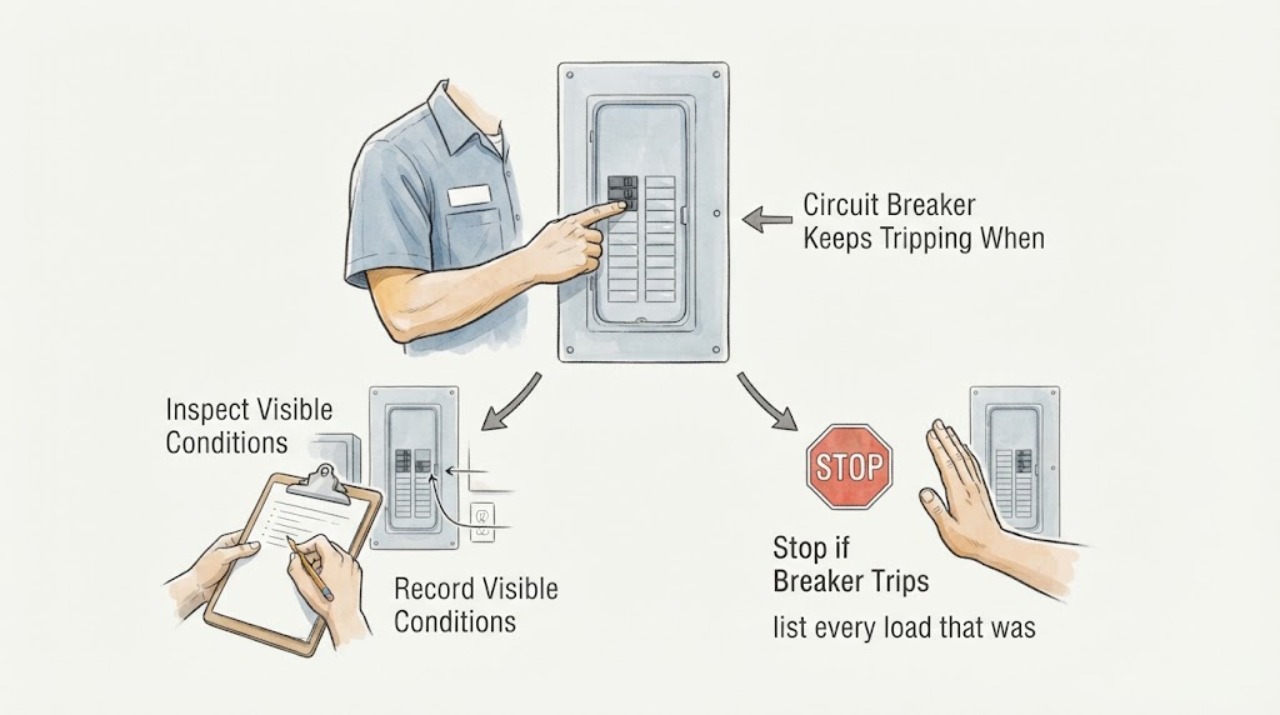
Work through in order
Diagnostic checks
Use only checks that match the exact appliance or system and its official guide.
-
Check 1
Stop the appliance or load and observe from a safe, dry position for smoke, sparks, arcing, a burning odor, a hot or discolored plug or receptacle, a damaged cord, water, shock or tingling, or another trip. Do not reset the breaker to reproduce the event.
Expected result: No warning sign is visible, or smoke, arcing, heat, burning odor, water, shock, or another trip is present.
Next step: For any warning sign, leave the equipment off, keep clear, and contact emergency help for fire or smoke and a licensed electrician for the electrical hazard. If no warning sign is present, continue only with external observations and keep the suspect load off.
Stop if: Stop immediately for smoke, sparks, visible arcing, burning odor, a hot or discolored connection, shock, water near electrical parts, or a repeated trip.
Why this matters
Why: The second result is a fire, shock, ground-fault, arc-fault, or overheating warning. A low-looking current figure does not override that hazard.
-
Check 2
Record the exact origin of “3A” without making a new electrical measurement: note whether it came from a nameplate, appliance display, energy monitor, plug-in instrument, or another person, and whether it describes the appliance alone or the whole branch circuit.
Expected result: The value is a label or estimate, it is a device-only reading, it was taken after the trip, it is not time-stamped, or its origin cannot be confirmed.
Next step: Tell the electrician exactly what the 3A figure means and do not use it to justify another run. Keep the suspect load off until the circuit and appliance are assessed with appropriate professional equipment.
Stop if: Stop for any request to measure live voltage or current, open the panel, insert a device into a damaged or hot receptacle, or reconnect the load to validate the number.
Why this matters
Why: A label or device-only value is not a verified circuit measurement. A post-trip or unknown value may miss the event, other branch loads, starting behavior, leakage, or a fault that appears only intermittently.
-
Check 3
From the breaker label and safe room observations, list every load that was operating when the trip occurred, not just the device associated with the 3A figure. Include lights, heaters, motors, chargers, and equipment that may be on the same branch, without adding a load or changing circuits.
Expected result: The named device was alone, several loads were operating, another load is unknown, or the trip happened when a second device started.
Next step: Keep the involved loads off and provide the list to a licensed electrician. Have the circuit mapped and its capacity assessed; do not solve the issue by adding a larger breaker or using an extension cord.
Stop if: Stop for a repeated trip, an extension-cord setup, a hot or loose connection, smoke, odor, arcing, or any attempt to move a high-demand load as an experiment.
Why this matters
Why: A single-device pattern points toward the appliance, its connection, or its branch. Several simultaneous loads can exceed circuit capacity, and unknown circuit mapping prevents a safe overload conclusion.
-
Check 4
Inspect only the outside of the cord, plug, and receptacle from a dry position for fraying, looseness, discoloration, melting, heat, buzzing, a cord pinched by furniture, or moisture. Do not touch, unplug, or inspect behind a hot, wet, damaged, smoking, or arcing connection.
Expected result: The exterior looks cool and intact, or there is looseness, damage, discoloration, heat, buzzing, moisture, smoke, or arcing.
Next step: Keep the appliance off and arrange a licensed electrician for the receptacle and circuit and qualified appliance service for the device. Do not use the connection until it is cleared.
Stop if: Stop for any hot, loose, damaged, wet, discolored, smoking, buzzing, or arcing cord, plug, or receptacle.
Why this matters
Why: A sound exterior does not clear the branch or appliance, but heat, buzzing, damage, moisture, or arcing is evidence of a connection or wiring hazard.
-
Check 5
Read only the external label or indicator that identifies whether the protective device is a standard breaker, AFCI, GFCI, or combination device, and note whether the trip followed moisture or occurred in a damp area. Do not remove the panel cover or touch wiring.
Expected result: A ground-fault or arc-fault device is indicated, equipment is wet or damp, the device type is unknown, or no moisture is present.
Next step: Keep the circuit and equipment off and arrange a licensed electrician to identify the protection and find the fault. Do not repeatedly reset, defeat, or replace the device yourself.
Stop if: Stop for wet equipment, standing water, a damp panel, shock or tingling, smoke, heat, arcing, or any need to open the panel.
Why this matters
Why: Ground-fault protection can interrupt power when leakage current is detected, including when equipment gets wet. Arc-fault protection addresses hazards from damaged, overheated, or stressed wiring or devices. A type that is unknown cannot safely be interpreted by guesswork.
-
Check 6
Observe whether lights dim or flicker, another device loses power, a switch or outlet buzzes, or the appliance seems underpowered when the suspect load operates. Use only visible information and the existing history; do not reconnect the load or make electrical measurements.
Expected result: Dimming, flicker, buzzing, discoloration, underpowered behavior, or no other visible symptom is present.
Next step: Stop using the suspect circuit for the affected load and arrange a licensed electrical inspection. Do not increase the breaker rating or continue operating to gather more evidence.
Stop if: Stop for buzzing, flicker with heat, a hot or discolored outlet, burning odor, smoke, arcing, or another trip.
Why this matters
Why: These warning signs can indicate overload, a poor connection, aged wiring, or a protection problem. No visible sign does not make the 3A figure proof that the circuit is safe.
-
Check 7
Prepare a service record without restoring power: breaker label and device type, origin and timing of the “3A” figure, appliance or load, operating stage, other loads, room conditions, cord and receptacle observations, moisture, prior work, and every trip. Keep the suspect load out of service.
Expected result: The same appliance is the only trigger, the circuit trips with several loads, the event follows moisture or a damaged connection, or the trigger remains uncertain.
Next step: Contact a licensed electrician for the circuit, breaker, receptacle, grounding, and wiring. Contact qualified appliance service for a single appliance that repeatedly triggers the event after the circuit is safely assessed. Restore use only after the fault is repaired and cleared.
Stop if: Stop for another trip, smoke, fire, odor, heat, arcing, shock, water, or any request to reconnect the load to validate the record.
Why this matters
Why: The pattern helps separate an appliance fault from circuit capacity, a connection, a protection-device, or a wiring issue without relying on an unverified low reading.
Use your observations
Decision map
Find the observation that best matches what you see, then follow the next safe action.
-
PATH 01Next step
What you see
Smoke, fire, visible arcing, burning odor, a hot or discolored connection, shock, or water near electrical equipment is present.
Do this next
Leave if necessary, keep others away, and contact emergency help for fire or smoke. Have a licensed electrician isolate and assess the circuit; do not touch, unplug, or restore wet or arcing equipment.
Why this path and its safety boundary
Why it matters: Treat this as an immediate fire or shock hazard; the reported 3A value does not lower the risk.
-
PATH 02Next step
What you see
The 3A figure is only a label, estimate, appliance-only display, post-trip reading, or unverified memory.
Do this next
Keep the suspect load off and give the figure's origin to a licensed electrician. Do not reconnect it to obtain a different number.
Why this path and its safety boundary
Why it matters: It cannot establish the total branch load, a brief starting event, leakage, an arc fault, or the condition of the breaker and wiring.
-
PATH 03Next step
What you see
The breaker trips only when several loads operate together, even though the named device is associated with a low-looking 3A figure.
Do this next
Keep the combination off and have an electrician map the branch and assess its capacity. Do not add a larger breaker or use an extension cord.
Why this path and its safety boundary
Why it matters: The combined demand may exceed the circuit's safe capacity, or the installation may have a wiring or protection fault.
-
PATH 04Next step
What you see
The breaker trips whenever one appliance starts or reaches the same operating stage while other loads are off.
Do this next
Leave the appliance off and arrange qualified appliance service and a licensed electrical assessment as appropriate. Do not keep running it to confirm the pattern.
Why this path and its safety boundary
Why it matters: The appliance, its connection, the branch, or its protection may be faulty; the low-looking figure does not clear any of them.
-
PATH 05Next step
What you see
The event follows moisture or a ground-fault device indication.
Do this next
Keep people away, do not touch wet equipment, and arrange qualified electrical service to isolate and assess the circuit. Do not reconnect it to see whether it has dried.
Why this path and its safety boundary
Why it matters: Leakage current can trip ground-fault protection and can create a shock hazard even when the steady load appears small.
-
PATH 06Next step
What you see
Lights dim, outlets buzz or discolor, the appliance is underpowered, or the breaker trips without a clear load pattern.
Do this next
Stop using the affected circuit for the load and arrange a licensed electrical inspection. Do not increase the breaker rating or rely on the 3A description.
Why this path and its safety boundary
Why it matters: These are warning signs of overload, a poor connection, aged wiring, or another electrical-system fault.
-
PATH 07Next step
What you see
One trip occurred, no warning signs are visible, and the 3A value cannot be verified.
Do this next
Record what was operating and seek professional advice if the cause is unknown, the load is high demand, or the event repeats. Do not reconnect solely to confirm the reading.
Why this path and its safety boundary
Why it matters: A transient or unresolved fault is possible; a quiet circuit after a trip does not prove it is safe for the same load.
Helpful context
Understand the symptom
Why a low-looking reading is not a clearance
“Only using 3A” is a condition to investigate, not a verified measurement to rely on. Ask what the number represents: a nameplate value, a smart-device estimate, a plug-in display, a remembered reading, or a value observed after the breaker opened. It may not include every load on the branch or a brief event that caused the protective device to operate. A breaker can also respond to ground-fault or arc-fault conditions rather than a steady high reading. The repeat trip remains the actionable symptom.
Keep the circuit intact while it is assessed
Safe troubleshooting here is limited to labels, timing, connected loads, and visible external conditions. Do not open the panel, take live electrical measurements, bypass protection, substitute a larger breaker, or move a suspect load to another circuit to see whether the symptom follows. A licensed electrician should assess the breaker, circuit, connections, grounding, and protection; qualified appliance service should assess the device after the electrical supply is safe.
Safety boundary
Stop conditions
- Stop immediately for smoke, fire, visible arcing, burning odor, a hot or discolored panel, outlet or plug, shock or tingling, water near electrical equipment, or another trip. Leave if needed and contact emergency or licensed electrical help.
- Do not treat 3A as a verified safety measurement. Do not reconnect the load to obtain another reading, reset repeatedly, install a larger-rated breaker or fuse, bypass AFCI or GFCI protection, or use an extension cord to change the result.
- Do not remove the panel cover, touch conductors, make live voltage or current measurements, inspect inside an outlet, open an appliance, or work on wiring. A licensed electrician must diagnose the circuit and protective device.
- Stop for a wet appliance or receptacle, standing water, an unstable floor, a damaged cord, a hot or loose connection, or any need to unplug or isolate equipment by entering the hazard. Keep clear and have a qualified person make the area safe.
- Stop using a high-demand load when lights dim, outlets buzz or discolor, appliances seem underpowered, or the breaker trips during use. Keep the circuit out of service until the cause is assessed.
When checks do not resolve it
Need a professional?
Keep the affected circuit and suspect load out of service and request electrical help when the breaker trips during use more than once, the 3A figure cannot explain the event, warning signs are present, or the circuit serves a high-demand appliance. Request appliance service when one device consistently triggers a safe circuit assessment.
Safety scope: Do not reset repeatedly, up-rate protection, bypass a safety device, open the panel or appliance, make live measurements, use an extension cord, or touch wet, hot, damaged, buzzing, smoking, or arcing equipment.
Common questions
FAQ
If the appliance uses only 3A, why does the breaker keep tripping?
The 3A description may not be a verified whole-circuit measurement and may miss other loads, a brief startup event, leakage, an arc-fault condition, or an intermittent appliance or wiring fault. Treat the repeat trip as the symptom and keep the load off until it is assessed.
Can I use another outlet to see whether the appliance is the problem?
Do not move a suspect high-demand load or use an extension cord as an experiment. The other outlet may be on a different circuit with different protection, and moving the load can create another hazard. Have the appliance and circuit assessed safely.
Could a GFCI trip even with a small current reading?
Yes. GFCI protection responds to leakage current and can operate when equipment gets wet; a small steady-load figure does not clear the equipment or the circuit. Keep wet or suspect equipment out of service and arrange qualified electrical help.
Should I install a higher-rated breaker if the reading is low?
No. The breaker protects the wiring, and a higher rating can permit unsafe current. Circuit capacity, wiring, protection, and the appliance must be assessed by a licensed electrician.
Read the exact guide
Official sources
- Understanding Your Home Electrical SystemElectrical Safety Foundation International · General residential electrical-safety education; actual wiring, devices, and local requirements vary.
- Home Electrical SafetyElectrical Safety Foundation International · General home electrical safety; inspection and code requirements depend on the installation and jurisdiction.
- How to Use GFCIsElectrical Safety Foundation International · General GFCI safety guidance; actual device type and local electrical requirements vary.
- CPSC Guide to Home Wiring HazardsU.S. Consumer Product Safety Commission · General residential wiring safety; the actual installation and local electrical requirements control.
Community feedback
Share a repair observation
Share a plain-text repair observation. Accepted observations are published automatically; this page may take a moment to update.