
On this page
Start here
Quick answer
An outdoor breaker that keeps tripping can be reacting to an overloaded branch, a faulty outdoor appliance, moisture in an enclosure or connection, or a wider supply problem. Treat the outdoor location as a safety clue, not permission to open the box: from a dry position, identify the exact breaker, note whether trips follow rain, an appliance start, or a long run, and observe only visible signs. Do not open an outdoor panel or disconnect, touch wet equipment, test live voltage, install a larger breaker, or keep resetting it. Leave it off and arrange qualified electrical service for a repeat trip, and include the relevant equipment professional when one outdoor appliance is the consistent trigger.
Before you begin
Safety first
- The homeowner scope ends at dry, stable external observation and ordinary load identification. Outdoor panel interiors, disconnects, receptacles, fixed wiring, protective-device replacement, motors, capacitors, compressors, and live testing require qualified service.
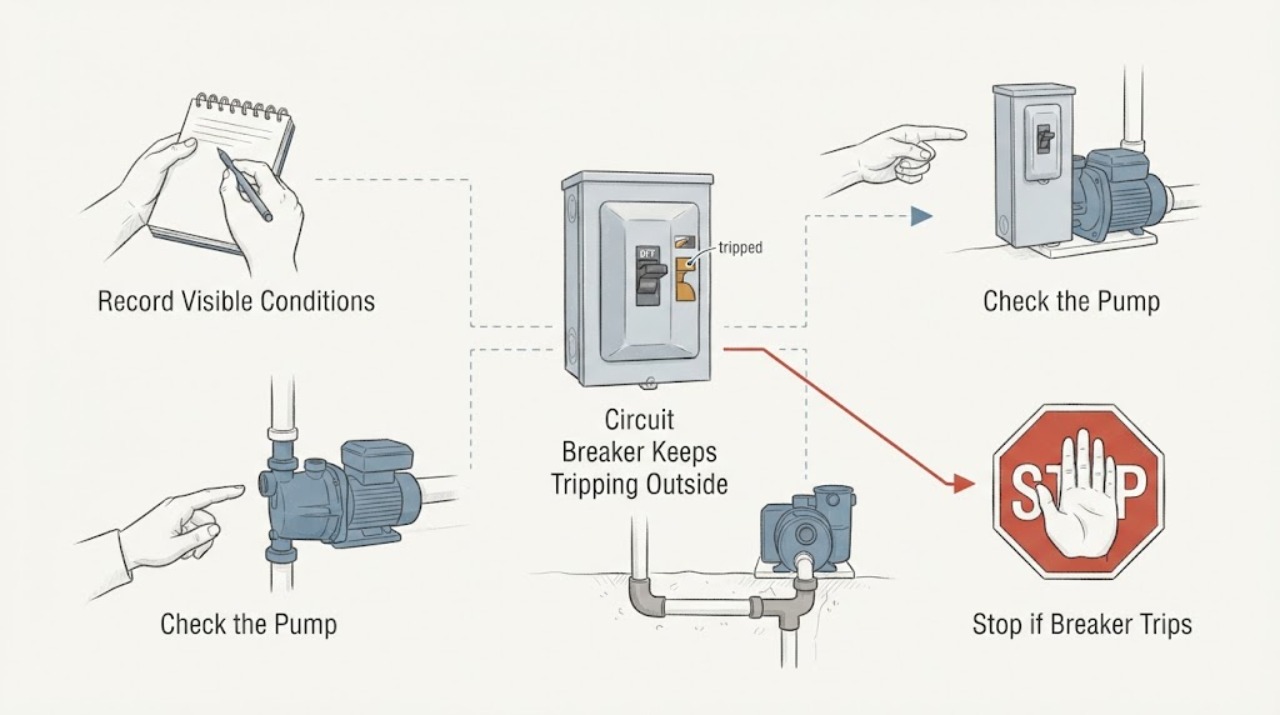
Work through in order
Diagnostic checks
Use only checks that match the exact appliance or system and its official guide.
-
Check 1
From a dry standing position, identify the exact outdoor breaker or protective device that opens and record whether it is a single branch, a ground-fault or arc-fault device, a two-pole equipment circuit, or the main device; do not approach a wet panel or touch the handle with wet hands.
Expected result: One labeled branch opens, more than one device changes state, or the main device opens.
Next step: Leave the affected device off after a repeat trip, note its label and the outdoor areas that lost power, and arrange qualified electrical service. Do not replace it with a larger protective device.
Why this matters
Why: A single branch points toward its outdoor loads or wiring, while several devices or a main trip can indicate a broader supply, service, or water-related problem.
-
Check 2
Record the weather and timing without deliberately recreating the fault: note whether the trip follows rain, irrigation, washing, high humidity, a storm, an outdoor appliance starting, or a long operating period.
Expected result: The trip follows wet weather, one appliance start, several overlapping loads, a long run, or occurs with no obvious outdoor load change.
Next step: Do not keep resetting to compare patterns. Keep the circuit off and give the electrician the timing, weather, and load context.
Why this matters
Why: A weather-linked event raises concern about moisture or damaged outdoor equipment; a load-linked event points to that equipment or branch; a delayed event can reflect heat accumulation or a fault that appears under sustained load.
-
Check 3
From a dry, safe distance, list the outdoor loads served by the breaker, such as lighting, pumps, receptacles, cooling equipment, tools, or permanently connected equipment; do not unplug or move anything wet or reach into a puddle.
Expected result: One appliance is the consistent trigger, multiple loads overlap, a wet-area device is affected, or no clear load is identifiable.
Next step: Keep the suspect equipment and circuit out of service and report the list. An electrician should verify the branch and protection; the appliance or HVAC professional can evaluate a consistent equipment trigger.
Why this matters
Why: The load list helps separate an appliance fault from branch demand or an unidentified fixed load, but a dry-looking exterior does not prove a device or wiring is safe.
-
Check 4
Look only from a safe distance for visible moisture, water tracks, damaged covers, displaced weather seals, chewed or cut cords, rust, or equipment tilted into water; do not open the enclosure, touch the cord, or inspect from a ladder or unstable surface.
Expected result: An enclosure, cord, receptacle, disconnect, or appliance appears wet or damaged, or no visible defect is present.
Next step: Keep people away and arrange qualified electrical service. Do not dry, tape, reseal, or return the equipment to service yourself.
Why this matters
Why: Visible moisture or damage is enough to keep the circuit isolated; no visible defect does not exclude water behind a cover, in conduit, or inside equipment.
-
Check 5
Observe the affected outdoor equipment only from a dry, clear location and without removing a guard: note a fan that does not start, humming, unusual cycling, a pump that runs continuously, or a light or receptacle that is dead; do not reach through grilles or restart the equipment.
Expected result: One motorized load hums or fails to start, a pump runs abnormally, equipment cycles and trips, or only an outdoor receptacle or light is affected.
Next step: Leave the circuit off and provide the observation to the appropriate equipment professional and electrician. Do not test capacitors, motors, compressors, or fixed wiring.
Why this matters
Why: The symptom may be in the appliance, motor, control, receptacle, or branch wiring; sound or a dead outlet cannot identify the failed component or make internal testing safe.
-
Check 6
From a dry place, note whether the panel, disconnect, receptacle, cord, or equipment is hot, discolored, buzzing, sizzling, smoking, sparking, or giving off a burning odor; do not touch it to confirm temperature.
Expected result: Any heat, discoloration, buzzing, sizzling, smoke, arcing, or burning odor is present, or no warning symptom is visible.
Next step: Stop using the area and leave the circuit off. For smoke or fire, leave and contact emergency services from a safe location; otherwise arrange urgent qualified electrical service.
Why this matters
Why: These are potential shock or fire indicators, not a reason to reset or investigate further; the absence of a visible symptom does not clear the circuit.
-
Check 7
Note whether nearby indoor circuits, common-area equipment, or neighboring properties also lost power, using only a safe view or ordinary conversation; do not inspect a meter, utility line, or service entrance.
Expected result: Only the outdoor branch is affected, several circuits in the property are affected, or nearby properties are also without power.
Next step: Keep the suspect circuit off and use the utility or building manager's normal reporting channel for a wider outage. Ask an electrician to assess a local or unexplained multi-circuit trip.
Why this matters
Why: A local branch event favors an outdoor load or wiring investigation, while a wider outage may involve the utility or building distribution rather than the outdoor device.
-
Check 8
Prepare a service handoff with the breaker label, weather history, exact trip timing, outdoor loads, first wet point if visible, external damage, warning symptoms, and whether the trip is repeatable; do not attempt another reset to complete the record.
Expected result: The record shows a weather-linked trip, a single equipment trigger, an overlap-load pattern, or no consistent pattern.
Next step: Leave the device in the safe state and schedule qualified electrical service. Add an HVAC, pump, lighting, or other equipment professional when that specific load is implicated.
Why this matters
Why: A clear pattern helps the professional decide whether to begin with moisture isolation, branch protection, the outdoor appliance, or the utility/building supply without repeatedly energizing a suspect circuit.
Use your observations
Decision map
Find the observation that best matches what you see, then follow the next safe action.
-
PATH 01Next step
What you see
The trip follows wet conditions or a visible outdoor moisture or seal problem.
Do this next
Do not reset, touch, dry, or open the equipment. Keep the branch off, keep people away, and arrange qualified electrical service to assess moisture intrusion and the affected equipment.
-
PATH 02Next step
What you see
The breaker opens when one pump, cooling unit, light, tool, or other load starts or runs.
Do this next
Leave the circuit and suspect appliance off. Have an electrician assess the branch and protective device, and have the equipment professional assess the appliance without consumer access to internal electrical parts.
-
PATH 03Next step
What you see
The trip occurs only when multiple substantial loads operate together.
Do this next
Turn off safe, dry, portable loads if they can be reached without touching wet equipment, but do not use extension cords or a larger breaker as a workaround. Have an electrician verify the branch design and connections.
-
PATH 04Next step
What you see
The outdoor branch trips while connected loads appear idle or the cause cannot be identified.
Do this next
Leave it off and arrange electrical service. A concealed fixed load, damaged cable, wet enclosure, protective-device issue, or upstream problem cannot be cleared by an exterior glance.
-
PATH 05Next step
What you see
Any outdoor electrical part or nearby panel is hot, discolored, sizzling, buzzing, smoking, sparking, or burning-smelling.
Do this next
Stop using the area and do not reset or investigate internally. Leave for active smoke or fire and contact emergency services from safety; otherwise request urgent qualified electrical service.
Helpful context
Understand the symptom
Why an outside breaker needs a different first question
Outdoor equipment is exposed to rain, condensation, irrigation, salt or dirt, temperature changes, and mechanical damage. The trip may involve a wet receptacle or disconnect, a pump or cooling unit, a damaged cord, or wiring that is not visible from outside. It may also be a normal overload pattern when several loads run together. The useful distinction is whether the same breaker trips after weather, when one load starts, after a long run, or even with the outdoor loads apparently idle.
The safe boundary for outdoor troubleshooting
Only make observations from a dry, stable location without touching the panel, disconnect, receptacle, cords, enclosures, or wet ground. Do not remove covers, use a meter, open a junction box, reach through equipment grilles, bypass a protective device, or repeatedly re-energize a circuit. A qualified electrician can isolate the branch and determine whether an appliance, enclosure, wiring fault, or service-side problem is responsible.
Safety boundary
Stop conditions
- Stop immediately for smoke, flame, visible arcing or sparks, sizzling, a burning or melting odor, a hot or discolored panel, disconnect, receptacle, cord, or appliance.
- Do not touch or operate an outdoor breaker, disconnect, receptacle, cord, or appliance that is wet or surrounded by standing water. Keep people away from the area.
- If the breaker trips again or trips immediately, leave it off. Do not repeatedly reset it, install a larger protective device, bypass ground-fault or arc-fault protection, or use an extension cord to defeat the symptom.
- Do not open an outdoor panel, disconnect, junction box, or equipment cabinet; measure live voltage; reach through a grille; handle a capacitor; or inspect utility or service equipment.
- Do not work from a ladder, roof, unstable ground, or wet surface. If outdoor equipment is damaged, flooded, humming without starting, or associated with a repeat trip, arrange professional service.
When checks do not resolve it
Need a professional?
Call a qualified electrician for any repeated, immediate, weather-linked, unexplained, multi-circuit, moisture-related, or warning-symptom trip. Add the relevant HVAC, pump, lighting, or equipment professional when one outdoor load is the consistent trigger.
Safety scope: The homeowner scope ends at dry, stable external observation and ordinary load identification. Outdoor panel interiors, disconnects, receptacles, fixed wiring, protective-device replacement, motors, capacitors, compressors, and live testing require qualified service.
Common questions
FAQ
Why does an outdoor breaker trip after rain?
Rain can expose moisture intrusion, a damaged enclosure, a wet receptacle or disconnect, or a fault in an outdoor appliance, although the trip may also be an unrelated overload or equipment failure. Do not touch or open wet equipment; leave the circuit off and arrange qualified electrical service.
Should I reset an outside breaker to see whether it stays on?
Do not repeatedly reset it. If it trips again or immediately, leave it off. A repeat trip is an unresolved protective warning, and outdoor moisture makes touching or re-energizing the equipment particularly unsafe.
Can I open the outdoor disconnect or panel to dry it?
No. Opening the enclosure, drying internal parts, measuring voltage, or repairing wiring is not a safe homeowner check. Keep clear and have a qualified electrician isolate, inspect, and restore the circuit.
Which professional should diagnose an outdoor breaker that keeps tripping?
An electrician should assess the breaker, outdoor disconnect, branch wiring, protection, and moisture path. Add an HVAC, pump, lighting, or other equipment professional when one specific outdoor load consistently triggers the trip.
Read the exact guide
Official sources
- Electricity 101U.S. Department of Energy · Household electricity demand and seasonal or weather-related load context
- CPSC Guide to Home Wiring HazardsU.S. Consumer Product Safety Commission · Residential circuit breakers, overloads, repeated trips, outdoor electrical hazards, and warning signs
- Air Conditioner Troubleshooting: Why Your AC Is Not CoolingTrane · Air-conditioner breaker, outdoor unit, airflow, motor, condensate, and professional service guidance
- Air Conditioner and Fan SafetyElectrical Safety Foundation International · Electrical safety around outdoor air-conditioning and cooling equipment
Community feedback
Share a repair observation
Share a plain-text repair observation. Accepted observations are published automatically; this page may take a moment to update.