
On this page
Start here
Quick answer
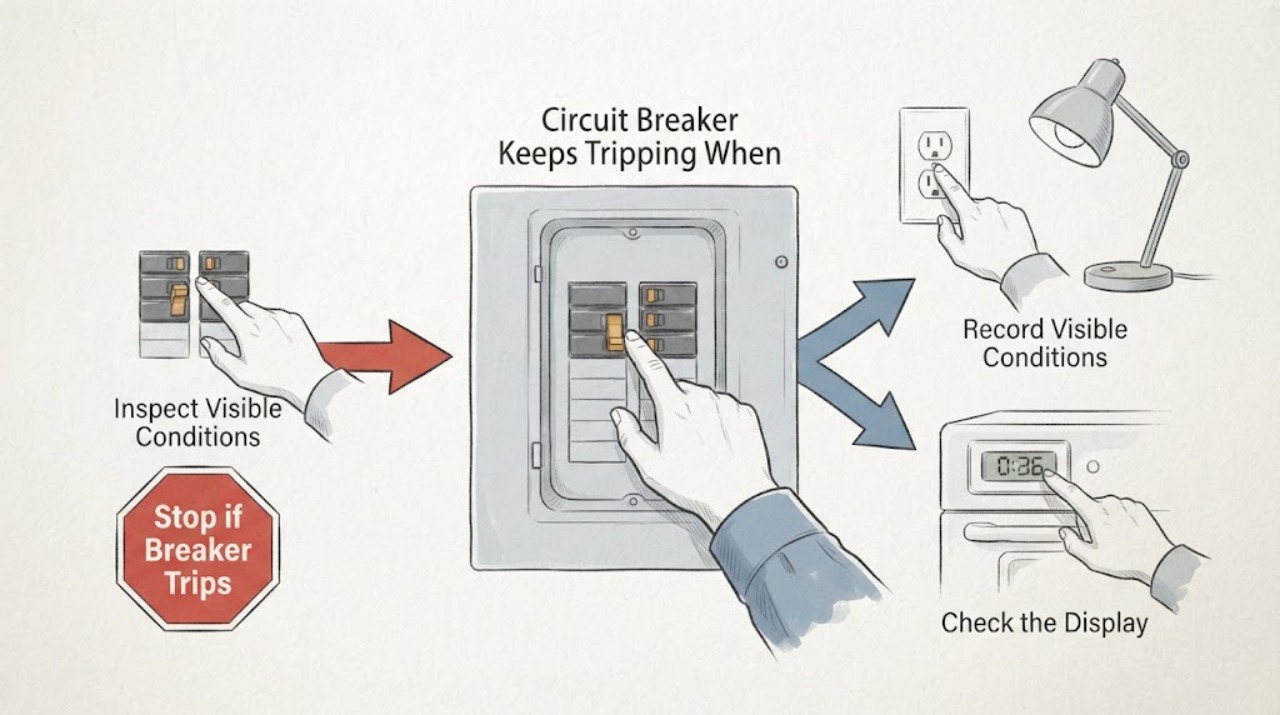
A breaker that trips again after you flip it off and on is signaling an unresolved overload, short, ground fault, arc fault, defective device, or wiring problem. Do not keep resetting it. If there is smoke, burning odor, sizzling, arcing, heat at the panel or an outlet, water, damaged insulation, or anyone feels unsafe, move away and call emergency help or a qualified electrician. If there is no warning sign and the panel is dry, turn off or unplug accessible loads on that circuit without opening the panel, then make at most one normal reset. If it trips immediately or trips again when a particular appliance is used, leave that circuit or appliance out of service and call an electrician. Never install a larger breaker, bypass protection, open the panel, touch wiring, use a wet outlet, or test by repeatedly switching the breaker.
Work through in order
Diagnostic checks
Use only checks that match the exact appliance or system and its official guide.
-
Check 1
From a safe, dry position, record whether the breaker trips immediately after the off-then-on action, only when a particular appliance starts, after several hours, or when several loads operate; also record the breaker label and affected rooms.
Expected result: The trip is immediate, tied to one appliance, tied to combined loads, delayed, or affects more than one circuit.
Next step: Do not repeat the switching action. Use only the safe load-isolation step below if there is no hazard; otherwise leave the area and call a qualified electrician or emergency service.
Why this matters
Why: An immediate trip keeps a short, ground fault, arc fault, breaker, or fixed wiring issue in focus. A trip tied to one device favors that load or its cord. A combined-load or delayed trip favors overload or a heat-related fault. Multiple circuits suggest a broader supply or installation concern.
-
Check 2
Without opening the panel or touching questionable equipment, turn off or unplug accessible appliances on the affected circuit, using dry hands and only normal controls; do not unplug anything that is hot, wet, damaged, sparking, or difficult to reach.
Expected result: The circuit has many simultaneous loads, one device is visibly damaged or hot, the area is damp, or no obvious load is present.
Next step: Leave any unsafe device disconnected only if it can be done without contact with the hazard. Do not use another circuit or an extension cord as a workaround; arrange electrician diagnosis for a damaged device, moisture, or an unexplained circuit.
Why this matters
Why: Several loads can overload a branch circuit. A damaged, hot, wet, or sparking device can create a fault and should not be handled. No obvious load keeps fixed wiring, a breaker, or a concealed fault in focus.
-
Check 3
From outside the panel and receptacles, look for smoke, burning odor, sizzling, flickering, scorch marks, warmth, damaged cord insulation, water, or visible arcing; do not touch the panel, outlet, cord, or breaker when any warning is present.
Expected result: A heat, odor, sound, water, scorch, damage, or arc warning is present, or the visible area appears normal and dry.
Next step: For any warning, keep clear and obtain emergency or qualified electrician help. If everything is dry and normal-looking, continue only with the single reset boundary and stop at the next trip.
Why this matters
Why: These signs can indicate overheating, an arc fault, a ground fault, or an unsafe connection and make a reset inappropriate. A normal-looking exterior cannot rule out a hidden wiring or device fault.
-
Check 4
Identify whether the device is a standard breaker, AFCI, GFCI, or combination device by its exterior label and test/reset markings; do not change the rating, substitute a different protective device, or remove the panel cover.
Expected result: The label identifies AFCI or GFCI protection, the device appears standard, or the device type cannot be identified.
Next step: Record the label and circuit location for service. Do not alter the protective device or repeatedly press a test/reset control outside its normal instructions.
Why this matters
Why: The protection type changes which overload, arc, or leakage conditions may have caused the trip. An unknown type or unusual handle behavior is information for an electrician, not a reason to experiment.
-
Check 5
Only if the area is dry, cool, undamaged, and free of odor, smoke, buzzing, arcing, or water, perform at most one normal off-then-on reset after the accessible loads are off; do not hold the handle in place or repeat the reset.
Expected result: The breaker stays on with loads off, trips immediately, or trips again when one load is restored.
Next step: If it trips at all after this one reset, leave the circuit off and call a qualified electrician. Do not restore the suspected appliance or add loads to make another comparison.
Why this matters
Why: A stable breaker with loads off supports a connected-load or appliance branch, but it does not prove the circuit is safe under load. An immediate trip points toward a continuing circuit, breaker, or wiring fault; a trip with one load implicates that load or its connection.
-
Check 6
Prepare a service handoff with the breaker label, trip timing, affected rooms, load list, moisture or damage observations, breaker type, and what happened after the one permitted reset; do not diagnose by opening covers or touching fixed wiring.
Expected result: The trip recurs, the circuit remains off, the breaker feels unusual, or the electrician needs a clear history.
Next step: Keep the circuit or suspect load out of service and arrange a qualified electrician. Escalate to emergency help for smoke, fire, arcing, or immediate shock risk.
Why this matters
Why: A repeatable history helps separate overload, appliance, AFCI/GFCI, breaker, and fixed-wiring paths without unsafe probing. Frequent trips warrant qualified inspection even when the circuit later appears to hold.
Use your observations
Decision map
Find the observation that best matches what you see, then follow the next safe action.
-
PATH 01Next step
What you see
The breaker trips immediately after the one safe reset, with accessible loads off.
Do this next
Leave it off and call a qualified electrician. A continuing circuit, breaker, arc-fault, ground-fault, or fixed-wiring issue is possible; do not open the panel or try another reset.
-
PATH 02Next step
What you see
The breaker stays on with loads disconnected but trips when one appliance is restored.
Do this next
Leave that appliance disconnected and have the appliance cord, plug, receptacle, and circuit evaluated. Do not move it to another circuit as a test or use a damaged device.
-
PATH 03Next step
What you see
The trip occurs only when several loads operate or after a period of use, with no visible hazard.
Do this next
Reduce simultaneous use without repeatedly resetting and ask an electrician to assess circuit loading and installation. Do not install a larger breaker or use an extension cord as a permanent solution.
-
PATH 04Next step
What you see
There is smoke, burning odor, sizzling, arcing, heat, water, damaged insulation, fire, or shock risk.
Do this next
Move away, do not touch the equipment or breaker, and call emergency help when necessary or a qualified electrician from a safe location. Do not use water on an energized electrical fire.
-
PATH 05Next step
What you see
More than one circuit trips or the pattern begins after renovation, a new large appliance, or other electrical work.
Do this next
Keep affected circuits out of service as needed and arrange an electrical inspection. Do not assume the breaker is defective or alter the panel configuration.
Helpful context
Understand the symptom
A second trip is a stop signal
The breaker is protecting the circuit, not causing the underlying problem. An immediate or repeated trip can come from a load that exceeds the circuit, a short, a ground fault, an arc fault, a damaged appliance, moisture, or fixed wiring. The timing matters: an instant trip, a trip when one appliance starts, and a trip after hours of use point to different diagnostic paths. Do not keep flipping the handle to see whether it holds.
Use only a limited load-isolation check
If the area is dry and there is no heat, odor, smoke, buzzing, arcing, or visible damage, turn off or unplug accessible appliances on the affected circuit. Do not open the panel, remove receptacle covers, handle damaged cords, or use an extension cord as a workaround. One normal reset is enough to see whether the circuit remains stable; a further trip means the circuit stays out of service until an electrician evaluates it.
The device type changes the likely fault
A standard breaker, AFCI, and GFCI protect against different electrical conditions. An AFCI can respond to an arc fault in wiring or equipment, while a GFCI responds to leakage toward ground. Do not replace one protective device with another or change its rating. Record the label, test/reset markings, affected rooms, and what was running when the trip occurred for the electrician.
Moisture and heat require a wider boundary
Water near an outlet, appliance, cord, or panel can create shock and fault risk. A hot or discolored outlet, a burning smell, sizzling, flickering, damaged insulation, or a panel that feels hot is not a nuisance trip. Move away without touching the affected equipment and obtain qualified electrical or emergency help.
Safety boundary
Stop conditions
- Stop immediately for smoke, burning odor, sizzling, arcing, flickering, a hot or discolored outlet or panel, water, damaged insulation, fire, or shock risk. Move away and obtain emergency or qualified electrician help.
- Do not repeatedly switch the breaker, hold it on, open the panel, remove receptacle covers, touch fixed wiring, measure live circuits, or bypass AFCI or GFCI protection.
- Do not install a larger breaker, replace a protective device with a different type, use an extension cord as a permanent workaround, or restore a hot, wet, sparking, or damaged appliance.
- If the breaker trips again after the one permitted reset, leave the circuit off until a qualified electrician diagnoses it.
Only after diagnosis
Potential parts
- circuit breaker or protective device
Only consider this category after a qualified electrician confirms the breaker or protective device itself is faulty and the replacement type is correct.
Panel, breaker, AFCI/GFCI type, rating, and local requirements must be confirmed by the electrician; do not substitute a larger or different device. - receptacle, cord, or appliance connection
Only consider this category after diagnosis links the trip to a specific damaged receptacle, cord, or connection rather than the fixed circuit.
Do not select or install electrical parts from symptoms alone; a qualified electrician must confirm the installation and rating.
When checks do not resolve it
Need a professional?
Call a qualified electrician after any repeat trip, an immediate trip with accessible loads off, a trip tied to one appliance, an unknown or unusual breaker, multiple affected circuits, or work-related onset after renovation. Treat smoke, arcing, fire, hot equipment, water, or shock risk as an emergency.
Common questions
FAQ
Why does the breaker trip again when I turn it off and back on?
The circuit still has an overload, short, ground fault, arc fault, defective load, breaker problem, or wiring issue. Turn off accessible loads only if the area is dry and safe, allow at most one normal reset, and leave the circuit off if it trips again.
Can I keep resetting a circuit breaker that keeps tripping?
No. Repeated trips are a reason for qualified electrician inspection. Do not hold the breaker on, bypass its protection, or replace it with a larger rating.
What should I do before calling an electrician?
Record the breaker label, affected rooms, trip timing, connected loads, breaker type, and any odor, heat, water, sound, or visible damage. Only turn off or unplug accessible loads when everything is dry and cool; do not open the panel or touch questionable equipment.
When is a tripping breaker an emergency?
Smoke, fire, arcing, burning odor, sizzling, hot or discolored equipment, water near electricity, damaged insulation, or shock risk requires moving away and obtaining emergency or qualified electrical help. Do not touch or wet the affected equipment.
Read the exact guide
Official sources
- Fuse and Breaker BreakdownElectrical Safety Foundation International · Electrical-safety reference for distinguishing protection types and the need for qualified inspection of frequent trips.
- Understanding Your Home Electrical SystemElectrical Safety Foundation International · Electrical-safety organization guidance for homeowner-level observation and the boundary between one reset and electrician diagnosis.
Community feedback
Share a repair observation
Share a plain-text repair observation. Accepted observations are published automatically; this page may take a moment to update.