
On this page
Start here
Quick answer
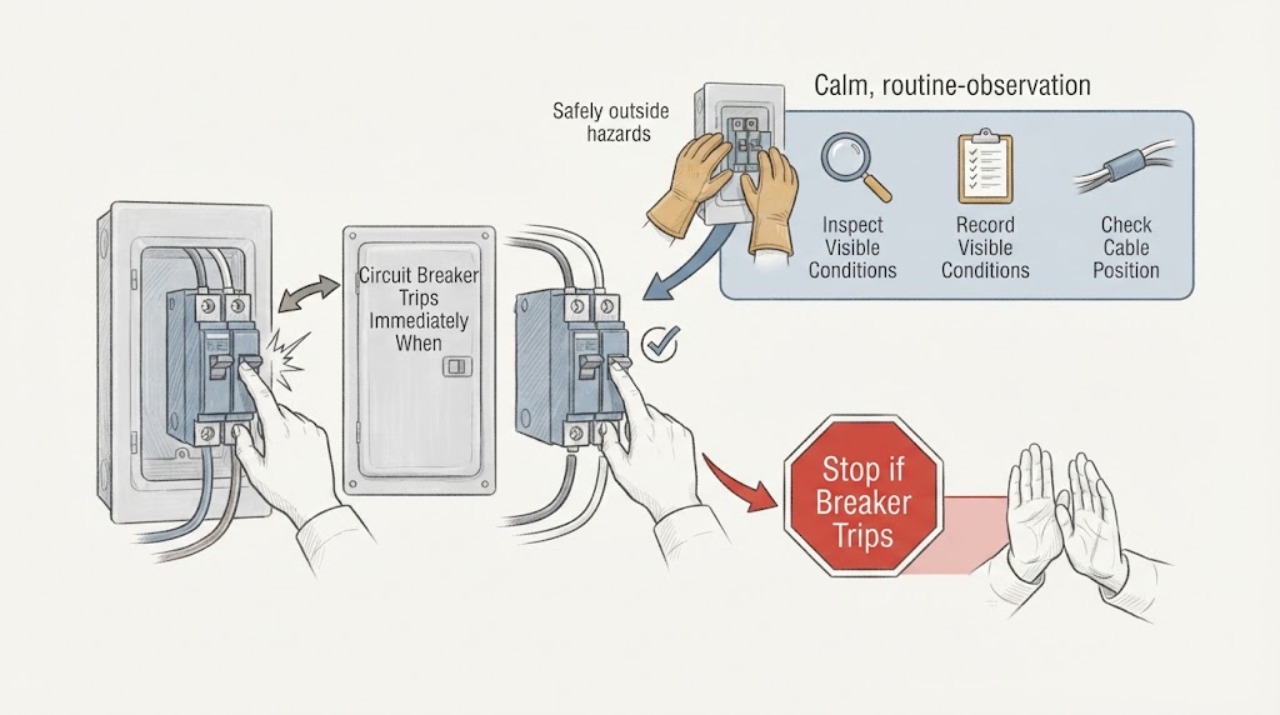
If a breaker trips immediately when a device is connected but stays set when the device is disconnected, the difference shows that the fault appears when the load or its wiring is brought into the circuit. Possible causes include a short circuit, ground fault, damaged insulation, incorrect connection, a faulty switch or device, moisture, or an arc-fault condition; the pattern does not identify which one. Do not reconnect or disconnect the device, turn the switch on again, reset the breaker repeatedly, open the panel, touch wires, or make live measurements. Keep the circuit and device out of service. From a safe, dry position, record the breaker type, device identity, timing, visible cord or enclosure damage, moisture, heat, buzzing, smoke, odor, sparks, and whether other loads are affected. A licensed electrician must assess the wiring, protection, and connections; qualified appliance or equipment service may be needed for the connected device.
Before you begin
Safety first
- Do not reconnect or unwire the device, operate the switch to reproduce the trip, open the panel or boxes, touch wiring, make live measurements, up-rate protection, bypass safety devices, use an extension cord, or handle wet, hot, damaged, buzzing, smoking, or arcing equipment.
Work through in order
Diagnostic checks
Use only checks that match the exact appliance or system and its official guide.
-
Check 1
Stop using the circuit and observe from a safe, dry position for smoke, sparks, arcing, burning odor, a hot or discolored switch or enclosure, exposed or damaged insulation, water, shock or tingling, or another immediate trip. Do not reconnect the device or reset the breaker to reproduce the result.
Expected result: No warning sign is visible, or smoke, arcing, heat, odor, exposed wiring, water, shock, or another trip is present.
Next step: Keep the circuit and device off, leave if fire or smoke makes the area unsafe, and contact emergency help for fire. Arrange a licensed electrician for any electrical warning; if no warning is visible, continue only with non-contact observations.
Stop if: Stop immediately for smoke, sparks, visible arcing, burning odor, hot or discolored parts, shock, water near electrical equipment, exposed wiring, or another trip.
Why this matters
Why: The second result is an immediate fire, shock, ground-fault, arc-fault, or overheating concern. The fact that the breaker stays on with the device unwired does not lower that risk.
-
Check 2
Record the exact sequence from the existing event without repeating it: whether the breaker opened as soon as the device was connected, when the switch was operated, when the device started, or after a delay. Note whether the device was recently installed, moved, repaired, or exposed to moisture.
Expected result: The trip was immediate on connection, immediate on switch operation, delayed until the device started, or occurred after moisture or recent work.
Next step: Keep the device disconnected only as it currently is and do not touch the conductors or terminals. Give the sequence, installation history, and moisture information to the electrician.
Stop if: Stop for any request to reconnect the device, strip insulation, move wires, make a live measurement, or open a junction, switch box, or panel.
Why this matters
Why: The timing helps the electrician distinguish a connection or wiring fault from a device or operating-load fault, but it cannot safely locate the fault without professional isolation and measurements.
-
Check 3
From outside the electrical installation, identify the device, switch, receptacle, cable route, breaker label, and protective-device indicator if it is plainly visible. Do not remove a faceplate, open a box, pull the device out, or touch an uninsulated conductor.
Expected result: The device is a fixed load, plug-connected appliance, motor, heater, light, or unknown equipment, and the protection appears standard, ground-fault, arc-fault, or unknown.
Next step: Write down the visible identity and labels and keep the circuit off. Arrange a licensed electrician for the installation and qualified service for the device if the electrician finds the branch safe.
Stop if: Stop for a missing cover, exposed conductor, wet box, damaged enclosure, heat, buzzing, odor, sparks, or any need to remove a cover to identify the device.
Why this matters
Why: The equipment type and protective device change what a professional must assess. A ground-fault or arc-fault indication can be meaningful even when the load appears small or the device is disconnected.
-
Check 4
Inspect only the accessible exterior of the device, cord, plug, switch plate, or enclosure from a dry position for cuts, pinching, looseness, discoloration, melting, a hot surface, water, or a damaged strain relief. Do not unplug a hot or arcing connection and do not handle a wet device.
Expected result: The exterior looks cool and intact, or damage, looseness, heat, discoloration, water, buzzing, smoke, or arcing is present.
Next step: Keep the device and circuit out of service and arrange electrical inspection. Do not tape, bend, splice, replace, or reposition the cord or wiring as a user repair.
Stop if: Stop for a hot, loose, wet, damaged, discolored, smoking, buzzing, or arcing device, cord, plug, switch, or enclosure.
Why this matters
Why: An intact exterior does not clear hidden wiring or the device, while visible damage, heat, water, buzzing, or arcing is direct evidence of a connection or equipment hazard.
-
Check 5
Note whether any other lights, outlets, or devices on the same labeled circuit dim, lose power, buzz, or seem underpowered, using only existing safe observations. Do not move this device to another circuit or add a load to compare behavior.
Expected result: Only the connected device is implicated, several loads are affected, lights dim, outlets buzz or discolor, or the affected circuit is unknown.
Next step: Keep the circuit off and provide the pattern to a licensed electrician. Do not install a larger breaker, use an extension cord, or transfer the device to another outlet as a trial.
Stop if: Stop for repeated trips, dimming with heat, buzzing, discoloration, smoke, burning odor, arcing, or any request to add or move loads for comparison.
Why this matters
Why: A single-device pattern can involve the device, its connection, or its branch. Multiple affected loads, dimming, buzzing, or unknown circuit mapping can indicate an overloaded, damaged, or poorly connected electrical system.
-
Check 6
Determine from the visible label or prior records whether the breaker or receptacle is AFCI, GFCI, or a combination device, and whether the device is in a damp area. Do not press reset repeatedly, defeat the protection, remove the panel cover, or touch wiring.
Expected result: A ground-fault or arc-fault device is indicated, moisture is involved, the device type is unknown, or no moisture is known.
Next step: Keep the circuit and connected equipment off and arrange a licensed electrician to identify the protection and locate the fault. Do not reconnect the device to see whether it has dried.
Stop if: Stop for wet equipment, standing water, a damp panel, shock or tingling, smoke, heat, arcing, or any need to open the panel.
Why this matters
Why: Ground-fault protection can operate for leakage involving wet equipment, while arc-fault protection responds to hazards associated with damaged or overheated wiring or devices. An unknown device type is not safe to interpret by guesswork.
-
Check 7
Prepare a service record without changing the wiring: breaker label and type, device and switch identity, the exact connected-versus-disconnected sequence, installation or repair history, visible condition, other affected loads, moisture, and every sound, odor, heat, spark, shock, or trip.
Expected result: The device alone causes an immediate trip, the trip follows a recent wiring change, the circuit trips only under the device's operating load, or the cause remains uncertain.
Next step: Request a licensed electrician to isolate and diagnose the circuit first. Request qualified device service after the electrician confirms a safe supply and identifies the device as the likely source. Restore operation only after the fault is repaired and cleared.
Stop if: Stop for another trip, smoke, fire, odor, heat, arcing, shock, water, or any request to reconnect the device for confirmation.
Why this matters
Why: The record helps separate a wiring or connection fault from an equipment fault without exposing anyone to another energized fault. None of these patterns proves that the breaker itself is the failed part.
Use your observations
Decision map
Find the observation that best matches what you see, then follow the next safe action.
-
PATH 01Next step
What you see
Smoke, fire, visible arcing, burning odor, hot or discolored parts, shock, exposed wiring, or water near electrical equipment is present.
Do this next
Leave if necessary, keep others away, and contact emergency help for fire or smoke. Have a licensed electrician isolate and assess the installation; do not touch, unplug, or restore wet or arcing equipment.
Why this path and its safety boundary
Why it matters: Treat this as an immediate fire or shock hazard; the disconnected switch state does not make reconnection safe.
-
PATH 02Next step
What you see
The breaker opens immediately when the device is connected or the switch is operated, but does not open while the device is disconnected.
Do this next
Keep the circuit and device out of service and arrange a licensed electrician. Do not reconnect, disconnect, or inspect the wiring yourself.
Why this path and its safety boundary
Why it matters: A connected-load fault is possible in the device, cable, switch box, junction, grounding, or protection path. The behavior does not locate the fault.
-
PATH 03Next step
What you see
The trip follows recent installation, repair, a moved device, pinched cable, water exposure, or an altered connection.
Do this next
Stop using the circuit and tell the electrician what changed and when. Do not undo the installation, open a box, dry a component while energized, or make a live measurement.
Why this path and its safety boundary
Why it matters: A connection error, insulation damage, ground fault, or moisture-related fault may have been introduced; safe diagnosis requires the circuit to remain isolated.
-
PATH 04Next step
What you see
The device is plug-connected and its exterior cord, plug, and receptacle are visibly cool, dry, and undamaged, but connecting it still trips the breaker.
Do this next
Keep the device disconnected and request a licensed electrician and, if indicated, qualified device service. Do not transfer it to another circuit or use an extension cord.
Why this path and its safety boundary
Why it matters: The fault may be hidden inside the device, receptacle, cable, or protective circuit; an intact exterior does not clear it.
-
PATH 05Next step
What you see
The device runs briefly and the breaker opens only when a motor, heater, lamp, or other operating load starts.
Do this next
Keep the device off and give the operating-stage timing to qualified service. Do not cycle it again to identify the stage.
Why this path and its safety boundary
Why it matters: The operating load, a component, or the circuit may have an overload, short, ground fault, or protection issue; the switch's disconnected behavior is not a clearance.
-
PATH 06Next step
What you see
An AFCI, GFCI, or combination device indicates a trip, especially after moisture or in a damp location.
Do this next
Keep the area and equipment out of service and arrange qualified electrical inspection. Do not reconnect it to see whether the condition has cleared.
Why this path and its safety boundary
Why it matters: Leakage or arc-fault protection may be responding to a dangerous device, wiring, or wet-equipment condition even if the load appears small.
-
PATH 07Next step
What you see
Several lights, outlets, or devices are affected, or the circuit label is unclear.
Do this next
Keep the circuit off and arrange a licensed electrician to map and assess it. Do not up-rate protection or add another load.
Why this path and its safety boundary
Why it matters: The issue may involve branch capacity, shared wiring, a poor connection, or a protection-device problem rather than only the connected equipment.
Helpful context
Understand the symptom
What the wired-in versus unwired pattern means
The observation narrows the timing, not the repair. With the device disconnected, the switch may energize an open circuit without delivering current to the fault. When the device is connected, current can reach a shorted conductor, grounded part, damaged cable, wet component, or defective load and the breaker can open immediately. The fault could also be in the switch box, junction, cable, or protective device. Do not use the no-trip disconnected state as permission to reconnect the load.
Leave the wiring undisturbed
This is not a safe do-it-yourself wiring diagnosis. The user-safe work is to stop the circuit, document what happened, and observe external conditions without touching the installation. A licensed electrician should make the circuit safe and trace the fault; if the connected equipment is defective, qualified equipment service should handle it after the electrical circuit is cleared.
Safety boundary
Stop conditions
- Stop immediately for smoke, fire, visible arcing, burning odor, hot or discolored equipment, shock or tingling, exposed wiring, water near electrical equipment, or another breaker trip. Leave if needed and contact emergency or licensed electrical help.
- Do not reconnect or disconnect the wired device, turn the switch on again, reset repeatedly, install a larger-rated breaker or fuse, bypass AFCI or GFCI protection, or move the device to another circuit as an experiment.
- Do not remove the panel cover, open a switch box or junction, touch conductors, strip or splice cable, make live voltage or current measurements, or open the device. A licensed electrician must diagnose the circuit.
- Stop for a wet, hot, loose, damaged, buzzing, smoking, or arcing switch, plug, cord, receptacle, enclosure, or cable. Keep clear and have a qualified person make the area safe.
- Stop using the circuit if the cause is uncertain, the trip follows recent wiring work or moisture, the device runs before tripping, or other loads are affected. Keep it out of service until assessed.
When checks do not resolve it
Need a professional?
Keep the circuit and wired device out of service and request electrical help because an immediate trip on connection is an unresolved fault, even if the switch remains on while the device is disconnected. Request equipment service only after the electrical installation is assessed safe.
Safety scope: Do not reconnect or unwire the device, operate the switch to reproduce the trip, open the panel or boxes, touch wiring, make live measurements, up-rate protection, bypass safety devices, use an extension cord, or handle wet, hot, damaged, buzzing, smoking, or arcing equipment.
Common questions
FAQ
Why does the breaker stay on when the device is unwired but trip when it is connected?
The device or its wiring may introduce a short, ground fault, damaged insulation, moisture path, arc-fault condition, or faulty load when connected. The difference narrows the timing but does not locate the fault; keep it disconnected and have a licensed electrician assess it.
Can I leave the switch on with the device unwired?
Do not use the unwired state as a normal operating condition. Leave the circuit and installation untouched and have an electrician verify the switch, wiring, protection, and connected device before restoring operation.
Should I reset the breaker and reconnect the device one more time?
No. An immediate trip is a warning, and repeating the connection can expose the device or wiring to another fault. Keep it out of service and arrange qualified electrical diagnosis.
Could a GFCI or AFCI trip even when the device seems small?
Yes. Ground-fault protection can respond to leakage involving wet equipment, and arc-fault protection can respond to dangerous wiring or device conditions. A small or unknown load does not clear the circuit.
Read the exact guide
Official sources
- How to Use GFCIsElectrical Safety Foundation International · General GFCI safety guidance; actual protection and local requirements vary.
- Understanding Your Home Electrical SystemElectrical Safety Foundation International · General residential electrical-safety education; wiring and device requirements vary by installation and jurisdiction.
- CPSC Guide to Home Wiring HazardsU.S. Consumer Product Safety Commission · General residential wiring safety; the actual installation and local electrical requirements control.
- Home Electrical SafetyElectrical Safety Foundation International · General home electrical safety; inspection and circuit requirements depend on the installation and jurisdiction.
Community feedback
Share a repair observation
Share a plain-text repair observation. Accepted observations are published automatically; this page may take a moment to update.