
On this page
Start here
Quick answer
If a circuit breaker keeps tripping even when only a few things are plugged in, the cause may be a single faulty appliance or cord, a fixed wiring or receptacle fault, moisture or ground leakage, an AFCI or GFCI protective trip, a hidden load on the same branch, or a breaker that needs professional evaluation. The small visible load does not prove the circuit is safe. Unplug or switch off accessible loads without touching damaged equipment, note which circuit and device are involved, and make at most one controlled reset only when there is no heat, water, smell, sound, or visible damage. If it trips again, stop using that circuit and have a qualified electrician diagnose it; never open the panel, measure live voltage, replace the breaker, or keep resetting it.
Before you begin
Safety first
- The owner scope ends at identifying the affected circuit, disconnecting intact accessible loads without contact with hazards, and observing from a safe distance. Panel work, wiring, receptacle work, live testing, protective-device replacement, and fault isolation belong to a qualified electrician.
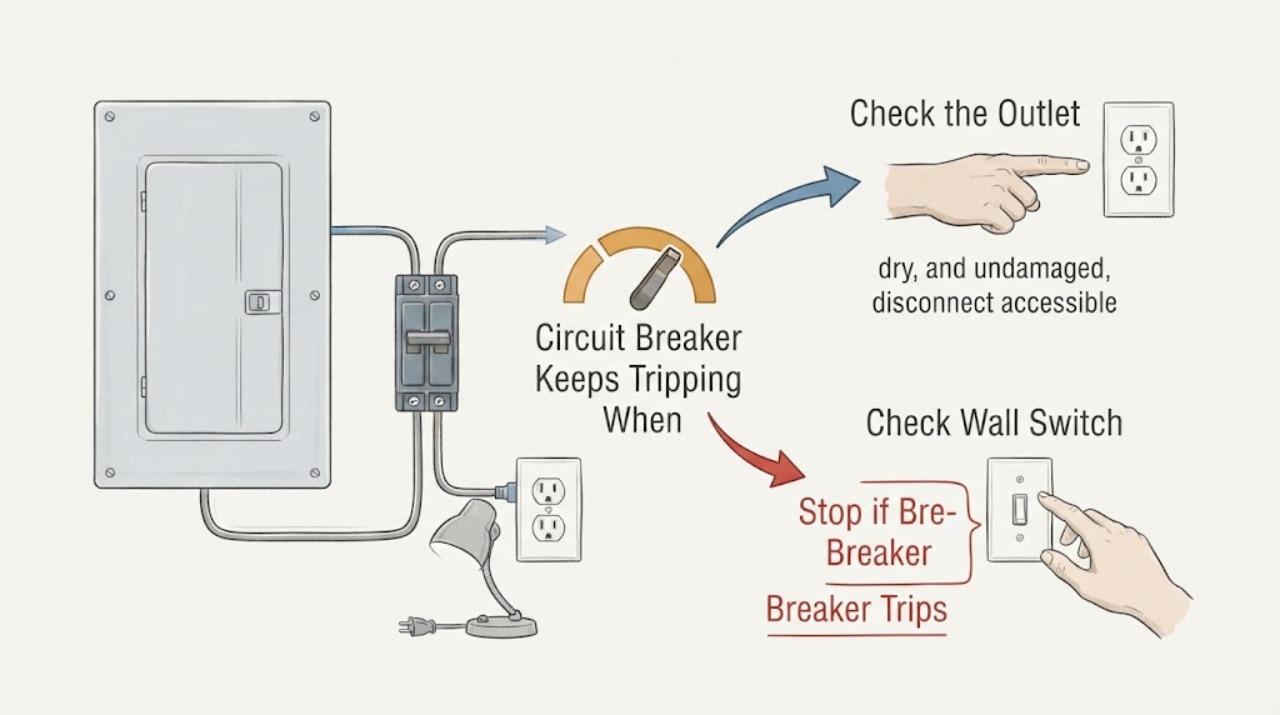
Work through in order
Diagnostic checks
Use only checks that match the exact appliance or system and its official guide.
-
Check 1
From a dry, safe position, identify the exact breaker that moved and list every outlet, light, fixed appliance, outdoor connection, and shared-room load that loses power; do not remove the panel cover.
Expected result: Only one outlet or room is affected, or several apparently unrelated outlets, lights, or fixed loads go off together.
Next step: Leave the affected circuit off if the mapping is unclear or any warning sign is present. Record the locations for an electrician instead of opening the panel or changing a breaker rating.
Why this matters
Why: A single branch may contain more loads than the visible plugs suggest. A broad or unexpected outage can also point to a circuit assignment, wiring, or protective-device issue rather than a simple plug count.
-
Check 2
With the circuit off and only if the plug and receptacle are cool, dry, and undamaged, disconnect accessible portable devices one at a time; do not touch a melted, wet, cracked, loose, or sparking connection.
Expected result: One device, cord, charger, power strip, or extension lead is associated with the trip, or the trip occurs with all accessible devices disconnected.
Next step: Keep the suspected device disconnected and label it for qualified product or electrical service. If everything accessible is disconnected and the breaker still trips, do not reconnect items or keep testing; arrange an electrician visit.
Why this matters
Why: A repeatable device association makes that product or cord a suspect. A trip with no portable load points more toward a fixed load, branch wiring, moisture, a protective trip, or the breaker itself.
-
Check 3
Inspect only the outside of plugs, cords, receptacles, switches, and nearby walls for darkening, melting, a loose faceplate, moisture, a burning smell, buzzing, or crackling, without touching the suspect point.
Expected result: There is visible damage, heat, moisture, an odor, buzzing, crackling, or a loose fitting; or the external surfaces look cool, dry, and intact.
Next step: For any warning sign, keep people away, stop using the circuit, and contact a qualified electrician. Do not spray liquid, tighten wiring, remove a receptacle, or restore power to see whether the symptom returns.
Why this matters
Why: The first result is a potential fire, shock, arc, or ground-fault condition and cannot be treated as a nuisance trip. A clean exterior does not rule out a concealed fault.
-
Check 4
Read the labels and indicator pattern visible on the breaker or receptacle from outside the panel area, noting whether it is marked or identified as AFCI, GFCI, or another protective device; do not press test buttons or remove the cover just to investigate the trip.
Expected result: The protective device reports an arc-fault or ground-fault style trip, or there is no clear indication of the trip type.
Next step: Record the indicator and affected locations for an electrician. If a GFCI receptacle can be safely identified as tripped without contact with water or damage, follow only its exact manufacturer instructions; do not repeatedly reset a device that trips again.
Why this matters
Why: AFCI and GFCI devices can respond to wiring, appliance, moisture, or leakage conditions that a simple load estimate will miss. The indicator does not identify which internal component is at fault.
-
Check 5
Compare the timing without deliberately reproducing the fault: note whether the trip is immediate on energizing, occurs after a device starts, follows rain or damp cleaning, or happens after the circuit has been carrying a load for a while.
Expected result: The timing is immediate, follows one device or switch, follows moisture, or has no consistent visible trigger.
Next step: Do not turn devices on and off to experiment. Keep the circuit isolated when the pattern is unsafe or unexplained and give the timing to a qualified electrician.
Why this matters
Why: Immediate operation can be consistent with a short or ground fault; device-linked timing points to that load; moisture can create leakage; delayed operation can reflect heat or a load that is not obvious at the outlet.
-
Check 6
If there are no warning signs, no water, and no damaged equipment, make at most one normal reset after accessible loads are switched off or unplugged, using the breaker handle only as the manufacturer's panel instructions allow; do not force it or repeatedly cycle it.
Expected result: The breaker stays on with no load, stays on until one particular device is connected, or trips again immediately or later with minimal load.
Next step: Leave the breaker off after a repeat trip. Do not substitute a higher-rated device, bypass protection, or open the panel; arrange qualified electrical service.
Why this matters
Why: A device-linked or repeat trip is evidence that the underlying problem remains. A breaker that will not stay on with the load removed needs professional diagnosis rather than a stronger reset.
-
Check 7
Prepare a service note with the breaker label, affected outlets and lights, connected or fixed loads, device and cord association, weather or moisture timing, indicator pattern, and every warning sign seen from a safe distance.
Expected result: The note identifies one suspect product, one receptacle or area, a shared circuit pattern, or a repeat trip with no visible load.
Next step: Give the note to a qualified electrician and keep suspect devices disconnected. Do not perform live measurements, remove covers, or make an internal repair yourself.
Why this matters
Why: The pattern helps an electrician decide whether to examine the product, receptacle, branch wiring, protective device, moisture path, or circuit assignment without unsafe trial and error.
Use your observations
Decision map
Find the observation that best matches what you see, then follow the next safe action.
-
PATH 01Next step
What you see
The breaker trips only when one portable device, cord, power strip, or charger is connected.
Do this next
Keep it disconnected and have the product or cord assessed; do not try a different outlet as a way to prove it is safe.
Why this path and its safety boundary
Why it matters: That load is a leading suspect even if it draws little power during ordinary use.
-
PATH 02Next step
What you see
The breaker trips with all accessible portable items disconnected.
Do this next
Leave the circuit off and call a qualified electrician. Do not open the panel or reconnect items one by one to locate the fault.
Why this path and its safety boundary
Why it matters: A fixed load, hidden shared connection, moisture, branch wiring, protective device, or breaker fault remains possible.
-
PATH 03Next step
What you see
The trip follows damp weather, cleaning water, an outdoor connection, a wet area, or a GFCI-style indication.
Do this next
Keep the affected area and electrical equipment out of use until it is dry and professionally assessed. Never restore power to a wet or damaged connection.
Why this path and its safety boundary
Why it matters: Ground leakage or moisture may be involved, and the protective trip may be preventing shock.
-
PATH 04Next step
What you see
The trip is associated with an AFCI-style indication, buzzing, crackling, heat, darkening, melting, or a burning smell.
Do this next
Stop using the circuit, keep clear, and arrange qualified electrical service. Do not reset to see whether the warning disappears.
Why this path and its safety boundary
Why it matters: An arc, overheated connection, damaged wire, or device fault may create a fire hazard that is not explained by load size.
-
PATH 05Next step
What you see
The breaker will not remain on, trips immediately, or trips again after a single safe reset with minimal load.
Do this next
Leave the breaker off and call a qualified electrician; never install a larger breaker or bypass the protective device.
Why this path and its safety boundary
Why it matters: The underlying fault has not been cleared, or the protective device and branch require diagnosis.
Helpful context
Understand the symptom
Why a nearly empty circuit can still trip
The number of plugs you can see is not the same as the electrical condition of the branch circuit. A device with an internal fault can trip protection by itself, and another outlet, light, permanently connected load, or outdoor connection may share the same branch. Protective devices can also respond to a short circuit, ground leakage, or an arc fault rather than to a large total load. The trip is a safety response, not proof that the breaker is defective.
What this symptom changes
When the breaker trips with minimal visible load, separate the safe, external observations: does one device or cord bring the problem back, does the breaker trip with everything disconnected, does a receptacle or light show heat or damage, and is the device an AFCI or GFCI type? Do not open the electrical panel or use a live test to answer those questions.
Safety boundary
Stop conditions
- Stop using the affected circuit immediately for smoke, sparks, arcing, buzzing or crackling, burning or melting odor, hot plugs or receptacles, darkening, or visible damage.
- Keep power off and keep away from any wet electrical equipment, standing water, damaged cord, loose receptacle, or outdoor connection exposed to moisture.
- Do not open the electrical panel, remove receptacles, touch wiring, measure live voltage, bypass AFCI or GFCI protection, install a higher-rated breaker, or repeatedly reset a tripping device.
- If there is fire or an immediate electrical emergency, leave the area and contact local emergency services from a safe location.
When checks do not resolve it
Need a professional?
Arrange a qualified electrician for any repeat trip that is not clearly resolved by disconnecting a single safe, accessible device, and for any branch, receptacle, moisture, AFCI, GFCI, or breaker concern.
Safety scope: The owner scope ends at identifying the affected circuit, disconnecting intact accessible loads without contact with hazards, and observing from a safe distance. Panel work, wiring, receptacle work, live testing, protective-device replacement, and fault isolation belong to a qualified electrician.
Common questions
FAQ
Why does a breaker trip when almost nothing is plugged in?
A single faulty appliance or cord, a hidden fixed load, moisture or ground leakage, an arc-fault device, a short, branch wiring, or the breaker itself can cause a trip. Visible plug count is not a complete load or safety check.
Should I keep resetting the breaker to find the cause?
No. Disconnect safe, intact accessible loads and make at most one normal reset only when there are no warning signs. If it trips again or will not stay on, leave it off and call a qualified electrician.
Can a GFCI or AFCI trip with a small load?
Yes. Those protective devices can respond to ground leakage or arc-fault conditions, not just a large total load. The indication is useful information for an electrician, not a reason to bypass protection.
What signs mean I should stop immediately?
Stop for smoke, sparks, arcing, buzzing or crackling, a burning smell, heat, darkening, melting, water, a damaged cord or receptacle, or a breaker that trips repeatedly. Keep clear and get qualified electrical help.
Read the exact guide
Official sources
- Fuse and Breaker BreakdownElectrical Safety Foundation International · Consumer guidance on frequent trips, AFCI, and GFCI protective devices
- CPSC Guide to Home Wiring HazardsU.S. Consumer Product Safety Commission · Residential branch-circuit, appliance, receptacle, and breaker safety
- Electrical Safety Advice for the Home officeElectrical Safety First · Consumer electrical product and socket safety
- Understanding Your Home Electrical SystemElectrical Safety Foundation International · Consumer guidance on circuit breakers, AFCIs, overloads, and qualified electrician diagnosis
- Considerations for Installation of Smoke Alarms on Residential Branch CircuitsU.S. Consumer Product Safety Commission · Circuit-breaker, thermal-trip, short-circuit, AFCI, and GFCI safety concepts
Community feedback
Share a repair observation
Share a plain-text repair observation. Accepted observations are published automatically; this page may take a moment to update.