
On this page
Start here
Quick answer
If a breaker trips when only the lights on that breaker are on, do not assume the load is simply too large. The pattern can point to one light fixture, switch or dimmer, a lighting connection, moisture or damage, a protective breaker, or another fault on the branch circuit. From a dry, stable position, turn off the affected light controls normally only when they are cool and behaving normally, then note which light or switch changes the result. Do not open the panel, remove a switch or fixture cover, work on wiring, take energized measurements, install a larger breaker, bypass AFCI/GFCI protection, or keep resetting the breaker. Repeated trips need a qualified electrician; smoke, arcing, burning odor, hot or discolored parts, or water exposure is an immediate stop-use hazard.
Before you begin
Safety first
- This article covers ordinary-access observation and normal switch operation only when the area and control are cool, dry, intact, and quiet. Electrical diagnosis, panel access, wiring, fixture or switch removal, protective-device work, and live measurements belong to a qualified electrician.
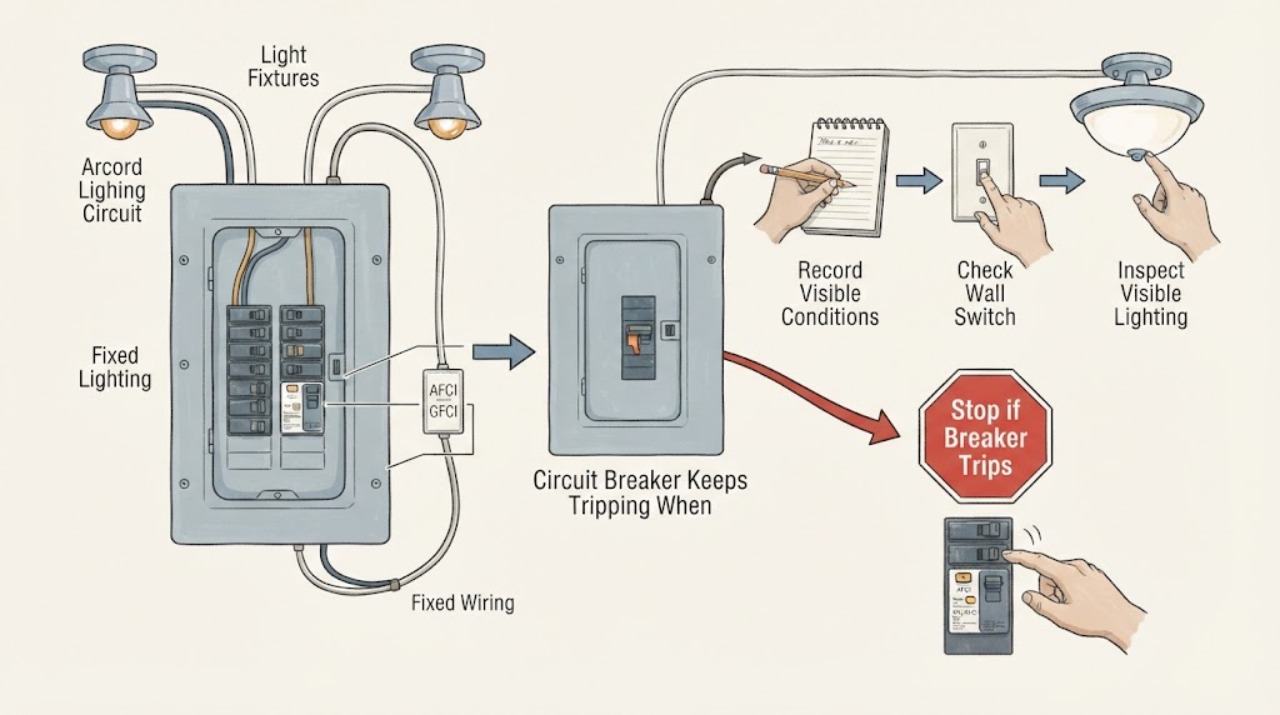
Work through in order
Diagnostic checks
Use only checks that match the exact appliance or system and its official guide.
-
Check 1
From a dry, stable position, record the affected breaker label, the light controls that were on, whether the trip happened immediately or after several minutes, and whether the pattern repeats without intentionally operating a suspect control.
Expected result: The trip is associated with one light or switch, all lights on the circuit, a particular delay, or the breaker trips even while the light switches are off.
Next step: Write down the pattern and stop repeated reset attempts. Use the appropriate branch below and give the record to a qualified electrician.
Why this matters
Why: A repeatable one-fixture or one-switch pattern is a useful clue toward that visible load; a whole-circuit or switches-off trip leaves fixed wiring, concealed loads, or protective-device causes open. Timing narrows the handoff but does not identify a part safely.
-
Check 2
If the switches and nearby plates are cool, dry, intact, and quiet, turn the light controls to Off in their normal manner; do not operate a control that is hot, buzzing, sparking, loose, wet, or visibly damaged.
Expected result: The breaker remains set with the lights off, or it trips anyway; note whether one control was the last one used.
Next step: Leave any suspected light or control off and arrange qualified electrical service. If the breaker will not remain set or a hazard is visible, leave the affected circuit out of service when safely possible.
Why this matters
Why: Holding with the lights off makes a lighting load, switch, or fixture a plausible focus. Tripping with the controls off means the fault is not cleared and could involve the branch circuit or protection; it is not a reason to keep resetting.
-
Check 3
From floor-level, ordinary access, look at the fixture, lamp, dimmer, switch plate, and nearby ceiling or wall for flicker, dimming, buzzing, sizzling, scorch marks, discoloration, cracked parts, moisture, smoke, or a burned odor; do not remove a cover or climb into an unsafe position.
Expected result: There is no visible abnormality, or one fixture, switch, plate, lamp, or nearby area shows heat, damage, odor, sound, arcing, or water exposure.
Next step: Keep the suspect control off and move people away from smoke, heat, water, or active arcing. For a normal-looking installation with repeated trips, proceed directly to an electrician rather than escalating the inspection.
Why this matters
Why: An abnormal visible condition is a stop-use signal and can identify the area for the electrician. A normal appearance does not clear concealed wiring or an internal protective-device fault.
-
Check 4
Without removing the panel cover or touching conductors, read the breaker label and any visible AFCI or GFCI indication from a safe position; record the circuit name and any indicator state without pressing reset repeatedly.
Expected result: The breaker is marked as an arc-fault or ground-fault protective device, shows an indicator, or has no clear marking; the circuit label may also identify rooms or lights served.
Next step: Photograph or transcribe only the visible label and provide it to the electrician. Do not change the breaker rating, defeat the protection, remove the cover, or perform live electrical checks.
Why this matters
Why: Protection markings and indicators are diagnostic context, not a bypass instruction. A protective device that trips may be responding to a fault that needs qualified assessment, and the circuit label may not reveal every connected load.
-
Check 5
From a normal, dry position, identify any portable item or plug-in lamp that may share the circuit and switch it off or unplug it only when the plug, outlet, and cord are cool, dry, and undamaged; do not pull a hot, burned, loose, or wet plug.
Expected result: The breaker still trips with those removable loads inactive, or the trip stops when one particular portable item is removed from the circuit.
Next step: Leave a suspect item disconnected and label the affected outlet or circuit for the electrician. Do not keep cycling the breaker or use an outlet that is hot, wet, discolored, buzzing, or damaged.
Why this matters
Why: A change tied to one removable load gives the electrician a useful lead; a continuing lights-only trip keeps the lighting circuit, protection, or fixed wiring in scope. An undamaged appearance does not rule out a fault.
-
Check 6
Prepare a service note with the breaker label, room and fixture names, trip timing, switch or dimmer type, recent bulb or fixture work, moisture or renovation history, visible symptoms, and whether the breaker trips with all light controls off.
Expected result: The record identifies one trigger, a broad circuit pattern, a recent change, or no consistent visible trigger.
Next step: Give the note and safe-distance photographs to an electrician. Keep the affected lighting circuit or suspect control out of use until the cause is assessed.
Why this matters
Why: These observations help a qualified electrician choose a safe diagnostic scope without asking the homeowner to expose the panel, wiring, or energized parts.
Use your observations
Decision map
Find the observation that best matches what you see, then follow the next safe action.
-
PATH 01Safety boundary
What you see
Smoke, flame, active arcing, a strong burning odor, a hot or discolored plate or fixture, water contacting electrical equipment, or a breaker that will not stay set is present.
Do this next
Stop using the circuit, keep people away, leave the area if smoke or fire risk is present, and seek emergency help from a safe location; arrange qualified electrical service when the area is safe.
Why this path and its safety boundary
Why it matters: This is a potential shock or fire hazard, not a routine lighting adjustment.
Safety stop: Do not use water on an electrical fire, touch the damaged part, reopen the breaker, or investigate behind a cover.
-
PATH 02Safety boundary
What you see
The breaker holds with the light controls off and trips when one particular light, dimmer, or switch is used, with no immediate smoke or fire.
Do this next
Leave that control off, identify it for the electrician, and use another safe circuit only if doing so does not involve extension cords or a second hazard.
Why this path and its safety boundary
Why it matters: That visible load is a focused clue, but the defect may be in the fixture, switch, connection, or branch wiring.
Safety stop: Do not reopen the breaker to repeat the trigger, replace wiring, remove the fixture, or open the switch box.
-
PATH 03Safety boundary
What you see
The breaker trips with multiple lights, or it trips while all light switches are off.
Do this next
Keep the circuit out of use when safely possible and request qualified electrical diagnosis. Give the electrician the circuit label and timing record.
Why this path and its safety boundary
Why it matters: The cause may be another connected load, concealed branch wiring, moisture, or the protective device; the lights-only description does not establish which one.
Safety stop: Do not substitute a higher-rated breaker, bypass AFCI/GFCI protection, remove the panel cover, or keep resetting.
-
PATH 04Safety boundary
What you see
No heat, odor, sound, flicker, moisture, or visible damage is present, but the breaker repeatedly trips when lighting is used.
Do this next
Stop using the affected lighting circuit and arrange a qualified electrician; provide the exact trip pattern rather than trying a more invasive check.
Why this path and its safety boundary
Why it matters: A hidden fault or protection response remains possible even when the ordinary-access inspection looks normal.
Safety stop: Do not treat a normal-looking fixture as clearance for live measurements, disassembly, or repeated resets.
Helpful context
Understand the symptom
Why a lights-only trip still needs diagnosis
A branch circuit can supply lights and other fixed or concealed loads, so the phrase when only lights on the breaker are on describes the observed condition rather than proving the cause. A trip that happens as one particular switch or fixture is used is different from a trip that happens with every light, or with the light switches off. Treat the pattern as a way to narrow the handoff to an electrician, not as permission to alter the breaker or open the circuit.
Keep the inspection at ordinary, safe access
The useful user-level evidence is timing and visible condition: which control was used, whether the trip was immediate or delayed, and whether a fixture or wall plate flickers, buzzes, feels hot, looks discolored, smells burned, or shows moisture. A panel label or visible breaker marking can be recorded without removing the panel cover. The breaker itself may be protecting the circuit from an unsafe condition, so a repeat trip is a reason to stop and arrange qualified service.
Safety boundary
Stop conditions
- Stop immediately for smoke, flame, active arcing or sparking, a strong burning odor, buzzing or sizzling, hot or discolored plates or fixtures, water exposure, or any sign of melting.
- Do not open the service panel, remove switch or fixture covers, disturb wiring, take energized measurements, or work on a live circuit.
- Do not repeatedly reset the breaker, install a higher-rated breaker or fuse, or bypass AFCI/GFCI protection.
- Do not touch a hot, wet, loose, burned, or damaged switch, fixture, outlet, cord, or plug; keep people away and seek qualified or emergency help from a safe location.
- Stop any inspection that would require a ladder in an unstable or wet area, moving a damaged fixture, or reaching behind a cover.
Only after diagnosis
Potential parts
- light fixture assembly
Consider this category only if the electrician confirms that one fixture is the source and the installed fixture is damaged or unsafe.
Confirm the exact fixture, mounting, enclosure, lamp requirements, location rating, and wiring compatibility with the electrician before ordering. - wall switch or dimmer
Consider this category only if the electrician confirms that the switch or dimmer is the trigger and identifies a compatible replacement.
Confirm load type, control arrangement, location, rating, and the circuit protection requirements; do not install it as a user experiment. - AFCI or GFCI circuit protection device
Consider this category only after an electrician identifies a failed or incompatible protective device and confirms the exact panel and circuit requirements.
The exact panel, circuit, protection type, local requirements, and manufacturer compatibility must be confirmed by a qualified electrician; never substitute a higher rating or bypass protection.
When checks do not resolve it
Need a professional?
Arrange a qualified electrician when the breaker trips again, trips with all light switches off, trips with one particular fixture or switch, or shows any unexplained AFCI/GFCI indication. Seek emergency help from a safe location for smoke, flame, active arcing, a strong burning odor, or rapidly heating or wet electrical parts.
Safety scope: This article covers ordinary-access observation and normal switch operation only when the area and control are cool, dry, intact, and quiet. Electrical diagnosis, panel access, wiring, fixture or switch removal, protective-device work, and live measurements belong to a qualified electrician.
Common questions
FAQ
Is a breaker tripping with only lights on always an overload?
No. A lighting circuit may have a fixture, switch, connection, protective-device, moisture, concealed-load, or fixed-wiring fault. The timing and which control was last used are useful clues, but repeated trips need qualified diagnosis.
Can I keep resetting the breaker to find the bad light?
No. Turn a normal, cool, dry control off once if it is safe to do so, record the result, and stop repeated reset attempts. Smoke, arcing, burning odor, heat, discoloration, or water exposure requires immediate stop-use action.
What if the lights look normal but the breaker still trips?
A normal appearance does not clear concealed wiring or a protective-device fault. Leave the affected circuit out of use when safely possible and provide the electrician with the exact timing and circuit-label record.
Should I install a larger breaker so the lights stay on?
No. Do not change the breaker rating or bypass AFCI or GFCI protection. The protective device may be preventing a fire or shock hazard, and a qualified electrician must determine the safe repair.
What information should I give an electrician?
Give the circuit label, room and fixture names, whether the trip is immediate or delayed, whether one switch triggers it, whether it trips with all light controls off, visible symptoms, and any recent fixture, dimmer, bulb, renovation, leak, or moisture change.
Read the exact guide
Official sources
- CPSC GUIDE TO HOME WIRING HAZARDSU.S. Consumer Product Safety Commission · Government electrical-safety guidance used for the lighting-circuit decision path and stop-use boundaries; it does not diagnose a particular installation.
Community feedback
Share a repair observation
Share a plain-text repair observation. Accepted observations are published automatically; this page may take a moment to update.