
On this page
Start here
Quick answer
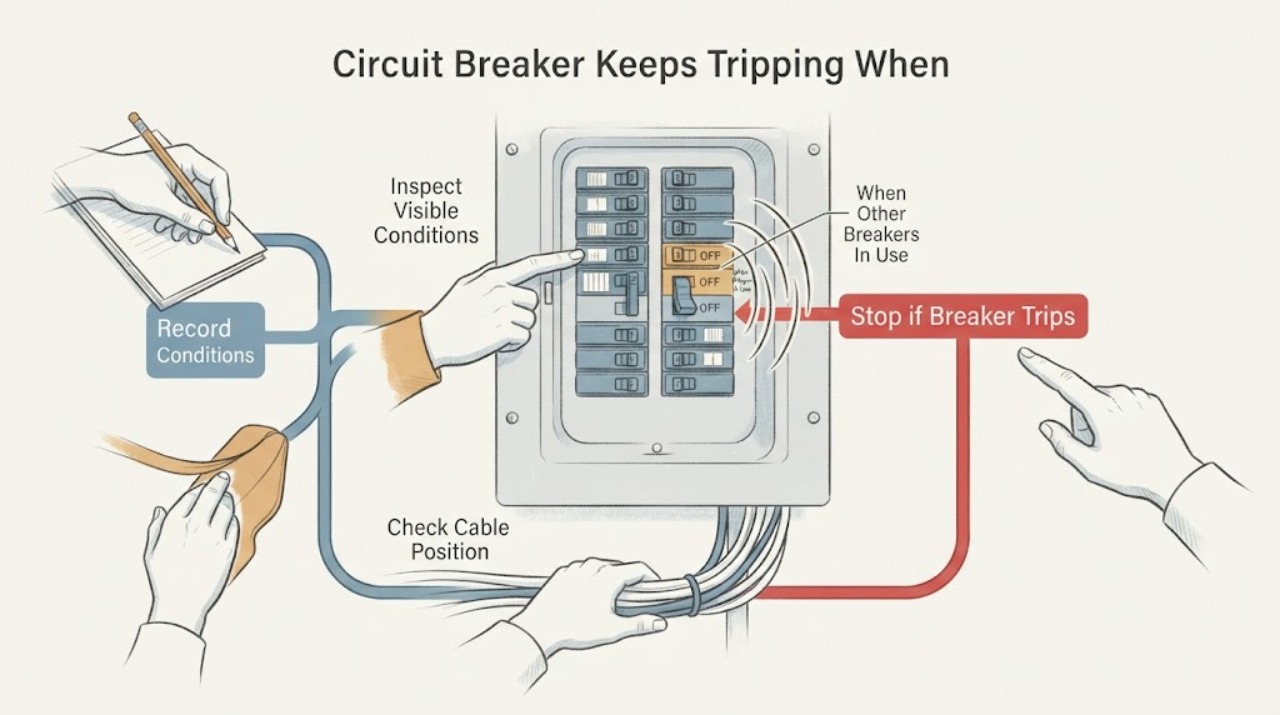
A breaker that trips when other breakers or their loads are active may be responding to a high combined load, a shared feeder or main-service limit, a fault in one device, or a fixed-wiring problem. Do not keep resetting it. From a dry, safe position, record which breaker moves, which loads start just before the trip, and whether lights dim or any outlet, cord, or breaker is hot, discolored, buzzing, wet, or sparking. Remove only accessible portable loads after power is off and safe; leave the circuit off and arrange an electrician if it trips again, trips with no load, or shows any warning sign.
Work through in order
Diagnostic checks
Use only checks that match the exact appliance or system and its official guide.
-
Check 1
From a dry position, note the exact breaker or protective device that moves, whether it is a branch breaker, a paired breaker, a main device, or a device with a test button. Write down which other loads were starting or already running and the order in which the trip occurred. Do not remove the panel cover or touch any exposed part.
Expected result: One branch breaker trips when a particular combination of large loads is active; a main or feeder device trips; or different breakers trip at different times.
Next step: Keep the recorded combination out of service and continue with the matching branch below. Give the breaker position, load list, and timing to the electrician.
Why this matters
Why: One branch with a repeatable combination points toward that branch's load or a connected device. A main or feeder trip can involve total service demand or a shared upstream problem. Different breakers or a changing pattern needs broader electrical diagnosis rather than a breaker swap.
-
Check 2
Check the surroundings without opening anything: look at accessible plugs, cords, receptacle plates, and the outside of the panel for heat damage, browning, melting, moisture, or unusual sound. Notice whether lights dim or flicker when another load starts. Do not touch a hot, wet, damaged, or noisy item.
Expected result: There is no warning sign and the trip is tied to several ordinary loads, or there is warmth, discoloration, buzzing, sizzling, a burning odor, flickering, or a shock or tingling sensation.
Next step: For any warning sign, leave the affected device or circuit off and arrange urgent electrical service; do not reset to see whether the sign returns. If the area is dry and normal, go to the load-isolation check without touching fixed wiring.
Why this matters
Why: A repeatable multi-load trip without warning signs can be an overload that becomes visible only when other breakers are used. Any heat, odor, sound, flicker, shock, or discoloration can indicate arcing, overheating, a wiring defect, or a damaged device and is not a load-balancing experiment.
-
Check 3
After the circuit has remained off and only if the floor and equipment are dry, turn off or unplug accessible portable loads on the affected branch. Do not unplug a wet or damaged item, move a heavy hardwired appliance, or enter the panel. If the cause was an obvious combination of portable loads and the enclosed breaker handle can be operated without exposure to energized parts, a single reset may be considered; do not reset repeatedly.
Expected result: The breaker holds after the obvious portable load is removed, or it trips again immediately or when a particular portable device is restored.
Next step: Keep any device linked to the trip unplugged and out of service. Do not restore the full combination. If the breaker trips again, leave it off and call an electrician; have the suspect device examined by an appropriately qualified repair person.
Why this matters
Why: Holding after load reduction is consistent with an overload, but it does not prove that the circuit has spare capacity for continued combined use. A repeat trip with no portable load, or a repeat trip linked to one device, points toward a fault in that device, its cord, or the fixed circuit.
-
Check 4
Compare the trigger with the load map rather than moving wiring: record whether the trip occurs only when two or more high-demand loads run together, whether it follows one load across different times, and whether a separate breaker or subpanel is also affected. Use nameplate wattage only as a record for the electrician; do not add a circuit, move a breaker, or change a protective rating.
Expected result: The trip follows a simultaneous high-demand combination; follows one appliance; or appears on a main, paired, or subpanel device while other circuits change state.
Next step: Keep the smallest safe set of loads operating and avoid the triggering combination. Ask an electrician to assess demand, feeder and panel condition, circuit protection, and the fixed wiring; do not try to solve the symptom with a larger breaker.
Why this matters
Why: A combination pattern supports an overload or limited panel/service capacity. A single-appliance pattern supports a defective product or cord. A main, paired, or subpanel pattern can involve a shared feeder, incorrect circuit arrangement, loose connection, or a larger fixed-system fault that cannot be safely diagnosed from the outside.
-
Check 5
Stop the troubleshooting path if the trip is immediate with no connected portable load, if it follows a wet area or a fixed appliance, or if there is smoke, visible spark, burning odor, a hot or discolored outlet, a hot breaker, a crackle, or a shock. From a safe dry position, keep people away; only operate an enclosed disconnect if doing so does not require entering water or approaching exposed conductors.
Expected result: The breaker stays off safely, or the condition includes smoke, fire, arcing, a strong burning odor, water at electrical equipment, or a person receiving a shock.
Next step: For fire or smoke, leave and contact emergency services from a safe location. For water, standing water, or damaged service equipment, keep clear and contact the utility or an electrician. For a shock, do not touch the person until the source is isolated and obtain emergency medical help. Do not re-energize until a qualified person has inspected the system.
Why this matters
Why: A no-load or fixed-equipment trip suggests a circuit or equipment fault. Smoke, fire, arcing, water, or shock creates an emergency boundary; the breaker may be preventing a more serious event and must not be defeated.
Use your observations
Decision map
Find the observation that best matches what you see, then follow the next safe action.
-
PATH 01Next step
What you see
The same branch breaker trips only when several high-demand loads are used together.
Do this next
Keep the combination off and ask an electrician to assess the branch load, panel capacity, and whether a correctly designed circuit is needed.
Why this path and its safety boundary
Why it matters: Treat this as a possible overload or capacity problem, not as permission to install a higher-rated breaker.
-
PATH 02Next step
What you see
The trip follows one portable appliance, cord, or plug after other loads are removed.
Do this next
Leave that product unplugged and have it examined or replaced through a qualified repair route; do not test it on another outlet.
Why this path and its safety boundary
Why it matters: The product or its cord may have a defect that is causing excessive current or a fault.
-
PATH 03Next step
What you see
The main, feeder, paired breaker, or subpanel device trips when several other breakers are active.
Do this next
Leave the affected device off and arrange an electrician to inspect the service and fixed wiring. Do not open the panel or move circuits.
Why this path and its safety boundary
Why it matters: The event may involve shared service demand, a feeder, panel arrangement, or a fixed connection.
-
PATH 04Next step
What you see
The breaker trips again after a safe load reduction or a single permitted reset.
Do this next
Keep it off. Repetitive manual reclosing is not a diagnostic method; a qualified person must examine the equipment and circuit before it is energized again.
Why this path and its safety boundary
Why it matters: The cause has not been removed or the circuit or device may have a fault.
-
PATH 05Next step
What you see
Lights dim or flicker, or outlets, plugs, cords, or the breaker are warm, discolored, buzzing, sizzling, or odorous.
Do this next
Stop using the affected circuit and arrange prompt electrical service. Do not touch the damaged item or repeat the trip.
Why this path and its safety boundary
Why it matters: These are electrical warning signs that can accompany overheating, damaged wiring, or arcing.
-
PATH 06Next step
What you see
Water is in or near electrical equipment, the floor is wet, smoke or fire is present, or someone has been shocked.
Do this next
Keep clear, use emergency services or the utility as appropriate, and do not enter water or approach exposed electrical parts. Re-energizing requires qualified inspection.
Why this path and its safety boundary
Why it matters: The situation is an emergency safety problem rather than a load diagnosis.
Helpful context
Understand the symptom
What the timing tells you
The condition matters: the trip occurs when other breakers are being used, not necessarily when one particular appliance starts. That pattern can mean the total demand is too high at the same time, that a main or feeder is carrying a problem from several branch circuits, or that the timing is coincidental and one device or fixed circuit is faulty. A branch breaker is designed to stop current when the protected wiring is beyond a safe level; the handle position alone cannot tell you which cause is present. Treat the timing as evidence to record, not as proof that the breaker itself is bad.
Safe boundary before any check
Do not remove the panel cover, touch bus bars or service conductors, open an outlet, measure live voltage, change a breaker rating, or bypass a protective device. Repeated reclosing after a trip is prohibited by electrical safety guidance unless a qualified person has determined that the circuit can be safely energized. If water is near electrical equipment, do not stand in it to reach a switch; get an electrician or emergency help to make the area safe.
Safety boundary
Stop conditions
- Do not remove a panel cover, touch exposed conductors, test live voltage, change breaker ratings, bypass protection, or make fixed-wiring repairs.
- Stop immediately for smoke, fire, visible sparks or arcing, burning odor, a hot or discolored breaker, outlet, cord, or plug, crackling, or repeated immediate trips.
- Do not operate a switch or appliance while standing in water, and do not approach a wet panel or service equipment.
- Do not keep resetting the breaker. If it trips again, leave it off until a qualified electrician has assessed the circuit and connected equipment.
When checks do not resolve it
Need a professional?
Arrange an electrician when the breaker trips again after a safe load reduction, trips with no portable load, follows a fixed appliance, affects a main or feeder, involves more than one circuit, or occurs with dimming, heat, discoloration, buzzing, odor, moisture, sparks, or a shock. Contact emergency services for fire or smoke, and contact the utility for service equipment or supply-side concerns.
Common questions
FAQ
Why does the breaker trip when another breaker is turned on?
The added load may push a shared branch, feeder, or service arrangement beyond its safe limit, but the same timing can also expose a faulty device or fixed-wiring issue. Record the exact loads and breaker positions instead of assuming the breaker is defective.
Can I keep resetting the breaker to see what happens?
No. Repeated reclosing is not a safe diagnostic method. After a second trip, or after any trip with warning signs, leave the device off until a qualified person determines that the circuit and connected equipment can be safely energized.
What should I do if the panel or floor is wet?
Do not stand in water to reach a switch or operate an appliance. Keep away from wet electrical equipment and arrange qualified electrical or emergency help; power should not be restored until the equipment has been inspected and is completely dry.
Read the exact guide
Official sources
- Qualifications for resetting circuits or replacing fuses; electrical enclosures must be approved.Occupational Safety and Health Administration · Safety boundary for deciding whether a protective device may be manually reclosed.
- CPSC Guide to Home Wiring HazardsU.S. Consumer Product Safety Commission · General residential electrical safety guidance.
- What to Do to Protect Yourself From Electrical HazardsCenters for Disease Control and Prevention · Residential electrical safety when equipment or circuits are wet or show damage.
- All About Home Electrical PanelsNew York State Energy Research and Development Authority · General residential panel-capacity context; exact capacity depends on the installation.
Community feedback
Share a repair observation
Share a plain-text repair observation. Accepted observations are published automatically; this page may take a moment to update.