
On this page
Start here
Quick answer
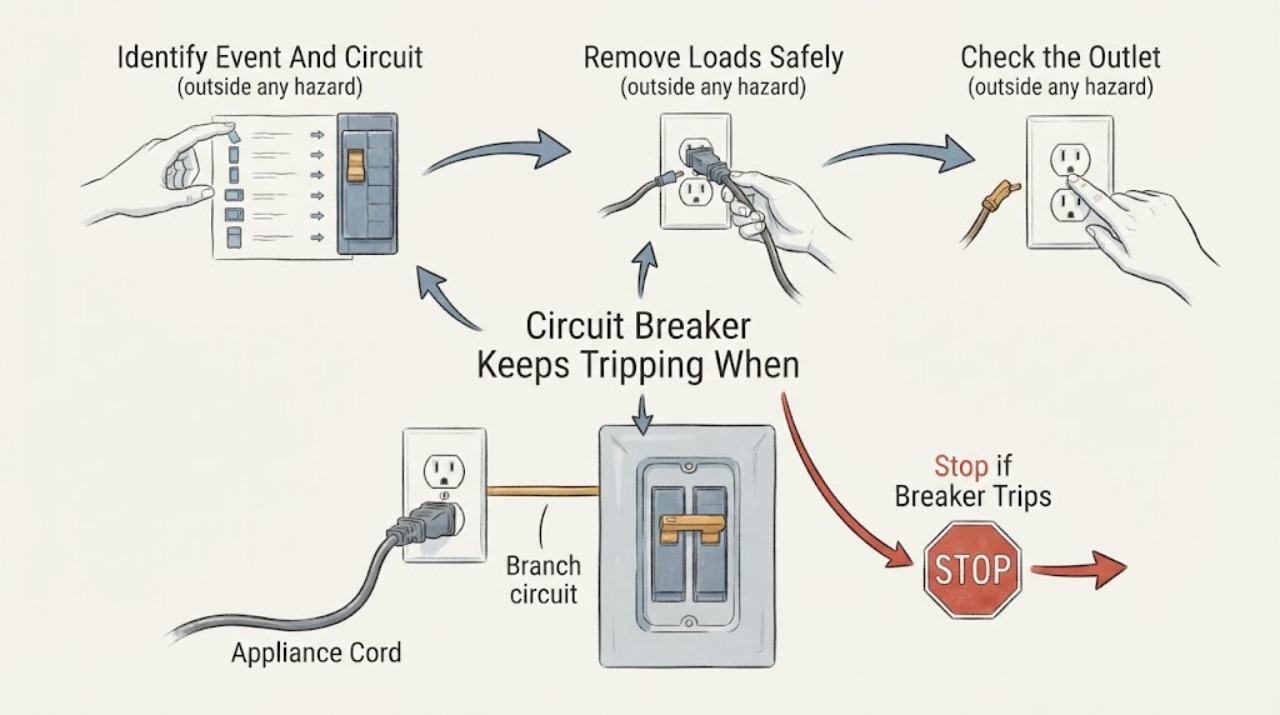
If a circuit breaker trips when one appliance is plugged in, leave that appliance disconnected and do not keep resetting the breaker. The pattern can indicate an appliance defect, a damaged cord or plug, a faulty receptacle, a ground-fault or arc-fault condition, or an overloaded branch circuit. From a dry, safe position, identify which breaker and receptacle are involved, note whether other devices lose power, and look only for visible damage, moisture, heat, smoke, arcing, or a loose fit. Do not open the panel or receptacle, test live wiring, use a higher-rated breaker, use an extension cord to bypass the circuit, or repeatedly plug the appliance back in. A qualified electrician should assess the circuit and receptacle; an appliance repair professional should assess the disconnected appliance. Smoke, burning odor, buzzing or crackling, a hot outlet, visible arcing, shock, or water near electricity requires immediate stop and emergency or qualified electrical help.
Work through in order
Diagnostic checks
Use only checks that match the exact appliance or system and its official guide.
-
Check 1
From a safe, dry position, record the breaker label or location, the receptacle, the appliance, and exactly when the trip occurred: as the plug entered, when the appliance switch was used, at motor start, or after it had been running.
Expected result: A trip at insertion points toward the plug, receptacle, cord, ground-fault path, or an immediate appliance fault; a trip after startup or under load points toward the appliance, inrush, overload, or a circuit fault.
Next step: Leave the appliance disconnected and do not reset or plug it in again merely to compare timings. Continue only with safe visual observations.
Why this matters
Why: The timing narrows which professional should inspect first without requiring another energized test.
-
Check 2
If there is no smoke, heat, water, arcing, damaged insulation, or shock risk and the other plugs are safely accessible, switch off or unplug ordinary portable loads without touching a hot or damaged plug; do not use an extension cord or power strip to relocate a high-load appliance.
Expected result: If several loads were on the same branch, the trip may involve an overload; if the breaker trips with the problem appliance left disconnected, the circuit or receptacle remains suspect.
Next step: Do not plug the suspect appliance back in. If the breaker still will not remain on or trips with the appliance disconnected, stop and arrange electrician service.
Why this matters
Why: Separating existing loads can remove a simple load interaction, but it does not prove that the appliance or circuit is sound.
-
Check 3
With the appliance disconnected and the area dry, inspect only the visible plug, cord jacket, receptacle faceplate, and surrounding wall for cuts, melting, discoloration, moisture, looseness, scorch marks, or a smell of overheated plastic; do not remove the faceplate or touch exposed parts.
Expected result: Damage, moisture, a loose receptacle, discoloration, a hot faceplate, buzzing, crackling, or an odor indicates a stop condition; an apparently normal exterior does not rule out an internal fault.
Next step: Keep the circuit and appliance out of service when any warning sign is present. Have the receptacle or wiring assessed by a qualified electrician and the appliance assessed by an authorized repair professional as appropriate.
Why this matters
Why: Visible evidence distinguishes an immediate fire or shock concern from an unresolved hidden appliance or wiring problem.
-
Check 4
Without moving the suspect appliance or deliberately energizing the fault, note whether the breaker affects one receptacle, several receptacles, lights, or a wet area, and whether a GFCI or AFCI indicator is involved if visible from normal access.
Expected result: One appliance or receptacle points toward that appliance, cord, receptacle, or local wiring; several outlets or lights point toward a branch-circuit or supply issue; a water-related trip raises ground-fault concern.
Next step: Do not open the panel, change the breaker rating, bypass a protective device, or perform live measurements. Provide the scope and event timing to an electrician.
Why this matters
Why: The affected scope gives the electrician useful information and prevents treating a whole-circuit problem as a bad appliance alone.
-
Check 5
Record the appliance nameplate information, receptacle location, breaker type or label if visible without opening anything, whether the appliance was wet or recently moved, the condition of the cord and plug, and every symptom that preceded the trip.
Expected result: A repeatable history tied to one appliance supports appliance service; a history tied to one receptacle, multiple loads, moisture, heat, or unexplained trips supports electrical inspection.
Next step: Keep the suspect appliance disconnected until the appropriate qualified professional confirms the appliance and circuit are safe. Use emergency services for fire, smoke, or immediate danger.
Why this matters
Why: A precise handoff reduces the need for a homeowner to recreate a potentially hazardous fault.
Use your observations
Decision map
Find the observation that best matches what you see, then follow the next safe action.
-
PATH 01Next step
What you see
There is smoke, flame, visible arcing, buzzing or crackling, a burning or fish-like odor, a hot or discolored receptacle, or a hot or damaged cord or plug.
Do this next
Stop using the appliance and keep people away. Do not touch the hot or damaged equipment, plug it back in, open the panel, or use water on an electrical fire. From a safe location, contact emergency services for fire or immediate danger and arrange qualified electrical service.
-
PATH 02Next step
What you see
The receptacle, appliance, floor, wall, or electrical panel is wet, flooded, or the appliance has given anyone a shock.
Do this next
Do not touch exposed wiring or wet equipment. If power can be isolated without entering water or touching the hazard, use the safe isolation point; otherwise leave the area and call emergency or qualified electrical help. Do not use the equipment until it has been professionally assessed.
-
PATH 03Next step
What you see
Only one appliance causes the trip when plugged in and there is no visible receptacle damage or active emergency sign.
Do this next
Keep that appliance disconnected and arrange authorized appliance repair. An electrician should also assess the receptacle if there is looseness, heat, damage, moisture, or any history of trips with other loads.
-
PATH 04Next step
What you see
Different loads cause the same receptacle or branch circuit to trip, or the breaker trips while the suspect appliance is disconnected.
Do this next
Treat the receptacle, wiring, protective device, or circuit load as unresolved. Stop using that circuit and arrange a qualified electrician; do not install a larger breaker or bypass protection.
-
PATH 05Next step
What you see
The trip occurred with several loads on the branch and no warning signs are visible.
Do this next
Leave the suspect appliance disconnected, keep high-load devices separated only as safely accessible, and ask an electrician to confirm the circuit capacity and condition. Do not assume an overload is the cause if the same appliance later trips protection by itself.
Helpful context
Understand the symptom
The plug-in moment is a useful boundary
A trip at the instant a plug is inserted is different from a trip after the appliance starts heating, running a motor, or sharing the circuit with other loads. The plug, cord, receptacle, appliance, and protective device are all possible parts of the fault path. The fact that the breaker resets does not prove the circuit is safe: the protective device may be responding to overload, leakage, or a wiring or appliance fault.
Separate the appliance from the receptacle without a repeat test
Record the appliance, receptacle, breaker label, and timing from the event that already happened. If the appliance has a damaged cord, moisture, scorching, a hot plug, smoke, or an unusual smell, keep it disconnected. A particular appliance repeatedly causing a trip is an appliance-service clue; a particular receptacle or circuit tripping with different loads is an electrician clue. Do not deliberately recreate the fault to make the distinction.
Why a larger breaker is not a fix
A breaker is selected to protect the wiring and equipment it supplies. Replacing it with a higher rating or bypassing it can allow an unsafe current level to remain in the circuit. CPSC home-wiring guidance directs qualified help when a particular appliance or receptacle repeatedly trips protection, and electrical-safety guidance treats arcing, overheating, and water-affected equipment as reasons to keep away and obtain professional assessment.
Safety boundary
Stop conditions
- Stop immediately for smoke, flame, visible arcing, buzzing or crackling, burning odor, a hot or discolored outlet, damaged insulation, a shock, water near electrical equipment, or repeated trips.
- Do not plug the suspect appliance back in to reproduce the event, repeatedly reset the breaker, or continue using a receptacle that feels hot or loose.
- Do not open a panel or receptacle, touch exposed wiring, take live voltage measurements, bypass a protective device, use an extension cord to defeat the circuit, or install a higher-rated breaker.
- Keep the appliance disconnected until an appropriate qualified appliance or electrical professional has assessed the fault.
When checks do not resolve it
Need a professional?
Call a qualified electrician when a receptacle or circuit trips with different loads, the breaker trips while the appliance is disconnected, there is heat, looseness, moisture, arcing, damage, or repeated tripping. Call an authorized appliance repair professional when one appliance repeatedly causes the event. Use emergency services for fire, smoke, shock, or immediate danger.
Common questions
FAQ
Why does the breaker trip as soon as I plug in one appliance?
The appliance, cord, plug, receptacle, or branch circuit may have an overload, leakage, arc-fault, or short-circuit condition. Leave the appliance disconnected and avoid a repeat test.
Can I try a bigger breaker or an extension cord?
No. A larger protective device can leave the wiring unprotected, and an extension cord is not a safe way to bypass a tripping circuit. Have the circuit and appliance assessed.
How can I tell whether the appliance or outlet is at fault?
Do not deliberately compare them by replugging the suspect appliance. The event timing, whether other loads trip the same circuit, and visible heat, looseness, moisture, or damage give a professional safer diagnostic context.
Is a breaker trip an emergency?
Repeated tripping, smoke, burning odor, arcing, a hot or discolored outlet, shock, or water near electricity is an urgent stop condition. Use emergency services for fire or immediate danger and qualified electrical help for the circuit.
Read the exact guide
Official sources
- CPSC Guide to Home Wiring HazardsU.S. Consumer Product Safety Commission · CPSC consumer guidance on circuit breakers, overloaded circuits, receptacle hazards, appliance trips, and qualified service
- Electrical safety after a floodElectrical Safety First · Electrical Safety First guidance on water-affected electrical equipment, arcing, overheating, tripping, and professional assessment
- Extension CordsU.S. Consumer Product Safety Commission · CPSC safety characteristics and shock or fire hazards of household extension cords
Community feedback
Share a repair observation
Share a plain-text repair observation. Accepted observations are published automatically; this page may take a moment to update.