
On this page
Start here
Quick answer
If a breaker trips when a motor starts or runs, the motor's starting or running demand may be interacting with an overloaded branch, another load, a mechanical stall, a damaged cord, or a short or ground fault. The trip is a protection response, not proof that the breaker itself is bad. Stop using the motor-driven equipment and do not repeatedly reset the breaker, open the panel, make live measurements, bypass protection, or keep restarting a humming or stalled motor. From a dry, safe position, record the exact equipment, whether the trip happens at start-up or after it runs, what other loads are on the circuit, and any hum, heat, burning odor, smoke, arcing, water, or damaged cord. Have a qualified electrician or appropriately qualified equipment technician determine whether the branch, protective device, wiring, or motor load is at fault.
Before you begin
Safety first
- User checks are limited to dry, non-contact observation and safely visible labels or external obstructions. Do not reset repeatedly, restart a stalled motor, open enclosures or panels, make live measurements, bypass protection, use an extension cord as a workaround, or energize wet or damaged equipment.
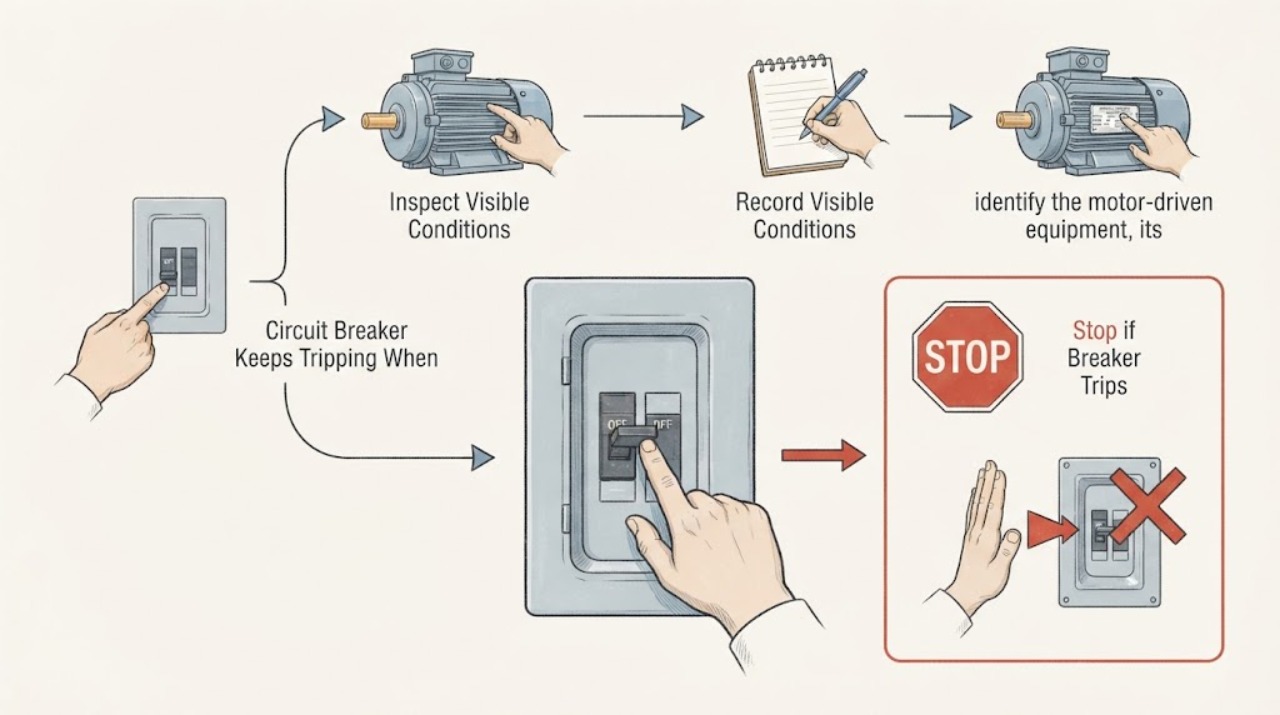
Work through in order
Diagnostic checks
Use only checks that match the exact appliance or system and its official guide.
-
Check 1
Stop the motor-driven equipment and observe from a dry, safe position for smoke, visible arcing, burning odor, a hot or discolored plug or receptacle, a damaged cord, water, shock or tingling, or a motor that hums without turning. Do not touch the equipment, breaker, or cord when wet or hot.
Expected result: There are no visible warning signs, or smoke, arcing, heat, odor, water, shock, exposed damage, or a stalled or humming motor is present.
Next step: Keep the circuit and equipment out of service. Leave and seek emergency help for fire or smoke; otherwise arrange qualified electrical or equipment service. If no warning sign is present, continue only with non-contact observations.
Stop if: Stop immediately for smoke, sparks, arcing, burning odor, hot or discolored parts, water, shock, exposed wiring, or a stalled or humming motor.
Why this matters
Why: The second result is an immediate fire, shock, water, or equipment hazard; a motor that cannot start may overheat and must not be restarted to see what happens.
-
Check 2
Record exactly when the breaker opens relative to the motor: at the first start command, after a hum or failed start, when the motor reaches speed, after several minutes, when a second motor starts, or only when the motor is heavily loaded. Do not restore power to reproduce the event.
Expected result: The trip is immediate at start, follows a hum or stall, occurs after run time, or follows another load starting.
Next step: Keep the equipment off and give the timeline to a qualified electrician or equipment technician. Do not wait for the motor to cool and keep trying it.
Stop if: Stop for any request to restart a stalled motor, repeat a trip, or energize equipment that is wet, damaged, hot, or producing odor or noise.
Why this matters
Why: Immediate or failed-start timing can point toward starting-current interaction or a motor/mechanical fault; a delayed trip can fit sustained overload or heat; a second-load pattern points toward branch loading. Timing alone cannot identify the failed part.
-
Check 3
From a safe position, identify the motor-driven equipment, its location, whether it is portable or permanently connected, and the other appliances or loads that lose power. Read the equipment nameplate only if it is safely visible; do not open a cover or alter a connection.
Expected result: One motor load is the only affected equipment, several loads share the circuit, or the circuit and equipment identity are unclear.
Next step: Keep the implicated load off and provide the circuit map and nameplate information to a qualified electrician. Do not move the equipment to another outlet or use an extension cord as a workaround.
Stop if: Stop for a wet area, damaged cord or plug, loose receptacle, inaccessible equipment, or any need to enter an enclosure or panel.
Why this matters
Why: A single affected motor load suggests equipment, cord, or its connection may be involved; several loads suggest branch loading or wiring; an unclear map prevents a safe conclusion.
-
Check 4
Only when the equipment is already disconnected by its normal external control or plug and there is no water or visible damage, inspect external vents, filters, guards, and the visible work area for lint, debris, ice, a blocked air path, or an obvious obstruction. Do not reach through a guard, turn a shaft, remove a cover, or access a capacitor or motor wiring.
Expected result: The external air path is clear, or a blockage, jam indication, ice, debris, or damaged guard is visible.
Next step: Do not operate the equipment until the manufacturer's user instructions and a qualified technician determine that the obstruction can be safely cleared. Escalate internal, jammed, wet, or damaged conditions for service.
Stop if: Stop for a jammed mechanism, sharp or moving parts, damaged guard, water, heat, odor, smoke, or any need to remove a cover or make an internal check.
Why this matters
Why: A blocked path or visible external obstruction can increase motor load, but clearing an external view does not prove the motor, controller, capacitor, wiring, or driven mechanism is safe.
-
Check 5
Read only the external label or indicator for the protective device, such as a standard breaker, AFCI, GFCI, or combination device, and note whether the motor is on a dedicated circuit or shares a branch. Do not open the panel or touch the device while wet.
Expected result: The device type is known, a ground- or arc-fault indicator is present, or the protection and circuit assignment are unknown.
Next step: Keep the circuit off and ask a qualified electrician to assess protective-device compatibility, branch loading, wiring, grounding, and the motor circuit. Do not install a larger breaker or defeat protection.
Stop if: Stop for a damp panel, wet hands, standing water, shock, smoke, heat, arcing, or any need to remove a panel cover.
Why this matters
Why: Different protective devices respond to different kinds of overcurrent, arcing, or leakage; the label can guide the professional but cannot identify a motor failure or justify a replacement rating.
-
Check 6
Observe existing symptoms without operating the suspect motor: lights dim, outlets buzz, a receptacle feels hot, other loads trip the same breaker, the motor runs normally on no load but trips under work, or the trip also occurs in dry conditions. Do not make live measurements or switch loads repeatedly.
Expected result: There is dimming or buzzing, a warm or discolored connection, a multi-load pattern, a motor-load-only pattern, or a dry-weather pattern.
Next step: Keep the affected circuit and motor equipment out of service and arrange qualified inspection. Give the technician the symptom pattern instead of trying another circuit or another start.
Stop if: Stop for flicker with heat, buzzing, burning odor, smoke, arcing, shock, repeated trips, or a damaged receptacle or cord.
Why this matters
Why: Dimming, buzzing, heat, or several affected loads raise concern about the branch or connection; a motor-only or loaded-run pattern raises concern about equipment or its circuit; dry-weather trips may be unrelated to the motor condition.
-
Check 7
Prepare a service record without restoring power: equipment and motor type, nameplate information, breaker label and protection type, trip timing, other loads, hum or stall behavior, external obstruction, moisture history, prior work, and every odor, sound, heat, spark, or shock.
Expected result: The event is confined to one motor load, follows a second load, follows a stalled start, occurs after run time, or remains unexplained.
Next step: Request a qualified electrician to assess the branch and protection, and qualified equipment service to assess the motor or driven mechanism once the circuit is safe. Return the equipment to use only after the cause is corrected and cleared.
Stop if: Stop for another trip, water, smoke, fire, odor, heat, arcing, shock, damaged wiring, or any request to reconnect for confirmation.
Why this matters
Why: The record helps separate starting-current interaction, branch overload, mechanical loading, equipment fault, and wiring or protection problems without another hazardous energization.
Use your observations
Decision map
Find the observation that best matches what you see, then follow the next safe action.
-
PATH 01Next step
What you see
Smoke, fire, visible arcing, burning odor, hot or discolored electrical parts, shock, exposed wiring, water, or a stalled and humming motor is present.
Do this next
Keep clear, leave if the area is unsafe, and seek emergency help for fire or smoke. Do not touch or restart the equipment; arrange qualified electrical or equipment service.
Why this path and its safety boundary
Why it matters: Treat the condition as an immediate fire, shock, water, or motor-overheating hazard.
-
PATH 02Next step
What you see
The breaker trips at the instant a motor starts, with no visible warning sign and no known second load.
Do this next
Leave the motor off and have a qualified electrician and, when appropriate, equipment technician assess the circuit, motor, driven load, and protective coordination. Do not retry the start.
Why this path and its safety boundary
Why it matters: Starting-current interaction, a failed-start condition, a motor fault, or a branch/protection issue is possible; the timing does not prove the breaker is defective.
-
PATH 03Next step
What you see
The motor starts, then the breaker trips after minutes or only when the equipment is working against a load.
Do this next
Keep the equipment off. Provide the run time, load condition, and safe external observations to qualified service; do not keep restarting after a cool-down.
Why this path and its safety boundary
Why it matters: Sustained overload, blocked airflow, mechanical resistance, heat, or a deteriorating electrical component may be involved.
-
PATH 04Next step
What you see
The breaker trips when another load starts, or several devices lose power together.
Do this next
Keep the branch and motor equipment out of service and have a qualified electrician map the loads and assess the circuit. Do not move the motor to another branch or add an extension cord.
Why this path and its safety boundary
Why it matters: Branch loading, a shared connection, or a circuit/protection problem may be involved rather than the motor alone.
-
PATH 05Next step
What you see
A GFCI or AFCI indicator is involved, or the motor equipment is in a damp area.
Do this next
Keep the equipment and circuit off and arrange qualified inspection. Do not reconnect wet equipment or bypass, replace, or repeatedly reset the protection.
Why this path and its safety boundary
Why it matters: Leakage, ground fault, arcing, wet equipment, or damaged wiring may be operating the protective device; the indicator does not identify the failed component.
-
PATH 06Next step
What you see
The breaker also trips in dry conditions or when the motor is not involved.
Do this next
Keep the repeatedly affected circuit off and request a qualified electrician to assess loading, wiring, connections, and protection. Do not use the motor as a repeated diagnostic load.
Why this path and its safety boundary
Why it matters: An ordinary overload, short circuit, wiring fault, protective-device problem, or separate appliance fault may coexist with the reported motor condition.
-
PATH 07Next step
What you see
No warning sign is visible, the trip happened once, and the motor and circuit cannot be identified safely.
Do this next
Leave the equipment off, document what happened, and obtain professional advice before restoring operation. Do not wait for another trip to collect evidence.
Why this path and its safety boundary
Why it matters: A transient overload or an unresolved equipment or circuit fault is possible; silence afterward does not establish safety.
Helpful context
Understand the symptom
Start-up timing changes the diagnosis
A motor can draw a brief starting surge before it reaches normal speed. A trip at the instant of start is therefore different from a trip after several minutes, when heat, overload, a blocked mechanism, or a deteriorating connection may be involved. The timing is useful evidence, but it does not authorize repeated start attempts. Keep the equipment out of service while the cause is identified.
A breaker protects the circuit, not the person
A breaker can interrupt overload or fault current while a shock, wet equipment, damaged cord, hot connection, or arc remains dangerous. User checks should stay outside enclosures and away from energized parts. Internal motor, capacitor, controller, branch-wiring, and protective-device diagnosis belongs to qualified electrical or equipment personnel.
Safety boundary
Stop conditions
- Stop immediately for smoke, fire, visible arcing, burning odor, hot or discolored parts, shock or tingling, exposed wiring, water, a stalled or humming motor, or another trip. Leave if needed and seek emergency or qualified help.
- Do not repeatedly reset the breaker, restart a stalled motor, wait for it to cool and try again, install a larger breaker, bypass AFCI or GFCI protection, or move the equipment to another circuit to change the result.
- Do not open the panel, outlet, junction, disconnect, appliance, motor housing, capacitor compartment, or guard. Do not make live measurements, trace wiring, or reach into moving or energized equipment.
- Stop for a wet or flooded area, damaged cord or plug, loose or hot receptacle, damp enclosure, damaged guard, jammed mechanism, or any condition that requires handling a wet or energized part.
- Keep the circuit and motor-driven equipment out of service when the trip is repeated, unexplained, load-related, or accompanied by dimming, buzzing, heat, odor, arcing, shock, or moisture until qualified personnel clear it.
When checks do not resolve it
Need a professional?
Call a qualified electrician for any repeated trip, a motor-associated branch fault, an unknown or questionable circuit rating, shared-load symptoms, AFCI or GFCI involvement, dimming, buzzing, heat, arcing, shock, damaged wiring, or any diagnosis requiring a panel, meter, or internal access. Request qualified equipment service for a motor that hums, stalls, overheats, trips only under load, or has a blocked or damaged driven mechanism. Use emergency help for smoke, fire, exposed energized damage, or an unsafe flooded area.
Safety scope: User checks are limited to dry, non-contact observation and safely visible labels or external obstructions. Do not reset repeatedly, restart a stalled motor, open enclosures or panels, make live measurements, bypass protection, use an extension cord as a workaround, or energize wet or damaged equipment.
Common questions
FAQ
Why does the breaker trip when the motor starts?
A motor can have a brief starting-current demand, but a start-up trip can also indicate a failed start, stalled mechanism, overloaded branch, damaged cord, protection-device issue, or motor fault. Keep the equipment off and have the circuit and load assessed rather than repeatedly restarting it.
What if the motor runs for a while before the breaker trips?
A delayed trip can fit sustained overload, rising heat, restricted airflow, mechanical resistance, or an electrical component that fails under load. Record the run time and load condition, stop using the equipment, and request qualified diagnosis.
Should I install a larger breaker so the motor can start?
No. A larger protective rating can leave wiring exposed to unsafe current. The electrician must determine the correct circuit, protection, wiring, motor load, and starting arrangement for the installation.
Can I reset the breaker one more time to confirm the motor is the cause?
Do not use repeated resets as a diagnostic experiment. After another trip, leave the circuit and equipment de-energized and have qualified personnel determine whether the fault is in the branch, protective device, cord, motor, controller, or driven mechanism.
Read the exact guide
Official sources
- 1926.405 - Wiring methods, components, and equipment for general useOccupational Safety and Health Administration · OSHA electrical-safety requirements and technical reference; residential equipment must also follow its listing, manufacturer instructions, and local rules.
- Electrical Hazards for Non-ElectriciansOccupational Safety and Health Administration · General electrical hazard education; it does not replace the exact equipment manual or a qualified inspection.
- Qualifications for resetting circuits or replacing fuses; electrical enclosures must be approvedOccupational Safety and Health Administration · OSHA interpretation for electrical work and re-energization; local residential rules and exact equipment instructions also apply.
- Part 1 - Technology for Detecting and Monitoring Conditions That Could Cause Electrical Wiring System FiresU.S. Consumer Product Safety Commission · Technical background on residential overcurrent and arc-fault protection; it is not a model-specific motor diagnosis.
- CPSC Guide to Home Wiring HazardsU.S. Consumer Product Safety Commission · General residential wiring safety; the actual installation and local requirements control.
Community feedback
Share a repair observation
Share a plain-text repair observation. Accepted observations are published automatically; this page may take a moment to update.