
On this page
Start here
Quick answer
A breaker that trips when the other switch in a 3-way circuit is operated is a fault signal, not normal 3-way behavior. Stop operating both switches and do not keep resetting the breaker to reproduce the event. From a safe position, note which switch action triggers the trip, which lights or devices lose power, and whether there is heat, discoloration, crackling, buzzing, odor, smoke, moisture, or a shock. A 3-way circuit has two control locations, so a fault may be in a switch box, traveler or load conductor, connected light, recent replacement, or fixed wiring; the trigger pattern does not identify the failed part. Leave the affected circuit off and arrange a qualified electrician, urgently for heat, burning odor, arcing, smoke, shock, or water exposure. Do not remove a wall plate, open a panel, pull a switch, test wiring, or install a larger breaker.
Before you begin
Safety first
- Keep the circuit off and do not operate either switch, open a box or panel, touch wiring, perform energized measurements, bypass protection, substitute a larger breaker, or repeatedly reset the device. Emergency responders or the utility should handle an active fire or inaccessible hazardous supply.
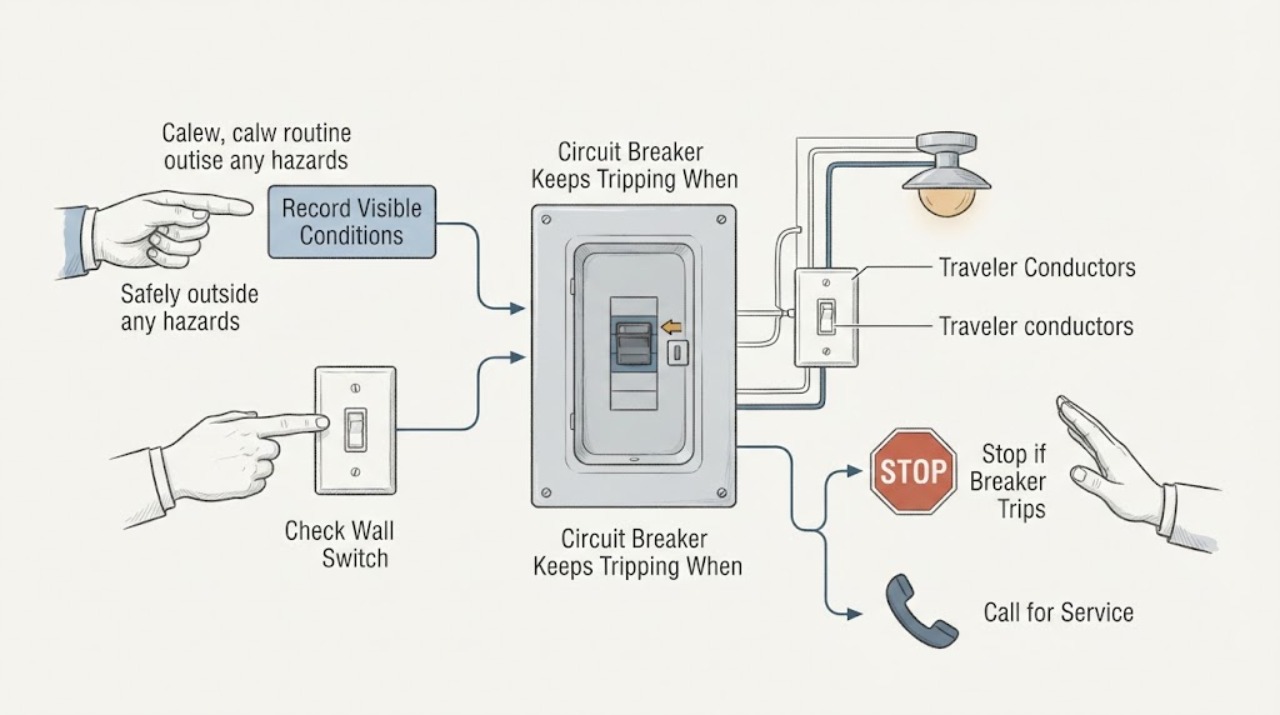
Work through in order
Diagnostic checks
Use only checks that match the exact appliance or system and its official guide.
-
Check 1
Stop using both 3-way switches and stand clear of the panel and wall boxes. Write down which switch was moved, which direction or position change occurred, whether the breaker tripped immediately or after a delay, and which light or appliance was controlled. Do not flip either switch again to confirm the pattern.
Expected result: The breaker trips only when the opposite switch is operated, or the timing is uncertain because the circuit has not been safely left alone.
Next step: Leave the affected breaker in its present safe state and give the electrician the exact switch, position, timing, and affected-load record. Do not repeat the trigger test.
Why this matters
Why: The switching event is a useful symptom boundary, but it does not prove a bad switch; the fault could be in the switching conductors, connected load, branch wiring, protective device, or an earlier alteration.
-
Check 2
From outside the electrical equipment, look and listen without touching for smoke, a spark or flash, crackling, sizzling, buzzing, a burning or unusual odor, a warm or discolored wall plate, a loose or tilted switch, or a shock or tingle. Keep away from any affected switch or outlet.
Expected result: Any heat, discoloration, odor, crackling, visible arc, smoke, shock, or damaged cover is present.
Next step: Stop immediately, keep people away, and call emergency help for smoke, fire, or active arcing. If there is no active emergency, isolate the circuit only from a safe dry location if that can be done without approaching the hazard, leave it off, and arrange an electrician.
Why this matters
Why: This is an electrical fire or shock warning, not a routine breaker-reset problem. An arc or overheated connection can worsen when the switch changes state.
-
Check 3
Without opening the panel, note whether the tripped device is labeled for the light or appliance controlled by the 3-way switches and which other lights, receptacles, or equipment lost power. Do not remove a dead-front cover, probe a receptacle, or move loads around while the fault is unresolved.
Expected result: Only the 3-way load is affected, several unrelated loads on the branch are affected, or the circuit identity is unclear.
Next step: Record the observed scope and leave the circuit off. Ask the electrician to identify the branch, load, protective-device type, and all connected points before inspecting the 3-way path.
Why this matters
Why: A single affected load supports a switch, connected-device, or branch-path investigation; multiple loads can add overload or shared-wiring possibilities. An unclear label increases the chance of isolating the wrong circuit.
-
Check 4
Recall whether the switch, dimmer, smart control, light fixture, ceiling fan, or wiring was recently installed, replaced, moved, painted around, or exposed to a leak. Do not remove the plate to inspect the connections and do not assume a recent change is the only cause.
Expected result: The tripping began after work or a new control was added, or there is no known recent change.
Next step: Tell the electrician what changed, when it changed, and whether the original device or wiring was disturbed. Keep the circuit off rather than attempting to restore the old arrangement yourself.
Why this matters
Why: A recent alteration is important history because 3-way devices and their line, load, and traveler arrangements are model- and wiring-specific. With no recent work, an aging device, damaged insulation, moisture, load fault, or protective-device issue remains possible.
-
Check 5
Check only the surrounding area for visible moisture, a recent leak, condensation, a wet wall or ceiling, or water near the switch, light, receptacle, or panel. Do not touch wet electrical equipment, stand in water, or operate the switch or breaker in a damp area.
Expected result: Water or dampness is near the switch circuit, or the area is dry with no visible water history.
Next step: Keep clear and arrange electrical inspection; address the water source through the appropriate qualified trade. If there is active water near energized equipment, smoke, or arcing, treat it as an emergency and do not approach the panel.
Why this matters
Why: Moisture can create a ground-fault or shock hazard and can damage connections even if the switch looks normal. A dry appearance does not rule out concealed moisture.
-
Check 6
Observe whether the breaker remains tripped without operating the switches and whether it trips again when other unrelated equipment is used. Do not reset it to run this experiment; use only observations that occur naturally and keep the 3-way controls untouched.
Expected result: The breaker stays off, trips again without the 3-way switch being touched, or another load is associated with a trip.
Next step: Leave the circuit off and tell the electrician whether the trip is switch-triggered, load-triggered, or spontaneous. Do not use a higher-rated protective device or keep cycling the breaker.
Why this matters
Why: A fault that persists without the switch event broadens the path to the branch load, appliance, overload, moisture, wiring, or protective device. It is not evidence that the 3-way switch is the sole cause.
-
Check 7
Make a service note with the breaker label and visible position, both switch locations, the controlled load, the exact trigger condition, recent work, moisture history, sounds, odor, heat, discoloration, and any other affected circuits. Photograph only from a safe, dry distance and do not photograph exposed wiring by opening anything.
Expected result: The fault can be described without further operation, or the identity of the affected circuit is uncertain.
Next step: Request a qualified electrician to inspect and test the de-energized 3-way circuit, connected load, protective device, and fixed wiring. If the electrician finds appliance damage, obtain the appropriate appliance service after the circuit is made safe.
Why this matters
Why: A precise history helps a professional inspect the correct switching path while avoiding repeated fault current and unnecessary disturbance of the installation.
Use your observations
Decision map
Find the observation that best matches what you see, then follow the next safe action.
-
PATH 01Next step
What you see
Smoke, active arcing, fire, a strong burning odor, a hot or discolored switch plate, a shock, or water at electrical equipment is present.
Do this next
Keep clear and call emergency help for smoke, fire, or active arc. If no emergency is active, isolate power only from a safe dry location if possible, leave the circuit off, and arrange an electrician. Do not approach a wet or damaged panel.
Why this path and its safety boundary
Why it matters: This is an immediate electrical, fire, or shock hazard.
-
PATH 02Next step
What you see
The breaker trips only when the opposite 3-way switch is changed, with no visible hazard.
Do this next
Stop using both switches, leave the circuit off, and have an electrician inspect the complete 3-way circuit. Do not replace the switch or repeat the trigger test.
Why this path and its safety boundary
Why it matters: The switching path is a high-value diagnostic lead, but the fault could be a switch, traveler, load, fixed wiring, protective device, or connected equipment.
-
PATH 03Next step
What you see
The breaker trips without either 3-way switch being used, or another load also causes a trip.
Do this next
Keep the affected circuit off and give the electrician the list of other loads and the timing. Do not keep resetting or substitute a larger breaker.
Why this path and its safety boundary
Why it matters: The problem may be an overload, connected device, branch wiring, moisture, protective-device issue, or a separate fault rather than the opposite switch alone.
-
PATH 04Next step
What you see
The switch, dimmer, smart control, fixture, or wiring was recently changed before the condition began.
Do this next
Leave the circuit off and tell the electrician exactly what was changed. Do not reopen the box or attempt a second wiring arrangement.
Why this path and its safety boundary
Why it matters: The alteration is relevant history because line, load, traveler, neutral, device compatibility, and terminal arrangements vary by product and installation.
-
PATH 05Next step
What you see
The area is damp, there has been a leak, or water is near the switch, fixture, receptacle, or panel.
Do this next
Do not touch the equipment or operate the switch. Keep people away, isolate power only from a safe dry location if it can be done without approaching the hazard, and arrange electrical inspection after the water source is controlled.
Why this path and its safety boundary
Why it matters: Moisture can make the circuit unsafe even if no spark is currently visible.
-
PATH 06Next step
What you see
No visible warning sign is present, but the breaker continues to trip or the circuit identity is unclear.
Do this next
Leave the breaker and switches alone, document the behavior, and call a qualified electrician for controlled diagnosis. Do not open panels, pull devices, probe wiring, bypass protection, or install a larger breaker.
Why this path and its safety boundary
Why it matters: An unseen fault or incorrectly identified branch remains possible; absence of a visible sign does not make repeated resets safe.
Helpful context
Understand the symptom
Why the opposite switch matters
A 3-way arrangement lets one light or appliance be controlled from two locations. Operating the second switch changes which conductors are connected, so a fault that appears only in one switch position can still be in the circuit, a device connection, a traveler, or the load. That timing is useful evidence for an electrician, but it is not a safe invitation to keep flipping the switch. Normal 3-way operation should not trip the protective device.
The trigger pattern is not a component diagnosis
A trip can result from a short, damaged insulation, a loose connection, an overloaded branch, a device fault, moisture, an incompatible control, or a breaker or protective-device issue. If the circuit trips only when the opposite switch is used, the switching path becomes a strong lead, but the exact location still requires de-energized inspection and appropriate testing. Do not infer that replacing the visible switch will fix the wiring.
Keep the boundary simple
External observations are enough to decide whether to leave the circuit off and how urgently to obtain help. They are not enough to identify a traveler, common terminal, neutral, ground, AFCI or GFCI behavior, or a damaged conductor. Do not open the wall box or panel, touch a conductor, bridge a protective device, use a larger breaker, or perform an energized test.
Safety boundary
Stop conditions
- Stop immediately for smoke, fire, active arcing, a strong burning odor, a hot or discolored switch plate, a shock or tingle, sizzling or crackling, or water near electrical equipment. Keep clear and obtain emergency or qualified electrical help as appropriate.
- Stop operating both 3-way switches and do not reset the breaker to reproduce the condition. Leave the affected circuit off until a qualified electrician has inspected it.
- Do not remove wall plates, open switch boxes or panels, touch conductors, probe terminals, perform energized measurements, bridge a protective device, or install a larger breaker.
- Do not assume the visible switch is the failed part. The trigger can be in the traveler path, load, fixed wiring, protective device, connected equipment, or a recent alteration.
Only after diagnosis
Potential parts
- 3-way switch or control assembly
Consider this only after an electrician confirms a failed or incompatible switch or control and rules out the traveler, load, fixed wiring, moisture, and protective-device causes.
3-way controls differ by load, wiring arrangement, box conductors, and listing. Confirm the exact device and installation requirements with the electrician before replacement. - branch-circuit conductor or connection repair
Consider this only if controlled inspection identifies damaged insulation, a loose termination, an incorrect traveler/common connection, or another fixed-wiring defect.
Wire and connection repairs must follow the existing installation, local code, conductor type, enclosure, and protective-device requirements; this is not a homeowner-selected replacement part. - circuit breaker or protective device
Consider this only after an electrician confirms the protective device is faulty or the installation requires a listed replacement; a trip is not proof of a bad breaker.
The device must match the panel listing, circuit conductors, load, and protection requirements. Never increase the rating to stop trips.
When checks do not resolve it
Need a professional?
Arrange service without further switch or breaker tests. Treat heat, discoloration, odor, crackling, arcing, shock, smoke, water exposure, or recurring trips as urgent or emergency conditions.
Safety scope: Keep the circuit off and do not operate either switch, open a box or panel, touch wiring, perform energized measurements, bypass protection, substitute a larger breaker, or repeatedly reset the device. Emergency responders or the utility should handle an active fire or inaccessible hazardous supply.
Common questions
FAQ
Why does the breaker trip only when the other 3-way switch is used?
A 3-way circuit changes its switching path when either control is operated, so the trigger can point to a fault in a switch, traveler or load conductor, connected light or appliance, fixed wiring, moisture, or a protective device. The pattern is useful history but does not identify the failed part. Stop using both switches and have an electrician inspect the complete circuit.
Should I keep resetting the breaker to see which switch causes the trip?
No. Do not repeatedly reset the breaker or keep operating the switches to reproduce the event. Leave the affected circuit off and record what already happened. Repeated fault current can worsen a wiring or device problem, and an electrician can diagnose it under controlled conditions.
Can I replace the 3-way switch myself?
Do not open the switch box for this symptom. 3-way wiring depends on the installation and device, and the breaker trip may be caused by a traveler, load, fixed conductor, moisture, or protective device rather than the visible switch. Have a qualified electrician inspect the circuit.
What signs make a switch-triggered breaker trip an emergency?
Smoke, active arcing, fire, a strong burning odor, a hot or discolored plate, crackling or sizzling, a shock, or water near electrical equipment requires immediate stopping and appropriate emergency or qualified electrical help. Keep clear and do not approach a wet panel or attempt a repair.
Could an overloaded circuit cause this even if the opposite switch is the trigger?
It is possible. A circuit can have multiple connected loads, and a breaker responds to the circuit condition rather than to a single switch label. If the breaker also trips with other equipment or without the switch being touched, record those details and leave the circuit off. Do not install a larger breaker.
Read the exact guide
Official sources
- OSHA Subpart S - Electrical Standard eToolOccupational Safety and Health Administration · OSHA electrical standard eTool; residential work must also follow applicable local requirements.
- Electrical - Electric-Arc Flash HazardsOccupational Safety and Health Administration · OSHA electrical safety information; the article uses it for hazard boundaries, not as residential repair instructions.
- How to Wire a 3-Way SwitchLeviton · General Leviton product-support explanation; exact device and wiring instructions vary by product and installation.
- Switch to SafetyElectrical Safety Foundation International · ESFI home-safety guidance for switch and lighting warning signs; local requirements and installation details vary.
- CPSC Guide to Home Wiring HazardsU.S. Consumer Product Safety Commission · CPSC consumer guide to home wiring hazards; the document is general safety guidance, not a substitute for local electrical code or an inspection.
Community feedback
Share a repair observation
Share a plain-text repair observation. Accepted observations are published automatically; this page may take a moment to update.