
On this page
Start here
Quick answer
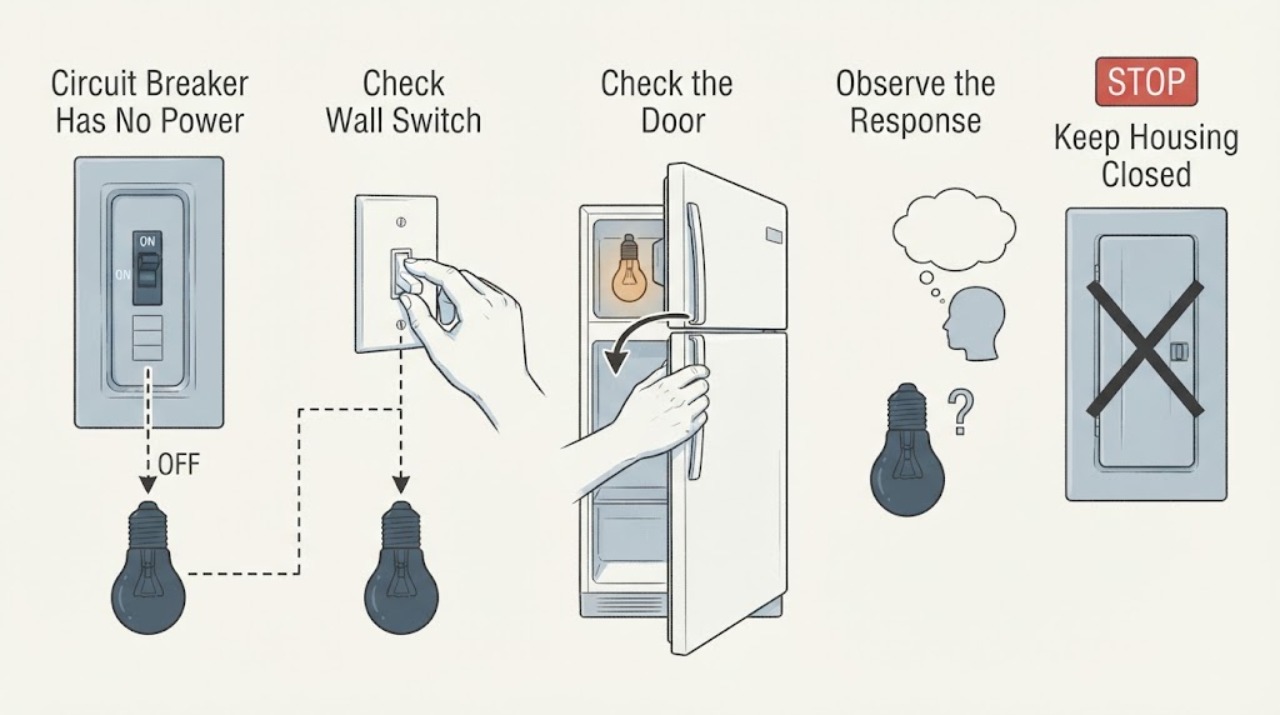
When a circuit breaker has no power at its outlets or lights, first determine whether the outage is limited to one circuit or affects the whole home. With the panel cover closed, you may observe a clearly tripped handle and, only if the enclosure is intact, dry, accessible, and shows no warning sign, make one external reset attempt after switching off or unplugging accessible loads. Do not open the panel, remove its cover, probe an outlet, measure voltage, or repeatedly reset a breaker. If the handle will not stay on, trips again, the breaker appears on but the circuit remains dead, a GFCI will not reset, or there is heat, burning odor, smoke, water, buzzing, or exposed wiring, stop and have a qualified electrician diagnose it.
Work through in order
Diagnostic checks
Use only checks that match the exact appliance or system and its official guide.
-
Check 1
Map the outage without tools: check whether the no-power symptom affects one receptacle or light, several outlets in one room, an appliance circuit, or the whole home. Use only normal switches and plugs that are dry and undamaged, and do not remove a cover plate or open a panel.
Expected result: Only one point is dead, several points on one circuit are dead, or many rooms and appliances lost power together.
Next step: Record the affected locations and what remains powered. Continue with the external breaker and GFCI observations only if there is no heat, odor, smoke, water, buzzing, or exposed wiring; otherwise stop and call an electrician or the utility as appropriate.
Why this matters
Why: A single dead point can be downstream of a GFCI or a local connection; several points can share one branch circuit; a whole-home outage keeps the main service or utility supply in consideration. The pattern alone cannot prove which device failed.
-
Check 2
From outside the electrical panel, inspect the closed door, cover, and visible breaker handles. Do not remove the cover, put fingers inside, touch an exposed conductor, or use a meter. Note whether the affected branch handle is clearly in the OFF or middle position, appears ON, or cannot be identified safely.
Expected result: A handle is visibly tripped, all visible handles appear ON, the panel is wet or damaged, or the handle position cannot be read without opening the enclosure.
Next step: If the panel is wet, hot, scorched, cracked, buzzing, or otherwise unsafe, stay clear and arrange urgent qualified help. If it is intact and dry, continue only to the single external reset decision; never open the panel to identify the circuit.
Why this matters
Why: A middle or OFF handle can indicate that the protective device interrupted the branch circuit. Handles that appear ON with no power, an unreadable position, or a damaged enclosure need professional diagnosis rather than a guessed reset. A panel hazard overrides all routine checks.
-
Check 3
If the panel enclosure is intact and dry, the handle is accessible with the cover closed, and there is no odor, heat, smoke, buzzing, water, or visible damage, switch off or unplug only accessible, dry loads on that circuit. Make no more than one reset attempt using the external breaker handle; do not force a handle or open the panel.
Expected result: Power returns and stays on, the handle will not latch, or it trips again immediately or when a load is reconnected.
Next step: Leave high-demand or suspect loads disconnected, restore them one at a time only if they are dry and undamaged, and stop if the breaker trips or the symptom returns.
Stop if: Do not reset again. Keep the circuit unused and arrange a qualified electrician to inspect the circuit and connected equipment.
Why this matters
Why: Power that returns and remains on after loads are removed is consistent with a temporary overload, but it does not prove the wiring is fault-free. A handle that will not latch or trips again indicates an unresolved overload, short, ground fault, arc-fault condition, connected-equipment problem, or breaker issue that needs diagnosis.
-
Check 4
If the dead point is in a kitchen, bathroom, garage, outdoors, laundry area, or another place with a GFCI receptacle, look for a dry, intact receptacle with an external RESET button. Press that button once only if the face and surrounding area are dry and undamaged; do not remove the receptacle or test it with a meter.
Expected result: The GFCI reset clicks and power returns, the reset will not stay in, or no nearby GFCI can be identified while the breaker appears ON.
Next step: If reset restores power, stop using any appliance that may have caused the trip and monitor without repeated testing. If it will not reset or power remains absent, leave the circuit unused and call a qualified electrician; do not bypass the GFCI.
Why this matters
Why: A GFCI can interrupt downstream receptacles without the branch breaker looking tripped. A reset that will not stay in, a dead GFCI with a normal-looking breaker, or no identifiable reset path can indicate a fault, upstream protection issue, wiring problem, or failed device.
-
Check 5
From a safe distance, inspect only the visible faces and cords of devices on the dead circuit for a burning odor, smoke, scorch or discoloration, unusual heat, buzzing, melted plastic, fraying, water, or a cord caught under furniture. Do not touch a suspect device or unplug anything that is hot, wet, sparking, or damaged.
Expected result: Any warning sign is present, or the visible devices and cords look normal but the breaker or circuit remains without power.
Next step: For smoke, flame, active arcing, or immediate danger, leave the area and contact emergency responders. Otherwise keep people away, do not restore power, and arrange a qualified electrician; provide the device, location, and timing details.
Why this matters
Why: Heat, odor, arcing, water, and damaged insulation can indicate fire or shock hazards and are not safe homeowner diagnostic clues. A normal-looking cord does not rule out a concealed receptacle, wiring, breaker, or service fault.
Use your observations
Decision map
Find the observation that best matches what you see, then follow the next safe action.
-
PATH 01Next step
What you see
One branch handle is visibly tripped, the panel is intact and dry, and there are no warning signs
Do this next
Switch off or unplug accessible loads and make one external reset attempt with the panel closed. If it will not latch or trips again, stop and call a qualified electrician rather than resetting repeatedly.
-
PATH 02Next step
What you see
The breaker appears ON but several nearby receptacles are dead, or an external GFCI will not reset
Do this next
Leave the circuit unused and arrange electrical service. A downstream GFCI, open connection, protective-device fault, or wiring issue requires diagnosis without removing covers or testing live parts.
-
PATH 03Next step
What you see
The outage affects many rooms or the entire home while the visible panel handles do not show a clear branch trip
Do this next
Check for a wider utility interruption from a safe location and contact the utility or a qualified electrician according to local practice. Do not open the service panel or attempt to manipulate the meter or service equipment.
-
PATH 04Next step
What you see
A breaker trips again, the handle will not latch, or power disappears when a particular appliance is connected
Do this next
Keep the suspect appliance disconnected and stop resetting the breaker. Have a qualified electrician diagnose both the circuit and appliance connection; do not substitute a different breaker or change its rating.
-
PATH 05Next step
What you see
There is heat, a burning odor, smoke, arcing, water, exposed wiring, melted plastic, or a damaged electrical enclosure
Do this next
Do not touch or restore power. Move people away; call emergency responders for fire or immediate danger, then arrange qualified electrical service when the area is safe.
Helpful context
Understand the symptom
Start with the size of the outage
A dead receptacle or light does not prove that the breaker itself failed. One room or one appliance circuit can be interrupted by a branch breaker or a downstream GFCI, while a wider outage may involve the main service, a utility interruption, or more than one protective device. Note what still works without opening any electrical enclosure, then give that pattern to the electrician.
No-power does not mean no hazard
A dark outlet or appliance is not proof that every conductor or terminal is safe to touch. Keep covers and dead-fronts in place, and do not use a tester, remove a receptacle, pull a breaker, or touch wet, hot, scorched, buzzing, or damaged equipment. Smoke, arcing, a strong burning smell, or water entering electrical equipment is a stop condition, not a reset experiment.
Only after diagnosis
Potential parts
- circuit breaker
Consider this only after a qualified electrician confirms that the breaker itself has failed and that replacing it is permitted for the existing panel and circuit.
The electrician must confirm the panel family, breaker type, circuit design, listing, and local requirements; never substitute a breaker by appearance or change the circuit rating. - GFCI receptacle
Consider this only after a qualified electrician confirms that the GFCI device is defective rather than responding to a downstream fault, moisture, wiring problem, or connected appliance.
Confirm the circuit, location, device protection requirements, wiring configuration, and approved device before replacement; do not bypass or self-install it as a no-power test.
When checks do not resolve it
Need a professional?
Use professional electrical service for a breaker that will not stay on, repeated trips, an ON handle with a dead circuit, a failed GFCI reset, concealed wiring, panel or receptacle work, or any testing and repair involving energized or potentially energized parts.
Common questions
FAQ
Can I reset a circuit breaker when an outlet has no power?
Only consider one external reset when the panel cover is closed, the enclosure is intact and dry, accessible, and there are no warning signs, after switching off or unplugging accessible loads. Do not open the panel or reset repeatedly; a second trip or a handle that will not latch needs a qualified electrician.
Why is the breaker ON but the receptacle still dead?
The dead receptacle may be downstream of a tripped GFCI, or there may be an open connection, failed protective device, connected-load fault, or wiring problem. Check only for a dry, intact external GFCI reset button; if it will not reset or the outlet remains dead, stop and call an electrician.
What does it mean if the breaker trips again right away?
It means the original condition has not been safely resolved or the protective device is detecting another fault. Keep loads disconnected and do not keep resetting it; repeated reclosing can leave an overload, short, ground fault, arc-fault condition, appliance problem, or breaker fault unexamined.
When is a no-power breaker problem an emergency?
Leave the area and seek urgent help for smoke, flame, active arcing, a strong burning smell, hot or melted equipment, water entering electrical parts, or exposed conductors. Do not touch the panel, restore power, or use a meter to investigate those signs.
Read the exact guide
Official sources
- Fuse and Breaker BreakdownElectrical Safety Foundation International · The opened ESFI page distinguishes standard, AFCI, and GFCI protection and says frequent breaker trips indicate a problem for qualified inspection.
- Meeting Log- Ground-Fault Circuit InterrupterU.S. Consumer Product Safety Commission · The opened CPSC GFCI document describes external reset and no-reset outcomes for GFCI circuit breakers and receptacles; it is used here only to support escalation when a GFCI will not reset.
- Indoor Electrical Safety CheckElectrical Safety Foundation International · The opened ESFI booklet covers a single reset after removing circuit loads, hot or discolored outlet and switch plates, exposed wiring, and damaged cords that need qualified inspection.
- Qualifications for resetting circuits or replacing fuses; electrical enclosures must be approved.Occupational Safety and Health Administration · The opened OSHA interpretation states that a circuit should not be manually re-energized until it is determined safe, repetitive reclosing is prohibited, and testing exposed energized equipment belongs to qualified persons.
- Understanding Your Home Electrical SystemElectrical Safety Foundation International · The opened ESFI guidance explains that breakers interrupt power for overload or system failure, that a tripped breaker may be reset after the problem is resolved, and that persistent problems need an electrician.
Community feedback
Share a repair observation
Share a plain-text repair observation. Accepted observations are published automatically; this page may take a moment to update.