
On this page
Start here
Quick answer
A shock from the outside of a breaker box is an electrical emergency, even if the shock seemed small and power is now off. Move away from the box and the surrounding floor, keep everyone else away, and do not touch the box, its cover, nearby wiring, switches, pipes, or another person who may still be in contact. Call the local emergency service for any shock symptoms, burn, fall, breathing or heart concern, or uncertainty about injury; contact the utility or a licensed electrician from a safe location to make the area safe. Do not approach the panel to reset a breaker, test for power, open the cover, or investigate the cause. If there is smoke, arcing, fire, or a burning odor, evacuate and use the emergency channel rather than attempting a shutdown.
Before you begin
Safety first
- The user must not approach, touch, open, reset, test, or attempt to de-energize the breaker box after a shock. Emergency responders, the utility, building management, and a licensed electrician establish the safe boundary and verify de-energization.
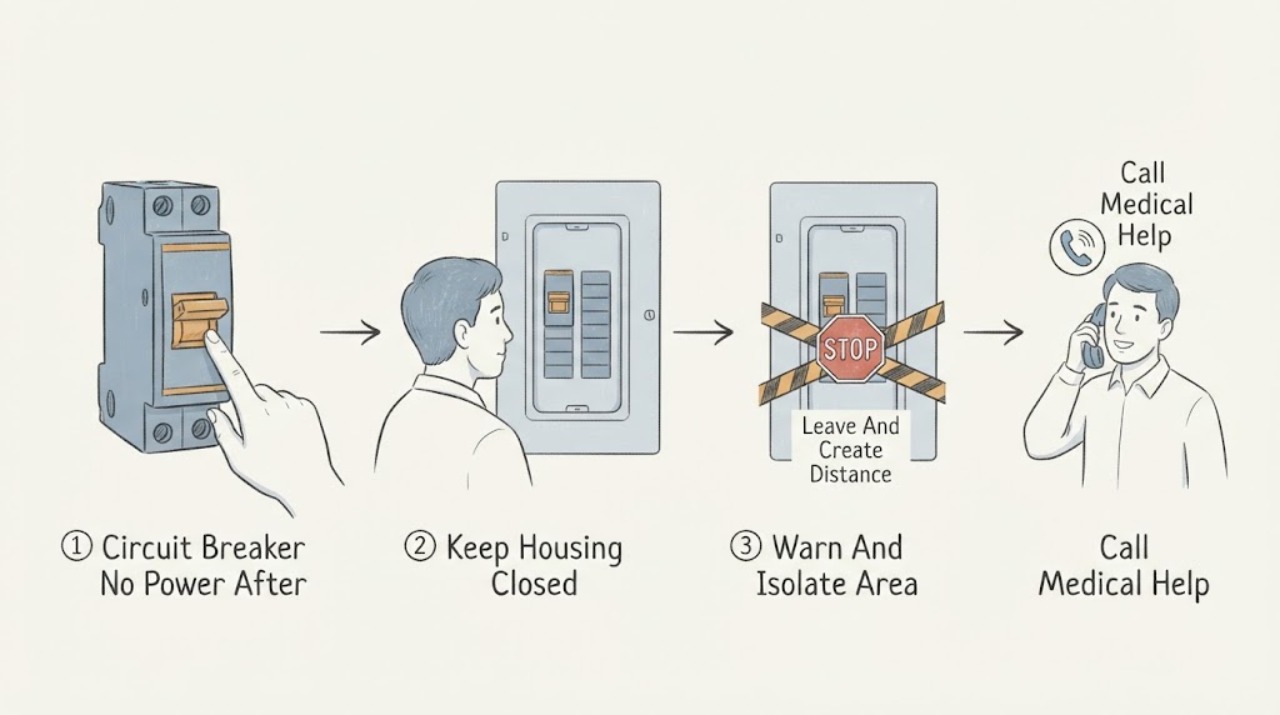
Work through in order
Diagnostic checks
Use only checks that match the exact appliance or system and its official guide.
-
Check 1
Immediately move away from the breaker box and its surrounding floor and keep your hands, feet, tools, jewelry, and metal objects away from the box, cover, nearby pipes, appliances, and wiring.
Expected result: From the safe location, note whether anyone else may still be touching the box, whether the floor is wet, and whether you have any shock symptom, burn, fall injury, breathing problem, chest symptom, or confusion.
Next step: Keep the area clear and call the local emergency service for any shock or injury concern; ask the utility, building manager, or licensed electrician to secure the equipment from a safe location.
Stop if: Do not return to the panel, touch another person in contact, stand in water, or use any object to probe or move the box or wiring.
Why this matters
Why: A shock means the enclosure or an associated conductive path cannot be assumed safe, and wet conditions increase the danger. A person still in contact may remain energized; approaching them can transfer current to the rescuer.
-
Check 2
From a safe location, contact the local emergency medical service after the shock and state that there was electrical contact with a breaker box; do not return to the box to assess the injury or source.
Expected result: Record whether there was a visible burn, chest discomfort, irregular heartbeat sensation, breathing difficulty, weakness, confusion, loss of consciousness, muscle pain, or a fall; do not delay help while trying to classify the voltage.
Next step: Follow the emergency dispatcher's instructions from the safe location and wait for responders; do not re-enter the area or attempt a self-test.
Stop if: Do not touch the shocked person until responders confirm the current is removed and the scene is safe; do not apply water to an electrical burn while the area may be energized.
Why this matters
Why: Electrical shocks can cause serious or hidden injury even when the skin mark is small or the person initially feels normal. Symptoms involving breathing, circulation, consciousness, or a fall increase urgency.
-
Check 3
From outside the hazard area, warn other occupants not to approach the breaker box, nearby metalwork, wet floor, or affected appliances, and keep access blocked without placing yourself between people and an exit.
Expected result: Record whether the hazard is indoors, outdoors, in a utility room, or in a shared building area; note whether water, smoke, sparks, or a damaged service component extends beyond the box.
Next step: Tell emergency responders, the utility, building manager, or electrician the location and observed extent from a safe position; evacuate if smoke, fire, or an unsafe electrical condition is spreading.
Stop if: Do not cross a wet floor, move the box or cover, touch a pipe or appliance to check it, or block an exit while warning others.
Why this matters
Why: The shock path may include more than the box, especially in a damp area or where metal piping and equipment are bonded. The safe boundary may need to include the whole room or building service area.
-
Check 4
From a safe location, notify the utility or building manager that the exterior of the breaker box delivered a shock and that the area must be treated as energized; do not approach service equipment to identify a meter, main, or breaker.
Expected result: Record whether the box is part of a single home, a multi-unit building, or an outdoor service installation; note whether neighbors or common areas also lost power and whether the shock followed a storm, water intrusion, or electrical work.
Next step: Follow the utility or building manager's safe-access instructions and keep everyone away until qualified personnel secure and inspect the equipment.
Stop if: Do not open an enclosure, operate a main or breaker, touch a meter, approach fallen or exposed conductors, or enter a restricted service area.
Why this matters
Why: A service-side, building-side, grounding, or utility fault may affect more than one branch circuit. A wider outage or storm event increases the need for utility or building response, but a local shock still requires electrician inspection.
-
Check 5
From a safe distance and without returning to the panel, observe only whether smoke, a bright flash, crackling, burning odor, heat shimmer, or fire is present and whether an exit path remains clear.
Expected result: Record the warning sign and its location only if it is visible without approaching; do not attempt to identify a breaker, source, or live circuit.
Next step: Evacuate and call the local emergency service for fire, smoke, arcing, or an unsafe exit; tell responders that the breaker box may be energized and that someone received a shock.
Stop if: Do not approach, open, spray, move, reset, or attempt to extinguish an electrical panel fire; do not use water on electrical equipment.
Why this matters
Why: Arcing, smoke, heat, odor, or fire can signal energized fault energy and an arc-flash or fire hazard. Low-voltage equipment is not automatically low risk, and the panel must remain undisturbed.
-
Check 6
From a safe location, write a short incident record for the responders: time, body contact point, footwear and floor condition, whether power was out, what was happening immediately before contact, and any visible symptoms or warning signs.
Expected result: Record only facts observed without approaching, touching, testing, photographing, or trying to reproduce the shock; note whether any work or water event occurred recently.
Next step: Give the record to emergency responders, the utility, building manager, and licensed electrician; leave the equipment untouched until they release it as safe.
Stop if: Do not go back for a label, turn power on or off, operate a switch, remove a cover, or take measurements.
Why this matters
Why: The sequence and environmental conditions help a qualified electrician and medical responder investigate an energized enclosure, grounding problem, moisture path, or damaged equipment without exposing you again.
Use your observations
Decision map
Find the observation that best matches what you see, then follow the next safe action.
-
PATH 01Safety boundary
What you see
The person has a burn, chest discomfort, abnormal heartbeat sensation, breathing difficulty, weakness, confusion, loss of consciousness, or a fall after touching the breaker box.
Do this next
Call the local emergency medical service from a safe location, keep away from the panel, and follow dispatcher instructions until responders secure the scene.
Why this path and its safety boundary
Why it matters: This is a medical emergency as well as an electrical hazard; hidden injury is possible even when a skin mark is small.
Safety stop: Do not return to the panel, touch the person if current may remain, or delay medical care to identify the breaker or power source.
-
PATH 02Safety boundary
What you see
The shock seemed brief and there is no obvious symptom or visible injury.
Do this next
Seek medical advice or assessment and arrange qualified electrical inspection while keeping everyone away from the box; do not resume use because the power is off.
Why this path and its safety boundary
Why it matters: The absence of an obvious injury does not prove that the shock was harmless or that the enclosure is safe; electrical shock can cause hidden injury.
Safety stop: Do not touch the panel again, operate a breaker, or ask someone else to test it for you.
-
PATH 03Safety boundary
What you see
The floor, wall, enclosure, conduit, or nearby equipment is wet or there is a plumbing or storm-water source.
Do this next
Stay out of the wet area, keep others away, notify emergency responders and the utility or building manager, and wait for qualified personnel to secure power and inspect the source.
Why this path and its safety boundary
Why it matters: Moisture lowers resistance and can expand the shock path; water and energized equipment must be treated as an immediate hazard.
Safety stop: Do not stand in water, touch the box or pipes, use a wet switch, mop near the enclosure, or operate a shutoff from within the hazard area.
-
PATH 04Safety boundary
What you see
There is smoke, arcing, a flash, crackling, burning odor, heat, or fire at or near the box.
Do this next
Evacuate through a safe route and call the local emergency service; tell responders about the shock and possible energized panel.
Why this path and its safety boundary
Why it matters: The equipment may have an active electrical fault and arc-flash or fire energy; the area is not safe for homeowner investigation.
Safety stop: Do not approach, open, spray, reset, or attempt to extinguish the box; never use water on electrical equipment.
-
PATH 05Safety boundary
What you see
Multiple circuits or neighboring properties are without power, or the shock followed a storm, utility event, or service work.
Do this next
Notify the utility or building manager from a safe location and arrange licensed electrician inspection; keep away from service equipment and exposed conductors.
Why this path and its safety boundary
Why it matters: The hazard may involve building service or utility equipment in addition to the local breaker box, and the safe boundary may be wider than one circuit.
Safety stop: Do not approach the meter, main, outdoor service, fallen line, or any enclosure to restore or test power.
Helpful context
Understand the symptom
The shock changes this from a no-power check to an emergency safety decision
A tingle, snap, or painful shock through the outside of a breaker box can indicate an energized metal enclosure, damaged insulation, a grounding or bonding fault, moisture, or another dangerous condition. You cannot determine the cause from the fact that a breaker appears off or that the box is no longer tingling. Treat the box and nearby conductive surfaces as energized until a qualified responder verifies otherwise.
Leave the panel and protect other people from the area
Move away without reaching back for the box, and keep children, pets, visitors, and anyone carrying metal objects away. Do not stand in water, touch a pipe or appliance to test whether it is affected, or use a phone charger, meter, screwdriver, or other object near the panel. If another person is still touching the box, do not grab them; call emergency responders and tell them there may be live electrical contact.
Get medical and electrical help from a safe location
Electrical shock can cause burns, falls, breathing problems, heart effects, or hidden injury. Arrange emergency medical assessment after a shock, especially for chest discomfort, palpitations, breathing difficulty, weakness, confusion, loss of consciousness, a burn, or a fall. Separately notify the utility or building manager if the service equipment may be involved, and arrange a licensed electrician to inspect the panel, grounding, bonding, branch circuits, and moisture or damage before anyone re-enters the area.
Only document from far away after the scene is stable
If it can be done without approaching the panel, write down when the shock occurred, where your body contacted the enclosure, whether the floor or area was damp, whether power was already out, and whether there was a flash, buzz, heat, odor, or visible damage. Do not return to obtain a photograph or read a label. A qualified responder can gather the panel identity and circuit information after the area is secured.
Safety boundary
Stop conditions
- Stay away from the breaker box and surrounding floor after a shock; do not touch the cover, enclosure, meter, pipes, appliances, wiring, or another person who may still be energized.
- Do not open the panel, reset a breaker, operate a main, measure voltage, use a test probe, remove a switch or receptacle, or attempt to identify the fault.
- Do not stand in water, mop or spray near the panel, touch wet equipment, use an extension cord, or try to restore power from within the hazard area.
- Do not approach smoke, arcing, fire, burning odor, crackling, heat, exposed conductors, or damaged service equipment; evacuate and call emergency responders.
- Do not touch a shocked person until qualified responders confirm the current is removed and the scene is safe; electrical shock requires medical attention even when the person appears well.
When checks do not resolve it
Need a professional?
Call local emergency medical service after an electrical shock, especially for any symptom, burn, fall, breathing or heart concern, confusion, or uncertainty about injury. Call emergency responders immediately for smoke, fire, arcing, exposed conductors, or an unsafe exit. From a safe location, notify the utility or building manager when service equipment, a storm, water intrusion, or a wider outage may be involved, and arrange a licensed electrician to inspect the breaker box, grounding, bonding, wiring, and moisture or damage before re-entry or re-energization.
Safety scope: The user must not approach, touch, open, reset, test, or attempt to de-energize the breaker box after a shock. Emergency responders, the utility, building management, and a licensed electrician establish the safe boundary and verify de-energization.
Common questions
FAQ
Is a small tingle from the outside of a breaker box serious?
Yes. Treat any shock from the enclosure as an unresolved electrical hazard. Move away, keep others away, seek medical attention, and arrange emergency or licensed electrical response without touching or testing the box again.
Can I turn off the main breaker after being shocked?
No. Do not approach or operate the panel after it has shocked you. Notify emergency responders, the utility, or building manager from a safe location and let qualified personnel establish and verify a safe de-energized condition.
What if the power is already off?
Power being off at the outlets or a breaker handle appearing off does not prove that the enclosure, service conductors, or nearby metalwork are safe. Stay away until qualified personnel inspect and verify the equipment.
Should I touch someone who was shocked by the panel?
Not while the person may still be in contact with the electrical source. Call emergency responders and follow their instructions; touching the person can transfer current to you. Approach only after qualified responders confirm the source is safe.
What if the panel is wet or there is smoke?
Treat it as an immediate emergency. Stay out of the wet area, do not touch the panel or use water, evacuate if smoke or fire is present, and call emergency responders and the utility from a safe location.
Read the exact guide
Official sources
- Electrical - Electric-Arc Flash HazardsOccupational Safety and Health Administration · OSHA arc-flash information for electrical work; homeowners should stay away and use emergency or licensed professional response.
- Electrical SafetyOccupational Safety and Health Administration · OSHA electrical-safety quick card; it is general safety guidance and does not replace emergency response or local requirements.
- CPSC Guide to Home Wiring HazardsU.S. Consumer Product Safety Commission · General residential electrical-safety guidance; emergency responders and licensed electricians control the incident-specific response.
- Basic Electricity SafetyOccupational Safety and Health Administration · OSHA electrical-safety training material; household emergency responders and licensed professionals control the actual incident response.
Community feedback
Share a repair observation
Share a plain-text repair observation. Accepted observations are published automatically; this page may take a moment to update.