
On this page
Start here
Quick answer
When a circuit has no power, first determine whether the loss is limited to one outlet or room and look for a tripped breaker, an open fuse, a utility outage, or an obvious external hazard. Only use dry, accessible controls and disconnect a suspect appliance if it can be done without touching damaged equipment. Do not open the breaker box, handle a fuse, touch wiring, make an energized electrical measurement, replace a protective device with a different rating, or bypass protection. A breaker or fuse that opens again, a hot or discolored outlet, water, smoke, burning odor, arcing, or any uncertainty about the wiring needs a licensed electrician; leave the circuit out of use until it is safe.
Before you begin
Safety first
- Keep the affected circuit out of use for smoke, arcing, burning odor, heat, water, shock, damaged equipment, a repeated trip, an open fuse, or any need to open the enclosure or alter wiring.
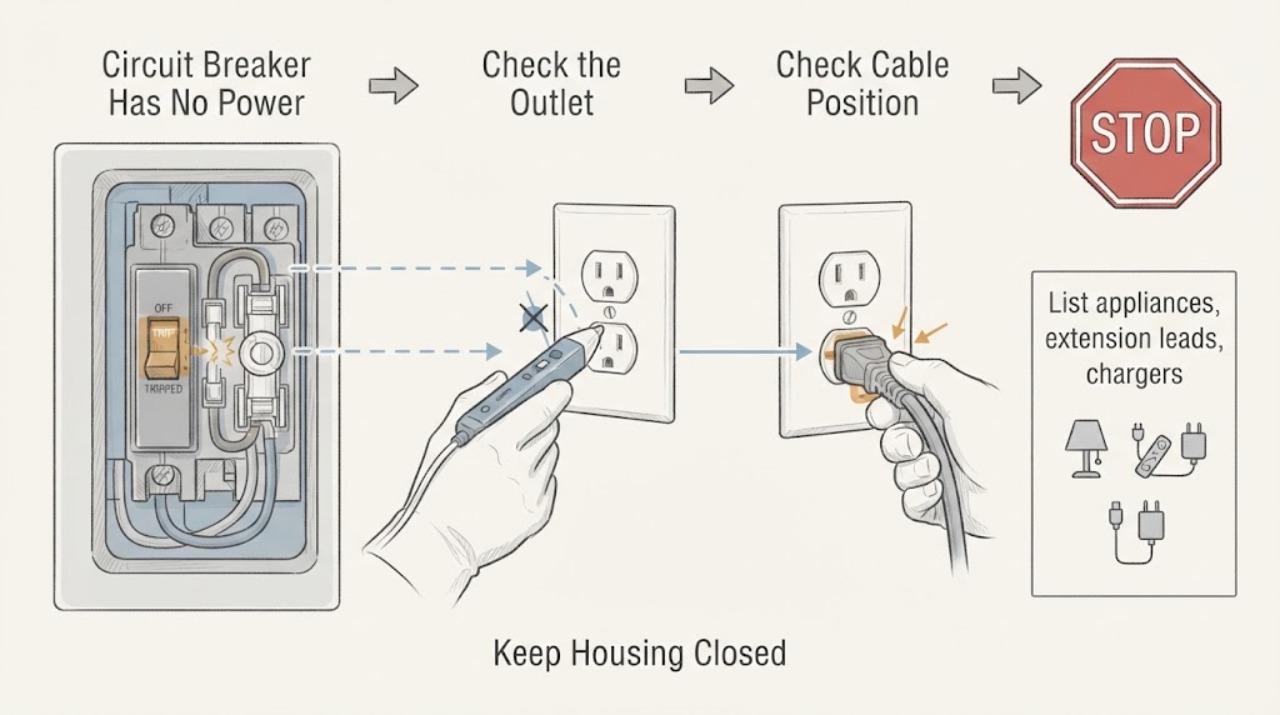
Work through in order
Diagnostic checks
Use only checks that match the exact appliance or system and its official guide.
-
Check 1
From a dry, safe position, look and listen for smoke, a burning or melted-plastic odor, visible arcing, a hot or discolored outlet, buzzing, water near electrical equipment, a shock or tingling sensation, or a breaker that opens immediately; do not approach a damaged or wet installation.
Expected result: Any of those warning signs is present, or the affected area cannot be reached without standing in water or touching damaged equipment.
Next step: Stop using the affected circuit, keep people away, and contact emergency help for smoke or fire. From a safe dry location, arrange a licensed electrician; do not attempt another reset or internal inspection.
Stop if: Stop immediately for smoke, fire, arcing, burning odor, a hot panel or outlet, water contact, shock, or an immediately recurring trip.
Why this matters
Why: This is a possible shock, fire, arcing, or water-contact event rather than a routine power-restoration check.
-
Check 2
Check which outlets, lights, or fixed appliances are affected and whether nearby rooms or other circuits still work; note the exact room, device, and time of loss without removing any cover or touching a fuse or wire.
Expected result: Only one outlet or appliance is dead, several points on one labeled circuit are dead, or the whole property has lost power.
Next step: Record the affected points and check the utility's outage information from a phone or other safe location if the whole property is affected. Give the scope to an electrician instead of guessing which fuse or wire is responsible.
Stop if: Stop if the outage is accompanied by smoke, a hot connection, water, a damaged service entry, or any sign of fire or arcing.
Why this matters
Why: A single point suggests a local receptacle, switch, cord, or upstream device; several points suggest a protective device or circuit issue; a whole-property loss may be a utility or service problem.
-
Check 3
List appliances, extension leads, chargers, heaters, and other loads that were operating when power disappeared; only disconnect a plug that is cool, dry, and visibly undamaged, and leave fixed wiring and damaged equipment alone.
Expected result: One appliance or cord was operating at the moment of the loss, several high-demand loads shared the circuit, or no unusual load was present.
Next step: Keep the suspected appliance disconnected and label it for service. Do not reconnect loads one by one to force the circuit to reveal a fault; have an electrician assess a recurrence or an unidentified cause.
Stop if: Stop for a damaged cord or plug, a warm connection, moisture, a burning smell, or any need to remove a receptacle or fixture.
Why this matters
Why: An overload or a faulty connected appliance may have opened protection, but the observation cannot prove that the appliance or wiring is safe.
-
Check 4
Without opening the enclosure, read the plainly visible label or indicator for the affected circuit and note whether a breaker handle is clearly out of its normal position or a fuse indicator is open; do not touch the fuse, wiring, or internal parts.
Expected result: A breaker appears open, a fuse indicator appears open, the protective device appears normal, or its status cannot be identified safely.
Next step: If status is unclear, leave the circuit out of use and call a licensed electrician. If the area is dry, undamaged, and the device is a clearly accessible resettable breaker, proceed to at most one manual reset only as described by the panel instructions.
Stop if: Stop for an open fuse that would require handling, a damaged enclosure, exposed parts, moisture, heat, odor, noise, or any uncertainty about the device.
Why this matters
Why: An open protective device is evidence that the circuit detected a fault or overload, not proof that a reset or replacement will be safe; a normal-looking device does not rule out a wiring fault.
-
Check 5
Only when the floor, enclosure exterior, and controls are dry and undamaged and no warning sign is present, use the normal external handle of a clearly identified resettable breaker once, following the panel's marked direction; do not repeat the reset if it opens again.
Expected result: Power returns and remains stable, the breaker opens immediately, the breaker will not stay set, or power does not return even though the handle appears set.
Next step: If it opens again or power remains absent, leave the circuit off and arrange licensed electrician service with the scope, load, and timing notes. If power returns, reconnect nothing suspect and monitor without adding loads until the cause is understood.
Stop if: Stop for any repeat trip, buzzing, heat, odor, smoke, spark, water, or unstable handle; do not substitute a fuse or breaker rating.
Why this matters
Why: Stable restoration may indicate a temporary overload, while an immediate or recurring opening indicates an unresolved fault, overload, appliance problem, or wiring issue. No restoration requires further diagnosis rather than repeated cycling.
-
Check 6
Prepare a handoff note with the affected locations, exact time and trigger, visible breaker or fuse indication, connected loads, utility-outage result, prior trips, moisture, heat, odor, noise, or damage, and any model or circuit-label information; leave internal fuse and wiring diagnosis to a licensed electrician.
Expected result: The loss is persistent, returns after one safe reset, affects one circuit without a clear load, or involves fuse or wiring concerns.
Next step: Keep the affected circuit and any suspect appliance out of use and request an electrician to diagnose the circuit, protective device, connections, and load before restoring normal operation.
Stop if: Stop all user diagnosis if it would require opening the box, handling a fuse, touching wiring, or continuing after a hazard appears.
Why this matters
Why: The remaining possibilities include a receptacle, appliance, protective device, service connection, or concealed wiring fault that cannot be assigned safely from the no-power symptom.
Use your observations
Decision map
Find the observation that best matches what you see, then follow the next safe action.
-
PATH 01Next step
What you see
Smoke, fire, arcing, burning odor, a hot or discolored outlet, water contact, shock, or a damaged electrical enclosure is present.
Do this next
Keep clear, leave the area if needed, contact emergency help for fire, and arrange licensed electrician service from a safe location. Do not operate nearby controls or restart the circuit.
Why this path and its safety boundary
Why it matters: The circuit may present an immediate shock or fire hazard.
-
PATH 02Next step
What you see
The whole property is without power.
Do this next
Check the utility outage status remotely and observe whether nearby properties are also affected. If utility power is available nearby or the service equipment shows a warning sign, call an electrician and do not open the service enclosure.
Why this path and its safety boundary
Why it matters: The cause may be a utility outage, service issue, or a main protective device rather than the named circuit alone.
-
PATH 03Next step
What you see
Only one outlet, fixture, or appliance has no power while nearby points work.
Do this next
Leave a suspect appliance disconnected if its plug is safe to handle and request electrician diagnosis for a persistent dead point; do not remove the receptacle or switch cover.
Why this path and its safety boundary
Why it matters: A local device, cord, upstream connection, or branch-circuit fault is possible.
-
PATH 04Next step
What you see
A fuse appears open or its indicator shows a fault.
Do this next
Do not handle, replace, up-rate, or bypass the fuse. Leave the circuit out of use and arrange a licensed electrician to identify the cause and verify the correct protective device.
Why this path and its safety boundary
Why it matters: The protective device operated because of a possible overload or fault; the fuse and its holder may still be hazardous.
-
PATH 05Next step
What you see
A resettable breaker opens immediately or opens again after one safe external reset.
Do this next
Stop resetting, keep suspect loads disconnected, and arrange licensed electrician service with the trigger and affected locations. Do not use a larger protective device or bypass the breaker.
Why this path and its safety boundary
Why it matters: An unresolved overload, faulty connected load, short, or wiring problem remains possible.
-
PATH 06Next step
What you see
The protective device looks normal or one reset does not restore power, and no obvious external hazard is visible.
Do this next
Leave the affected circuit unused and request an electrician to diagnose it. Record the scope, load history, device indication, and any intermittent behavior.
Why this path and its safety boundary
Why it matters: A local receptacle, upstream connection, service issue, or concealed wiring fault remains possible and cannot be identified safely by appearance.
Helpful context
Understand the symptom
What no power can mean
A dead outlet can result from a local breaker or fuse opening, a fault in an appliance or cord, a receptacle or switch problem, a wider utility outage, or a wiring fault. The label on a panel can help identify a circuit, but an intact display or a working outlet elsewhere does not prove that the affected circuit is safe. Treat the fuse and wiring detail as a reason to use an electrician, not as permission to inspect inside the enclosure.
Keep the first checks external
Stay on dry flooring and use only controls that are plainly accessible without removing a cover. If the area is wet, an outlet is hot or discolored, or there is smoke, a burning smell, a spark, or a shock or tingling sensation, stop before trying to restore power. Do not keep resetting a protective device to discover what happens.
Safety boundary
Stop conditions
- Stop immediately for smoke, fire, visible arcing, burning or melted-plastic odor, a hot or discolored outlet or enclosure, buzzing with heat, water near electrical equipment, shock, or a damaged cord or plug.
- Do not open the breaker box, remove a cover, handle or replace a fuse, touch wiring, make an energized electrical measurement, change a protective-device rating, or bypass a breaker or fuse.
- Stop after one safe external breaker reset if it opens again, will not stay set, makes noise, or fails to restore power; arrange licensed electrician service.
- Keep the circuit out of use when the cause is unclear, the outage is persistent, or diagnosis would require internal work.
Only after diagnosis
Potential parts
- circuit protective device
Consider a protective-device replacement only after a licensed electrician confirms that the device itself is defective and identifies the exact approved type and rating.
Breaker and fuse type, rating, interrupt capacity, and panel compatibility are installation-specific. Never select a substitute by appearance or use a higher rating. - receptacle, switch, or wiring connection
Consider this category only when an electrician traces the dead point to a failed device or connection rather than an appliance or utility fault.
Fixed wiring and device work requires local-code compliance and qualified installation; the no-power symptom does not identify a safe replacement.
When checks do not resolve it
Need a professional?
A breaker opens again after one safe external reset or will not stay set., A fuse appears open, or the fuse holder, breaker enclosure, outlet, or wiring status is uncertain., Power remains absent after the accessible protective device appears normal or one reset does not restore it., Only one outlet, fixture, or appliance is dead without an obvious safe external cause., There is a hot, discolored, wet, buzzing, sparking, damaged, or recently altered electrical connection., The suspected cause involves fixed wiring, an internal panel, a service connection, or a load that cannot be safely isolated.
Safety scope: Keep the affected circuit out of use for smoke, arcing, burning odor, heat, water, shock, damaged equipment, a repeated trip, an open fuse, or any need to open the enclosure or alter wiring.
Common questions
FAQ
Why does one outlet have no power while the rest of the house works?
The outlet may be on an opened branch circuit, have a failed upstream connection, or be affected by a damaged appliance or cord. Map the affected points and leave the circuit unused if the cause is not obvious; do not remove the receptacle cover.
Can I keep resetting a breaker that has no power?
No. If a clearly accessible breaker is safe to approach, one normal external reset is the limit. If it opens again, makes noise, or does not restore power, leave it off and arrange licensed electrician service.
What should I do if a fuse appears blown?
Do not handle, replace, up-rate, or bypass it. A blown fuse indicates that protection operated during a fault or overload, and an electrician should identify the cause and confirm the correct device.
Is a hot or discolored outlet safe to use?
No. Stop using it, keep clear of heat, smoke, arcing, or water, and arrange qualified electrical help. Do not keep reconnecting appliances to find the cause.
Read the exact guide
Official sources
- Electrical wiring in your homeWorkSafe New Zealand · General household electrical-safety guidance; local installation rules and equipment details can differ.
- Indoor Electrical Safety CheckElectrical Safety Foundation International · General indoor electrical-safety checklist; it does not replace local code or a licensed electrician's diagnosis.
- Introduction to electrical safetyHealth and Safety Executive · General electrical-safety guidance from the UK regulator; use local emergency and electrical-service rules for the property.
- Electrical equipment safety at homeElectrical Safety Office Queensland · General household guidance; equipment and licensing requirements vary by location.
- Reset Circuit BreakersSouthern California Edison · General residential guidance from a utility; breaker and fuse equipment differs by installation.
Community feedback
Share a repair observation
Share a plain-text repair observation. Accepted observations are published automatically; this page may take a moment to update.