
On this page
Start here
Quick answer
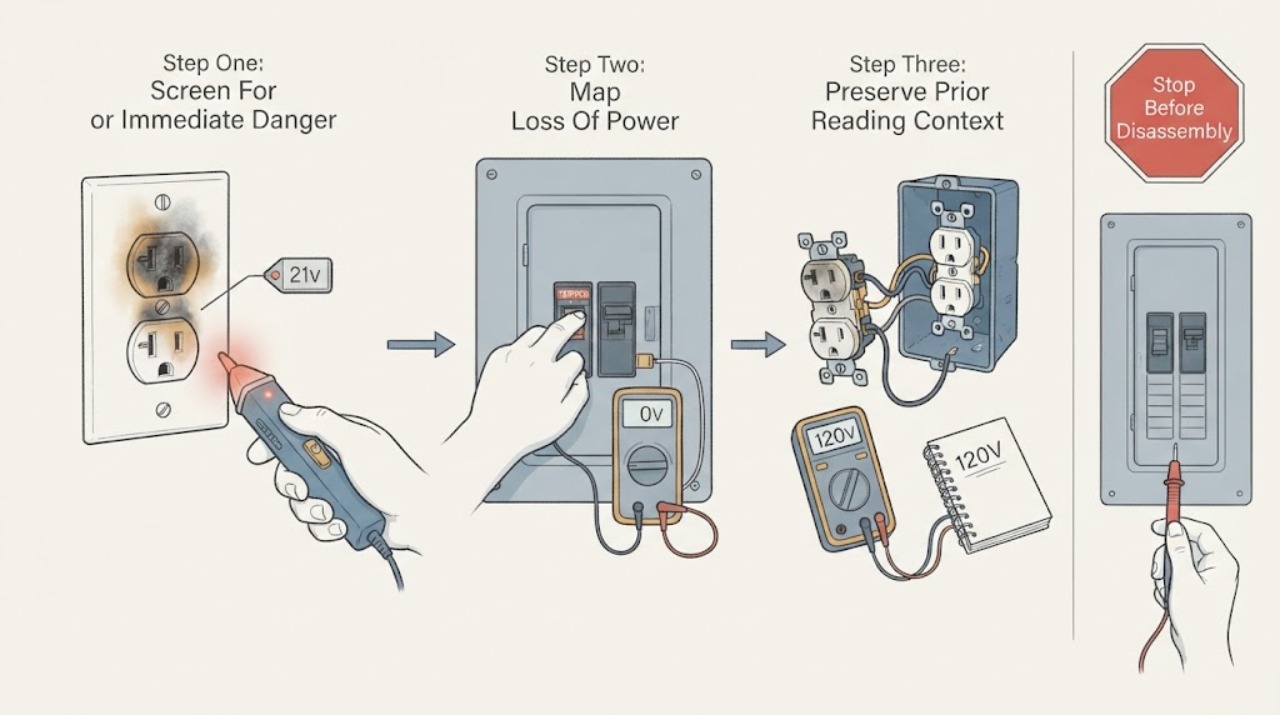
No power after a receptacle was burnt and replaced is a high-risk electrical fault, not a situation to solve by plugging in the television or taking another voltage reading. Treat the reported 21V as an unverified prior observation, not as a safe or confirmed diagnosis. Keep the affected receptacle and circuit out of use, avoid the panel, box, wiring, and any damaged plug, and do not repeatedly reset a breaker or protective device. From a safe position, document which outlets or lights are dead, whether the breaker or GFCI or AFCI indicator is visibly tripped, the old burn damage, what was replaced, and any heat, smell, buzzing, arcing, smoke, water, or shock. A licensed electrician must verify de-energization, the circuit wiring, connections, grounding, protective device, replacement receptacle, and any upstream or downstream receptacles before restoring power. Use emergency services for smoke, flame, active arcing, or immediate danger.
Work through in order
Diagnostic checks
Use only checks that match the exact appliance or system and its official guide.
-
Check 1
From a safe distance, note whether there is smoke, flame, active arcing, buzzing or crackling, a burning odor, heat at the outlet or wall, exposed wiring, water, or a shock history; do not touch the replaced outlet, box, panel, cord, or wall surface.
Expected result: Any smoke, flame, arcing, heat, burning odor, exposed conductor, water, or shock is an immediate hazard; a quiet, cool, dry exterior still does not prove that the circuit is safe.
Next step: For smoke, flame, or active arcing, leave the area and use emergency services. Otherwise keep the circuit and affected equipment out of use and arrange a licensed electrician.
Why this matters
Why: The presence or absence of visible danger determines whether emergency evacuation or urgent electrical isolation is needed before routine diagnosis.
-
Check 2
Without re-energizing the fault, list which receptacles, lights, television, or other equipment are dead and whether the loss is limited to the replaced outlet, the room, or several areas; record any visibly tripped breaker or GFCI or AFCI indicator without opening the panel.
Expected result: One outlet can have an upstream connection or receptacle fault; several outlets or lights suggest a branch-circuit or protective-device issue; a dead appliance alone may also have its own cord or internal fault.
Next step: Do not restore power repeatedly, move the television to another outlet, or use an extension cord as a workaround. Provide the affected-scope list to the electrician.
Why this matters
Why: The scope of the outage tells the electrician whether to inspect the receptacle, upstream or downstream connections, the branch circuit, or the equipment as well.
-
Check 3
Write down the reported 21V as a prior, unverified observation together with when it was recorded, what instrument or reference was used if known, the burnt-outlet history, and what replacement work was completed; do not take another reading.
Expected result: A documented but unverified number is only context; missing instrument, reference, or circuit information means it cannot establish the circuit state or identify the fault.
Next step: Tell the electrician that 21V was reported but not independently verified. Do not interpret, correct, or compare the number yourself.
Why this matters
Why: Preserving the original history helps the electrician without exposing the occupant to another live measurement or a false sense of safety.
-
Check 4
From ordinary safe access, observe the faceplate, surrounding wall, plug, and cord for scorch marks, melting, discoloration, looseness, moisture, or a damaged insulation jacket without inserting anything, removing the faceplate, or touching exposed parts.
Expected result: Any remaining scorching, looseness, melting, moisture, or damaged insulation means the area remains out of service; a clean new faceplate does not establish that hidden connections are correct.
Next step: Keep people away from the area and arrange electrical assessment. Do not pull on a cord, touch a hot plug, remove a cover, or try a different appliance in the outlet.
Why this matters
Why: Visible damage can show that the event extended beyond the replaced part and that upstream or connected equipment may need inspection.
-
Check 5
Collect the outlet location, breaker or protective-device label, date and scope of the replacement, whether the old receptacle was hot or arcing, whether the circuit was wet or overloaded, and whether any upstream or downstream device was also changed; do not open the panel or box to verify it.
Expected result: A recent replacement followed by no power may leave an unresolved upstream feed, downstream connection, breaker, GFCI or AFCI, grounding, or wiring fault; a known appliance event may also have damaged the branch circuit.
Next step: Keep the circuit isolated as directed by the electrician or building manager and provide the complete history before any restoration attempt.
Why this matters
Why: The work history tells the electrician what must be verified and prevents assuming the visible replacement fixed the cause.
-
Check 6
Arrange a licensed electrician to verify the breaker, protective devices, receptacle connections, grounding, branch conductors, and affected equipment under controlled conditions; give them the original 21V report and do not perform the test yourself.
Expected result: The electrician may find a loose or damaged connection, a protective-device state, an open conductor, a wiring fault, a damaged appliance, or a problem beyond the replaced receptacle; no conclusion is safe from the prior number alone.
Next step: Keep the television and affected outlet out of use until the electrician completes the assessment and authorizes restoration. Escalate to emergency services if smoke, fire, or active arcing appears.
Why this matters
Why: The circuit must be verified as safe at the wiring and equipment level before power is restored.
Use your observations
Decision map
Find the observation that best matches what you see, then follow the next safe action.
-
PATH 01Next step
What you see
Smoke, flame, active arcing, strong burning odor, or rapidly increasing heat is present.
Do this next
Leave the area and use emergency services for fire or immediate danger. Do not touch the outlet, cord, panel, or water; do not attempt to extinguish an energized electrical fire with water.
-
PATH 02Next step
What you see
The outlet, wall, floor, panel, or connected equipment is wet, flooded, or anyone received a shock.
Do this next
Keep away from the equipment and exposed wiring. Isolate power only from a safe, dry location without entering water or touching the hazard; otherwise leave and call qualified electrical help. Do not use the equipment until it is professionally assessed.
-
PATH 03Next step
What you see
Only the replaced outlet is dead, with no heat, odor, smoke, water, or visible damage.
Do this next
Keep it out of use and arrange an electrician to verify upstream feed, connections, grounding, protective devices, and the replacement work. Do not insert a plug or take a voltage reading as a test.
-
PATH 04Next step
What you see
Several outlets or lights are dead, or the breaker, GFCI, or AFCI is visibly tripped.
Do this next
Treat the branch circuit or protective device as unresolved. Do not repeatedly reset it or open the panel; provide the outage scope to a qualified electrician for controlled diagnosis.
-
PATH 05Next step
What you see
The television or another appliance remains dead elsewhere but the receptacle scope is unclear, or the appliance cord was involved in the burn.
Do this next
Keep the appliance disconnected and have it assessed by an authorized repair professional. An electrician should still verify the burnt receptacle and circuit before another appliance is connected.
-
PATH 06Next step
What you see
The only electrical evidence is the prior user-reported 21V reading.
Do this next
Do not interpret or repeat the measurement. Tell the electrician it was unverified and provide all available context; the circuit remains out of service until professionally verified.
Helpful context
Understand the symptom
Why the burnt-outlet history matters
A receptacle can be damaged by a loose connection, overloaded circuit, faulty appliance or plug, moisture, or a wiring fault. Replacing the visible receptacle does not prove that the upstream connection, downstream receptacles, branch conductor, grounding, or breaker is sound. If a television or another device still has no power, leave it disconnected rather than using it as a test load.
Treat the 21V report as context, not a diagnosis
A number recorded by a homeowner may have come from an unknown instrument, reference point, or energized condition, and it has not been independently verified here. Do not repeat the measurement, touch probes to a receptacle, or infer that a low reading makes the circuit safe. Give the electrician the original number, how it was obtained if known, the outlet history, and the exact work already performed.
The safe endpoint is a circuit inspection
The electrician should verify the circuit from a safe, controlled condition, including the breaker, protective devices, receptacle connections, grounding, and any devices fed through the burnt outlet. If water or heat affected nearby equipment, those items need professional assessment before use. Do not close the problem by installing a larger breaker, bypassing protection, or assuming that a replacement faceplate means the wiring is repaired.
Safety boundary
Stop conditions
- Stop immediately and leave the area for smoke, flame, active arcing, rapidly increasing heat, or immediate fire danger; use emergency services.
- Stop for water near the outlet, panel, wiring, or equipment, exposed conductors, a shock, burning odor, a hot or damaged plug, or a loose or discolored receptacle.
- Do not take another voltage reading, plug in the television, restore power repeatedly, reset the breaker or protective device repeatedly, or use an extension cord as a workaround.
- Do not open the panel, outlet box, faceplate, or appliance, touch wiring, make connections, install a larger breaker, or bypass GFCI or AFCI protection.
- Keep the replaced outlet and affected circuit out of use until a licensed electrician verifies the repair and authorizes restoration.
When checks do not resolve it
Need a professional?
Arrange urgent licensed electrical service because a burnt receptacle followed by no power may involve hidden connections, a branch conductor, protective device, grounding, or connected equipment. Use emergency services for smoke, flame, active arcing, shock, or immediate danger. Have an appliance professional assess a television or other device involved in the original event.
Common questions
FAQ
Is the reported 21V reading enough to diagnose the dead outlet?
No. It is an unverified prior observation and is not a reason to take another live reading. Give the electrician the original context and keep the circuit out of use.
Can I plug the television into the replaced outlet to test it?
No. A burnt receptacle can leave hidden wiring or protective-device problems even after the visible part is replaced. Have a licensed electrician verify the circuit first.
Why is there still no power after replacing a burnt outlet?
The fault may involve an upstream connection, downstream receptacle, breaker, GFCI or AFCI, branch conductor, grounding, moisture, or the appliance itself. The replacement alone does not identify the cause.
When is a burnt outlet an emergency?
Smoke, flame, active arcing, strong burning odor, rapidly increasing heat, shock, or water near electricity requires immediate stop and emergency or qualified electrical help. Do not use water on an energized electrical fire.
Read the exact guide
Official sources
- Extension CordsU.S. Consumer Product Safety Commission · CPSC safety characteristics and shock or fire hazards associated with household extension cords
- Electrical safety after a floodElectrical Safety First · Electrical Safety First guidance on water-affected electrical equipment, exposed wiring, arcing, overheating, tripping, and professional assessment
- CPSC Guide to Home Wiring HazardsU.S. Consumer Product Safety Commission · CPSC consumer guidance on burnt or hot receptacles, circuit-breaker trips, appliance defects, arcing, damaged cords, and qualified electrical service
Community feedback
Share a repair observation
Share a plain-text repair observation. Accepted observations are published automatically; this page may take a moment to update.