
On this page
Start here
Quick answer
If a circuit has no power and the suspected protective component is a fuse, treat the missing power as a protective shutdown until an electrician confirms the cause. A fuse can open because of an overload, short, damaged appliance, wiring fault, moisture, or an incorrectly rated or aging device; a dark fuse window or dead circuit does not tell you which cause is present. Check only from a safe position which rooms, outlets, lights, or appliances are affected and whether there is smoke, burning odor, heat, crackling, water, exposed damage, or a shock. Do not open the panel, touch or remove the fuse, replace it, bridge it, use foil or a coin, install a larger rating, make a live measurement, or repeatedly re-energize the circuit. Leave the circuit off and arrange a qualified electrician, urgently for heat, odor, arcing, smoke, water exposure, or shock.
Before you begin
Safety first
- Keep the circuit off. Do not open the panel, touch or replace the fuse, use an improvised substitute, install a larger rating, perform live testing, bypass protection, or repeatedly re-energize. Emergency responders or the utility should handle active fire, inaccessible service damage, or a dangerous supply condition.
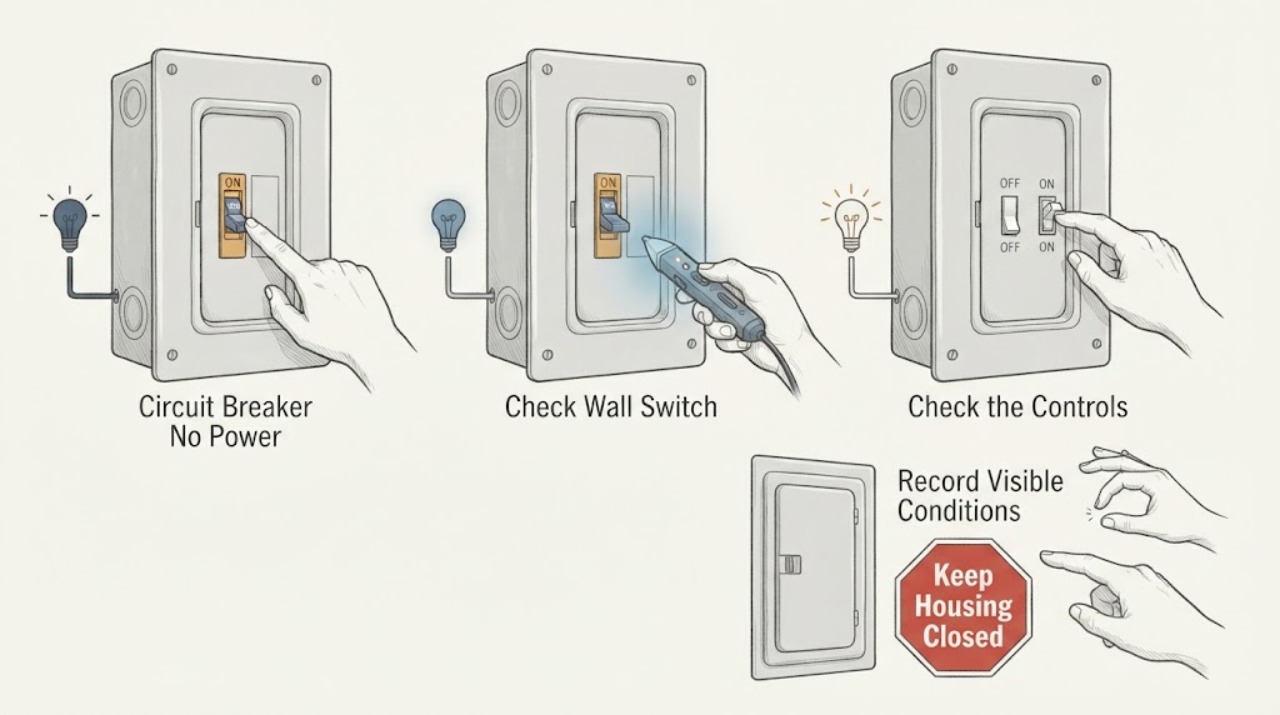
Work through in order
Diagnostic checks
Use only checks that match the exact appliance or system and its official guide.
-
Check 1
Stop using the affected circuit and list every room, light, outlet, appliance, and fixed device that lost power. Note whether the loss began when one appliance, switch, or receptacle was used, or whether it appeared without an obvious trigger. Do not touch the fuse or operate the dead circuit to reproduce the failure.
Expected result: Only one device or room is affected, several loads on one branch are dead, or power is absent throughout the property.
Next step: Record the affected scope and check for a wider outage from a safe, non-electrical source if needed. Leave the suspected circuit alone and arrange electrical service if the cause is not clearly external.
Why this matters
Why: A single-load pattern points toward that device or its local circuit; several loads suggest a branch or protective-device issue; whole-property loss may involve service equipment or utility supply. None proves a blown fuse.
-
Check 2
From a safe distance, look and listen around the switch, receptacle, appliance cord, and accessible wall plate without touching them. Check only for smoke, a burning or unusual odor, crackling, sizzling, buzzing, a warm or discolored surface, visible damage, or a shock or tingle that occurred before power was lost.
Expected result: Any smoke, fire, arc, burning odor, heat, discoloration, unusual sound, shock, or exposed damage is present.
Next step: Keep clear and call emergency help for smoke, fire, or active arcing. Otherwise isolate power only from a safe dry location if that can be done without approaching the hazard, keep the circuit off, and obtain qualified electrical inspection.
Why this matters
Why: The no-power event has an immediate fire or shock warning and is not a fuse-handling task.
-
Check 3
Without opening the panel, record the visible label and position of the affected protective device if it can be read from a normal standing position. Do not remove the panel cover, unscrew a fuse, touch a fuse holder, or reach around other equipment to identify it.
Expected result: The label is clear, the device appears open or damaged, or the affected device and circuit cannot be identified safely.
Next step: Leave the enclosure closed and provide the label or a safe-distance photograph to the electrician. Do not attempt to make the device look on or replace the fuse.
Why this matters
Why: The label can help an electrician connect the symptom to the correct branch, but visual position cannot confirm the cause or make handling safe. An unclear or damaged enclosure increases the service boundary.
-
Check 4
Recall whether the no-power event followed a high-load appliance, a new installation, a switch or receptacle change, a storm, a leak, or a damaged cord. Do not reconnect a suspect appliance or move a damaged cord to another outlet as a test.
Expected result: The event followed a particular load or recent work, followed moisture or weather, or has no known trigger.
Next step: Keep the involved load disconnected only if it can be done without touching damage or wet equipment, preserve the history, and have an electrician inspect before restoring the circuit.
Why this matters
Why: A load or recent work can be relevant to overload, short, connection, or compatibility; moisture can create a ground-fault or shock risk; no trigger leaves the fault open between load, wiring, fuse, and supply.
-
Check 5
Check from a dry, safe location whether other circuits and neighboring properties also appear without power, using ordinary lights or a utility outage notice rather than opening electrical equipment. Do not approach an outdoor service entrance, wet panel, or damaged cable.
Expected result: The interruption is widespread, limited to the property, or limited to the suspected branch.
Next step: Follow the utility's outage process for a confirmed external interruption. For a local loss, leave the circuit off and request an electrician; do not use the outage as a reason to handle the fuse.
Why this matters
Why: A widespread interruption may be a utility event; a property-only or branch-only loss keeps the local service, fuse, load, or wiring path in scope.
-
Check 6
Do not reset, replace, or bypass the suspected fuse. If someone has already replaced it, reset protection, or used an improvised substitute, record exactly what was done and whether the no-power condition returned; do not repeat that action.
Expected result: The fuse or protection opened again, the circuit remains dead, or an improvised or wrong-rated substitute was used.
Next step: Keep the circuit de-energized and tell the electrician the exact sequence. Emergency assistance is appropriate for heat, smoke, odor, arcing, or signs of damage; do not attempt another replacement.
Why this matters
Why: A recurring opening or improper substitute indicates an unresolved fault and increases fire and shock concern. The event does not establish that the fuse itself is defective.
-
Check 7
Prepare a service note with the affected locations and loads, visible label, timing, trigger appliance or switch, recent work, moisture or storm history, sounds, odor, heat, discoloration, and any previous reset or fuse substitution. Photograph only closed equipment from a safe, dry distance.
Expected result: The fault is fully described without further operation, or the circuit and protective component remain uncertain.
Next step: Arrange qualified electrical service and keep the affected circuit off. Give the electrician the complete history and do not authorize a larger fuse or improvised bypass as a solution.
Why this matters
Why: A clear record helps an electrician inspect the correct branch and determine whether the issue is an overload, short, load defect, wiring fault, fuse, or service-supply problem.
Use your observations
Decision map
Find the observation that best matches what you see, then follow the next safe action.
-
PATH 01Next step
What you see
Smoke, fire, active arcing, burning odor, a hot or discolored surface, a shock, or exposed damage is present.
Do this next
Keep clear and call emergency help for smoke, fire, or active arcing. If no emergency is active, isolate power only from a safe dry location if possible, leave the circuit off, and arrange qualified electrical inspection.
Why this path and its safety boundary
Why it matters: This is an immediate electrical or fire hazard.
-
PATH 02Next step
What you see
Water, dampness, a leak, or storm damage is near the fuse panel, wiring, appliance, switch, or receptacle.
Do this next
Do not touch the equipment or approach a wet panel. Keep people away, isolate power only from a safe dry location if it can be done without approaching the hazard, and request electrical inspection after the water source is controlled.
Why this path and its safety boundary
Why it matters: Moisture can create a shock or ground-fault hazard even when the fuse is not visibly damaged.
-
PATH 03Next step
What you see
Only one appliance, switch, or receptacle caused or appears to have caused the no-power event.
Do this next
Leave the suspect load disconnected without touching damage, do not restore power to test it, and ask an electrician to inspect the load and the branch before use.
Why this path and its safety boundary
Why it matters: That load or its local wiring is a useful lead, but the fuse, branch wiring, and protective device remain possible causes.
-
PATH 04Next step
What you see
Several outlets, lights, or rooms on the same branch are dead and there is no visible hazard.
Do this next
Do not handle or replace the fuse. Leave the branch off and have an electrician identify the loads and cause before re-energizing it.
Why this path and its safety boundary
Why it matters: An open fuse, overload, short, branch-wiring fault, or protective-device issue is possible.
-
PATH 05Next step
What you see
The whole property appears without power while nearby properties also appear affected.
Do this next
Use the utility's normal outage channel for an external interruption. Do not open the panel or touch a service fuse; arrange emergency electrical help for damaged lines, smoke, or a hot service area.
Why this path and its safety boundary
Why it matters: A utility interruption is plausible, but a local service or panel fault cannot be ruled out solely from darkness.
-
PATH 06Next step
What you see
The fuse has been replaced, bypassed, or re-energized and the power failed again.
Do this next
Stop all further replacement or reset attempts, keep clear, and tell the electrician exactly what was installed or done. A larger fuse, foil, coin, or bypass must not be used.
Why this path and its safety boundary
Why it matters: The cause remains unresolved and the protective function may have been compromised.
Helpful context
Understand the symptom
No power is a symptom, not proof that the fuse is the only fault
A fuse is intended to open when current exceeds the safe level for the circuit. The same no-power symptom can also be caused by a wider service interruption, a disconnect, a circuit that feeds several areas, a damaged device, an overload, a short, or a wiring problem. The safest first question is which loads are affected, not whether the fuse can be pulled out.
Why a fuse must not be bypassed
The fuse rating is part of the circuit's protection. Substituting a larger rating, foil, a coin, or another conductor can allow wiring to overheat before the protection opens. A fuse that opens again is evidence that the underlying condition has not been resolved, not a reason to keep trying replacements.
Keep the inspection outside the enclosure
A fuse panel and its connected conductors can contain exposed or energized parts. Do not remove a cover, touch a fuse holder, probe a socket, or test a circuit while energized. Record what is visible from a dry, safe position and let an electrician determine whether the fault is the fuse, the load, the wiring, or the service equipment.
Safety boundary
Stop conditions
- Stop immediately for smoke, fire, active arcing, burning odor, hot or discolored electrical surfaces, a shock or tingle, exposed damage, or water near electrical equipment. Keep clear and obtain emergency or qualified electrical help as appropriate.
- Do not open the fuse panel or electrical enclosure, touch or remove a fuse, probe a fuse holder, perform a live measurement, or reach around exposed parts.
- Do not replace a fuse, use a larger rating, use foil or a coin, bridge the fuse, repeatedly re-energize the circuit, or move a suspect damaged appliance to another outlet.
- A blown or missing fuse is a protective event, not proof that the fuse itself is the failed component. Leave the circuit off until the underlying cause is evaluated.
Only after diagnosis
Potential parts
- correctly rated fuse
Consider this only if an electrician identifies a blown fuse and confirms the required type and rating after finding no unresolved load, wiring, moisture, or protection fault.
Fuse type, rating, voltage, holder, and panel requirements must be confirmed by a qualified person and the installation documentation. Never substitute a larger rating or improvised conductor. - fuse holder or panel connection
Consider this only when an electrician finds heat damage, a loose holder, corrosion, or another confirmed protective-device connection fault.
Panel and holder compatibility, enclosure listing, conductor condition, and local requirements must be verified by the electrician. - branch-circuit wiring or load repair
Consider this only when controlled inspection identifies an overload source, damaged conductor, short, moisture damage, or faulty connected appliance or device.
The repair depends on the existing circuit, protective device, conductor, enclosure, load, and local code; it is not a homeowner-selected replacement.
When checks do not resolve it
Need a professional?
Request service without handling the fuse or re-energizing the circuit. Escalate urgently for heat, odor, crackling, arcing, smoke, shock, water, a damaged enclosure, or a fuse that was bypassed or replaced with the wrong rating.
Safety scope: Keep the circuit off. Do not open the panel, touch or replace the fuse, use an improvised substitute, install a larger rating, perform live testing, bypass protection, or repeatedly re-energize. Emergency responders or the utility should handle active fire, inaccessible service damage, or a dangerous supply condition.
Common questions
FAQ
Does no power mean the fuse is blown?
Not necessarily. No power can involve a fuse, branch overload, short, damaged appliance, wiring fault, service interruption, or another protective device. Record which loads are dead and what happened immediately before the loss, then have an electrician identify the cause without handling the fuse yourself.
Can I replace the fuse with a larger one to restore power?
No. A larger fuse can allow unsafe current through wiring and defeat the protection. Do not use foil, a coin, or another bypass. Leave the circuit off and have a qualified electrician determine the required protection and underlying fault.
Should I remove the fuse to see if it is dark or damaged?
No. Do not touch or remove the fuse or open the panel for this troubleshooting task. A visual fuse condition does not identify the reason it opened, and the enclosure can contain energized parts. Give the electrician the visible label and affected-load history instead.
What if power returns and then disappears again?
Treat a returning loss as an unresolved overload, short, load, wiring, moisture, or protection issue. Stop resetting or replacing the fuse and leave the circuit off. Arrange qualified electrical service, especially if there is heat, odor, noise, smoke, arcing, water, or a shock.
When is a no-power fuse problem an emergency?
Smoke, fire, active arcing, burning odor, hot or discolored equipment, a shock, exposed damage, or water near electrical equipment requires immediate stopping and appropriate emergency or qualified electrical help. Keep clear and do not approach a wet panel or attempt a fuse replacement.
Read the exact guide
Official sources
- OSHA Subpart S - Electrical Standard eToolOccupational Safety and Health Administration · OSHA electrical standard eTool; applicable residential code and licensed professional practice remain controlling for a home installation.
- Qualifications for resetting circuits or replacing fuses; electrical enclosures must be approved.Occupational Safety and Health Administration · OSHA interpretation for workplace electrical safety; it is used here for the conservative no-repeated-reenergizing boundary, while residential code and professional judgment also apply.
- CPSC Guide to Home Wiring HazardsU.S. Consumer Product Safety Commission · CPSC consumer guide to home wiring hazards; local electrical requirements and a qualified inspection control the actual installation.
- Electricity – Farm SafetyMissouri Department of Agriculture and Missouri Farm Safety · Missouri government electrical-safety guidance written for farm environments; the fuse-rating and qualified-help principles apply generally, while local code controls home work.
- Switch to SafetyElectrical Safety Foundation International · ESFI home-safety guidance for switch and lighting warning signs; exact installation and local requirements vary.
- Electrical - Electric-Arc Flash HazardsOccupational Safety and Health Administration · OSHA electrical safety information used for hazard recognition, not as a consumer repair procedure.
Community feedback
Share a repair observation
Share a plain-text repair observation. Accepted observations are published automatically; this page may take a moment to update.