
On this page
Start here
Quick answer
If a circuit breaker has no power, first separate a normal outage or tripped protective device from a wiring fault. From a dry, safe position, note whether one outlet or light, one branch, or the whole home is affected; look at the breaker handle and any accessible GFCI or AFCI indicator without removing a panel cover; and record any smell, heat, buzzing, flicker, spark, shock, or water. Do not open the panel, touch wiring, measure voltage, bypass protection, install a larger breaker, or repeatedly reset a breaker. Stop immediately for smoke, arcing, burning odor, a hot panel or outlet, damaged insulation, water, or a shock, and call emergency help or a qualified electrician. If power remains absent without a visible hazard, leave the circuit off and arrange an electrician to diagnose the breaker, wiring, connections, and load.
Before you begin
Safety first
- Keep the circuit off for smoke, arcing, burning odor, hot or discolored equipment, damaged insulation, water, shock, or repeated interruption. Do not open the panel, touch wiring, test energized parts, bypass protection, use a larger breaker, or repeatedly restore power.
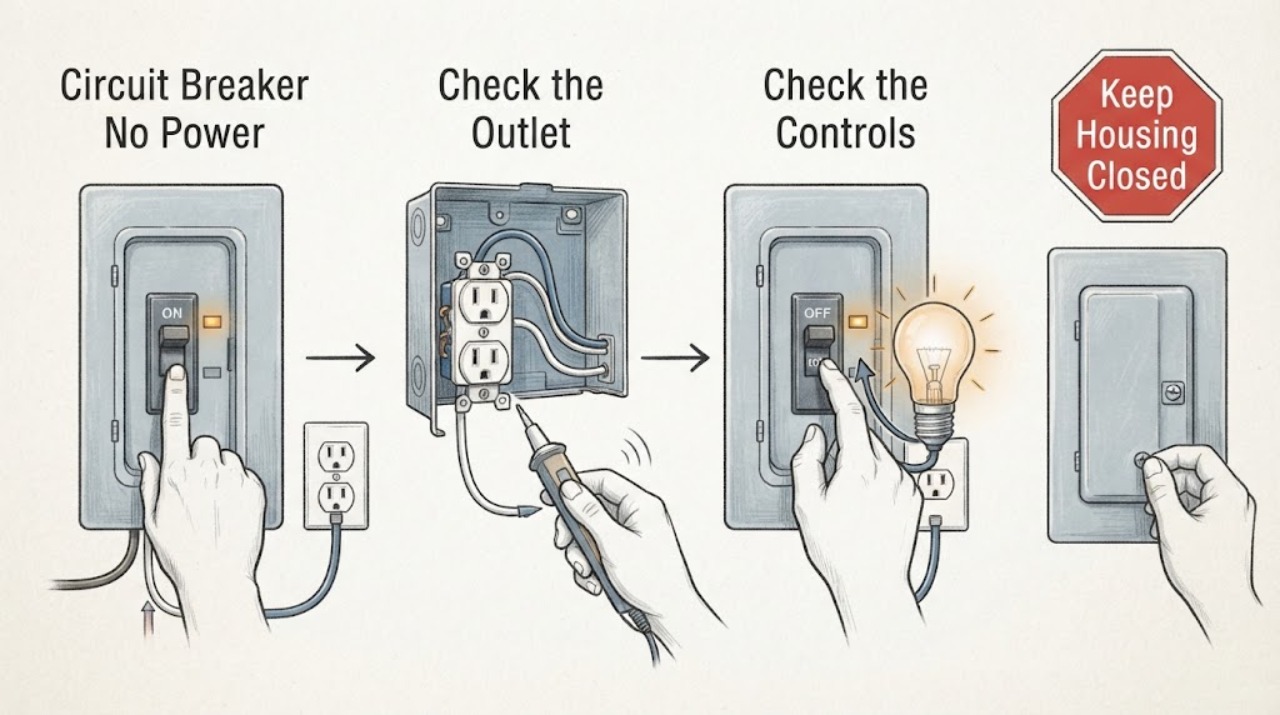
Work through in order
Diagnostic checks
Use only checks that match the exact appliance or system and its official guide.
-
Check 1
Stand on a dry surface and look from a safe distance for smoke, flame, sparks, arcing, a burning smell, buzzing or sizzling, a hot or discolored outlet or panel, damaged insulation, water, or a shock history. Keep the panel cover, receptacles, and equipment boxes closed.
Expected result: Any warning sign is present, or there is no visible warning sign.
Next step: For any warning sign, keep people away and call emergency help or a qualified electrician as appropriate. If none is present, continue with scope mapping without touching wiring or repeatedly restoring power.
Why this matters
Why: A warning sign suggests an active fire, shock, moisture, arcing, or overheating hazard; no visible sign only means that none was observed from outside.
-
Check 2
Map the outage from dry, safe locations: note whether one outlet or light is dead, several points on one branch are dead, multiple branches are dead, or the whole home is out. Note whether nearby homes or street lighting also appear out, and do not use a meter or remove an outlet cover.
Expected result: Only one point is dead, several points on one branch are dead, many branches are dead, or the whole neighborhood appears without power.
Next step: Record the locations and contact the utility for a confirmed area outage. For an isolated home or branch problem, arrange qualified electrician service and leave the affected circuit unused.
Why this matters
Why: A single point suggests a local device or connection; a branch pattern suggests a breaker, GFCI/AFCI, connection, or branch wiring; a broad outage may involve the main service or utility supply.
-
Check 3
Look at the breaker handle and any accessible GFCI or AFCI indicator from outside the equipment. Record whether the handle is fully on, fully off, or between positions; whether a GFCI reset button appears released; and whether the device is hot, cracked, wet, or discolored. Do not remove the panel cover or touch terminals.
Expected result: The breaker is between positions or off, a protective device shows an interruption, the device is damaged or hot, or the indicators look normal while the branch is dead.
Next step: Do not repeatedly reset or force the handle. Leave the affected circuit off and provide the observed position and any label to an electrician; use emergency help for heat, smoke, arcing, or fire.
Why this matters
Why: A visible interruption can explain no power, but a damaged or hot device and a dead branch with normal-looking handles require diagnosis rather than a guessed reset.
-
Check 4
From a dry position, note what was operating when power disappeared: a heater, motor, charger, tool, appliance, renovation activity, storm, water event, or no known event. Leave suspect loads disconnected only if their plugs are cool, dry, undamaged, and safe to reach; do not unplug equipment with a hot plug, exposed wire, or water around it.
Expected result: The outage followed one device or a high-load event, followed work or moisture, occurs with no clear trigger, or returns only when a particular device is used.
Next step: Keep the suspect device and circuit out of use and arrange electrician or qualified appliance service. Never use a larger breaker, extension lead, or bypass to keep the device running.
Why this matters
Why: A load or device may be overloading or faulting the branch; work or moisture raises wiring and shock concern; a repeat tied to one device needs an appliance and electrical diagnosis.
-
Check 5
Check only the exterior of accessible switches, receptacles, cords, and covers for looseness, cracks, discoloration, moisture, heat, or a burning odor. Keep hands away from exposed conductors and do not open a box, tighten a terminal, or probe for power.
Expected result: A cover or receptacle is damaged, a cord is frayed, a plate is warm or discolored, moisture is present, or all visible devices look intact.
Next step: Stop using the affected point and call a qualified electrician. If everything looks intact but power remains absent, report the exact dead locations and breaker position rather than opening anything.
Why this matters
Why: Damage, heat, moisture, or exposed wiring can indicate an unsafe connection or arc fault. An intact exterior does not clear wiring hidden in the wall or panel.
-
Check 6
If water is present in or near an electrical area, keep out of standing water and do not approach a switch, receptacle, panel, or appliance to restore power. From a dry safe location, note the water path and whether the panel or equipment may have been wet.
Expected result: Electrical equipment is wet or near water, water is contained away from equipment, or the area is dry.
Next step: For wet equipment, keep clear and have an electrician isolate and inspect it; do not restore power until cleared. For a dry area, continue only with non-contact scope and label observations.
Why this matters
Why: Wet electrical equipment can create a shock and fire hazard even when the circuit appears dead; dry conditions permit only the other external observations in this article.
-
Check 7
Prepare the electrician handoff with the dead locations, breaker label and visible handle position, GFCI or AFCI indicator, devices operating at the time, recent work or moisture, outage timing, sounds, smells, heat, sparks, and any prior shock. Photograph only closed exterior surfaces from a safe dry position.
Expected result: The pattern is limited to a branch, tied to one load, broad across the home, or accompanied by a hazard sign.
Next step: Leave the affected circuit off and request qualified electrical service. Contact the utility for a confirmed area or service-side outage; do not make a panel repair or replace a protective device yourself.
Why this matters
Why: This record helps the electrician select a branch, load, service, or urgent safety path without requiring the homeowner to expose wiring.
Use your observations
Decision map
Find the observation that best matches what you see, then follow the next safe action.
-
PATH 01Next step
What you see
Smoke, flame, sparks, arcing, a burning smell, a hot or discolored panel or outlet, exposed wiring, or a shock is present.
Do this next
Keep clear, do not touch or reset anything, and call emergency help or a qualified electrician as appropriate. Do not use water on energized electrical equipment.
Why this path and its safety boundary
Why it matters: The no-power symptom is accompanied by a possible fire or shock hazard.
-
PATH 02Next step
What you see
Water is in or near a panel, receptacle, switch, appliance, or other electrical equipment.
Do this next
Do not enter standing water or operate a switch to reach power. Keep people away and have an electrician isolate and inspect the equipment before power is restored.
Why this path and its safety boundary
Why it matters: The circuit may be a wet electrical hazard even if the breaker handle appears off.
-
PATH 03Next step
What you see
The whole home or nearby homes are without power, with no local wiring warning sign.
Do this next
Check the utility outage channel from a safe location and contact the utility for a confirmed outage. Do not open the service panel or attempt a service-side repair.
Why this path and its safety boundary
Why it matters: A utility, service, or main-supply outage is more likely than one branch device.
-
PATH 04Next step
What you see
Several outlets or lights on one branch are dead, but other circuits work and the breaker or protective device shows an interruption.
Do this next
Leave suspect loads unused and arrange electrician diagnosis. Do not repeatedly reset, use a larger protective device, or touch wiring to find the fault.
Why this path and its safety boundary
Why it matters: A tripped breaker, GFCI/AFCI interruption, overload, short, device fault, or branch wiring issue may be involved.
-
PATH 05Next step
What you see
Only one receptacle, light, or device is dead while nearby points work.
Do this next
Stop using the dead point and report any heat, looseness, discoloration, or recent work to an electrician. Do not remove the cover or assume the breaker is the failed part.
Why this path and its safety boundary
Why it matters: The local device, an upstream connection or protective outlet, or a short segment of branch wiring may be involved.
-
PATH 06Next step
What you see
The outage returns whenever one particular device or load is used.
Do this next
Keep that device disconnected only from a cool, dry, undamaged plug and leave the circuit off. Obtain qualified appliance and electrical diagnosis; do not test by repeatedly reconnecting it.
Why this path and its safety boundary
Why it matters: The device, its cord, its connection, or the branch may be overloading or faulting.
-
PATH 07Next step
What you see
The breaker handle looks on and no visible hazard is present, but the mapped branch remains without power.
Do this next
Leave the branch unused and request an electrician. Do not remove the dead front, probe an outlet, measure voltage, or touch the wiring.
Why this path and its safety boundary
Why it matters: The handle position does not establish that the branch is safe or energized; an internal breaker issue, connection fault, upstream protective device, or wiring fault is possible.
Helpful context
Understand the symptom
No power does not prove the breaker itself failed
A circuit can be without power because its breaker opened, a GFCI or AFCI interrupted it, a connection failed, a load fault remains, or utility power is out. A breaker handle can also look on while the circuit remains dead. The useful first distinction is scope: one device, several outlets or lights on one branch, several branches, or the entire home. Do not remove the dead front or panel cover to investigate wiring.
Treat wiring signs as a stop condition
CPSC lists power outages, arcs or sparks, unusual sizzling or buzzing, overheating, odors, and damaged insulation among home electrical warning signs. A no-power report paired with any of those signs is not a routine reset. Keep clear, do not touch the panel or affected device, and obtain qualified help. If water is present, CDC says not to enter standing water to reach a main switch and not to restore power until electrical equipment has been inspected.
Map the dead area without energized testing
Use only ordinary observation from dry standing areas. Note which existing lights are out, which devices no longer operate, whether neighbors or the street are also out, and whether a bathroom, garage, exterior, or other damp location is involved. Do not probe an outlet, remove a receptacle, test a wire, or use a meter. The pattern gives an electrician useful evidence while avoiding contact with a possibly live conductor.
A breaker is a protective device, not a repair
CPSC explains that a breaker opens a circuit when current exceeds a safe level, and that a trip may be associated with an overload, short, damaged device, or wiring problem. Repeatedly restoring a dead circuit can reintroduce the fault. Never substitute a higher-rated breaker or bypass a protective device. The electrician should establish why protection opened before replacing a breaker or repairing wiring.
Safety boundary
Stop conditions
- Stop immediately for smoke, flame, sparks, arcing, a burning odor, a hot or discolored panel or outlet, buzzing or sizzling, exposed wiring, a shock, or repeated loss of power. Keep clear and obtain emergency or qualified electrical help.
- Stop for water in or near electrical equipment. Do not enter standing water or operate a switch to reach power; have an electrician isolate and inspect the area.
- Do not open the service-panel cover or an equipment box, touch wiring or terminals, measure voltage, probe an outlet, bypass a breaker, install a higher-rated breaker, use an extension lead as a workaround, or repeatedly reset the circuit.
- Stop troubleshooting when the circuit remains dead after external scope checks, the breaker handle looks normal but power is absent, or the same load causes the outage again. Leave the circuit off and call a qualified electrician.
Only after diagnosis
Potential parts
- circuit breaker
Consider this only after an electrician confirms that the breaker is defective and that the replacement rating and type match the panel and branch wiring.
Breakers are not interchangeable by appearance. A qualified electrician must identify the panel, circuit, rating, and approved device. - GFCI or AFCI protective device
Consider this only when diagnosis confirms a failed or unsuitable protective device rather than an upstream fault, overload, moisture event, or wiring problem.
Device type, rating, wiring method, and local code determine fit. Have a qualified electrician select and install it. - branch wiring or connection repair
This is a service category only after inspection identifies damaged insulation, a loose connection, an overheated termination, or another fixed-wiring defect.
Do not select wire, terminals, or connectors from the symptom alone; the electrician must match the existing system and applicable requirements.
When checks do not resolve it
Need a professional?
Request electrician service for no power on an isolated branch, a breaker or protective device that opens again, a dead circuit with a normal-looking handle, a suspected wiring or connection fault, damaged equipment, or a load-linked outage. Escalate immediately for smoke, flame, arcing, burning odor, shock, water near electrical equipment, or hot/discolored parts.
Safety scope: Keep the circuit off for smoke, arcing, burning odor, hot or discolored equipment, damaged insulation, water, shock, or repeated interruption. Do not open the panel, touch wiring, test energized parts, bypass protection, use a larger breaker, or repeatedly restore power.
Common questions
FAQ
Why is a circuit dead when the breaker looks on?
The handle position alone does not prove that the branch is energized. An upstream GFCI or AFCI, failed breaker, loose connection, damaged device, or branch wiring issue may be involved. Leave the branch unused and have an electrician diagnose it without opening the panel yourself.
Should I keep resetting a breaker with no power?
No. Repeated resetting can reintroduce an overload, short, moisture fault, or damaged-wiring condition. Do not bypass protection or install a larger breaker; leave the circuit off and call a qualified electrician, especially if it opens again.
What if only one outlet or light has no power?
Map nearby points without meters or outlet disassembly. A single dead point can involve the device, an upstream protective outlet, a connection, or a short branch segment. Stop for heat, discoloration, looseness, odor, moisture, sparks, or a shock and arrange electrician service.
Can I open the panel to check the wiring?
No. This article limits the homeowner check to closed exterior observations. Do not remove the panel cover, touch wiring or terminals, measure voltage, or probe an outlet. A qualified electrician can inspect the branch and protective device with the proper equipment.
What should I do if water is near the electrical panel?
Keep out of standing water and do not operate a switch or enter a wet area to reach power. Keep people away, call an electrician to isolate and inspect the equipment, and do not restore power until it has been cleared.
Read the exact guide
Official sources
- CPSC Guide to Home Wiring HazardsUS Consumer Product Safety Commission · US consumer electrical-safety guide; local codes and service arrangements may differ.
- What to Do to Protect Yourself From Electrical HazardsCenters for Disease Control and Prevention · US public-health safety guidance; emergency response and utility procedures vary by location.
- Home Electrical Safety ChecklistUS Consumer Product Safety Commission · US consumer checklist; use the installed equipment instructions and local requirements.
Community feedback
Share a repair observation
Share a plain-text repair observation. Accepted observations are published automatically; this page may take a moment to update.