
On this page
Start here
Quick answer
If a circuit breaker appears on but the equipment associated with the transformer has no power, do not assume the transformer is the only cause. The lost power may be limited to one branch, a receptacle or control circuit, a GFCI or AFCI protective device, a failed breaker or connection, a utility interruption, or the transformer itself. From a dry, safe position, map which lights, outlets, controls, and equipment are affected, read the breaker indicator without opening the panel, and inspect only the outside of accessible equipment for heat, damage, moisture, odor, or sound. Do not open the panel or transformer, touch wiring, measure live voltage, bypass protection, or keep resetting the breaker. A repeat trip, warning sign, or loss of power with the breaker apparently on needs a qualified electrician.
Before you begin
Safety first
- The owner scope ends at mapping the outage, reading visible labels and indicators, disconnecting intact accessible loads, and observing the outside of equipment from a safe distance. Panel, transformer, wiring, terminals, protective-device, and live-testing work belongs to a qualified electrician.
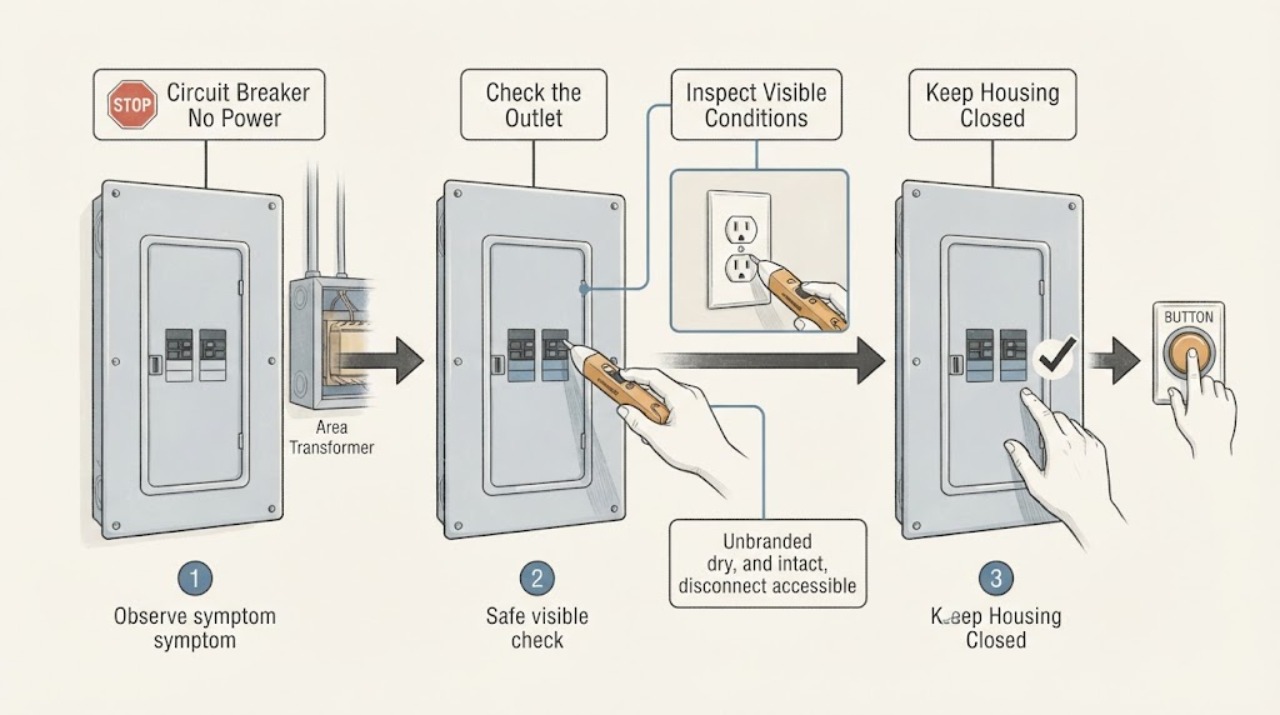
Work through in order
Diagnostic checks
Use only checks that match the exact appliance or system and its official guide.
-
Check 1
From a dry, safe position, list what lost power and what still works: one device, one room, one branch of outlets and lights, the transformer-fed control, or the whole home; do not remove any panel or equipment cover.
Expected result: Only the transformer-associated device is dead, several outlets or lights are dead together, or power is absent throughout the home.
Next step: Record the affected locations and leave hazardous or unexplained areas unused. If the outage is broad or other circuits are also abnormal, contact the utility or a qualified electrician rather than opening the panel.
Why this matters
Why: A single downstream symptom keeps the transformer, its control circuit, and its local supply in scope. A wider outage points toward a branch, service, utility, or protective-device condition instead of proving a transformer fault.
-
Check 2
Look at the breaker handle and any visible indicator from outside the panel, noting whether it is clearly on, in a middle or tripped position, labeled for the affected circuit, or associated with a test button; do not open the panel cover.
Expected result: The breaker appears tripped, the handle position is ambiguous, an AFCI or GFCI indicator is involved, or the breaker appears on while the circuit remains dead.
Next step: Use only the exact panel instructions and make no more than one normal reset when the area is dry, cool, undamaged, and free of warning signs. If it trips again or power remains absent, leave it off and call a qualified electrician.
Why this matters
Why: A protective device may have interrupted the branch even when its position is hard to read. An apparently on breaker with no power can indicate a failed device, open connection, upstream issue, or a separate transformer fault; the handle does not establish which one.
-
Check 3
With power left isolated and only when plugs and receptacles are cool, dry, and intact, disconnect accessible portable loads associated with the dead circuit; do not touch wet, melted, cracked, loose, or sparking equipment.
Expected result: One device or cord is visibly damaged or associated with the outage, or all accessible loads are disconnected with no change.
Next step: Keep a suspect device disconnected and arrange product or electrical service. If the circuit is still dead, do not reconnect loads to experiment; call a qualified electrician.
Why this matters
Why: A device fault can open protection or remove power from a branch. If no portable load explains the symptom, a fixed load, wiring, protective device, transformer supply, or transformer output remains possible.
-
Check 4
Identify the transformer-fed function from its label or equipment documentation without opening it: note whether the dead function is a doorbell, HVAC control, lighting control, alarm, or another device, and whether unrelated functions still work.
Expected result: Only the low-voltage function is dead, the transformer and its upstream device are both inaccessible, or several unrelated functions are dead together.
Next step: Keep the function out of service and give the equipment label and documentation to an electrician. Do not remove the transformer, open a control box, bridge terminals, or substitute a power source.
Why this matters
Why: The application changes the correct service path. A single low-voltage function can involve the transformer or downstream control, while several dead functions suggest a shared supply or broader electrical fault; no visual symptom identifies an internal transformer failure.
-
Check 5
From a safe distance, inspect the outside of the accessible transformer enclosure, disconnect, nearby receptacle, and cable route for heat discoloration, melting, moisture, corrosion, loose cover, buzzing, or a burning odor without touching the equipment.
Expected result: Any heat, odor, noise, moisture, discoloration, damage, or exposed part is visible, or the exterior appears cool, dry, intact, and quiet.
Next step: For any warning sign, stop use, keep clear, and contact emergency or qualified electrical service as appropriate. Do not wipe wet equipment, tighten terminals, open a cover, or restore power to test it.
Why this matters
Why: The first result is a potential electrical, fire, shock, or water hazard. A clean exterior does not prove the transformer or its wiring is safe or energized.
-
Check 6
Note the timing without deliberately recreating the failure: record whether power disappeared after a storm, water exposure, a device was connected, a switch was operated, or the breaker was reset, and whether other circuits changed at the same time.
Expected result: The outage follows moisture, one device or switch, a breaker event, a recent installation, or has no clear trigger.
Next step: Keep the affected circuit or transformer-fed function off when the cause is unclear. Give the timing to a qualified electrician and do not use repeated switching or resets as a diagnostic test.
Why this matters
Why: Timing can separate a local downstream issue from a branch, service, environmental, or transformer-supply issue, but it cannot replace electrical testing by a professional.
-
Check 7
Prepare a service note with the breaker label and visible position, affected locations, transformer label and function, device or cord association, weather or moisture, external condition, sounds or odors, and any single reset result.
Expected result: The note points to one downstream function, a local receptacle or fixed load, a broad branch outage, or an apparently energized circuit with no output.
Next step: Provide the note and model documentation to a qualified electrician. Leave the circuit off when power remains absent or a warning sign exists; do not attempt a transformer or panel repair.
Why this matters
Why: This narrows the handoff without asking the owner to expose energized transformer terminals or panel wiring.
Use your observations
Decision map
Find the observation that best matches what you see, then follow the next safe action.
-
PATH 01Next step
What you see
Only the transformer-associated function has no power while unrelated outlets, lights, and equipment work.
Do this next
Keep the function out of service and arrange qualified electrical diagnosis; do not open or replace the transformer yourself.
Why this path and its safety boundary
Why it matters: The transformer, its local supply, downstream control, or a local protective device remains possible.
-
PATH 02Next step
What you see
Several outlets, lights, or fixed loads on one branch are dead while the rest of the home works.
Do this next
Use no more than one normal reset only when the area is safe. If power does not return or the breaker trips again, leave it off and call a qualified electrician.
Why this path and its safety boundary
Why it matters: An opened breaker, GFCI or AFCI device, branch connection, fixed load, or wiring fault may be involved.
-
PATH 03Next step
What you see
The breaker appears on but the circuit or transformer-fed function remains without power.
Do this next
Do not open the panel or transformer and do not measure live voltage. Arrange qualified electrical service to trace the circuit safely.
Why this path and its safety boundary
Why it matters: A failed breaker, open connection, upstream supply issue, protective device, transformer input, or transformer output is possible.
-
PATH 04Next step
What you see
The transformer enclosure or nearby electrical equipment is hot, wet, discolored, buzzing, damaged, or smells burned.
Do this next
Stop use and keep clear. Contact emergency or qualified electrical service from a safe location; do not touch, dry, open, reset, or restart the equipment.
Why this path and its safety boundary
Why it matters: This is an immediate electrical, shock, water, or fire concern.
-
PATH 05Next step
What you see
A single accessible appliance, cord, switch, or receptacle is associated with the loss of power.
Do this next
Keep the suspect item disconnected and call qualified product or electrical service. Do not try another outlet as a safety test or alter the circuit protection.
Why this path and its safety boundary
Why it matters: The downstream product or local connection may be faulty even if its normal load is small.
Helpful context
Understand the symptom
No power does not prove a transformer failure
The assigned component is the transformer, but its exact type and application are not supplied. It could be part of a low-voltage control, doorbell, lighting, HVAC, or another system. A circuit can show no usable output because power is absent upstream, a protective device has opened, a connection is faulty, or a transformer has failed. The safe first step is to define the extent of the outage without opening either the panel or the transformer enclosure.
Use boundaries, not a guessed test
A transformer may have an energized input even when its downstream device appears dead. That makes internal inspection and live measurement hazardous. The checks below are limited to mapping the affected power, reading visible indicators, disconnecting intact accessible loads when safe, and recording external observations for an electrician.
Safety boundary
Stop conditions
- Stop immediately for smoke, sparks, arcing, burning or melting odor, hot equipment, buzzing or crackling, damaged insulation, exposed parts, or a shock.
- Keep power isolated and away from wet equipment, standing water, a damaged transformer enclosure, or a receptacle or cable with heat or discoloration.
- Do not open the electrical panel or transformer, touch wiring or terminals, measure live voltage, remove or replace the transformer, bridge low-voltage terminals, bypass protection, or install a higher-rated breaker.
- Do not repeatedly reset the breaker or reconnect devices to reproduce a no-power condition. Call emergency or qualified electrical service for an immediate fire or electrical hazard.
When checks do not resolve it
Need a professional?
Arrange qualified electrical diagnosis for any no-power condition involving a transformer, an apparently on breaker, a fixed load, a protective device, or a dead branch that is not safely resolved by one normal reset.
Safety scope: The owner scope ends at mapping the outage, reading visible labels and indicators, disconnecting intact accessible loads, and observing the outside of equipment from a safe distance. Panel, transformer, wiring, terminals, protective-device, and live-testing work belongs to a qualified electrician.
Common questions
FAQ
Why can a circuit breaker show on but still have no power?
The handle may be hard to read, or the problem may be a failed breaker, open connection, upstream supply, protective device, fixed load, transformer input, or transformer output. Do not open the panel or measure live voltage; call a qualified electrician.
How do I know whether the transformer is the problem?
You usually cannot safely prove that by looking at it. Map what lost power, identify the transformer-fed function, note external warning signs, and give the information to a qualified electrician who can isolate the input and output safely.
Can I reset the breaker if the circuit has no power?
Only one normal reset is reasonable when the area is dry, cool, intact, and free of warning signs, and only as the exact panel instructions allow. If power remains absent or the breaker trips again, leave it off and call an electrician.
What signs make a no-power problem urgent?
Smoke, sparks, arcing, burning odor, hot or discolored equipment, buzzing or crackling, moisture, exposed parts, a shock, or repeated trips requires stopping use and getting appropriate emergency or qualified electrical help.
Read the exact guide
Official sources
- CPSC Guide to Home Wiring HazardsU.S. Consumer Product Safety Commission · Residential electrical panels, branch circuits, appliances, receptacles, breakers, and warning signs
- Considerations for Installation of Smoke Alarms on Residential Branch CircuitsU.S. Consumer Product Safety Commission · Circuit-breaker, short-circuit, thermal-trip, AFCI, and GFCI safety concepts
- Understanding Your Home Electrical SystemElectrical Safety Foundation International · Consumer guidance on breakers, AFCIs, overloads, and qualified electrician diagnosis
Community feedback
Share a repair observation
Share a plain-text repair observation. Accepted observations are published automatically; this page may take a moment to update.