
On this page
Start here
Quick answer
A GFCI outlet that trips and will not reset is protecting against a possible ground fault, has no upstream power, is miswired, or has reached a failed or end-of-life condition. From a dry position, note the indicator state, unplug visible downstream appliances only if their plugs and the area are dry, and identify whether another GFCI or breaker upstream is off. Do not open the outlet box, remove conductors, perform a live-voltage test, bypass the GFCI, or keep pressing Reset. If the outlet remains tripped, the circuit feeds a wet area, a device or wiring may be damaged, the indicator shows a fault, or there is heat, smoke, burning odor, buzzing, arcing, or water, leave the circuit out of use and call a licensed electrician.
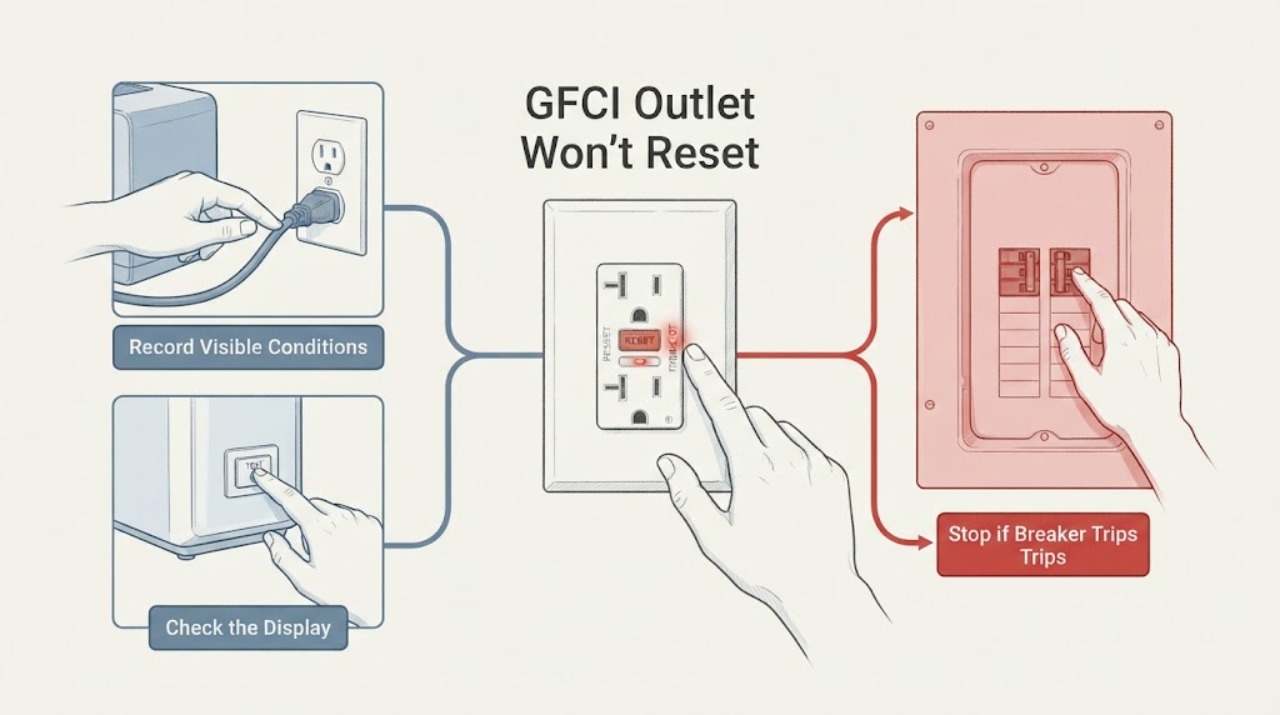
Work through in order
Diagnostic checks
Use only checks that match the exact appliance or system and its official guide.
-
Check 1
From a dry standing position, inspect the GFCI face, surrounding wall, plugs, cords, and nearby equipment for water, condensation, scorch marks, heat, smoke, buzzing, arcing, damaged insulation, or a burning odor without touching the outlet or wiring.
Expected result: Everything is dry and cool, water is present, a cord or outlet is damaged or hot, smoke or arcing is visible, or the smell suggests burning or electrical failure.
Next step: Keep clear and stop using the circuit. If it can be done from a dry, safe location without touching the hazard, use the normal accessible disconnect; otherwise wait for emergency personnel. Call a licensed electrician, and use emergency response for fire, smoke, shock, or an immediate danger.
Stop if: Do not touch wet equipment, remove a cover plate, pull a hot or damaged plug, open the electrical box, or repeatedly reset the GFCI or breaker.
Why this matters
Why: A dry, cool face permits only external identification. Water, heat, smoke, arcing, and burning odor indicate a shock or fire hazard and are not a downstream-isolation exercise.
-
Check 2
Without opening the device, record whether the Reset button is out or in, the Test button position, the indicator color or blink pattern, whether the face is dark, and whether other nearby protected receptacles are also without power; compare only with the exact device instructions.
Expected result: The indicator is off, green, red or blinking, the device shows an end-of-life indication, the device is tripped, or several downstream receptacles are also off.
Next step: Record the exact model and pattern and stop if the manual does not clearly identify a safe user action. Have an electrician investigate missing power, persistent fault indication, end of life, or a no-reset condition.
Stop if: Do not remove the outlet, probe slots, use a meter, open a panel, infer a wire fault from an LED alone, or continue pressing Reset to force power on.
Why this matters
Why: An off indicator can mean the branch has no power; a red or end-of-life indication can mean the device failed its self-test; a tripped device can be reacting to a ground fault or downstream load. Several dead receptacles suggest upstream power or the protected load side, not necessarily a bad button.
-
Check 3
From a dry, safe position, identify whether another GFCI in the same wet-area, garage, basement, outdoor, or laundry circuit is tripped and whether the electrical panel shows an obvious tripped breaker, without opening the panel or touching any wiring; do not repeatedly reset protection.
Expected result: An upstream GFCI or breaker is clearly tripped, no upstream device appears tripped, the panel or device is wet or hot, or the breaker trips again after a reset.
Next step: If the exact instructions permit one ordinary reset and everything is dry, a qualified or competent adult may perform only that single normal reset; if it trips again or the GFCI remains locked out, leave it off and call a licensed electrician. Do not reset wet or damaged equipment.
Stop if: Do not open the panel, remove dead fronts, touch conductors, reset repeatedly, use an extension cord, or work on a wet or hot device.
Why this matters
Why: A downstream GFCI may have no line power because protection upstream opened. A repeat trip, hot or wet equipment, or unknown panel condition indicates an active fault or unsafe installation, not permission to keep restoring power.
-
Check 4
Only when the room, receptacles, plugs, and cords are dry and undamaged, unplug visible appliances connected to the GFCI and downstream receptacles, one at a time, without moving heavy equipment or touching a damaged cord; do not open or disconnect fixed wiring.
Expected result: The GFCI resets and holds after one appliance is unplugged, remains tripped with all visible loads disconnected, or a load has moisture, a damaged cord, or a burning odor.
Next step: Leave the suspected appliance unplugged and label it for service. If the GFCI still will not reset, stop isolating and call a licensed electrician to locate the downstream fault; do not restore power by bypassing the device.
Stop if: Do not unplug from water, pull a hot or damaged plug, open a junction or receptacle, remove conductors, use a tester, or keep resetting to find a load.
Why this matters
Why: A held reset after one appliance is removed points to that appliance, cord, moisture, or connection for professional evaluation. A no-reset condition with loads disconnected keeps fixed wiring, the GFCI, upstream power, and hidden downstream receptacles in scope.
-
Check 5
Record whether the GFCI or any downstream receptacle was recently installed, replaced, painted around, exposed to water, or modified, and whether the problem began immediately after that event; do not remove the cover or compare wire positions yourself.
Expected result: The no-reset began after replacement or wiring work, began after water or a damaged appliance, or has no identifiable triggering event.
Next step: Give the timeline and exact device model to a licensed electrician. Keep the circuit off when the fault is persistent or hazardous and do not treat copying the old wiring as a safe repair.
Stop if: Do not open the electrical box, move wires, test energized conductors, replace the GFCI, bypass load terminals, or restore a device that shows damage or fault indication.
Why this matters
Why: A recent replacement can leave line and load reversed or another installation fault; water or a damaged load can create a ground fault. No trigger leaves device failure, upstream power, fixed wiring, and hidden downstream loads open.
-
Check 6
Prepare a service record with the GFCI make and model, location, indicator state, Test and Reset button positions, upstream device observations, downstream appliances unplugged, moisture or damage, recent work, and exactly when the trip occurred; take photographs only from a dry safe position.
Expected result: The record identifies a likely appliance load, upstream loss of power, recent installation, wet location, persistent ground-fault indication, end-of-life device, or an unresolved protected-circuit fault.
Next step: Call a licensed electrician for persistent no-reset, repeat trips, suspected wiring or device failure, or any wet or damaged condition. Keep people away and use only a separately safe circuit for essential equipment as directed by a professional.
Stop if: Do not continue observing near heat, water, smoke, arcing, exposed wiring, or a panel that requires opening; do not restore power to reproduce the failure.
Why this matters
Why: The record helps the electrician isolate the downstream circuit without encouraging an untrained person to open a box or defeat a shock-protection device. A no-reset GFCI should remain out of service until the cause is resolved.
Use your observations
Decision map
Find the observation that best matches what you see, then follow the next safe action.
-
PATH 01Safety boundary
What you see
There is smoke, fire, arcing, buzzing, burning odor, unsafe heat, exposed wiring, water at the outlet or panel, shock, or a damaged cord or receptacle.
Do this next
Keep clear and keep others away. From a safe dry location use only an accessible normal disconnect if it does not require approaching the hazard; otherwise wait for emergency personnel. Call a licensed electrician and use emergency response for fire, smoke, shock, or immediate danger.
Why this path and its safety boundary
Why it matters: This is an immediate electrical or fire hazard, not a reset or downstream-isolation exercise.
Safety stop: Do not touch the device, wet floor, cord, panel, or wiring; do not reset protection or use water on an electrical fire.
-
PATH 02Safety boundary
What you see
The GFCI indicator is off, another protective device upstream is tripped, or multiple protected receptacles are dead.
Do this next
Record the state and have an electrician diagnose the upstream device, branch power, and wiring. Only one ordinary reset is acceptable when the exact instructions permit it and everything is dry; stop if it does not hold.
Why this path and its safety boundary
Why it matters: The GFCI may not have line power, so Reset cannot latch; the fault may be upstream or in the branch rather than the button itself.
Safety stop: Do not open the panel, probe the outlet, repeatedly reset the breaker or GFCI, or touch a wet or hot device.
-
PATH 03Safety boundary
What you see
The GFCI holds only after a visible dry appliance is unplugged, or a particular appliance or cord shows moisture or damage.
Do this next
Leave the load unplugged and label it for repair or replacement evaluation. Do not use another outlet to defeat the trip or reconnect it to see whether it trips again.
Why this path and its safety boundary
Why it matters: That load or its cord may be creating the ground fault; the GFCI is preventing power from returning to a potentially unsafe device.
Safety stop: Do not handle a wet or damaged plug or cord, open the appliance, use an adapter, or repeatedly restore power.
-
PATH 04Safety boundary
What you see
The GFCI remains tripped with visible downstream loads unplugged, or it trips again after a single dry, normal reset.
Do this next
Leave the circuit off and call a licensed electrician to isolate the protected circuit. Do not remove wires, use a meter, bypass the GFCI, or keep resetting.
Why this path and its safety boundary
Why it matters: A hidden downstream appliance, fixed wiring fault, moisture intrusion, GFCI failure, or upstream issue remains possible.
Safety stop: Do not open receptacles or panels, test live voltage, bridge the device, or restore power to reproduce the fault.
-
PATH 05Safety boundary
What you see
The no-reset condition began after outlet replacement or wiring work, or the indicator shows a persistent red, end-of-life, or self-test failure state.
Do this next
Keep the circuit out of service and give the electrician the device model and recent-work timeline. Have the device and conductors inspected and corrected by a qualified person.
Why this path and its safety boundary
Why it matters: Line/load reversal, another installation fault, or a failed GFCI is possible. The device's lockout is designed to prevent unprotected power.
Safety stop: Do not copy wire positions, open the box, swap conductors, install a bypass, or replace the device without safe power isolation and qualified electrical work.
-
PATH 06Safety boundary
What you see
The area is dry, the exact manual identifies the device as powered and functional, the GFCI resets once, and the TEST/RESET sequence operates normally without a downstream hazard.
Do this next
Keep a record of the event, reconnect only known-dry, undamaged loads one at a time if appropriate, and stop immediately for another trip or abnormal symptom. Call an electrician for unexplained recurrence.
Why this path and its safety boundary
Why it matters: The device may be functioning, but a reset that holds does not prove every downstream appliance or conductor is safe if the original trip has no explanation.
Safety stop: Do not use the one reset as permission to bypass protection, reconnect damaged equipment, or repeat the test to force a pattern.
Helpful context
Understand the symptom
A GFCI that will not reset is doing its safety job or reporting a fault
A GFCI compares current leaving and returning on a circuit and trips when it detects an imbalance that could indicate a shock path. A no-reset condition can also mean the device has no upstream power, was wired incorrectly, cannot pass its self-test, is damaged, or has reached end of life. If the outlet protects other receptacles downstream, one wet appliance or damaged cord can keep the whole protected section off. The button behavior is a clue, not permission to bypass the protection.
Start with the dry, visible part of the circuit
Look at the GFCI face, indicator, surrounding wall, plug area, and nearby appliances without opening anything. A dark indicator can mean the branch has no power; a red or end-of-life indication varies by model. Check the exact device instructions and record the result. Never assume a light pattern from another brand has the same meaning.
Downstream isolation means unplugging appliances, not removing wires
When the area and plug are dry, unplug visible appliances served by the GFCI and other downstream receptacles, one at a time, without opening boxes or touching damaged cords. A reset that holds after one appliance is disconnected points to that appliance, cord, moisture, or its connection. If the GFCI still will not reset with loads disconnected, the fault may be in fixed wiring, the device, upstream power, or the protected circuit and needs an electrician.
Recent replacement changes the likely branch
If the GFCI was recently installed or replaced, line/load reversal or another installation issue can prevent reset. Correcting conductors is electrical work: it requires power isolation, verification, code knowledge, and a qualified electrician. Do not copy the old outlet's wire positions or open the box as a troubleshooting experiment.
Safety boundary
Stop conditions
- Stop immediately for smoke, fire, arcing, buzzing, burning odor, unsafe heat, exposed wiring, water at the outlet or panel, shock, or a damaged cord or receptacle; keep clear and call emergency or licensed electrical help.
- Do not open the outlet box or electrical panel, remove conductors, probe slots, perform a live-voltage test, touch wiring, or correct line/load connections as a casual check.
- Do not repeatedly press Reset, repeatedly reset the breaker, bypass the GFCI, use an adapter or extension cord to defeat the trip, or reconnect a suspected wet or damaged load.
- Only unplug visible loads when the room, plugs, and cords are dry and undamaged; leave a suspected appliance unplugged and have the circuit evaluated if the GFCI remains tripped.
- Leave the circuit out of use and call a licensed electrician for a persistent no-reset, repeat trip, fault or end-of-life indication, missing upstream power, recent replacement, moisture, or suspected downstream fixed-wiring fault.
Only after diagnosis
Potential parts
- GFCI receptacle
Only consider replacement after a licensed electrician confirms a failed or end-of-life device or an installation-specific requirement; a no-reset symptom can also come from no power, a downstream fault, or fixed wiring.
Confirm the exact device rating, self-test and weather-resistant requirements, box conductors, line/load arrangement, and local code with the electrician. - weather-resistant GFCI receptacle
Only consider this category when the location and code require a weather-resistant listed device and a qualified electrician confirms the installation conditions.
Confirm enclosure, cover, grounding, downstream protection, and local requirements; do not replace a wet or damaged outlet as a casual reset workaround. - GFCI protective device cover
Only consider a cover after an electrician confirms that water entry or missing environmental protection contributed to the trip and the box and wiring are safe.
Confirm the exact receptacle, box, location, and weather-exposure requirements; a cover cannot repair a ground fault or damaged wiring.
When checks do not resolve it
Need a professional?
Call a licensed electrician for a GFCI that will not reset after safe visible-load isolation, trips again after one normal dry reset, shows a persistent fault or end-of-life indication, lost power upstream, was recently replaced, or may involve fixed wiring, moisture, a hidden downstream receptacle, or a damaged appliance. Use emergency response for fire, smoke, shock, arcing, burning odor, or immediate danger.
Have this ready
- Provide the GFCI make and model, location, indicator color or blink pattern, button positions, upstream protection observations, visible downstream loads unplugged, moisture or damage, recent installation history, and the exact timing of the trip. Do not report a live-voltage measurement made by an unqualified person.
Common questions
FAQ
Why will a GFCI outlet not reset?
It may have no upstream power, a continuing ground fault downstream, reversed line and load connections after installation, a failed self-test, or an end-of-life device. Record the indicator state and have a licensed electrician diagnose a persistent no-reset condition rather than bypassing the protection.
Can a downstream appliance keep a GFCI from resetting?
Yes. A defective appliance, cord, moisture condition, or downstream receptacle can keep the GFCI tripped. Only if the area and plugs are dry and undamaged, unplug visible loads without opening anything and stop if the GFCI still will not reset. Do not reconnect a suspected load or use another outlet to defeat the trip.
Should I keep pressing the Reset button?
No. At most, follow one normal dry reset described by the exact device instructions after safe external checks. If the device does not latch or trips again, leave the circuit off and call a licensed electrician. Repeated resets can restore power to a fault and do not fix the underlying problem.
Can I open the outlet box to fix a line and load reversal?
Not as an ordinary reset check. Line/load reversal is an electrical wiring condition; correcting it requires power isolation, verification, and qualified work. Do not remove conductors, probe live wiring, or copy the old outlet's wire positions. Call a licensed electrician.
Read the exact guide
Official sources
- GFCI, AFCI & AFGF Trip indicator light meaningsEaton · Eaton GFCI and combination protection device indicator states, no-power clues, ground-fault indication, end-of-life indication, and electrician escalation
- If a Smart GFCI Outlet Trips, Can I Reset It With The App?Leviton · Leviton GFCI trip persistence, manual reset, electrical-hazard escalation, and red-indicator device replacement guidance
- The Indicator LED On My Device Is Solid Red Or Blinking Red. What Does This Mean?Leviton · Leviton GFCI red or blinking-red indicator and no-reset support guidance
- GFCI Outlets & Receptacles | Leviton Safety DevicesLeviton · Leviton GFCI LED states, no-power diagnosis, reset lockout, line/load reversal, self-test, and protected-circuit guidance
- What is a GFCI? / How to Test a GFCILeviton · Leviton GFCI reset lockout, no-power and line/load conditions, test sequence, moisture location, wiring safety, and replacement boundary
Community feedback
Share a repair observation
Share a plain-text repair observation. Accepted observations are published automatically; this page may take a moment to update.