
On this page
Start here
Quick answer
A Kichler LED fixture that flickers only when controlled by a dimmer most often has a dimmer, phase, LED driver, or load-compatibility mismatch, especially at the low end of the dimming range. First determine whether the fixture is marked dimmable and record the Kichler fixture or LED-module information and dimmer model. Compare flicker at full and low brightness, with one fixture and with any other lights on the circuit. Use only the dimmer type and settings identified by Kichler's documentation; a user-adjustable low-end trim may help only when that dimmer and fixture support it. Do not open the wall box, change wiring, bypass a driver, or work on an energized circuit. If flicker occurs at full brightness, spreads to other lights, or comes with buzzing, heat, odor, sparks, a tripping breaker, or loose-feeling controls, turn the circuit off when safe and have a qualified electrician diagnose it.
Before you begin
Safety first
- A qualified electrician should inspect and alter wall-box wiring, test circuits and connections, verify phase and multi-location controls, diagnose LED drivers, and replace dimmers or fixtures; the homeowner's checks should remain visual, documentation-based, and limited to user-accessible settings.
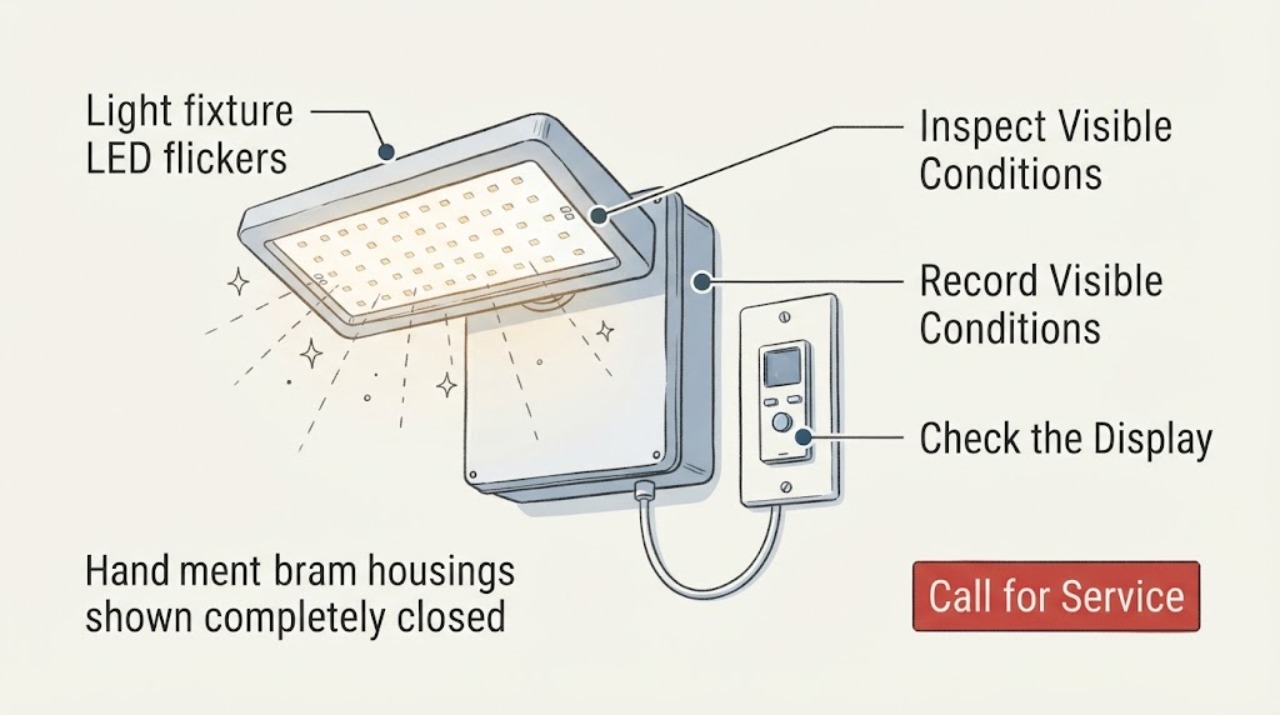
Work through in order
Diagnostic checks
Use only checks that match the exact appliance or system and its official guide.
-
Check 1
Observe the Kichler fixture with the dimmer untouched, at full brightness, through the middle of the range, and near the lowest setting; note whether the flicker is confined to dimming or present continuously.
Expected result: The fixture is steady at full output and flickers only near the low end; it flickers throughout the range; or it flickers even at full output with the control untouched.
Next step: Record the pattern and continue with documentation checks only. If flicker is continuous or accompanied by heat, odor, buzzing, sparks, or a breaker trip, stop using the circuit and arrange qualified electrical service.
Why this matters
Why: Low-end-only flicker supports a dimmer and LED-driver compatibility or low-end-range issue. Flicker throughout the range suggests broader compatibility, driver, or control trouble. Flicker at full output broadens concern to wiring, the fixture, or circuit conditions.
-
Check 2
Read the Kichler fixture, LED module, lamp, or driver documentation and confirm that the light source is marked dimmable; record any named dimmer type, phase, driver, or control requirement without removing the fixture.
Expected result: The light is marked non-dimmable, the documentation names a dimmer or driver requirement, or no compatibility information is available.
Next step: If the source is non-dimmable, stop using it with the dimmer and use the control arrangement specified by the manufacturer. If a requirement is named, compare the installed dimmer to it; if information is missing, identify the exact model or have an electrician verify it.
Why this matters
Why: A non-dimmable source is not a suitable load for an ordinary dimmer. A named requirement is more useful than a generic LED description. Missing information means compatibility cannot safely be assumed.
-
Check 3
Identify the installed dimmer model from its face, label, or paperwork and note whether the circuit has one control or multiple locations; do not remove the wall plate or expose wiring to read hidden markings.
Expected result: The dimmer is an LED-rated or manufacturer-listed control, its type does not match the Kichler documentation, multiple controls are involved, or the model cannot be identified.
Next step: Use Kichler's compatibility information and the dimmer manufacturer's documentation to confirm the pairing. Do not substitute a control, alter a companion, or change phase settings unless the exact instructions assign that task safely; otherwise use an electrician.
Why this matters
Why: A mismatch or unidentified control leaves compatibility unresolved. Multi-location circuits may require a particular companion arrangement and cannot be judged from one visible slider alone.
-
Check 4
If the dimmer documentation provides a user-accessible low-end trim or range adjustment, make only the documented adjustment and observe whether the Kichler fixture stops flickering without drop-out, delayed start, buzzing, or heat.
Expected result: The documented adjustment improves the low-end output and the control remains cool and quiet; flicker persists; the fixture turns off before the intended low level; or the control buzzes or heats.
Next step: Leave the setting at the documented stable range only. If the result is not stable or the instructions do not identify the adjustment for this control, stop changing it and arrange service; do not open or modify the dimmer.
Why this matters
Why: Improvement with a supported adjustment is consistent with a low-end compatibility range issue, not proof that the driver or dimmer is universally compatible. Persistent flicker, drop-out, buzzing, or heat indicates the pairing or circuit still needs diagnosis.
-
Check 5
Compare the Kichler fixture with other lights on the same circuit and note whether flicker changes when a large appliance or load starts, whether several fixtures flicker, and whether the dimmer plate or fixture feels unusually warm; do not touch exposed electrical parts.
Expected result: Only this fixture flickers during dimming and there are no heat, odor, sound, or breaker symptoms; or multiple lights flicker or the circuit shows buzzing, heat, odor, sparks, or trips.
Next step: For a localized symptom, provide the fixture and dimmer identities for compatibility review. For circuit-wide flicker or any warning sign, turn the circuit off when safe, avoid the control, and arrange qualified electrician assessment.
Why this matters
Why: A single fixture with dimming-dependent flicker supports a local compatibility or driver issue. Circuit-wide or load-dependent flicker, and any warning sign, raises concern for wiring, connection, overload, or service-equipment problems.
-
Check 6
After a confirmed compatible control or professional repair, move the dimmer slowly from full to low and back while checking reliable start, steady light, quiet operation, and absence of heat or odor; record the exact condition if the symptom returns.
Expected result: The fixture stays steady across its usable range and the control remains normal; or it flickers, drops out, buzzes, heats, or returns to the prior symptom.
Next step: Stop using the dimmer if the symptom returns with a warning sign and arrange electrician service. Keep the fixture, driver, dimmer, and installation information available rather than ordering a part from appearance alone.
Why this matters
Why: A stable range supports a successful control and load match. Recurrence indicates unresolved compatibility, a failing LED driver or dimmer, loose wiring, or a circuit condition that cannot be identified by observation alone.
Use your observations
Decision map
Find the observation that best matches what you see, then follow the next safe action.
-
PATH 01Next step
What you see
The Kichler LED is steady at full output, flickers only near the low end, and no other light or electrical warning is present.
Do this next
Confirm the exact fixture and dimmer requirements and use only a documented user-level low-end adjustment if supported. If the pairing is not listed or flicker remains, have an electrician select and install a compatible control.
Why this path and its safety boundary
Why it matters: A low-end dimming range or LED-driver and dimmer compatibility issue is more likely than a whole-circuit fault.
-
PATH 02Next step
What you see
The fixture is not marked dimmable, or the installed dimmer type does not match the Kichler documentation.
Do this next
Stop using the incompatible pairing and follow the fixture documentation for a compatible control arrangement. Do not bypass the driver or alter wiring; use a qualified electrician for a control change.
Why this path and its safety boundary
Why it matters: The control and light source are mismatched; continued dimming can produce flicker, drop-out, noise, or stress without identifying which component is defective.
-
PATH 03Next step
What you see
Flicker occurs at full brightness, affects multiple fixtures, changes with other loads, or appears with buzzing, heat, odor, sparks, or breaker trips.
Do this next
Stop using the affected circuit when safe and arrange qualified electrician evaluation. Do not remove the service-panel cover, expose wiring, repeatedly reset a breaker, or touch suspected service equipment.
Why this path and its safety boundary
Why it matters: A circuit, connection, control, or fixture fault is more likely than a low-end compatibility symptom, and the warning signs create an electrical safety boundary.
-
PATH 04Next step
What you see
The fixture is integrated LED, the driver information is missing, the installation is multi-location, or a compatible dimmer cannot be identified.
Do this next
Gather the fixture label, installation guide, dimmer identity, number of controls, and symptom pattern. Have an electrician or the manufacturer-qualified service path verify the combination before replacing a driver or control.
Why this path and its safety boundary
Why it matters: Model-specific driver, companion-control, or phase requirements remain unresolved; a generic LED dimmer recommendation could be wrong.
Helpful context
Understand the symptom
Flicker only with dimming is a useful clue
If the Kichler fixture is steady at full output but flickers as the slider approaches a low setting, the LED driver and dimmer may be interacting poorly at that part of the waveform. That does not prove the dimmer is defective: the fixture may require a particular dimmer type, phase behavior, or compatible driver. If the light flickers at full brightness or when the control is not being touched, broaden the concern to wiring, connections, or the fixture itself.
Start with the exact Kichler identity
Integrated LED fixtures and replaceable LED lamps do not necessarily use the same driver or dimming requirements. Read the label, installation guide, or product documentation for the Kichler fixture or LED module and note whether it is dimmable and what dimmer family it names. Do not infer compatibility from the word LED alone or from a similar-looking fixture.
Check the dimmer without opening the box
Record the dimmer model from its visible face or documentation, whether the installation is single-location or multi-location, and whether the flicker changes with the dimmer's low-end adjustment. Kichler notes that LED modules respond differently to incandescent phase-control, leading-edge, trailing-edge, three-wire, and 0–10 V dimmers. The correct replacement or setting depends on the fixture and driver documentation, not on a generic LED label.
Treat other electrical symptoms as a separate branch
A compatibility symptom is usually localized to the fixture and dimming range. Flicker that changes when large loads start, affects several lights, or comes with sizzling, buzzing, hot plates, odor, sparks, or breaker trips can indicate an electrical connection or circuit problem. CPSC guidance says not to touch suspected service-equipment faults; stop using the affected circuit and obtain qualified electrical help.
A stable retest is part of the repair
After a documented, compatible adjustment or a professional control change, move the dimmer gradually through its range and check the fixture at full, middle, and low output. It should turn on reliably, remain steady, and not buzz or heat the control. If the flicker remains or the fixture drops out, record the exact level and stop experimenting with incompatible parts.
Safety boundary
Stop conditions
- Stop using the dimmer and arrange qualified electrical help for flicker at full brightness, circuit-wide flicker, repeated breaker trips, sparks, sizzling or buzzing, hot controls, burning odor, or visible wiring damage.
- Do not remove wall-box or service-panel covers, work on energized wiring, bypass the LED driver, change phase or companion wiring by guesswork, or substitute a dimmer solely because it is labeled LED.
- Do not use a Kichler LED source marked non-dimmable with a dimmer. If the fixture, driver, or control requirement cannot be identified, keep the circuit in a safe non-dimming state and obtain model-specific help.
- Use a qualified electrician for persistent flicker, integrated-LED driver diagnosis, multi-location controls, loose or corroded connections, circuit-wide symptoms, or any repair that requires accessing wiring.
Only after diagnosis
Potential parts
- LED-compatible dimmer
Consider this only when the Kichler documentation and the installed circuit identify a dimmer compatibility problem; flicker at full brightness or circuit-wide symptoms need electrical diagnosis first.
Match the exact Kichler fixture or driver, dimmer type and phase, load, voltage, and single- or multi-location arrangement; have an electrician install or verify the control. - Kichler LED driver or power supply
Consider this only after testing confirms the driver or power supply is faulty and compatibility with the dimmer has been established; a dimmer mismatch can mimic driver failure.
Confirm the exact fixture model, output voltage, load, dimming method, enclosure, and manufacturer fit information before ordering or installing. - Kichler LED module or replacement fixture
Consider this only when the fixture documentation and professional testing identify a failed non-serviceable LED module or fixture; do not replace it solely because dimming flickers.
Confirm the exact Kichler model, electrical ratings, mounting, light output, dimming requirements, and installation instructions.
When checks do not resolve it
Need a professional?
Safety scope: A qualified electrician should inspect and alter wall-box wiring, test circuits and connections, verify phase and multi-location controls, diagnose LED drivers, and replace dimmers or fixtures; the homeowner's checks should remain visual, documentation-based, and limited to user-accessible settings.
Common questions
FAQ
Why does my Kichler LED flicker only when I dim it?
The dimmer and the fixture's LED driver may not be compatible across the dimming range, especially near low output. Confirm that the Kichler source is dimmable, identify the exact dimmer, and follow Kichler's product-specific compatibility information before changing a control.
Can I use any LED dimmer with a Kichler LED fixture?
No. LED drivers can respond differently to leading-edge, trailing-edge, three-wire, 0–10 V, and other dimmer types. A dimmer labeled for LED use is not automatically compatible with every Kichler fixture or driver. Check the exact product documentation and load arrangement.
What if the Kichler light flickers at full brightness too?
Flicker at full output broadens the concern beyond low-end dimming compatibility to the driver, control, wiring, circuit, or incoming electrical conditions. If other lights flicker or there is buzzing, heat, odor, sparks, or a breaker trip, stop using the circuit and arrange qualified electrical service.
Should I adjust the dimmer's low-end trim?
Only when the exact dimmer documentation provides a user-accessible adjustment and the Kichler fixture is a compatible load. A supported adjustment may reduce low-end flicker or drop-out, but persistent flicker, buzzing, or heat means the pairing or circuit needs professional diagnosis.
When should an electrician handle a flickering Kichler LED?
Use an electrician for an unidentified or integrated LED driver, a multi-location control, persistent flicker after compatibility checks, full-output or circuit-wide flicker, loose or corroded connections, breaker trips, sparks, buzzing, heat, or burning odor. Do not open the wall box or service panel as a homeowner troubleshooting step.
Read the exact guide
Official sources
- Using Dimmers With LED LightingKichler Lighting · Kichler LED modules and fixtures; exact requirements vary by product and dimmer
- Power Supply Planning 101Kichler Lighting · Kichler LED tape, accent, and related low-voltage systems; fixture-specific documentation controls compatibility
- CPSC Guide to Home Wiring HazardsU.S. Consumer Product Safety Commission · Residential electrical safety; local code and installation conditions determine required professional work
Community feedback
Share a repair observation
Share a plain-text repair observation. Accepted observations are published automatically; this page may take a moment to update.