
On this page
Start here
Quick answer
When an LED fixture flickers on a dimmer but appears normal from another switch, first determine whether the flicker happens only at the low or high end, throughout the range, during startup, or while the light is off. The usual next checks are whether the LED is marked dimmable, whether the dimmer and LED are a tested combination, and whether a multi-location circuit has the correct companion or mechanical control at the other location. A user-accessible minimum-level or locator-light setting may help, but do not open the wall box or alter wiring. Stop using the circuit and call a licensed electrician if there is heat, a burning smell, buzzing, visible damage, a loose fixture, breaker operation, or flicker at every setting that persists after the simple checks.
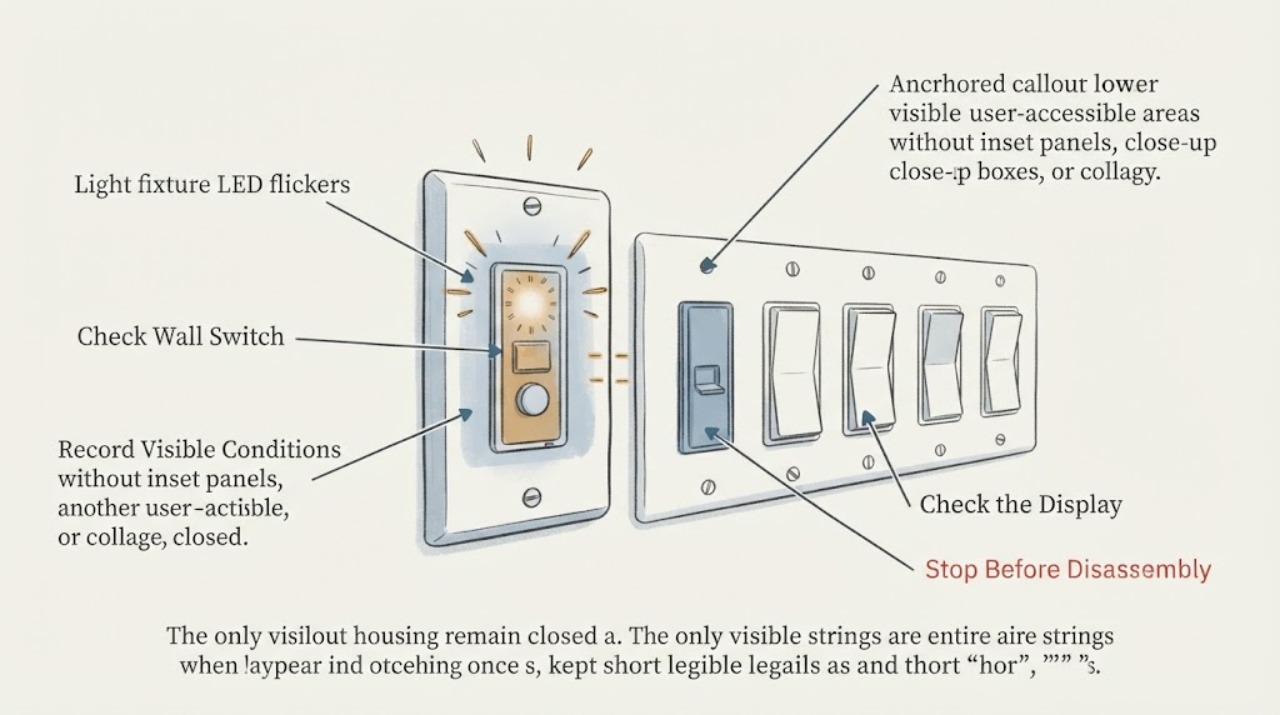
Work through in order
Diagnostic checks
Use only checks that match the exact appliance or system and its official guide.
-
Check 1
Set the dimmer to full brightness, then lower it slowly while noting whether the flicker occurs only near the low end, only near the high end, throughout the range, at startup, or only after the light is switched off.
Expected result: The light is stable at full brightness but flickers at one end of the range, flickers at every level, flashes while starting, or flickers while off.
Next step: Record the pattern before changing anything. Use the matching branch below rather than repeatedly cycling a light that flickers at every setting.
Why this matters
Why: A range-specific symptom points toward a dimming-limit or trim issue; flicker throughout the range makes LED compatibility, a lamp or fixture fault, or a connection problem more likely. Flicker while off is a different symptom from unstable dimming.
-
Check 2
Read the LED lamp or fixture label and packaging without opening the fixture, and confirm that it is marked for use with a dimmer; also record the dimmer model number if it is visible without removing the device.
Expected result: The LED is marked non-dimmable or has no dimming indication, or it is marked dimmable and the dimmer model is identifiable.
Next step: Do not use a non-dimmable LED on the dimmer. For a marked dimmable LED, look up the dimmer manufacturer's compatibility guidance using the recorded model; do not guess from appearance or wattage alone.
Why this matters
Why: A non-dimmable LED is not a suitable load for a dimmer. A dimmable marking alone does not prove that this LED and this dimmer perform well together, so the exact pair still needs manufacturer compatibility confirmation.
-
Check 3
If the flicker is limited to the lowest or highest part of the slider range, use only the dimmer's documented user programming control to raise the minimum or lower the maximum level, without removing the wallplate or exposing wiring.
Expected result: The light becomes stable after the range is narrowed, or it still flickers at the adjusted limit and at ordinary brightness.
Next step: Keep the stable range only if the control's own instructions support that setting. If there is no documented user adjustment or the symptom remains, stop experimenting and move to compatibility or professional diagnosis.
Why this matters
Why: Stability after a range adjustment supports an LED operating-range mismatch rather than proving that the dimmer or fixture is repaired. Continued flicker outside the edge of the range points toward compatibility or a device/load fault.
-
Check 4
At the other switch location, identify only the visible control type: a plain mechanical switch, an illuminated switch with a locator light, or another dimmer or companion control; compare whether the flicker changes when the light is turned on from that location.
Expected result: The other location has an illuminated control, two dimmers, a companion control, or a plain switch, and the flicker changes or stays the same when that control is used.
Next step: Use the original dimmer and fixture documentation to confirm the allowed multi-location arrangement. Do not swap controls or rewire the circuit as a test; call an electrician if the control types do not match the instructions.
Why this matters
Why: An illuminated control can contribute current that makes an LED flicker or glow, and some multi-location dimmers require a specific companion arrangement. Two dimmers in one circuit can also be an incompatibility for certain systems. A plain switch that merely turns the light on does not by itself prove the dimmer is healthy.
-
Check 5
If the LED flickers or glows when the dimmer is off and the control has a user-accessible locator-light setting, switch that locator feature off according to the device instructions and observe the light with the load off.
Expected result: The off-state glow or flicker stops when the locator light is disabled, or it continues with the locator light off.
Next step: Leave the locator feature off if the device instructions allow it and the light is otherwise stable. If the light still flickers while off, stop using the dimmer until an electrician checks the circuit.
Why this matters
Why: A change after disabling the locator light supports interaction between that indicator circuit and the LED load. No change means the off-state symptom may have another cause, such as LED and dimmer compatibility or a wiring/device fault that needs professional diagnosis.
-
Check 6
After recording the symptom and control types, try one LED lamp or fixture that the dimmer manufacturer identifies as compatible, using the fixture's normal user replacement procedure and keeping power off before handling a removable lamp.
Expected result: The compatible test LED is stable while the original flickers, or both LEDs flicker in the same way.
Next step: Use only a verified compatible replacement after checking the fixture's labeling and fit instructions. If both loads flicker or the fixture is integrated, stop replacing parts and have a licensed electrician inspect the installation.
Why this matters
Why: A stable compatible LED makes the original LED and dimmer pairing the leading suspect. Flicker with both loads makes a dimmer, control arrangement, fixture connection, or circuit issue more likely.
Use your observations
Decision map
Find the observation that best matches what you see, then follow the next safe action.
-
PATH 01Next step
What you see
Do this next
Keep the level within the stable range if the device instructions permit it, then verify the exact LED and dimmer pairing. Replace the LED with a documented compatible type or ask an electrician about a suitable control if the range is unusably narrow.
-
PATH 02Next step
What you see
Do this next
Confirm dimmability and manufacturer compatibility without opening the box. If a documented compatible LED does not help, stop using the circuit and call a licensed electrician rather than changing wiring.
-
PATH 03Next step
What you see
Do this next
Leave the locator light off if permitted and monitor normal operation. If the off-state flicker continues, or if the other control is not the type supported by the dimmer, have an electrician verify the multi-location circuit.
-
PATH 04Next step
What you see
Do this next
Turn the circuit off if it can be done safely at the normal control, avoid opening the device, and call a licensed electrician. Do not continue cycling the dimmer or substitute wiring based on a generic diagram.
Helpful context
Understand the symptom
Why the other switch can seem normal
In a multi-location circuit, the second wall control may only provide on and off control while the dimmer sets the light level. A light can therefore look stable when the second switch is used at a preset level but flicker as the dimmer moves through a range. An illuminated switch can also allow a small current through the circuit when it is off, which may make an LED glow or flicker. The control arrangement and the LED's dimming behavior have to be considered together.
Keep electrical checks at the user-safe boundary
Use only visible labels and controls that are designed for normal operation. Do not remove a wallplate, pull a dimmer from the box, probe conductors, or copy a wiring diagram for a different device. If the symptom suggests a loose connection or a device fault, leave the circuit off and have an electrician diagnose it.
Only after diagnosis
Potential parts
- compatible dimmable LED lamp or fixture
Consider this only when the original LED is non-dimmable, absent from the dimmer manufacturer's compatibility information, or a documented compatible test load is stable while the original flickers.
Confirm the fixture type, dimmer model, dimming method, electrical rating, and manufacturer compatibility before ordering; do not assume a product labeled dimmable will work with every dimmer. - LED-compatible dimmer
Consider this only after the LED is confirmed dimmable, the other control type is identified, and the existing control is not compatible or continues to flicker with a verified compatible load.
A replacement must match the fixture load and the single-location or multi-location control arrangement; have an electrician verify the model and wiring before installation.
When checks do not resolve it
Need a professional?
Stop using the dimmer and call a licensed electrician if the LED flickers at every level, the dimmer or fixture is hot, buzzing, smells burnt, shows discoloration or damage, cuts out, or causes a breaker to operate. Professional help is also needed when the fixture is integrated, a control type at the other switch is unknown or unsupported, the compatibility check does not resolve the issue, or any diagnosis would require opening a wall box, testing exposed conductors, replacing a dimmer, or changing wiring.
Common questions
FAQ
Why can the light be steady from the other switch but flicker on the dimmer?
The other control may only switch the light on and off at a preset level. Flicker that appears while the dimmer moves through its range still points to the LED and dimmer pairing, the usable dimming range, or the multi-location control arrangement.
Does a dimmable LED work with every dimmer?
No. A dimmable marking does not guarantee good performance with every control. Check the dimmer manufacturer's compatibility information for the exact LED and dimmer models before replacing parts.
What should I try if the LED flickers only at the lowest setting?
If the dimmer has a documented user adjustment, raise its minimum light level until the LED is stable. If there is no such control or the stable range is too narrow, use a compatible LED or have an electrician assess the dimmer.
Should I open the switch box to check the other switch?
Not as a first check. Identify only the visible control type and use the device instructions. Opening the box or changing connections is electrical work; leave it to a licensed electrician, especially if the control arrangement is unknown.
Read the exact guide
Official sources
- Can I Use a 3-Way Illuminated Switch With a Dimmer?Leviton Manufacturing Co., Inc. · Supports diagnosing off-state LED flicker or glow and identifying interaction with an illuminated switch at another location.
- LED/Compact Fluorescent/Incandescent Slide DimmerLeviton Manufacturing Co., Inc. · Supports the general checks for dimmable LED labeling, low-end flicker, full-range flicker, dimmer range settings, and normal multi-location identification.
Community feedback
Share a repair observation
Share a plain-text repair observation. Accepted observations are published automatically; this page may take a moment to update.