
On this page
Start here
Quick answer
Separate a flicker that stays with one light from a flicker that follows a load or affects several lights. If one fixture flickers continuously, even at full brightness, a bulb, socket, LED driver, or local connection is more likely; if several lights flicker or the event starts when an appliance or motor runs, treat a branch-circuit, service connection, or voltage problem as possible. Start with safe observations and a bulb or control compatibility check, but do not open an energized fixture, remove a panel cover, or tighten wiring. Turn the circuit off before touching a bulb or trim. Stop using the circuit and arrange qualified electrical service for heat, discoloration, buzzing, burning odor, sparks, shocks, repeated breaker trips, flicker in multiple rooms, or flicker that tracks a large load.
Before you begin
Safety first
- Do not open energized fixtures or panels, touch hot or sparking parts, probe sockets, rewire a dimmer, install an unverified driver, or keep using a circuit with heat, odor, noise, smoke, shocks, or repeated breaker trips.
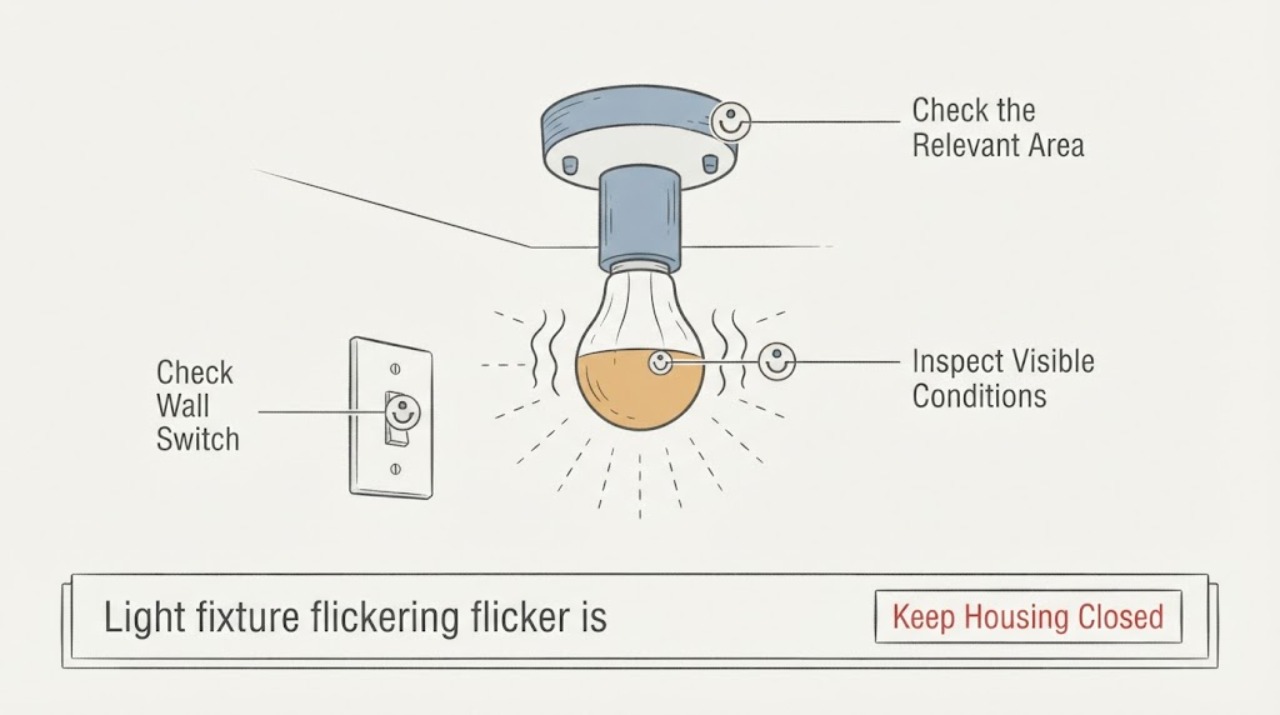
Work through in order
Diagnostic checks
Use only checks that match the exact appliance or system and its official guide.
-
Check 1
From a normal standing position, note whether one fixture or several fixtures flicker, whether the light is unstable continuously or only during startup or dimming, and whether the timing matches a large appliance or motor; do not remove a switch, receptacle, fixture, or panel cover.
Expected result: Record whether the same fixture remains the only one affected, whether nearby lights change at the same moment, and whether the flicker starts when a heater, air conditioner, refrigerator, microwave, pump, or other substantial load operates.
Next step: Use the single-fixture path for a safe bulb and control check. If multiple lights change together or the symptom follows a load, avoid deliberately adding load and arrange qualified electrical service.
Why this matters
Why: A single constant symptom favors a local bulb, driver, socket, dimmer pairing, or fixture connection. A load-related symptom in several fixtures makes a branch-circuit, service connection, or supply issue more plausible and is not safely diagnosed by replacing bulbs.
-
Check 2
For a fixture with a replaceable bulb, turn the light off, switch off its circuit breaker before touching the bulb or socket, allow it to cool, and compare the symptom with one known-good bulb that matches the fixture's marking; do not touch exposed contacts or energized parts.
Expected result: The flicker stops or follows the original bulb, or it remains in the same fixture with the replacement. Also note whether the socket is loose-looking, scorched, cracked, or visibly damaged without probing it.
Next step: Use only a replacement that matches the fixture's stated type and limits. If the replacement does not change the symptom or any damage is visible, leave the breaker off when practical and arrange an electrician or fixture service; do not repair the socket yourself.
Why this matters
Why: A symptom that follows one bulb supports a failed or incompatible lamp. A symptom that stays with the fixture, or a damaged socket, points toward the socket, LED driver, fixture connection, or circuit and cannot be cleared by repeated bulb swaps.
-
Check 3
Identify whether the fixture is controlled by a dimmer, smart switch, occupancy control, or other electronic control, then observe the light with hands off the wiring at full output and at the normal dimming range; do not change a control's wiring or alter protective equipment.
Expected result: The flicker appears only at the low end, high end, or during a control transition, or it continues at full output. Check the bulb or fixture label for dimmable status and record the control model for comparison with the manufacturer's compatibility information.
Next step: For a compatible, accessible setup, follow the control and fixture manufacturer's instructions and use a listed compatible dimmable lamp. If compatibility is unclear, the fixture is integrated, or flicker persists at full output, stop adjusting and have an electrician or the fixture manufacturer assess it.
Why this matters
Why: Flicker limited to a dimming range makes bulb-control incompatibility, minimum-load behavior, or a control setting more likely. Flicker that persists at full output is less likely to be solved by a dimmer-range adjustment and keeps a bulb, driver, local connection, or circuit fault in play.
-
Check 4
Without intentionally overloading the home, compare the light's timing with ordinary operation of nearby high-demand appliances and check whether other lights on the same apparent circuit change; do not repeatedly start appliances just to reproduce a fault and do not move appliances to overloaded extension cords.
Expected result: The flicker begins or deepens when a motor or heating appliance starts, affects more than one light, or is accompanied by dimming elsewhere; alternatively, the fixture flickers independently while other lights stay stable.
Next step: For synchronized or load-related flicker, stop using the suspect combination and arrange qualified electrical inspection. For an isolated fixture, continue only with the safe bulb and control checks; do not open a junction box or panel.
Why this matters
Why: Synchronized changes across lights or with a substantial load make a circuit, overload, loose connection, or service-supply problem more likely. An isolated fixture with stable surrounding lights makes a local lamp, driver, control, or fixture connection more likely, but does not make an inaccessible wiring repair safe.
-
Check 5
From outside the fixture and without touching it, look and listen for a hot or discolored switch plate, socket, or cover; buzzing or sizzling; a burning or rubbery odor; sparks; a tingle or shock; smoke; or a breaker that trips when the light is used.
Expected result: Any warning sign is present, or the light and surrounding surfaces remain normal and quiet while only the light output changes.
Next step: If a warning sign is present, stop using the fixture. If it is safe to do so without approaching heat, sparks, or damaged equipment, turn off the circuit breaker and keep clear; call a qualified electrician, and contact the utility for suspected service-equipment trouble. Otherwise continue only with non-contact observations.
Why this matters
Why: Heat, discoloration, odor, arcing, shock, smoke, or repeated trips can indicate an electrical hazard and outweighs any possible bulb or dimmer explanation. A quiet, cool, undamaged exterior lowers the immediate warning-sign evidence but does not prove the wiring is sound.
-
Check 6
If the light is an integrated LED fixture with no replaceable bulb, record its label, model, control type, installation date, and whether the flicker is constant or load-related; use only the normal wall control and do not remove the diffuser or access the driver while energized.
Expected result: The integrated fixture flickers independently at full output, flickers only with dimming, or joins other lights when a load starts. Note any warranty or manufacturer instructions available for that fixture.
Next step: Use the recorded model and control details for manufacturer support or a qualified electrician. Replace an integrated driver or fixture only after the exact part and installation method are confirmed; do not substitute an unverified driver.
Why this matters
Why: Independent full-output flicker points toward the fixture's driver or local connection; dimming-only flicker points toward control compatibility; synchronized flicker keeps the circuit or supply path in question. None of these patterns authorizes opening a live integrated fixture.
Use your observations
Decision map
Find the observation that best matches what you see, then follow the next safe action.
-
PATH 01Next step
What you see
One replaceable-bulb fixture flickers continuously at full output, while nearby lights remain steady and a correctly matched replacement bulb stops the symptom.
Do this next
Keep the replacement within the fixture's stated limits and monitor it. If the symptom returns or follows more than one lamp, stop swapping and have the fixture and circuit assessed.
Why this path and its safety boundary
Why it matters: The original lamp or its lamp electronics is more likely than a whole-house supply fault.
-
PATH 02Next step
What you see
The light flickers only at the low or high end of dimming, or only while a dimmer or smart control changes level, and it is stable at full output.
Do this next
Confirm that the lamp or fixture is intended for dimming and compare the exact control and model with manufacturer compatibility guidance. Do not rewire the control; use a qualified electrician for replacement or unclear wiring.
Why this path and its safety boundary
Why it matters: LED-control compatibility, minimum-load behavior, or a dimmer setting is more likely than a constant fixture failure.
-
PATH 03Next step
What you see
Several lights dim or flicker together, or the fixture flickers when a heater, air conditioner, refrigerator, microwave, pump, or other substantial load starts.
Do this next
Stop trying to reproduce the event, avoid the suspect load combination, and arrange qualified electrical inspection. If the pattern changes with weather or appears across the home, report possible service-side trouble to the electric utility.
Why this path and its safety boundary
Why it matters: A shared circuit, overload, loose connection, or service-supply problem is more likely than one bad bulb.
-
PATH 04Next step
What you see
Flicker is accompanied by heat, discoloration, buzzing, sizzling, burning odor, sparks, smoke, a shock or tingle, or a breaker that trips when the fixture is used.
Do this next
Stop using the fixture and keep clear. If it can be done safely, switch off the circuit breaker without touching the suspect device, then call a qualified electrician or emergency services for smoke or active fire.
Why this path and its safety boundary
Why it matters: The warning pattern indicates a potential electrical hazard; a bulb or dimmer adjustment is not an adequate next step.
-
PATH 05Next step
What you see
An integrated LED fixture flickers independently at full output, or the symptom remains after a compatible bulb and control check where no bulb is replaceable.
Do this next
Provide the fixture label, control model, symptom timing, and any photos of the exterior warning signs to the manufacturer or electrician. Do not install an unverified driver or open the fixture while energized.
Why this path and its safety boundary
Why it matters: The driver, fixture electronics, local connection, or installation is more likely; the correct replacement cannot be selected from the symptom alone.
-
PATH 06Next step
What you see
The light remains stable at full output, no other lights change, no warning signs are present, and the observed flicker is limited to a known control range.
Do this next
Follow the control and fixture manufacturer's compatibility instructions and stop if the flicker becomes constant, spreads to other lights, or introduces heat, noise, odor, sparks, shocks, or breaker trips.
Why this path and its safety boundary
Why it matters: A control and lamp pairing issue remains plausible, with lower immediate evidence of a wiring hazard, but the condition is not proven safe by observation alone.
Helpful context
Understand the symptom
The constant-versus-load pattern is the first useful split
A single fixture that flickers continuously points the investigation toward its bulb, LED driver, dimmer pairing, socket, or local wiring. A flicker that begins when a heater, air conditioner, refrigerator, microwave, or other motor or heating load starts—or that appears in multiple fixtures—points toward a circuit or supply problem. The pattern does not prove a cause, so use it to choose the next safe check rather than to justify opening the wiring.
LED flicker can be a control mismatch, not just a bad bulb
LEDs respond quickly to changes in the current supplied by their driver. A bulb may be marked dimmable yet still perform poorly with a particular dimmer or fixture control. Flicker only near the top or bottom of a dimming range is a useful compatibility clue; flicker at full output, a new flicker after a control change, or flicker in an integrated fixture needs a broader electrical and fixture assessment.
Safety signs change this from a lighting adjustment to an electrical call
Flickering with a hot or discolored switch plate, buzzing or sizzling, a burning smell, sparks, a shock or tingle, or repeated breaker trips is not a routine bulb-selection problem. Do not touch the suspect device or remove a panel cover. If it can be done without approaching a hot, sparking, or damaged part, switch off the circuit and keep it out of use until a qualified electrician assesses it; suspected utility-side service trouble should be reported to the electric utility.
Safety boundary
Stop conditions
- Do not remove panel covers, open an energized fixture, reach into a socket, or tighten or splice house wiring as a homeowner troubleshooting step.
- Stop using the fixture and arrange electrical service for heat, discoloration, buzzing, sizzling, burning odor, sparks, smoke, shocks or tingles, or repeated breaker trips.
- Do not intentionally overload a circuit or repeatedly start large appliances to reproduce load-related flicker; avoid the suspect load combination until it is assessed.
- Use a qualified electrician for flicker affecting several fixtures, flicker that follows a substantial load, suspected service-equipment trouble, inaccessible wiring, or any integrated-driver replacement.
Only after diagnosis
Potential parts
- dimmable LED bulb
Consider this only when the fixture has a replaceable bulb, the symptom follows that bulb or is limited to a dimming range, and the fixture and control manufacturer identify the replacement as compatible.
Match the fixture's lamp type, base, rated wattage, enclosure requirements, and dimmer compatibility; a generic dimmable label does not prove compatibility with every control. - LED-rated dimmer
Consider a different dimmer only after a dimming-only pattern and the exact bulb or fixture compatibility information point to the control as the limiting component.
Confirm the fixture, lamp type, control scheme, neutral requirements, and local installation rules; dimmer replacement and wiring should be handled by a qualified electrician when wiring changes are involved. - fixture-specific LED driver
Consider this only for an integrated fixture after its model and driver diagnosis are confirmed by the manufacturer or a qualified electrician; constant flicker alone does not identify a driver or its ratings.
Match the exact fixture model, electrical output requirements, enclosure and thermal ratings, and approved installation method; do not substitute an unverified driver or open the fixture while energized.
When checks do not resolve it
Need a professional?
Request electrical service when the symptom is constant at full output, load-related, present in more than one fixture, associated with an integrated driver or inaccessible connection, or accompanied by any electrical warning sign. Use the utility for suspected service equipment and emergency services for smoke or active fire.
Safety scope: Do not open energized fixtures or panels, touch hot or sparking parts, probe sockets, rewire a dimmer, install an unverified driver, or keep using a circuit with heat, odor, noise, smoke, shocks, or repeated breaker trips.
Have this ready
- Provide the fixture type and model, replaceable-bulb or integrated-LED status, bulb and control details, whether flicker is constant or limited to dimming, which other lights change, what load was operating, when the symptom began, and photos of any exterior discoloration without touching the equipment.
Common questions
FAQ
Why does one light fixture flicker constantly while the other lights are steady?
A bulb, LED driver, dimmer pairing, socket, or local fixture connection is more likely when only one fixture flickers. With power off and the bulb cool, a replaceable-bulb fixture can be compared with a correctly matched known-good bulb. If the symptom remains or the socket looks damaged, stop and arrange electrical service.
What does it mean if the lights flicker when an appliance starts?
If several lights change when a heater, air conditioner, refrigerator, microwave, pump, or other substantial load starts, a shared circuit, overload, loose connection, or service-supply issue is more plausible than one bad bulb. Avoid deliberately reproducing the event and arrange qualified electrical inspection.
Can an LED bulb flicker even when it says dimmable?
Yes. LED and dimmer behavior is product-specific. Flicker limited to a dimming range can indicate an incompatible bulb and control or a control setting. Check the exact fixture, bulb, and dimmer compatibility information; do not rewire the control as a home troubleshooting step.
Is flickering with a buzzing sound dangerous?
Treat buzzing or sizzling, especially with heat, discoloration, a burning odor, sparks, shocks, smoke, or breaker trips, as an electrical warning. Stop using the fixture and, only if safe, switch off the circuit breaker without touching the suspect equipment; call a qualified electrician or emergency services for smoke or active fire.
What should I do with an integrated LED fixture that keeps flickering?
Record the fixture model, control type, and whether the symptom is constant, dimming-only, or load-related. Do not open an energized fixture or install an unverified driver. Use the manufacturer's instructions or have a qualified electrician diagnose the driver, fixture, and local connection.
Read the exact guide
Official sources
- Flicker BasicsU.S. Department of Energy · Government lighting research used to explain why LED driver and dimmer behavior can make output vary and why flicker is not always a simple loose-bulb symptom.
- 8 Signs You May Have a Problem with Your Electrical WiringUL Solutions · Safety-organization guidance used as corroboration for load-related flicker, appliance effects, hot or discolored parts, buzzing, odors, and electrician escalation.
- Light Fixtures (Downlights)ENERGY STAR · Government-backed program guidance used for checking manufacturer-recommended dimmers and treating LED/dimmer compatibility as a product-specific question.
- CPSC Guide to Home Wiring HazardsUnited States Consumer Product Safety Commission · Government safety guidance used for flickering-light warning signs, service-side flicker, overload clues, and avoiding DIY work on service equipment.
- Dimming LED Bulbs and FixturesLeviton Manufacturing · Manufacturer guidance used for the dimming-only branch and for checking a specific bulb/control pairing rather than assuming every dimmable LED works with every dimmer.
- Electrical Safety: ChecklistNational Fire Protection Association · Fire-safety checklist used for escalation when lights flicker or dim, signs of heat or arcing appear, and bulbs must remain within the fixture's stated limit.
Community feedback
Share a repair observation
Share a plain-text repair observation. Accepted observations are published automatically; this page may take a moment to update.